


More news on this day
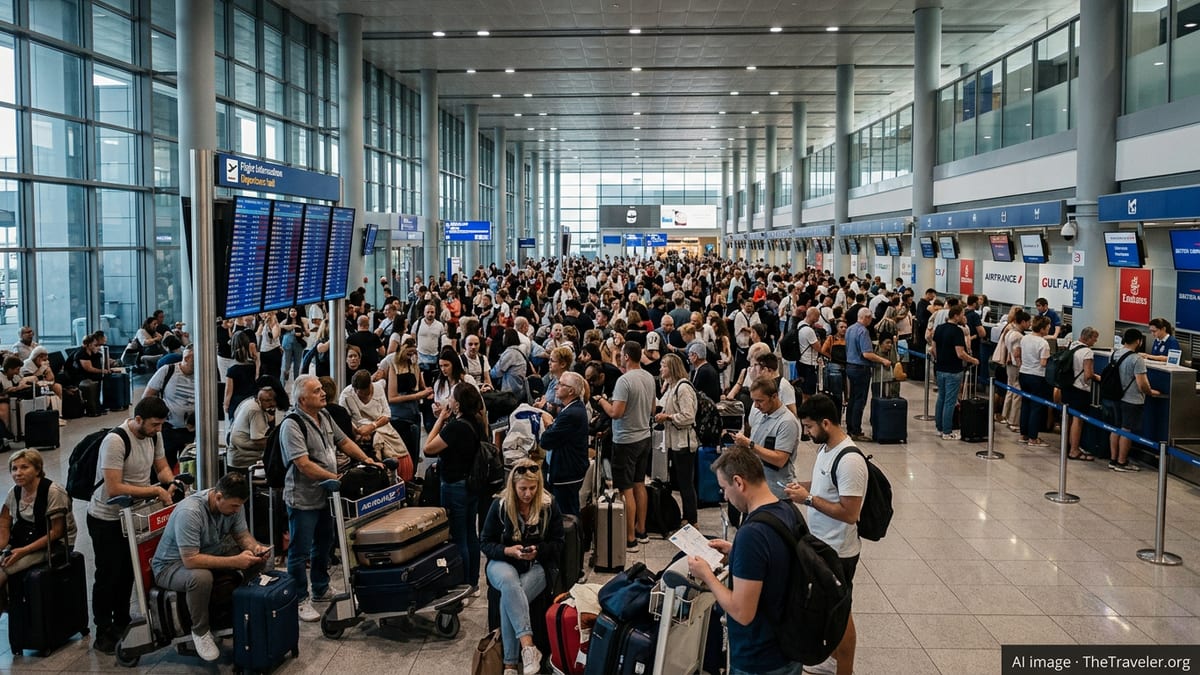
Major European airports have recorded more than 1,900 flight delays and cancellations in the opening week of July 2026, yet publicly available performance data suggests that several core network airlines have largely maintained schedule stability despite mounting pressure on the continent’s busiest hubs.
Get the latest news straight to your inbox!
Delays Mount Across Key European Gateways
Reports compiled from flight tracking analyses and passenger rights services indicate that disruption has intensified across several large European airports in recent days. A roundup of this week’s travel coverage points to more than 1,900 combined delays and cancellations at major hubs, including Amsterdam Schiphol, Paris Charles de Gaulle, Rome Fiumicino and Milan Malpensa, as the peak summer holiday season accelerates.
Recent reporting on Europe-wide disruption has highlighted a single week in which more than 2,100 delays and close to 100 cancellations were registered at airports across Denmark, the United Kingdom, France and other states, underscoring the strain on the broader network. Within that context, a succession of localised problems at major hubs has further amplified knock-on effects for connecting passengers.
Operational data for the first week of July from European network managers shows that overall traffic has reached new seasonal records, with average daily flights surpassing 36,000 and delays increasingly concentrated at a handful of air traffic control centres and large airports. While the average air traffic flow management delay per flight has eased compared with last summer, the sheer volume of movements means relatively small disruptions can cascade quickly across the system.
Analysts note that these patterns align with pre-season forecasts that warned of another challenging summer for European aviation, driven by high demand, infrastructure constraints and lingering staffing gaps in certain parts of the network. The early July figures suggest that those pressures are now materialising in the form of uneven but sometimes severe local congestion.
Amsterdam, Paris and Italian Hubs Under Particular Strain
Amsterdam Schiphol has emerged as one of the most disrupted hubs in early July. A detailed breakdown of flight data published on Wednesday points to approximately 80 cancellations and more than 220 delays in a single operational episode, affecting services operated by KLM, Air France, easyJet and other carriers. The disruptions were spread across both European and long-haul routes, illustrating how a single congested hub can impact passengers on multiple continents.
In Italy, separate reporting from passenger compensation specialists indicates that the national network suffered more than 220 cancellations and over 700 delays on 5 July alone, with Rome Fiumicino and Milan Malpensa accounting for a substantial share of the problems. These figures contributed significantly to the region’s overall disruption tally and created additional pressure on airlines that rely on Italian airports as feeder points into wider European and intercontinental networks.
Paris Charles de Gaulle has also experienced a spike in irregular operations. Data-focused articles on the French hub describe at least 38 cancellations and more than 40 significant delays over 5 and 6 July, affecting around 80 scheduled services at the height of the early summer surge. Those disturbances followed earlier signs of instability in French airspace, where capacity limits and staffing issues at several control centres have been linked to elevated en route delays.
The concentration of delays at such interconnected hubs means that even passengers travelling on flights that depart relatively close to schedule can face misconnected itineraries or tight transfers. Publicly available analyses point out that when short-haul feeder flights are cancelled or heavily delayed, the consequences can ripple into long-haul operations, hotel stays and tour departures far from the original problem airport.
Network Data Shows Pressure, But Also Relative Resilience
Despite the headline numbers on delays and cancellations, broader European network statistics for late June and early July depict a more nuanced picture. According to the latest summer briefings produced by regional air traffic management bodies, average delay per flight has remained below last year’s levels, even as total flight numbers have risen above 2025 records.
For example, network summaries for week 27, covering the period from 29 June to 5 July, cite an average of around 3.4 minutes of air traffic flow management delay per flight, with both en route and airport components down sharply compared with the previous summer. Separate seasonal planning documents note that, across the spring months leading into July, many large airports were recording on-time performance levels above 80 percent, assisted by mild weather patterns and targeted capacity measures.
Travel industry commentaries interpret these figures as evidence that Europe’s aviation system is under intense strain but not in outright crisis. While certain days and locations stand out for high disruption totals, the underlying metrics suggest that structural improvements introduced since the pandemic, such as better staffing models and more conservative scheduling at some carriers, are helping to prevent a repeat of the severe chaos seen in earlier years.
However, experts also stress that average network data can mask highly uneven passenger experiences. A traveller whose flight is cancelled out of Amsterdam or whose connection is missed in Paris may see little comfort in knowing that overall delays are lower than last year, particularly when rebooking options are limited during peak holiday weeks.
Core Network Airlines Work To Protect Reliability
Within this challenging environment, a group of large network airlines has so far managed to keep cancellation rates relatively low and overall punctuality broadly stable, according to aggregated punctuality tables and carrier performance snapshots released for the first half of 2026. The leading European members of this cohort include major flag carriers and airline groups with extensive hub-and-spoke operations.
These airlines collectively handle a significant share of Europe’s long-haul and connecting traffic, yet public performance dashboards indicate that they continue to post cancellation percentages in the low single digits. Industry-facing analyses attribute this relative resilience to a combination of increased schedule buffers, additional spare aircraft capacity and more conservative peak-day planning compared with pre-pandemic summers.
Several data-focused reports highlight that, while low-cost and regional operators have contributed materially to this week’s disruption totals in certain markets, core network airlines have often opted to prioritise protecting long-haul and high-yield routes. When forced to trim schedules during operational pinch points, some carriers have reportedly favoured cancelling shorter intra-European sectors with alternative options available, thereby reducing the wider impact on the most time-sensitive and commercially important services.
At the same time, the reliability of these core airlines is tightly linked to the performance of their main hubs. If congestion at airports such as Schiphol, Frankfurt, Paris Charles de Gaulle or Rome Fiumicino intensifies later in July, analysts caution that even the most robust scheduling strategies may come under renewed pressure, particularly if adverse weather or industrial action compounds existing constraints.
Passengers Confront Uneven Summer Outlook
For passengers, the emerging pattern across early July 2026 is one of considerable regional variation. Travellers passing through less congested secondary airports, or flying with carriers that have maintained strong on-time records this year, may encounter few issues. Others, especially those relying on tight connections through major hubs at peak hours, face a measurably higher risk of delay or cancellation as traffic volumes crest.
Consumer-focused travel guides responding to this week’s disruption have emphasised several practical steps for minimising risk, such as choosing earlier departures, allowing longer connection windows, and monitoring flight status closely via airline apps or airport information feeds. They also stress the importance of understanding passenger rights under European regulations, including entitlement to care provisions and, in certain circumstances, financial compensation.
Looking ahead to the rest of July, network planning documents suggest that workload at key air traffic control centres in France, Spain and Greece will remain elevated, while major holiday destinations across the Mediterranean continue to attract heavy traffic. In that context, analysts expect further pockets of disruption, even if average delay per flight remains contained by recent standards.
The balance between rising demand, constrained capacity at some airports and the stabilising influence of Europe’s largest airlines will likely determine whether the remainder of the summer travel period is remembered for isolated flashpoints or a broader deterioration in reliability across the continent’s skies.