


More news on this day
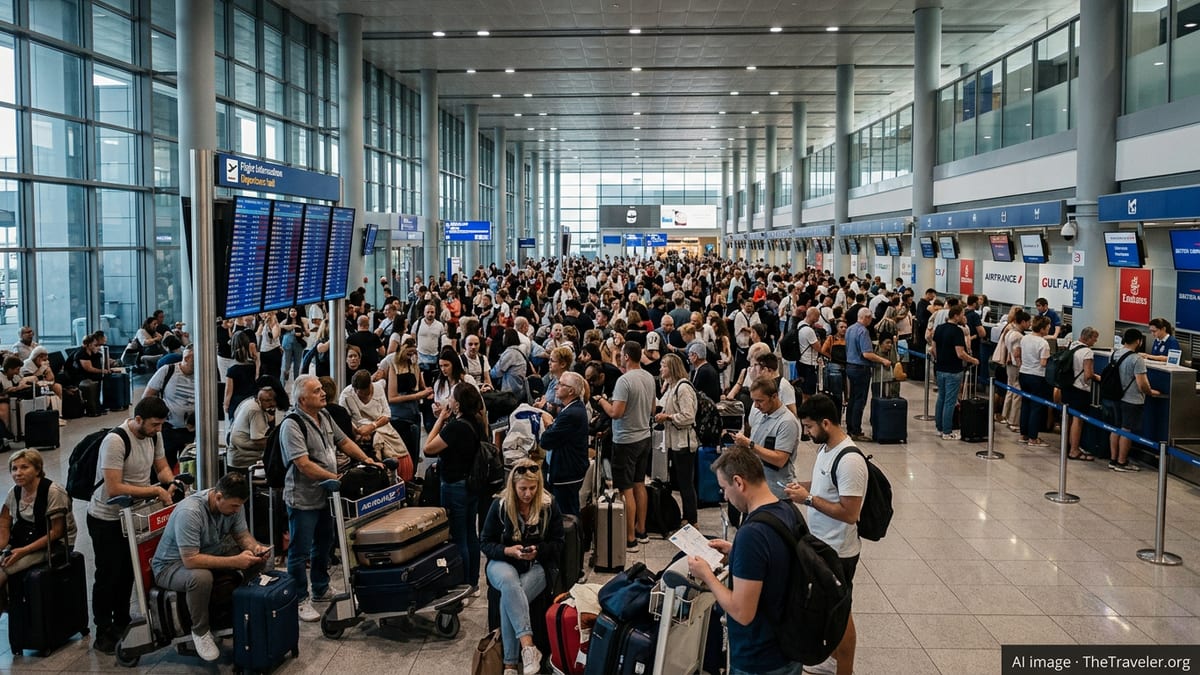
Europe’s main airport and airline groups are warning that border control queues of up to six hours risk becoming a defining feature of this summer’s travel season, urging European Union institutions to act quickly to ease pressure from the bloc’s new biometric Entry/Exit System.
Get the latest news straight to your inbox!
A new border regime meets peak summer demand
The European Union’s Entry/Exit System, fully activated across the Schengen Area in April 2026 after years of delay, is facing its first major stress test as peak holiday traffic begins. The system replaces manual passport stamping for non EU nationals with biometric registration using fingerprints and facial images, creating a centralised database of border crossings.
Publicly available information indicates that the change has already lengthened processing times at many airports. Industry assessments suggest that registering a first time traveller can take several minutes at a staffed desk or automated kiosk, compared with a matter of seconds for a traditional stamp. With summer schedules restoring or exceeding pre pandemic passenger volumes on many routes, that additional time is multiplying across long arrival waves.
Trade publications and travel media report that some passengers arriving from outside the EU are already encountering queues stretching to four or even five hours at passport control in popular leisure markets such as Spain, Portugal, France and Italy. Aviation groups argue that without corrective measures, July and August could see widespread knock on disruption as missed connections, delayed departures and crew scheduling problems cascade through the network.
Airports and airlines warn of a “critical point”
In recent weeks, Europe’s largest airport and airline associations have stepped up a coordinated campaign for urgent action in Brussels. ACI Europe, which represents more than 600 airports, Airlines for Europe (A4E) and the International Air Transport Association have jointly described the situation as reaching a “critical point” for border operations during the summer peak.
According to their published statements and letters, the organisations are not calling for the Entry/Exit System to be abandoned, but for more flexibility in how and when it is applied. Their core message is that, under current conditions, the system is not scaling smoothly with passenger demand and is exposing structural weaknesses in staffing, infrastructure and technology.
Industry analyses highlight particular concern about hub airports and popular gateways that receive concentrated arrivals from long haul markets outside the EU. Early morning waves from North America and overnight services from the Middle East and Asia are seen as especially vulnerable, as hundreds of passengers from multiple widebody aircraft converge on the same border halls within narrow time windows.
Calls for temporary suspension powers and more staff
The central demand from airport and airline groups is for member states to retain the right to suspend or scale back Entry/Exit checks during extreme peaks, through the summer and into late October 2026. Trade briefings note that current EU rules envisage a phased withdrawal of such emergency flexibilities from July, just as traffic reaches its highest levels.
European airports argue that these temporary opt outs are essential safety valves when operational conditions deteriorate, allowing border authorities to revert to simpler procedures to clear backlogs. Reports from several countries indicate that some national police forces and border agencies have already used this option informally at ports and airports when queues have threatened to overwhelm terminals.
Alongside legal flexibility, the sector is pushing for rapid reinforcement of front line staffing. Industry presentations ahead of the northern summer highlighted chronic understaffing at many external Schengen frontiers, with recruitment and training lagging behind the new system’s more labour intensive processes. Operators contend that even well designed technology cannot compensate when too few officers are available to supervise kiosks, resolve errors and manage passenger flows.
Stakeholders are also urging governments to accelerate investment in e gates and biometric equipment that can be integrated with the Entry/Exit System, arguing that greater automation could help restore throughput once initial registration backlogs are cleared.
Patchwork national responses as queues grow
Member states are beginning to respond with a mix of national level measures, creating a patchwork of approaches across the Schengen area. In Greece, local media report that authorities have relaxed the use of biometric checks for some non EU arrivals at busy island airports for the core summer months, prioritising flow over full registration in order to avoid scenes of stranded tourists.
In Italy, the head of the company operating Rome’s main airports has publicly warned that Fiumicino may need to suspend Entry/Exit processing for certain categories of travellers at times of maximum demand to avert what has been described as a potential “disaster” in terminal operations. Similar warnings have been reported from other large Mediterranean gateways that rely heavily on peak season holiday traffic.
Elsewhere, the picture is mixed. Some northern European airports with extensive e gate networks and more dispersed traffic patterns report smoother operations, with travellers passing through Entry/Exit checks in a matter of minutes. However, anecdotal accounts from passengers and crew circulating in travel forums describe inconsistent experiences between airports, and even between different trips through the same hub, as systems are updated and local procedures evolve.
What travellers can expect in summer 2026
For travellers from countries outside the EU and Schengen Area, including the United Kingdom, North America and much of Asia Pacific, the immediate impact is most visible at first entry into the bloc. Since April, first time registrants have been required to provide biometric data on arrival at the external border, while repeat visitors are checked against the Entry/Exit database.
Independent travel advisories now commonly recommend that passengers flying into major European gateways this summer allow significantly more time for border formalities than in previous years. Guidance from airlines, tour operators and consumer groups ranges from an additional hour at quieter airports to several extra hours at busier hubs or during peak holiday changeover days.
Looking further ahead, industry observers note that the Entry/Exit System is intended to work in tandem with the separate European Travel Information and Authorisation System, now expected to begin in late 2026. Once both are fully operational, advocates argue that Europe’s borders will be more secure and predictable. For the moment, however, the focus for airports and airlines is on securing rapid, practical adjustments to prevent this summer’s queues becoming a longer term deterrent to travel to the region.