


More news on this day
Europe’s troubled rollout of its new biometric Entry/Exit System is raising alarm across the travel industry, with the World Travel & Tourism Council warning that prolonged border delays could deter millions of visitors and wipe out billions in tourism spending.
Get the latest news straight to your inbox!
Research Points to 41 Million Fewer Arrivals
New analysis commissioned by the World Travel & Tourism Council indicates that lengthy queues linked to the European Union’s Entry/Exit System, or EES, are already reshaping travel decisions from key long-haul and regional markets. The research, published in June, models the impact of persistent three hour or longer waits at external Schengen borders on visitor sentiment and booking intent.
According to the findings, as many as 41 million potential visitor arrivals to Europe could be at risk if severe delays become a structural feature of travel over the next seasons. Estimated losses in international visitor spending could reach about 45.4 billion dollars, concentrated among travelers from the United Kingdom, United States, Canada and Australia. These markets are among Europe’s most valuable in terms of length of stay and average daily expenditure.
Survey data cited in published coverage shows that around four in ten UK travelers would be much less likely to visit if they anticipated three hour or longer queues at border control. Roughly one in three respondents from the United States and Canada expressed similar reluctance, along with more than a quarter of surveyed Australian travelers. Industry analysts note that even a modest shift away from European destinations in these markets would translate into substantial revenue losses for airlines, hotels and local tourism providers.
Publicly available information on the research suggests that concern is less about the principle of biometric screening and more about inconsistent implementation. Many travelers report supporting digital border controls in principle but say their trip plans could change if the new system translates into routine disruption at airports, ports and major land crossings.
Queues Stretch to Hours as Rollout Widens
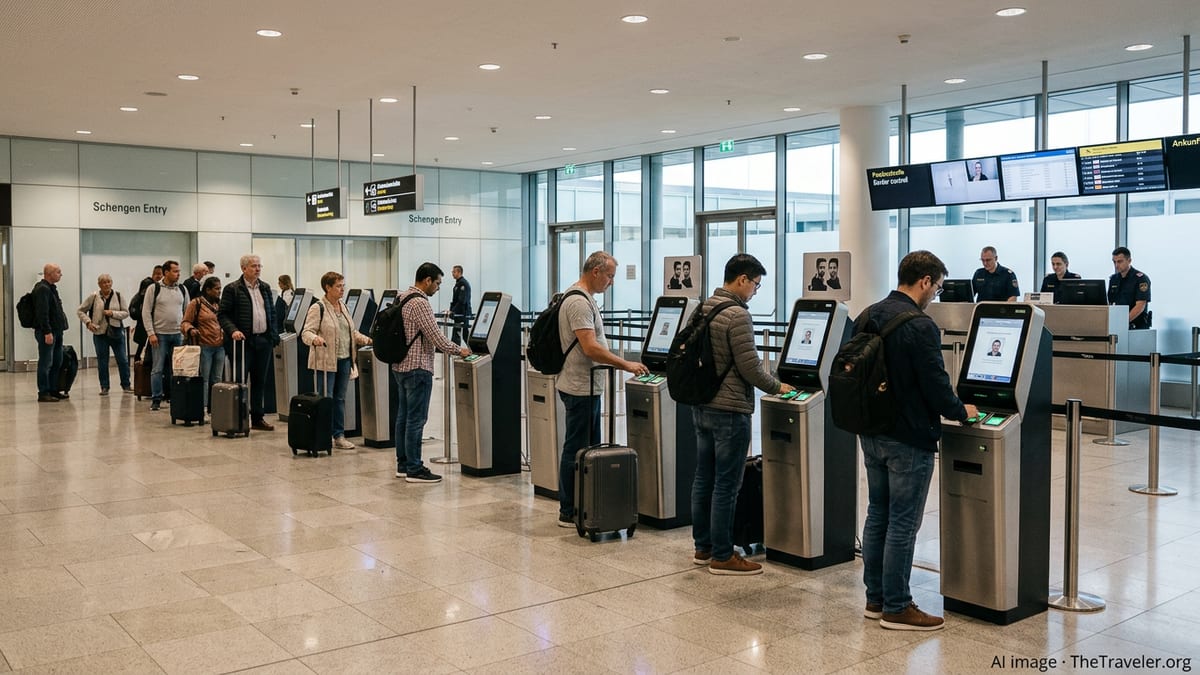
The EES, now being phased in across the Schengen area, replaces manual passport stamping for most non EU and non Schengen short stay visitors with a centralized biometric database. First time registrants must provide facial images and fingerprints in addition to passport scans, a process that has contributed to long lines at busy checkpoints since early spring. Reports from airports in Italy, Portugal and other popular gateways describe passengers waiting several hours at peak times.
Coverage from European broadcasters and trade outlets indicates that waits of four hours have already been recorded at some airports during busy periods, with industry bodies warning that six hour queues are a realistic risk at certain hubs this summer if traffic surges and equipment problems persist. At some locations, travelers who have previously enrolled have reportedly been required to repeat biometric capture due to apparent data mismatches, further slowing throughput.
Border management agencies stress that the system is still in a progressive rollout phase, with only a portion of eligible travelers processed through the new infrastructure. Aviation and tourism groups argue that this makes the current bottlenecks particularly worrying, since full scale operation later in the year and into 2027 will involve far larger passenger volumes. They also highlight uneven readiness among member states, with some front line airports better equipped than others to manage the added checks.
Passenger advisories have already shifted in response. Low cost carriers and travel associations in markets such as the United Kingdom are recommending that customers arrive at departure airports at least three hours before flights to or from the Schengen zone, even outside traditional peak dates. Consumer groups warn that the cost of missed connections caused by queues often falls on travelers, adding financial risk to the uncertainty of long waits.
Industry Calls for Flexibility and Contingency Plans
The WTTC’s warning comes as airports and airlines across Europe intensify calls for a review of EES implementation before traffic peaks in late July and August. Joint statements from Airports Council International Europe, Airlines for Europe and the International Air Transport Association argue that there is a widening gap between the perception among some EU institutions that EES is functioning smoothly and on the ground reports of disruption for non EU travelers.
These groups are urging EU authorities and member states to make greater use of flexibility mechanisms embedded in the Schengen Borders Code, including temporary relaxation of certain checks or activation of contingency procedures in cases of “excessive waiting times.” Industry representatives note that at present many border posts are struggling even though only a minority of third country nationals are being processed through the system, raising questions about capacity when coverage expands.
WTTC statements referenced in recent coverage align with those concerns but focus particularly on the risk to Europe’s competitiveness as a destination. The council stresses that, while modernizing borders is essential, the rollout must be matched by robust staffing, reliable hardware and clear passenger communication. Without those elements, it argues, “operational bottlenecks” at checkpoints could erode the visitor experience just as the region seeks to consolidate its post pandemic recovery.
National travel trade associations have echoed the need for pragmatic contingency measures. In guidance issued earlier this year, the UK based ABTA called on authorities to ensure that manual processing lanes and additional staff can be deployed quickly when biometric systems fail or queues swell unexpectedly. The group also advised travelers departing the EU to proceed to passport control immediately after check in and security to complete EES checks as early as possible.
Border Delays Threaten Wider European Economies
Although the immediate effect of EES delays is felt at immigration booths, WTTC and other tourism bodies warn that the economic consequences could ripple far beyond airports. Travel and tourism supported more than one in ten jobs across the EU before the pandemic, and the sector is a major driver of small business revenue in coastal resorts, heritage cities and rural regions that depend heavily on seasonal visitors.
If significant numbers of high spending long haul travelers divert to alternative destinations in North America, Asia or the Middle East, local economies that rely on peak summer tourism could face a noticeable downturn. Analysts point to indirect impacts such as lower demand for cultural attractions, restaurants and transport services, as well as reduced tax receipts for municipalities investing in visitor infrastructure.
There are also concerns about reputational damage. Persistent stories of chaotic border scenes risk undermining Europe’s longstanding image as an accessible, hassle free destination, particularly among first time visitors who may be weighing multiple options for long haul vacations. Tourism boards in competing regions are closely watching developments, with some already positioning themselves as smoother alternatives in their marketing.
Published commentary from European airport leaders describes the current situation as “unmanageable” without urgent policy adjustments and investments. They argue that, in addition to immediate contingency steps for the 2026 peak season, a longer term strategy is needed to align digital border controls with projected passenger growth and the EU’s broader objective of encouraging sustainable, multimodal travel across the continent.
Balancing Security Gains With Traveler Experience
For policymakers, the challenge is to reconcile the security and migration management benefits promised by EES with the imperative of keeping travel friction as low as possible. The system is designed to automate the tracking of short stay visits by non EU nationals, closing gaps in data that previously depended on manual passport stamps. Supporters argue that, once fully bedded in, EES should enable faster processing for frequent travelers and more accurate enforcement of stay limits.
Industry critics do not dispute those goals but question whether operational planning has kept pace with the technology. They point to repeated delays to the system’s launch, which left front line staff little time for practical training, as well as uneven deployment of self service kiosks and automated gates across major ports of entry. Communication with travelers has also been flagged as inconsistent, with many visitors arriving unaware they must complete biometric registration.
As the summer season unfolds, the WTTC’s warning about billions in potential tourism losses is likely to feature prominently in debates in Brussels and national capitals. Governments face pressure from both border security advocates and tourism dependent regions that fear losing a crucial source of income. Observers suggest that the coming months will be a critical test of whether Europe can fine tune a complex new border regime without sacrificing its appeal to international visitors.
For now, travel planners and tourism businesses across Europe are watching the data closely. If queues shorten and processing times improve as staff gain experience with the system, some of the projected losses could be avoided. If not, the region risks a period in which its most significant border modernisation effort in decades inadvertently constrains the very tourism flows it aims to better manage.