


More news on this day
Europe’s much-delayed Entry/Exit System was billed as a flagship leap into frictionless, data-driven border control. Yet fresh analysis shows the same technology meant to streamline travel could instead choke visitor flows, with up to 41 million tourist arrivals and more than 45 billion dollars in spending now judged to be at risk if border queues reach several hours during the peak season.
Get the latest news straight to your inbox!
A Security Upgrade That Collides With Peak-Season Realities
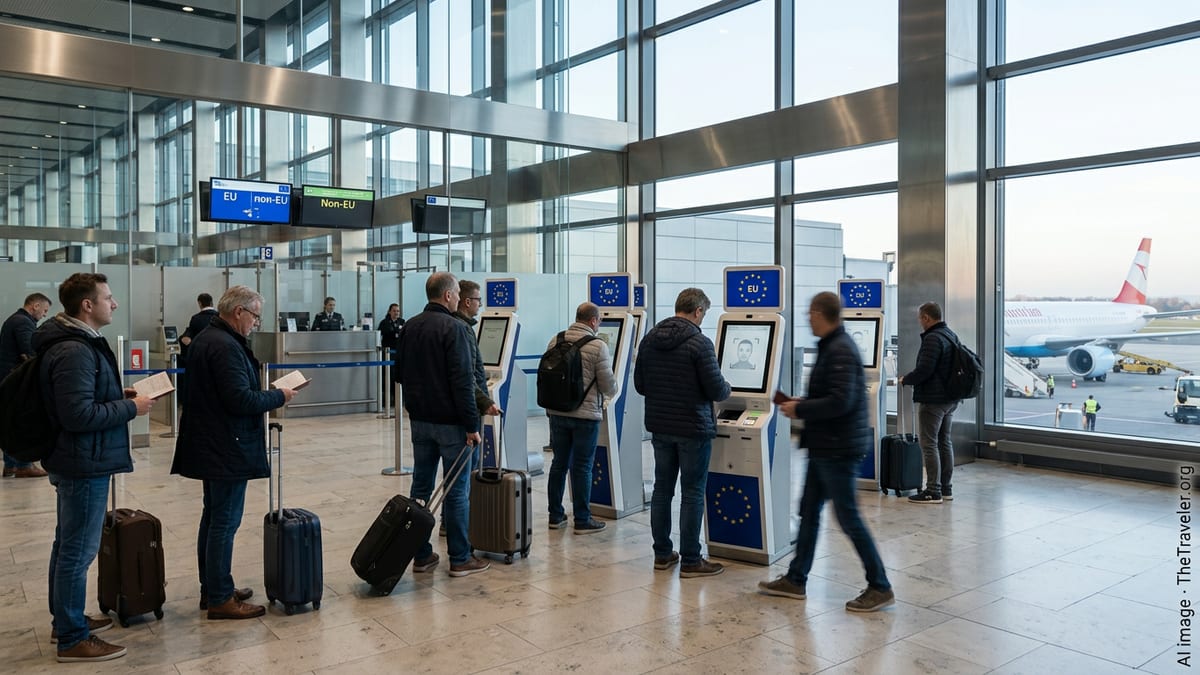
The European Union’s new Entry/Exit System, fully activated across the Schengen external borders after a phased rollout beginning in late 2025, replaces passport stamping with biometric registration for non-EU short-stay travellers. Publicly available information describes a system that captures facial images, fingerprints and travel document data at airports, seaports and key land crossings, then stores each crossing in a central database for three years.
In principle, EES is intended to make travel more predictable by automatically calculating remaining days in the 90/180-day rule and detecting overstays without manual checks. The system is also framed as a tool to strengthen external border management at a time when migration, security and irregular stays are politically sensitive issues across Europe.
The challenge, tourism analysts argue, is that the technology has been deployed into an infrastructure that was already running close to capacity. Reports from early phases of implementation describe passengers waiting up to three hours at some border points, particularly where terminal space and staffing were designed around traditional manual booths rather than clusters of biometric kiosks.
Those bottlenecks matter because Europe remains the world’s leading tourism region. European Parliament material and other official briefings underline that tourism supports millions of jobs and contributes hundreds of billions of euros to economic output, with a particularly high dependence in Mediterranean destinations. For these economies, delays at the first point of contact with visitors are not a minor operational issue but a macroeconomic risk.
41 Million Arrivals and $45 Billion in Spending at Stake
The scale of that risk has been quantified in new research commissioned by the World Travel & Tourism Council and circulated through trade and business media in recent days. The analysis models what would happen if EES queues at external Schengen borders regularly stretched to three or more hours during busy periods, focusing on four of Europe’s most valuable long-haul source markets: the United States, the United Kingdom, Canada and Australia.
According to published summaries of the study, up to 41 million visitor arrivals from those markets could be deterred over a multi-year horizon if such delays become a persistent feature of travel. The projected impact on spending is around 45.4 billion dollars, roughly equivalent to just under 40 billion euros at current exchange rates, concentrated in destinations that rely heavily on long-haul, higher-spend tourists.
Travel trade outlets report that the modelling is based on both historical data about traveller sensitivity to disruption and recent surveys of more than 2,500 potential visitors. Many respondents indicated they would reduce trip frequency, shorten stays or choose alternative destinations if confronted with repeated stories or personal experiences of multi-hour queues to enter Europe.
The distribution of potential losses is not even. Major gateway countries such as France, Spain, Italy, Greece and Portugal are highlighted in coverage as particularly exposed, because they handle a large share of intercontinental arrivals and depend strongly on tourism for regional employment. Smaller tourism-driven economies that market themselves on convenience and lifestyle are also considered vulnerable if reputational damage from border delays accumulates over successive seasons.
The Paradox of “Frictionless” Borders Creating New Friction
The central paradox emerging from the rollout is that a system designed to create more efficient, automated borders is temporarily introducing more friction at the very moment when European destinations are trying to manage high demand and concerns about overtourism. Long-haul visitors generally account for a disproportionate share of tourism receipts per trip, spending heavily on accommodation, culture, dining and premium experiences that local economies have come to depend on.
Industry reactions compiled in specialist media suggest that travellers may accept biometric collection in principle but are far less tolerant of opaque processes, unclear signage and sudden surges in waiting times. Reports from several airports describe confusion among first-time EES users when kiosks malfunction, require repeated scans or are not supported by sufficient staff to guide passengers, particularly families or older travellers.
Travel commentators also point to timing. The system’s full activation has coincided with a wider tightening of travel rules across Europe, including expanding tourist taxes, stricter enforcement on short-term rentals and preparations for the separate ETIAS travel authorisation scheme. Taken together, these changes can make a European holiday feel more regulated and more expensive just as competing destinations in Asia, the Middle East and the Americas are investing in simplified entry schemes and aggressive marketing.
There are broader reputational risks as well. If the narrative about EES focuses on stranded tour groups and missed connections rather than smoother journeys and better security, analysts warn that consumer perceptions could lag behind operational improvements. Once travellers start to believe that a region is complicated to visit, it can take several seasons of positive experiences to reverse that impression.
Strains at Land Borders and Key Transit Hubs
While attention often centres on airports, publicly available reports indicate that some of the greatest operational challenges are appearing at busy land and sea borders. Cross-Channel routes between the United Kingdom and France are frequently cited as stress points, where the combination of space constraints, mixed passenger profiles and car-based traffic makes it harder to introduce biometric kiosks without causing tailbacks.
Ferry ports and international rail terminals face similar issues. Terminals built for rapid processing of passports by mobile officers are now being adapted to accommodate queues of passengers who must stop at kiosks for first-time EES registration, then proceed to a staffed booth for verification. During early holiday peaks, images and testimonies shared in European media have described lines stretching through car parks and platforms, with knock-on effects on schedules.
In some cases, national authorities and infrastructure operators have accelerated investment in additional kiosks, redesigned queuing areas or trialled appointment systems for coach operators to smooth flows. However, tourism industry analysis stresses that construction, procurement and staffing cycles are slower than the seasonal rhythms of travel. The risk, they argue, is that each summer until the system stabilises could bring renewed episodes of disruption.
These pressures coincide with structural labour shortages in aviation security and ground handling across many European hubs. Even well-designed digital systems rely on human staff to resolve errors, assist travellers and handle exceptional cases. Where staffing remains tight, any spike in kiosk faults or confusion among passengers can quickly translate into visible queues.
Balancing Long-Term Control with Short-Term Tourism Health
European institutions have framed EES as part of a broader shift toward more sustainable, controlled tourism and better-managed borders, noting that unregulated surges in visitor numbers can strain cities, transport and local housing. Strategy documents on tourism highlight the need to balance economic gains from arrivals with quality of life for residents and resilience of infrastructure.
From a policy perspective, the Entry/Exit System responds to longstanding calls for accurate data on who is entering and leaving the Schengen Area, and for tools that can address overstays without blanket restrictions on legitimate tourists. In the long run, supporters argue, a mature EES could enable more targeted enforcement and potentially more flexible visa or travel authorisation policies.
The short-term challenge is that tourism economics operate on a much tighter feedback loop. Airlines, hotels and tour operators set capacity and pricing months in advance, based on expectations of seamless entry. If reports of repeated three-hour queues continue into another peak season, planners may start to redirect capacity toward regions where perceived entry friction is lower, even if formal border controls there are no less strict.
Analysts observing the rollout note that much will depend on how quickly operational bottlenecks are addressed and how clearly expectations are communicated to travellers. Clearer pre-departure information, staggered check-in times for group travel, and visible contingency staffing during known peaks are among the measures being discussed in industry forums. Whether those adjustments arrive in time to preserve Europe’s appeal for high-value long-haul visitors will be closely watched by tourism boards and finance ministries alike.