


More news on this day
A temporary Federal Aviation Administration ground stop at George Bush Intercontinental Airport in Houston has disrupted operations at one of United Airlines’ largest hubs, prompting the carrier to extend flexible rebooking options to customers whose travel plans were affected.
Get the latest news straight to your inbox!
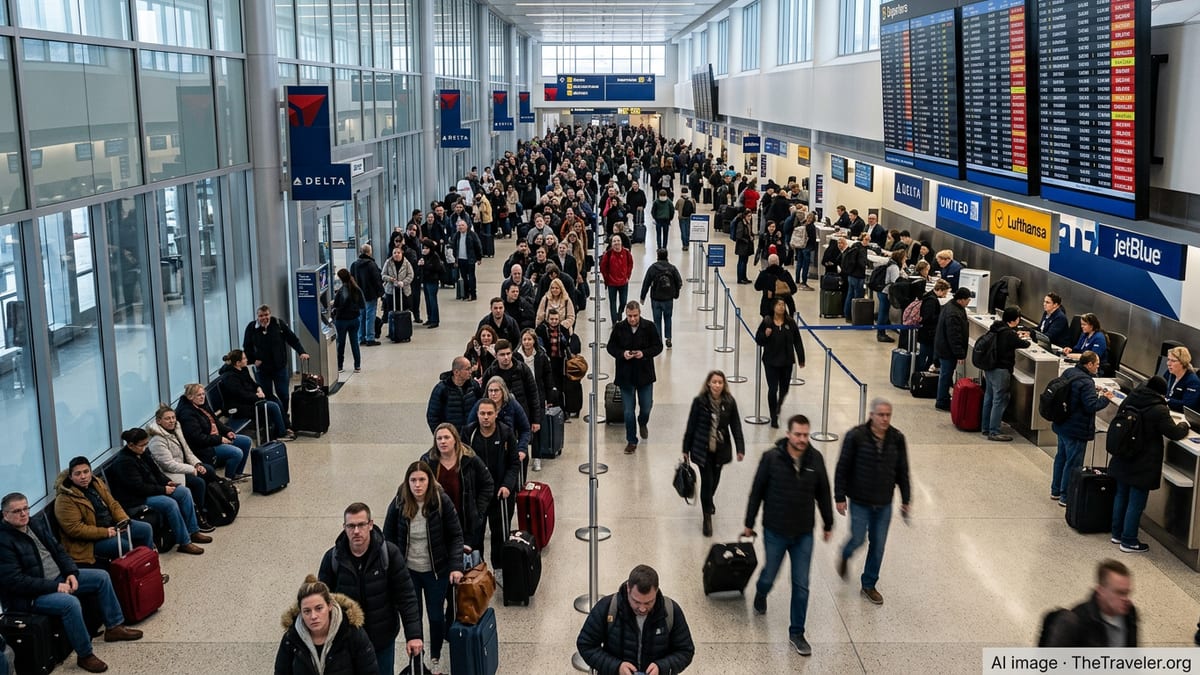
Short FAA Ground Stop Ripples Across United’s Network
Publicly available advisories from the Federal Aviation Administration’s Air Traffic Control System Command Center indicate that a coordinated ground stop was put in place at George Bush Intercontinental Airport, a major Texas hub, as strong thunderstorms moved across the Houston area. During the pause, departing flights from multiple air traffic control centers feeding into Houston were held to manage safety and congestion while the weather system passed.
The airport status data for Houston showed elevated delay metrics and a spike in both average and maximum delay times around the period of the stop. Although the ground stop itself was relatively short, the knock-on effects extended well beyond its official end time as crews, aircraft, and gates cycled back into position.
As United’s largest hub in Texas and one of its key domestic and international gateways, Houston plays an outsized role in the airline’s daily schedule. Disruptions there can quickly cascade through connecting flights, particularly for travelers heading between smaller regional cities and long haul destinations that rely on tightly timed connections.
Once the FAA lifted the restriction, operations transitioned to a ground delay phase, with inbound and outbound flights subject to spacing controls and revised departure slots. That second phase continued to generate delays even as new departures began to push back from gates.
United Activates Flexible Rebooking for Affected Customers
In response to the disruption, United Airlines activated a travel flexibility policy for customers booked through Houston during the affected period. Information available through the airline’s public channels shows that travelers whose itineraries touched the Houston hub were given the option to rebook without change fees, and in many cases without additional fare charges when remaining in the same cabin and origin and destination cities.
Under the rebooking offer, eligible customers were able to move their travel to alternate flights within a defined window around the original travel date. United encouraged passengers to use its mobile app and website to self service new itineraries, reflecting the airline’s broader push in recent years to handle irregular operations through digital tools rather than exclusively at airport customer service counters.
The policy also made provisions for travelers whose connections through Houston had become impossible due to the compressed schedule. Those customers were typically able to shift to later connecting flights or, when available, routings through other United hubs such as Denver, Chicago, or Washington to complete their journeys with a reduced risk of misconnection.
For some passengers, particularly those originating or ending their trips in Houston, same day rebooking on flights outside the peak weather window helped avoid overnight stays. Others accepted later travel dates or requested refunds when their trips were no longer practical.
Weather and Hub Concentration Drive Operational Vulnerability
Houston’s position along common Gulf Coast storm tracks means that summer weather can quickly become a critical operational factor. Thunderstorms, lightning, and associated low visibility often trigger ramp closures, arrival spacing programs, and full ground stops when conditions exceed safety thresholds.
Because United concentrates a large share of its domestic and international flying at the airport, even a short pause in traffic can create a backlog that is difficult to absorb during busy travel periods. The hub and spoke structure that improves connectivity for smaller markets also heightens the risk that a local disruption will spread outward, touching flights hundreds or thousands of miles from the original problem.
Industry data and academic analyses of hub operations show that airlines use a mix of schedule padding, reserve aircraft, and crew positioning strategies to cushion the impact of such events. However, when several waves of connecting flights bunch up during or after a ground stop, gate space, crew duty limits, and air traffic control flow restrictions can still combine to produce widespread delays and scattered cancellations.
Travelers who rely on minimum connection times at busy hubs are particularly exposed when weather or congestion slows the operation. A delay of less than an hour on an inbound segment can be enough to strand passengers if onward flights depart on time to preserve the overall schedule.
What Travelers Can Expect After a Ground Stop
For passengers booked on United through Houston and other major hubs, a temporary FAA ground stop often marks the beginning of a dynamic and sometimes unpredictable recovery period. Once the stop is lifted, airlines typically prioritize longer haul departures, flights with limited frequency, and aircraft that are needed to operate later segments downline.
Customers may see rolling departure time changes as flight release times are updated and crews approach duty time limits. Same day rebooking options can shift as seats open on alternative flights or as additional cancellations occur, which makes monitoring reservations through the airline’s digital channels especially important in the hours following a major disruption.
Travel policy documents and consumer guidance materials indicate that in weather related events, regulators do not generally require airlines to provide hotel accommodations or meal vouchers. As a result, the principal remedy for many affected travelers is rebooking at no additional cost, either on the same day or on a later date within the window defined by the airline’s waiver.
Frequent travelers often recommend that passengers proactively search for acceptable alternative itineraries and request those options through the app, website, or airport agents rather than waiting for automatic reassignments, especially when flying from or through a major hub where seats on later departures can fill quickly.
Regulatory Context and Evolving Passenger Rights
The response to the Houston disruption also reflects a broader shift in how airlines, including United, handle irregular operations in light of evolving federal rules and public expectations. Recent regulatory actions have emphasized clearer communication of passenger rights, including when rebooking or refunds are available following cancellations and significant delays.
Policy documents and notices in the Federal Register describe new requirements for airlines to be transparent about their commitments to rebook passengers during disruptions, particularly when the cause is within the carrier’s control. Weather related delays, such as those that triggered the Houston ground stop, typically fall into a category where airlines have more discretion, but many have adopted standardized waivers to maintain customer confidence.
United and other major carriers have increasingly formalized travel waivers in response to major storms, system outages, or air traffic management constraints. These waivers, which outline who qualifies for fee free changes and during what travel window, are commonly published on airline websites and amplified by travel advisers and consumer advocates so that travelers can act quickly.
For now, the Houston ground stop serves as another reminder that even short interruptions at a key hub can have wide ranging effects. It also underscores the growing importance of flexible rebooking policies as airlines and regulators adapt to a system in which extreme weather and traffic saturation can challenge the reliability of tightly timed schedules.