


More news on this day
U.S. air travelers are facing renewed disruption at the start of the week as the Federal Aviation Administration highlights ongoing weather impacts and traffic management restrictions across 18 major airports following several days of storms, ground stops, and rolling delays.
Get the latest news straight to your inbox!
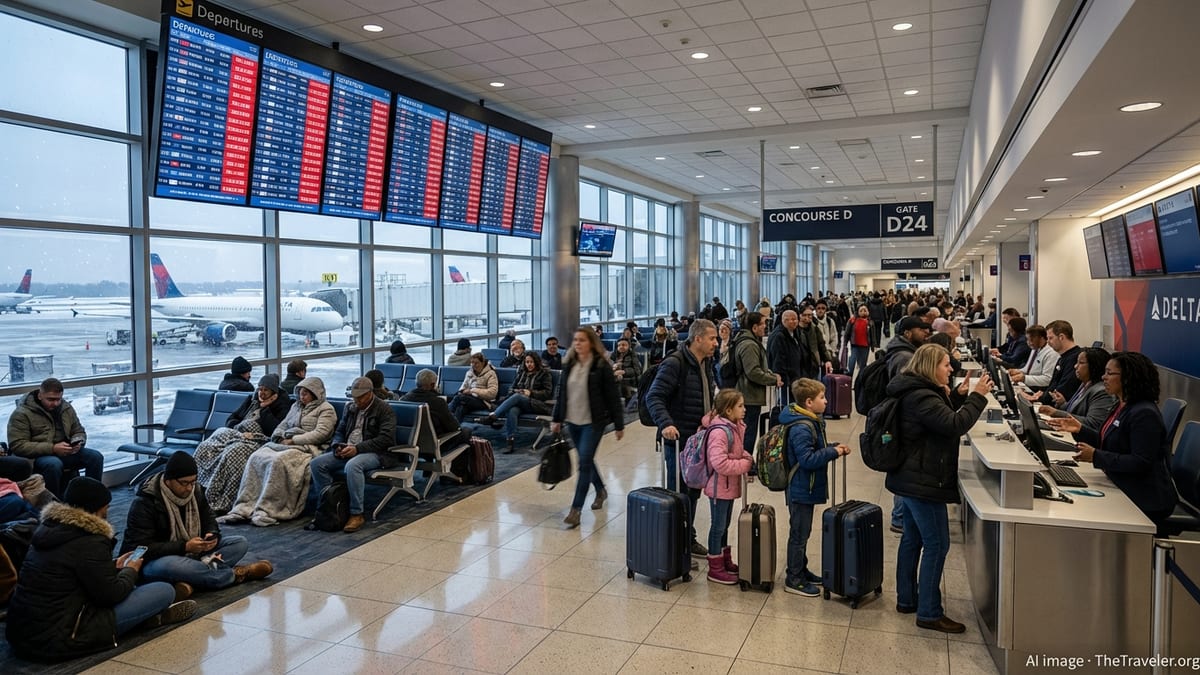
Days Of Storms Leave Airlines Struggling To Recover
The latest advisory comes after a volatile stretch of severe weather that has swept across key aviation hubs in the Midwest, Northeast, and South, triggering a chain reaction of delays and cancellations. Publicly available operations summaries from the FAA’s Air Traffic Control System Command Center point to repeated thunderstorms, low clouds, and convective systems near major hubs as primary drivers of disruption over the past several days.
Traffic management initiatives, including ground stops and ground delay programs, have been used at times to meter departures into already congested airspace. These measures help maintain safety but can quickly cascade into missed connections and overnight disruptions as aircraft and crews fall out of position. Industry trackers show that on some peak days, thousands of flights across the national network have been delayed, with several hundred cancellations concentrated around a handful of large hubs.
Although airlines increased schedules for the busy summer period, the intensity and persistence of recent storms have made recovery difficult. When severe cells park over a hub or move repeatedly through the same region, departures and arrivals are periodically halted, which in turn affects the rest of the national grid for hours after skies clear locally.
Eighteen Major Airports Flagged For Weather-Related Constraints
At the start of the week, the FAA’s national airspace status tools and command center advisories indicate that 18 major U.S. airports are under some combination of weather-related operational constraints. These include large hubs in the New York region, Chicago, Texas, and key East Coast and Midwest cities that serve as connection points for millions of passengers.
The affected airports range from coastal gateways dealing with low clouds, fog, and rain, to inland hubs where slow-moving storm systems and high winds are prompting reroutes and spacing restrictions. In certain locations, arriving aircraft are being sequenced with increased separation, while departures are being throttled to avoid overloading en route sectors that are already rerouting traffic around active storm cells.
According to published coverage from aviation and travel data providers, airports such as New York’s Kennedy and Newark, Chicago O’Hare, Dallas Fort Worth, Houston, Charlotte, Philadelphia, Washington-area fields, and select Midwest and Southern hubs have each seen repeated bouts of disruption over the past week. While the specific mix of airports under constraints shifts as storms move, the total count of impacted major fields to start this week is high enough to reverberate across the national network.
Ground Stops, Reroutes And Longer Flight Times For Passengers
For travelers, the FAA advisories and airport status alerts translate into a range of on-the-ground and in-the-air impacts. Ground stops, which temporarily halt departures bound for a particular airport, can leave passengers waiting at gates for extended periods even when their aircraft is already boarded. Ground delay programs, which meter departures using assigned departure times, can lead to rolling schedule adjustments throughout the day.
In the air, pilots may be instructed to follow longer routing around storm clusters, especially in regions experiencing convective weather. This can add flying time, burn more fuel, and increase the likelihood of missed connections at downline hubs. National airspace status pages show flow restrictions on certain high-density routes as controllers work to keep traffic safely separated from the most active weather cells.
Published industry analysis notes that even a short ground stop at a hub can ripple into hours of disruption because of how tightly airline schedules are built. Aircraft and crews that arrive late into one city may miss their next scheduled departure, forcing carriers to reassign equipment or cancel flights outright. When multiple hubs are affected on consecutive days, the system can take several cycles to rebalance.
Airlines Extend Travel Waivers As Disruptions Spread
In response to the unsettled pattern and the FAA’s continued use of traffic management initiatives at 18 major airports, several large U.S. carriers have issued or extended travel waivers for affected regions. Publicly posted alerts from major airlines indicate flexibility for customers whose itineraries touch storm-prone hubs, allowing date changes without additional change fees within specified windows.
These waivers often cover itineraries involving large connecting airports where disruption risk is elevated, including Chicago, Dallas Fort Worth, Charlotte, Houston, New York area airports, and Washington-area fields, among others. The policies vary by carrier but generally permit passengers to move their trip to an earlier or later date, keep the same origin and destination, and avoid additional penalties if they rebook within the airline’s defined timeframe.
Consumer advocates note that while federal regulations require refunds when flights are canceled and passengers choose not to travel, waivers offer a proactive option for those who expect significant delays but still plan to take their trip. With the FAA highlighting continuing weather-related constraints at a wide set of major airports, travelers with flexibility are being encouraged by many airline advisories to adjust schedules before conditions worsen.
What Travelers Should Expect In The Coming Days
Looking ahead, meteorological outlooks and FAA planning documents suggest that periods of unsettled weather are likely to persist in several regions, particularly during afternoon and evening peak travel times when thunderstorms are most active. The number and identity of airports under active FAA advisories will shift as storm systems move, but the agency’s current focus on 18 major airports underscores the breadth of the disruption risk.
Travel industry reports advise passengers to build additional buffer time into itineraries that require tight connections at large hubs and to monitor the status of both their departure and arrival airports through airline apps and official airport status pages. Early morning departures may offer a better chance of avoiding the most severe knock-on delays, since aircraft and crews are more likely to be in position from overnight.
Publicly available FAA guidance on summer travel emphasizes that weather remains the leading cause of delays in the national airspace system. With storms continuing to track across high-traffic corridors and the agency managing flows at 18 major airports to start the week, travelers are being urged to stay alert to changing conditions, check for carrier-specific waivers, and be prepared for schedule changes even after reaching the airport.