

More news on this day
Passengers at Chicago O’Hare International Airport faced mounting travel disruptions on March 4 as United Airlines, Qatar Airways, Etihad Airways, SkyWest, and Emirates collectively canceled nine flights and logged more than 200 delays, snarling key connections to Johnstown, London, Toronto, Brussels, Denver, and other major destinations.
Ripple Effects From Middle East Airspace Closures
The latest wave of disruptions at Chicago O’Hare comes as global aviation continues to reel from widespread airspace closures across parts of the Middle East, triggered by escalating regional conflict and associated security restrictions. Airlines with hubs in the Gulf, including Emirates, Qatar Airways, and Etihad Airways, have suspended or sharply reduced services through Dubai, Doha, and Abu Dhabi, forcing carriers worldwide to rework long-haul schedules and reroute traffic.
Industry analysts report that thousands of flights to and from the Gulf region have been canceled in recent days, leaving aircraft and crews out of position and squeezing capacity on remaining long-haul routes. That operational shock is now manifesting at major North American gateways like O’Hare, where multiple international departures and arrivals are being trimmed or delayed as airlines adjust to longer routings and constrained hub access.
With Chicago a key connecting point for both transatlantic and domestic networks, relatively small numbers of outright cancellations can produce outsized impacts. The nine canceled flights recorded on Monday triggered knock-on delays and missed connections for travelers attempting to reach Europe, Canada, and smaller US markets, as well as those relying on onward links via Gulf megahubs.
Key Routes Affected: From Johnstown to London and Brussels
Among the most visible impacts for travelers at O’Hare were schedule disruptions on high-profile international routes. Services to London and Brussels, typically operated by a mix of US and European carriers alongside Gulf-based airlines via their respective hubs, saw extended delays as aircraft arrived late into Chicago or departed behind schedule due to revised routings.
Short-haul cross-border traffic also felt the strain. Flights to Toronto, usually frequent and reliable, experienced cascading delays as aircraft turned late from earlier segments and crews bumped up against duty-time limits. For travelers connecting in Toronto to onward transatlantic or transpacific flights, even moderate delays out of Chicago risked turning into missed connections and overnight stays.
Domestically, regional operations were far from immune. SkyWest, which operates numerous United Express services out of O’Hare, canceled and delayed flights on feeder routes to smaller communities such as Johnstown and key western hubs including Denver. Those cancellations effectively severed some travelers’ only same-day options to reach the broader United network, heightening frustration for passengers far from the main international story driving the disruption.
Airlines Scramble With Rebookings and Reroutes
United Airlines, O’Hare’s largest carrier, faced the complex task of absorbing disrupted Gulf connections and long-haul reroutes into an already busy early March schedule. With partner airlines in the Middle East temporarily grounded or operating at sharply reduced frequency, United has had to lean more heavily on its own transatlantic services and those of European partners to move passengers whose original itineraries depended on connections through Dubai, Doha, or Abu Dhabi.
For Gulf carriers at O’Hare, the playbook is similarly constrained. Emirates, Qatar Airways, and Etihad Airways have focused on reaccommodating stranded passengers on alternative routings through Europe or other available hubs where possible, prioritizing those with urgent travel needs. Limited capacity and longer flight times, however, mean that many travelers are being pushed days beyond their original departure dates, particularly on popular corridors between North America, Europe, and South Asia.
SkyWest’s regional cancellations added another layer of complexity, especially for passengers working with closely timed domestic connections. With spare aircraft and crews in short supply, same-day rebooking options on certain smaller-city routes were limited, forcing some travelers to accept lengthy ground transfers, overnight stays in Chicago, or complete changes in destination.
What Travelers at O’Hare Are Experiencing
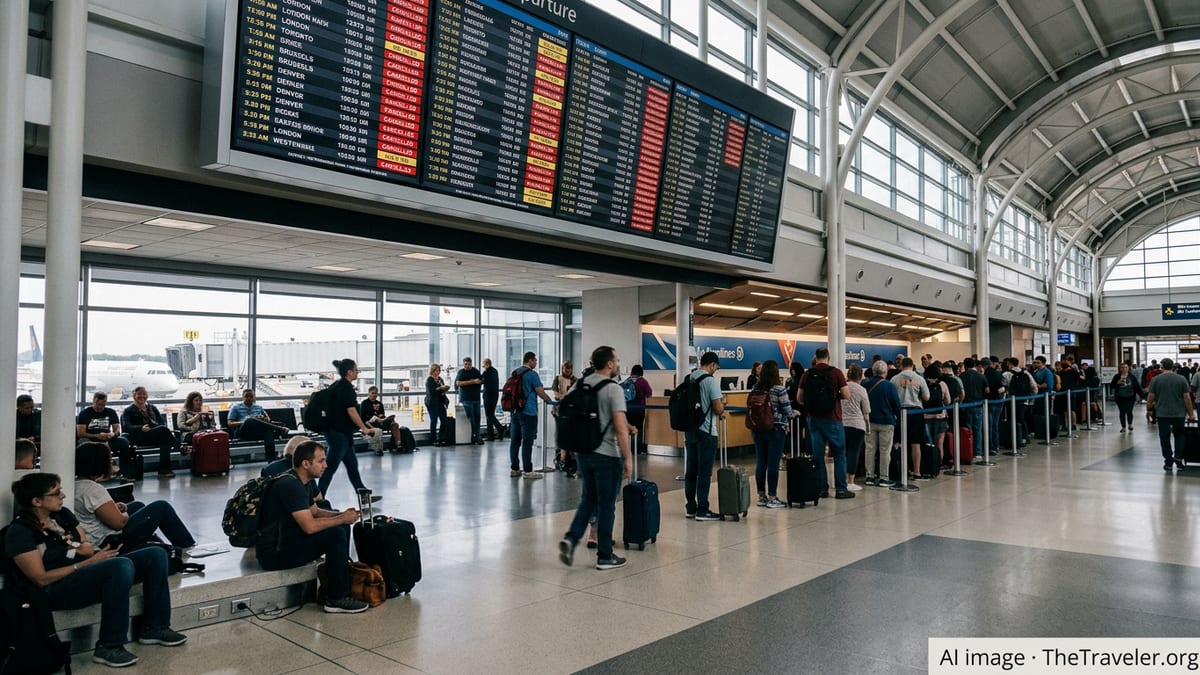
Inside O’Hare’s terminals, the operational stress translated into crowded gate areas, long lines at customer service counters, and departure boards thick with yellow and red delay markers. Travelers heading to major hubs like London, Brussels, Toronto, and Denver reported receiving multiple rolling delay notifications as airlines sought updated slot times and revised routings around restricted airspace.
Many affected passengers described confusion around the root causes of their disruptions, with some initially assuming routine weather or technical issues. Only after extended waits did some travelers learn that their delayed or canceled flights were collateral damage from the broader international airspace crisis, rather than problems confined to Chicago or their airline alone.
Airport staff and airline agents worked to provide meal vouchers, hotel accommodations, and alternative routing options where permitted by carrier policies. Still, capacity constraints meant that even generous reaccommodation efforts could not fully absorb the displaced demand, and some travelers faced the prospect of multiple days of disrupted plans, particularly those with complex multi-stop itineraries.
How to Navigate Ongoing Disruptions
With airspace restrictions and schedule changes still evolving, aviation experts caution that disruption at Chicago O’Hare may persist in some form over the coming days. Travelers booked on flights involving Gulf carriers or connections to the Middle East are being urged to monitor their itineraries frequently, make use of mobile apps and text alerts, and consider rebooking to more direct routings where possible.
For passengers traveling on United, SkyWest-operated United Express flights, or codeshares with Emirates, Qatar Airways, or Etihad Airways, airline representatives stress the importance of verifying flight status before leaving for the airport and allowing extra time for security and potential re-screening in the event of rebookings. Those connecting through Toronto, London, Brussels, or Denver should be prepared for longer layovers and carry-on essentials in case of unexpected overnight stays.
While the nine cancellations and more than 200 delays recorded on Monday represent only a fraction of O’Hare’s daily movements, they underscore how quickly distant geopolitical events can ripple through one of the world’s busiest hubs. For now, travelers are being advised to pack patience along with their passports as airlines and regulators work to restore a more stable operating environment.