


More news on this day
Travelers at Buenos Aires’ Aeroparque Jorge Newbery faced a chaotic start to the day as 23 domestic flights were delayed and 8 were canceled, disrupting operations for Aerolíneas Argentinas, Flybondi, JetSMART and other carriers on busy routes to Córdoba, Mendoza, Rosario, Bariloche and Salta.
Get the latest news straight to your inbox!
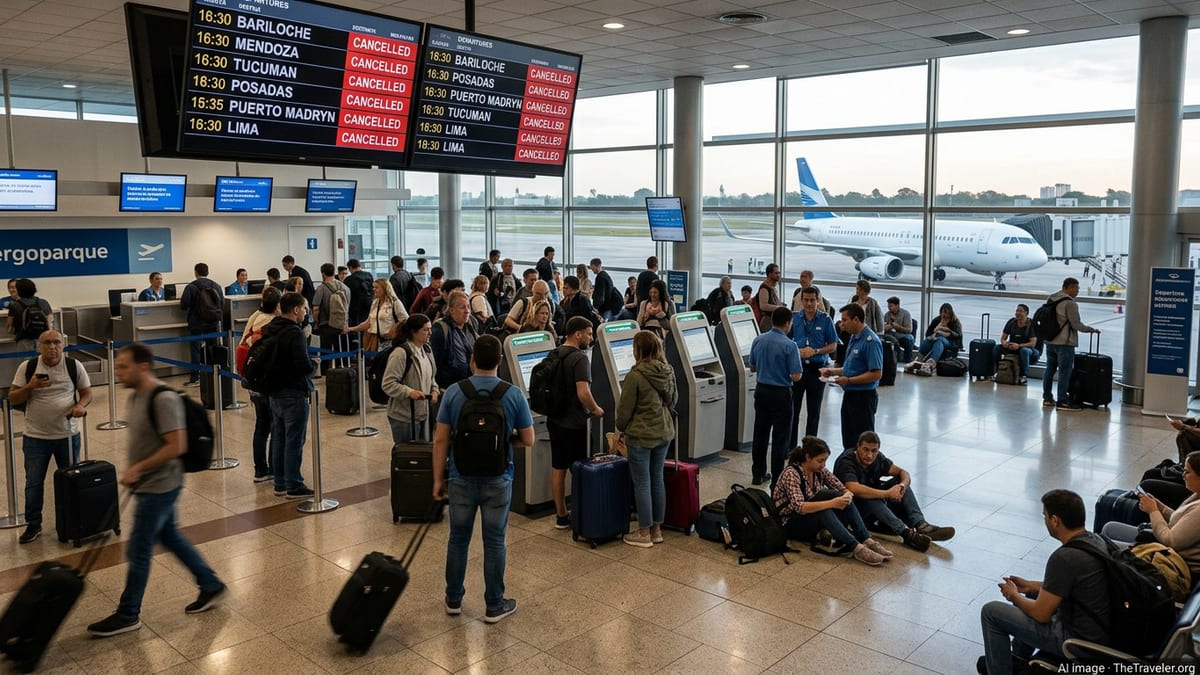
Weather and congestion trigger a wave of disruptions
Publicly available flight-tracking data and local media coverage indicate that a combination of adverse weather over the Río de la Plata and heavy morning traffic contributed to the disruption at Aeroparque, Buenos Aires’ main domestic hub. The airport, which routinely handles hundreds of daily movements connecting the capital with major provinces, saw operations bunch up in key banks of departures and arrivals.
Reports show that low clouds and reduced visibility forced tighter spacing between takeoffs and landings, creating a ripple effect across an already congested schedule. As aircraft and crews fell out of position early in the day, delays quickly mounted and some services were removed from the program altogether.
The pattern of disruption was most severe on short-haul domestic links, where high frequencies leave airlines with limited slack to absorb operational shocks. With Aeroparque operating close to capacity on a regular basis, even brief interruptions have the potential to cascade into significant timetable changes.
Observers note that the latest disruption follows a series of recent operational challenges in Argentina’s aviation sector, including previous days marked by industrial actions and nationwide air traffic control slowdowns that have periodically strained airport and airline resilience.
Domestic routes to key cities hardest hit
According to same-day schedule summaries, the bulk of the 23 delayed flights involved popular domestic routes from Aeroparque to Córdoba, Mendoza, Rosario, Bariloche and Salta. These corridors are among the country’s busiest, linking Buenos Aires with major economic, educational and tourism centers in central and northern Argentina as well as Patagonia.
Travel search platforms and airport information boards showed departure times slipping well beyond the 30-minute mark for several services, with some flights departing more than two hours behind schedule. In multiple cases, arriving aircraft were held in sequence or rerouted, contributing to late inbound operations and further complicating the departure profile for the rest of the day.
The eight cancellations recorded during the disruption removed capacity on routes that are often heavily booked, particularly on peak weekday and leisure-travel periods. Passengers bound for Bariloche and Mendoza, two of Argentina’s most important tourism gateways, were among those most affected by lost frequencies and extended waiting times for rebooking options.
In Salta and Córdoba, domestic media and airport status boards reflected knock-on effects as delayed aircraft from Buenos Aires arrived late, compressing ground times and prompting additional adjustments to local departure waves. The interconnected nature of Aeroparque’s domestic network meant that a problem concentrated in Buenos Aires reverberated across several provincial terminals.
Aerolíneas Argentinas, Flybondi and JetSMART face operational strain
Aerolíneas Argentinas, Flybondi and JetSMART, the three main operators at Aeroparque on the affected routes, all saw parts of their schedules reshaped by the disruption. Publicly available schedules show that these carriers collectively operate dozens of weekly frequencies between Aeroparque and Córdoba, Mendoza, Rosario, Bariloche and Salta, making them particularly exposed when conditions deteriorate.
Sector analysts point out that Aerolíneas Argentinas typically carries the largest share of domestic traffic, using Aeroparque as a primary hub. Low-cost competitors Flybondi and JetSMART, which also rely heavily on rapid aircraft turnarounds to maximize utilization, tend to be vulnerable to upstream delays that erode the buffer built into their timetables.
In recent months, published coverage has highlighted how issues such as labor actions, infrastructure constraints and air traffic control measures have repeatedly tested airlines’ ability to keep to schedule. While the latest episode was driven primarily by operational and meteorological factors, it unfolded against a backdrop of broader structural pressures in Argentina’s aviation system.
Despite those strains, airlines were able to operate the majority of Aeroparque’s daily program, and many delayed services eventually departed. However, the relatively small number of cancellations still translated into hundreds of disrupted travel plans given the typical load factors on these domestic sectors.
Passengers face long waits, rebookings and missed connections
Travelers caught up in the disruption encountered long queues at check-in areas and service counters as they sought information, meal vouchers and alternative itineraries. Airport information displays cycled through status changes while some departure gates remained occupied for extended periods as ground crews waited for aircraft clearance or final operational decisions.
Passengers on point-to-point domestic journeys mainly faced late arrivals and curtailed time at destination, but those connecting via Aeroparque to other Argentine cities or on to regional flights were at greater risk of missed onward services. Public advisories and news reports emphasized the importance of checking flight status frequently through airline apps and official channels.
Travel industry commentators noted that disruption on Aeroparque’s domestic network can have outsized impact because many travelers time their itineraries tightly around business meetings, medical appointments or tourism activities. Even a modest schedule change can translate into lost reservations, extra hotel nights or rearranged ground transport, particularly on routes to high-demand leisure destinations such as Bariloche.
Some passenger advocates renewed calls for clearer, more proactive communication from airlines and airport operators during fast-evolving operational events. They argue that timely updates and transparent rebooking options can significantly reduce stress, especially when widespread delays and cancellations unfold across multiple carriers at once.
What the disruption reveals about Aeroparque’s vulnerabilities
Analysts consulted in recent coverage of Argentina’s aviation sector have repeatedly underscored Aeroparque Jorge Newbery’s dual role as a vital domestic hub and a potential single point of failure. The airport’s location close to central Buenos Aires offers convenience but also limits its physical capacity to expand runways, taxiways and terminal space at the pace of demand growth.
Operational data and previous incident reports suggest that, when factors such as weather, labor disputes or air traffic control measures arise, Aeroparque can quickly reach a tipping point at which schedule recovery becomes challenging. This creates a fragile environment for airlines that build their networks around multiple daily rotations linking the capital with provincial centers.
Recent policy discussions and infrastructure studies have explored options to alleviate pressure on Aeroparque by shifting some operations to Ezeiza or by optimizing runway use and approach procedures. The latest disruption is likely to feed into that ongoing debate, reinforcing arguments that system-wide resilience depends on both physical investment and coordinated planning among airlines, airport operators and service providers.
For passengers, the episode serves as a reminder to build flexibility into itineraries touching Aeroparque, particularly during periods of unsettled weather or known operational stress. Travel planners recommend allowing extra time for connections, monitoring flights closely and considering travel insurance products that specifically address delays and cancellations on domestic routes within Argentina.