


More news on this day
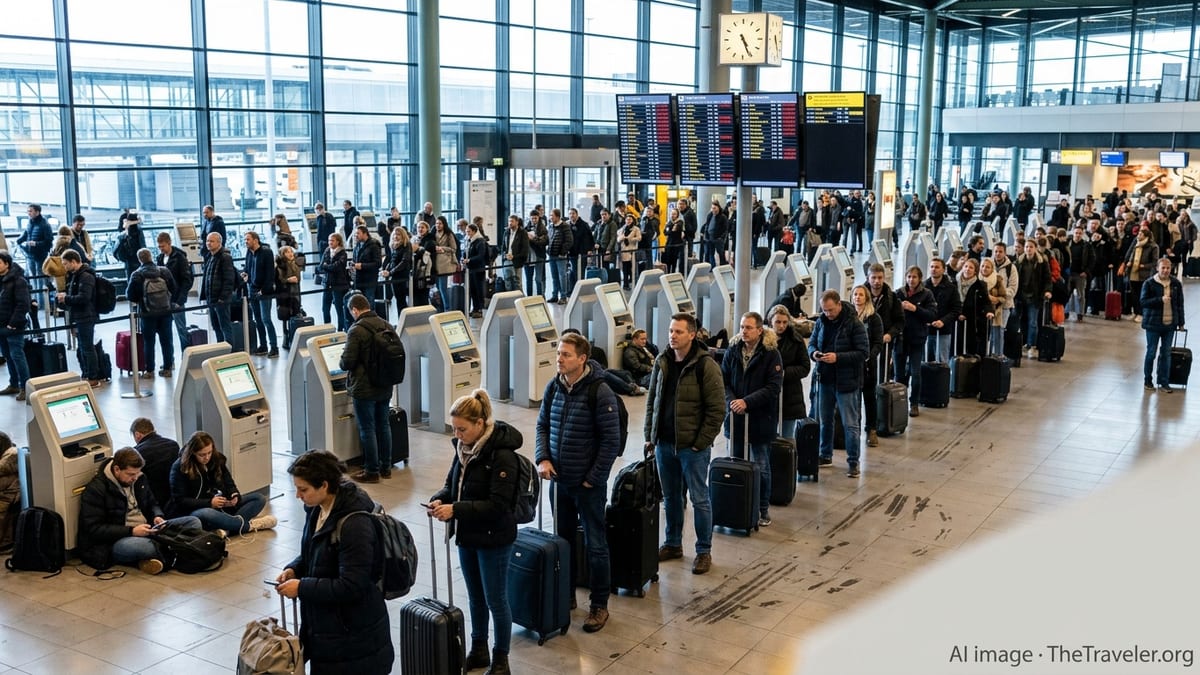
Europe’s already busy summer aviation network came under renewed strain this week as more than 1,600 flight delays and 49 cancellations disrupted operations at major hubs in Amsterdam, Paris and London, unsettling travel plans for tens of thousands of passengers and underscoring the fragility of Europe’s high-season schedules.
Get the latest news straight to your inbox!
Network Pressure Peaks in Early July
The disruption unfolded against a backdrop of record traffic levels across the European aviation network in the first week of July. Publicly available network data for early July indicate that Europe is handling well over 36,000 flights per day, with total volumes now exceeding last summer and leaving limited margin when problems arise. In such conditions, delays and cancellations at just a few hubs can cascade quickly across the continent.
According to aggregated operational reports, the latest turbulence in the network centered on Amsterdam’s Schiphol Airport, Paris Charles de Gaulle and the main London airports, which together function as critical transfer points linking intra-European services with long haul routes to North America, Africa and Asia. The concentration of traffic at these hubs means even modest schedule disruptions can create visible knock-on effects.
In this latest episode, a combination of weather-related constraints, runway and airspace flow management measures, and local capacity bottlenecks contributed to a spike in reactionary delays. Once aircraft and crews fell out of position on key trunk routes between the Netherlands, France and the United Kingdom, airlines were forced to adjust rotations, leading to cancellations and extended waiting times at terminals.
The impact was widely felt by leisure travelers heading to and from major summer destinations, as well as business passengers connecting through the three cities. Social media posts and consumer-rights platforms pointed to missed connections, long queues at rebooking desks and overnight stays prompted by the disruption.
Amsterdam Schiphol Feels the Brunt
Amsterdam Schiphol once again emerged as one of the most heavily affected hubs. Recent coverage of operations at the airport highlights a pattern of recurring pressure as airlines ramp up their peak-season schedules. On the day of the latest incident, Schiphol saw dozens of delayed departures and arrivals and dozens more cancellations, contributing a significant share of the 1,603 delays and 49 cancellations recorded across the interconnected Amsterdam Paris London corridor.
Data from aviation tracking services show that Schiphol’s busy European links, particularly to London and Paris, were among the hardest hit. Flights to London Heathrow, London Gatwick and Paris Charles de Gaulle experienced repeated delays, while some short haul rotations to regional European cities were scrapped entirely so that aircraft and crews could be reassigned to longer haul or strategically important services.
Travel rights organizations report increased queries from passengers affected by Schiphol disruptions in recent days. Many travelers sought clarity on whether they are entitled to rerouting, refunds or compensation under European Union passenger-protection rules. Guidance from consumer advocates stresses that eligibility depends on the cause of the disruption and whether airlines can demonstrate that the problems were outside their control, but passengers are encouraged to document delays and keep receipts for additional expenses.
Despite operational challenges, Schiphol’s infrastructure and ground handling teams have continued to process high passenger volumes. However, the latest episode reinforces concerns about how quickly the airport’s operations can become stretched when network-wide demand and local capacity constraints intersect during peak hours.
Paris and London Hubs See Knock-on Delays
Paris’s main international hub and the London airport system also recorded substantial disruption, largely in connection with the strain originating in the wider European network. Paris Charles de Gaulle, one of Europe’s busiest long haul gateways, reported elevated levels of arrival and departure delays as inbound aircraft from Amsterdam and other European cities landed late and departed outside their scheduled slots.
In Paris, the delays were most visible on popular intra-European routes that rely on quick turnarounds to maintain punctuality. Once rotations slipped behind schedule, ground teams faced compressed time windows to service aircraft, while air traffic flow management measures limited the ability to recover lost minutes in the air. Airlines prioritized maintaining connectivity for long haul passengers, resulting in some regional flights being canceled or consolidated.
London’s airports, particularly Heathrow and Gatwick, experienced their own share of disruption tied to the network ripple effects. High-frequency routes linking London with Amsterdam and Paris are a backbone of European business and leisure travel, and irregular operations on these corridors quickly translated into crowded departure lounges and rebooking challenges. Aviation data services recorded a spike in late-evening arrivals as carriers attempted to clear backlogs and restore aircraft to overnight bases.
Operational updates from the London hubs indicated that while most flights ultimately operated, a minority were canceled as the day progressed, especially those scheduled at the margins of the timetable. This contributed to the overall tally of 49 cancellations associated with the latest disruption pattern on the northwestern European network.
Structural Factors Behind the 1,603 Delays
While individual flight problems are often attributed to weather or technical checks, analysts point to broader structural issues behind the figure of 1,603 delays. Europe’s air traffic system currently operates near full capacity on many peak-season days, leaving little buffer to absorb disturbances such as thunderstorms, temporary airspace restrictions or staff shortages in control centers.
Network briefings for the summer 2026 season highlight that France and parts of southern Europe are generating a significant share of en route delays, reflecting both strong demand and capacity constraints in specific control centers. When those en route bottlenecks intersect with busy arrival and departure banks at Amsterdam, Paris and London, queueing builds rapidly in the sky and on the ground.
Another factor is the tight aircraft utilization built into many airline schedules. To maximize fleet productivity during the summer, carriers often plan short ground times and complex rotation patterns that depend heavily on punctuality. Once an early rotation between two hubs runs late, the same aircraft may continue to propagate delays through multiple subsequent sectors, inflating statistics across the day.
Additionally, passenger demand has rebounded strongly since the pandemic, and some airports and suppliers continue to adapt staffing levels and training pipelines to this higher baseline. While overall staffing is more robust than in the summers immediately after travel restrictions eased, the system remains vulnerable in certain specialized roles where replacement and training times are long.
What Travelers Should Expect in the Coming Weeks
For travelers planning to pass through Amsterdam, Paris or London in the weeks ahead, the latest disruption is a reminder to build flexibility into itineraries. Industry observers recommend allowing longer connection times at major European hubs, particularly during morning and late-afternoon peaks when banks of arrivals and departures are densest and the risk of knock-on delays is highest.
Passengers are also encouraged to monitor their flights closely through airline apps and airport information displays on the day of travel. Same-day schedule adjustments, aircraft swaps and gate changes have become more common in a high-load network, and early awareness can help travelers rebook or reroute more efficiently when problems emerge.
Travel rights organizations reiterate that European regulations provide important protections in the event of long delays or cancellations, including rights to care such as meals and accommodation, rerouting or refunds, and in certain circumstances financial compensation. However, they emphasize that every case hinges on the specific operational cause, and encourage travelers to keep records of disruption and follow up with airlines after returning home if necessary.
With summer 2026 shaping up to be one of the busiest seasons on record for European aviation, the episode of 1,603 delays and 49 cancellations across the Amsterdam Paris London hubs illustrates both the resilience and fragility of the network. Flights are largely operating, but when conditions tighten, even a modest disruption can quickly be felt by passengers across multiple countries.