


More news on this day
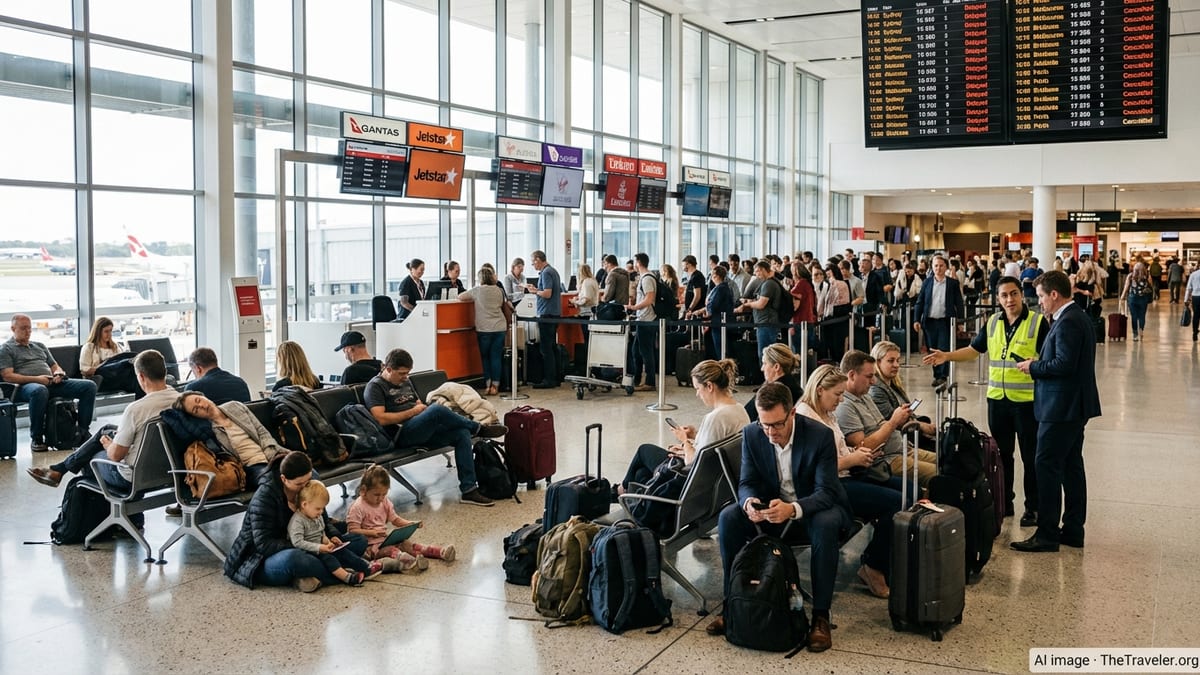
Hundreds of passengers have been left stranded at Melbourne Tullamarine Airport and at regional hubs across Australia after a fresh wave of flight cancellations and extensive delays disrupted the country’s already stretched aviation network this week.
Get the latest news straight to your inbox!
Melbourne Tullamarine at the Centre of Network Turbulence
Melbourne Tullamarine has again emerged as a flashpoint for aviation disruption, with domestic and regional services facing rolling delays and last minute cancellations that left queues snaking through departure halls and rebooking desks. Publicly available data and media coverage indicate that services operated by Qantas, Jetstar and Virgin Australia were among those affected, with flow on impacts to regional carriers that rely on Melbourne for connecting traffic.
Passengers reported lengthy waits for rebooking and limited information at the terminal, highlighting how quickly disruption at a major hub can cascade through the wider network. Melbourne’s role as a key connection point for flights to Tasmania, South Australia and regional Victoria meant that problems on core routes rapidly translated into missed connections, overnight stays and abandoned travel plans for travellers heading beyond the capital.
The strain at Tullamarine is unfolding against a backdrop of broader capacity adjustments and timetable changes across the domestic market. Qantas has already been reducing some services to manage higher fuel costs and softening demand on selected routes, while smaller operators are reshaping their networks in response to cost pressures and changing passenger patterns.
Surface access to Melbourne Airport has also become more complicated, with ongoing road works and lane closures on key approach routes contributing to longer travel times to and from the terminals. For disrupted passengers trying to leave the airport late at night or reach hotels at short notice, these ground transport issues have added to the sense of confusion and delay.
Regional Hubs Hit Hard as Capacity Is Cut Back
While images of stranded travellers at large terminals attract most attention, the latest round of disruption has again underscored the vulnerability of regional communities. When cancellations originate or ripple out from Melbourne, smaller airports that depend on a limited number of daily services can be left without any viable same day alternatives.
Published reports on recent schedule changes show regional centres across South Australia, New South Wales and Queensland facing reduced frequencies or suspended routes as airlines trim capacity in response to higher costs. Link Airways, for example, has suspended services from Shellharbour in New South Wales, citing cost pressures and concerns about the viability of the route. When irregular operations occur at the same time as structural cutbacks, the result for travellers can be days of delay rather than hours.
Submissions to federal inquiries into regional airfares and aviation reliability have documented how cancellations in smaller communities often mean missed medical appointments, work shifts and family events, with limited or no public transport alternatives. For some remote areas, seasonal road closures or long driving distances mean a cancelled flight is not merely an inconvenience but a serious barrier to essential travel.
Industry analysis provided to policymakers in 2026 points to an on time departure rate that frequently falls below 80 percent for domestic services, with cancellation rates higher on some regional and low competition routes. Consumer groups argue that this leaves regional travellers disproportionately exposed when large carriers adjust schedules or when sudden disruptions occur at hub airports such as Melbourne.
Systemic Strains: Weather, Technology and Industrial Tensions
The immediate triggers of the latest cancellations and delays span several familiar factors: adverse winter weather across southeastern Australia, technical problems affecting airline and airport systems, and broader industrial and infrastructure challenges in the transport sector.
Weather related disruption has been a recurring theme over recent seasons. Earlier this year, Tropical Cyclone Koji forced widespread cancellations across northern Queensland, demonstrating how a single severe event can reverberate through airline networks nationwide when aircraft and crew are displaced. During peak holiday and busy business travel periods, there is little slack in schedules to absorb those shocks, and Melbourne often bears the brunt of reaccommodation efforts as aircraft are repositioned.
Technology outages have also left a mark on Australian aviation in recent years. Global IT incidents have temporarily grounded flights and disrupted check in and boarding processes at major airports including Melbourne, while recent telecommunications problems have affected critical systems in other transport modes such as rail. Each episode has raised questions about the resilience of digital infrastructure that now underpins nearly every aspect of airline operations.
At the same time, industrial relations pressures continue to shape the wider transport environment. Recent information from workplace regulators notes changing penalties for unlawful industrial action and highlights concern about stoppages that could significantly affect key parts of the economy, including aviation. Although the current wave of cancellations appears to be driven primarily by operational and weather related issues, the possibility of protected industrial action remains an underlying risk factor for future disruption.
Passenger Rights, Airline Policies and Growing Political Debate
The scenes at Melbourne Tullamarine and regional airports have added urgency to a national debate over passenger protections in the event of delays and cancellations. Consumer advocates have long argued that Australia lags behind comparable markets in Europe and North America when it comes to mandatory compensation and standardised assistance when flights are disrupted.
Under current practice, the level of support typically depends on whether a delay or cancellation is considered within an airline’s control. Publicly available policy documents from major carriers show that when disruptions are attributed to weather or air traffic control, passengers are often offered limited assistance, such as rebooking on the next available flight, with accommodation and meal support provided only in specific circumstances.
Lawmakers have been considering stronger frameworks. A private member’s proposal known as the Airline Passenger Protections (Pay on Delay) Bill has argued that domestic cancellation rates on some high frequency routes remain unacceptably high and has called for clearer minimum standards for care and, in certain cases, financial compensation. While the measure has not yet been adopted, it has helped bring detailed performance statistics and case studies of disrupted journeys into the public spotlight.
Travel industry groups and legal specialists caution that passengers need to review conditions of carriage and keep thorough records of expenses if they seek remedies under existing law. However, the complexity of current arrangements means many travellers abandon claims or are unaware of what support they might be entitled to when their journey is derailed.
What Stranded Travellers Can Expect in the Current Disruptions
For those caught up in the latest wave of cancellations and delays at Melbourne and regional hubs, publicly available guidance from airlines indicates a similar pattern of responses. When the disruption is inside the carrier’s control, such as some technical or scheduling issues, passengers can generally expect to be rebooked and may be entitled to accommodation, meal vouchers and ground transport where overnight stays become necessary.
Where flights are disrupted by severe weather or broader network issues considered outside airline control, assistance is more limited, and travellers are often responsible for their own accommodation and incidental costs, even when left stranded far from home. Many carriers advise passengers to contact their travel insurer in such circumstances, underlining the growing role of insurance in covering the gaps left by current aviation regulations.
Consumer organisations recommend that affected passengers document all communications, retain receipts for additional expenses and monitor airline notifications closely for alternative routing options through other hubs such as Sydney, Brisbane or Adelaide. Given the tight capacity on many domestic and regional routes, especially following recent schedule cutbacks, same day alternatives can be scarce when multiple flights in a sequence are cancelled.
As disruption continues to ripple through the system, the experience at Melbourne Tullamarine and regional airports is likely to deepen scrutiny of airline reliability, network planning and the adequacy of passenger protections. For travellers, the episode serves as another reminder to build in extra time, maintain flexible plans and carefully consider the fine print on tickets and insurance before flying within Australia.