


More news on this day
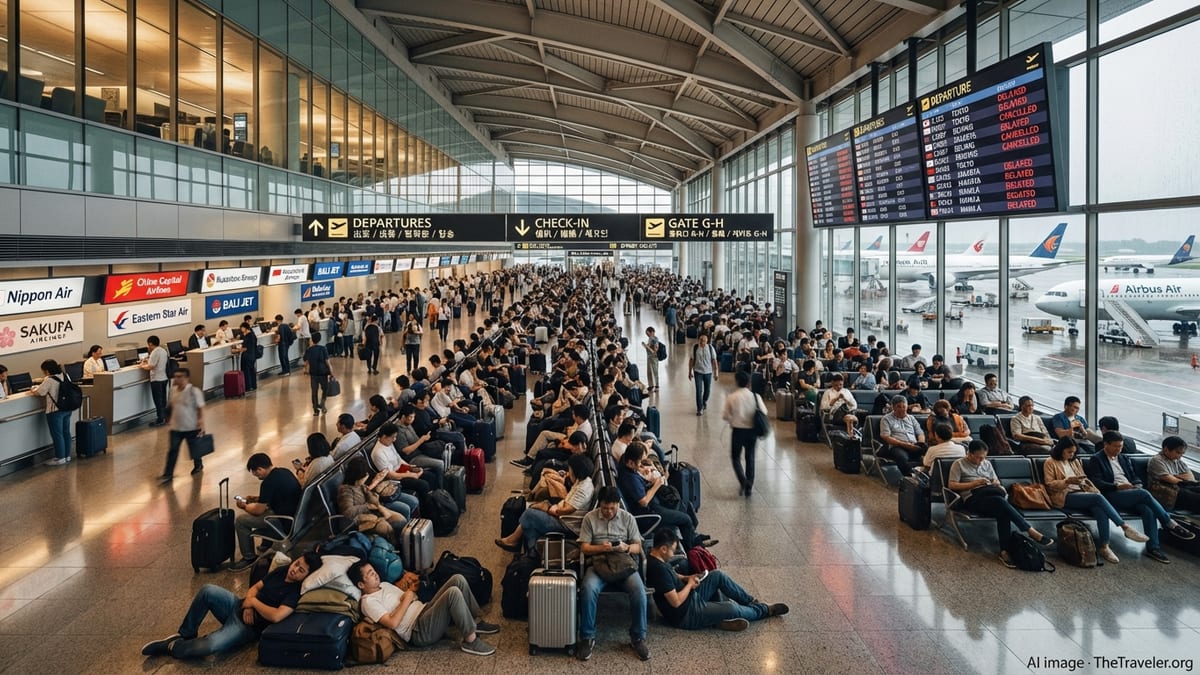
Wave after wave of flight cancellations and delays is rippling across Asia’s biggest aviation hubs this week, as war-related airspace closures, severe weather and sporadic IT outages combine to disrupt travel for hundreds of thousands of passengers.
Get the latest news straight to your inbox!
War in the Middle East Forces Reroutes Over Asia
The ongoing conflict involving Iran has upended traditional air corridors between Europe and Asia, pushing more long-haul traffic around the edges of the Middle East and over already busy Asian skies. Publicly available industry analysis indicates that airspace closures across Iran and several neighboring states have forced airlines to abandon some of the most direct transcontinental routes, adding hours to flying times and concentrating traffic along narrower bands of usable airspace.
Economic and aviation assessments show that major hubs in the Gulf once handled a substantial share of global connecting traffic between Europe, Africa and Asia. With parts of that network operating at sharply reduced capacity or temporarily shut, airlines have shifted routings to rely more heavily on South and Southeast Asian hubs for fuel stops and passenger connections. Industry briefings suggest that this rebalancing is contributing to congestion at airports from Mumbai and Delhi to Bangkok and Singapore, where schedules were already tight at peak hours.
Analysts note that the pattern resembles a supply-side shock to global aviation, rather than a collapse in passenger demand. Carriers are still selling strong loads on Asia–Europe and Asia–Africa routes, but they are now operating longer diversions, juggling limited airspace slots and rotating aircraft through unfamiliar routings. The result has been a rise in late-arriving aircraft, missed connections and rolling knock-on delays at key Asian hubs.
In parallel, evacuation and humanitarian flights tied to the Iran conflict have further absorbed scarce capacity on some routes. Commercial operators sharing congested skies with state and charter traffic report that any small disruption can quickly cascade into multi-hour delays, particularly at airports that serve both civil and military operations.
Weather and Monsoon Patterns Compound Airport Gridlock
Seasonal weather has added another layer of complexity. The Asian summer brings intense monsoon storms and typhoons that regularly trigger ground stops, runway closures and diversions at coastal airports. Meteorological agencies across the region have reported repeated bouts of heavy rainfall and low visibility in recent weeks, conditions that tend to reduce arrival and departure rates at even the most efficient hubs.
When storms pass through the South China Sea, the Bay of Bengal or the Philippine Sea, carriers must simultaneously divert en route flights, hold departures on the ground and resequence complex banks of connections. Airport operations data from previous seasons show that such weather events can cut an airport’s movement capacity by a third or more over several hours. In a network that is already strained by longer routings and tighter aircraft utilization, those reductions quickly translate into large numbers of delayed or canceled flights.
Airports serving as regional transfer points, including Hong Kong, Manila and Ho Chi Minh City, are particularly exposed. Their schedules are built around timed banks of arrivals that feed onward departures within short connection windows. When storms disrupt a single bank, aircraft and crews often end up out of position for the next several rotations, creating a chain of delays that reaches far beyond the immediate weather hotspot.
Travel forums and social media posts from affected passengers in early August describe long queues at transfer desks, scarce hotel rooms near airports and limited information about rebooking options, especially for those traveling on multi-ticket itineraries involving different carriers. These anecdotal reports align with historical patterns in the region during peak monsoon disruptions.
IT Outages and Ground Handling Strains Hit Key Asian Gateways
Beyond war and weather, digital infrastructure has emerged as another point of vulnerability. Recent years have seen several high-profile IT incidents that temporarily crippled airline and airport operations in Asia, including outages that forced staff to revert to manual check-in and paper boarding passes. Coverage of a large global software failure in 2024 highlighted how airports in Hong Kong, the Philippines and Taiwan experienced significant delays as systems went offline, a scenario that continues to inform contingency planning today.
While current disruptions in early August 2026 are primarily linked to airspace closures and operational bottlenecks, aviation analysts caution that even short-lived IT glitches at busy hubs could sharply intensify the present wave of delays. Check-in and baggage systems are tightly coupled with crew scheduling and aircraft turnaround software; when one element fails, it slows gate operations, lengthens queues and reduces an airport’s effective throughput.
Ground handling capacity is under pressure as well. After the pandemic downturn, many service providers in Asia rebuilt their workforce more slowly than flight schedules have recovered. Industry reports suggest that some major airports are still operating with lean staffing in ramp operations, catering and security screening. During irregular operations, these constraints can stretch turnaround times for each aircraft, limiting the ability of airlines to recover from earlier delays.
Observers point out that smaller regional airports feeding into big hubs are often the first to see cancellations when crews or aircraft are out of position. Flights from secondary cities into Singapore, Kuala Lumpur, Bangkok or Tokyo may be dropped from the schedule so that a limited number of planes and crews can be redeployed to maintain long-haul services, leaving local passengers with fewer immediate options.
Passengers Face Cascading Disruptions and Longer Journeys
The practical impact for travelers across Asia has been a noticeable increase in missed connections, unplanned overnights and multi-stop reroutings. Flight-tracking services and consumer advocacy groups report heightened levels of disruption on itineraries that once relied on smooth single-stop transfers through the Gulf or major Southeast Asian hubs. Journey times between Europe and destinations such as Japan, Australia or Indonesia are often extended by several hours, whether due to enforced detours or stretched layovers.
Reports from travel communities show that some passengers bound for North America from Southeast Asia, for instance, are being rebooked through alternate hubs in East Asia or via secondary European gateways when their original flights via the Middle East are canceled. These workarounds can involve multiple airlines, overnight stays and complex baggage handling, raising the risk of lost luggage and compounding stress for travelers.
For business travelers and tour operators, the uncertainty is particularly costly. Meeting schedules, cruise departures and package-tour start dates are tightly choreographed around flight arrivals. When long-haul segments are delayed or rerouted, entire itineraries may have to be rewritten at short notice. Some companies have begun advising clients to build in extra buffer days at the start of long-distance trips that involve Asia–Europe or Asia–Africa connections.
At the same time, there are indications that pent-up demand for travel remains robust, with many passengers opting to endure longer and less predictable journeys rather than cancel outright. Airlines, meanwhile, are adjusting their customer policies, in some cases offering more flexible rebooking windows or waiving change fees on itineraries that cross conflict-affected airspace.
Regional Carriers, Governments and Travelers Adapt
Faced with sustained disruption, Asia’s aviation sector is experimenting with a range of responses. Network planners are exploring additional nonstop routes that bypass traditional hubs entirely, especially on city pairs with strong point-to-point demand. Some carriers have deployed longer-range aircraft to fly direct services that avoid the need for fuel stops in constrained airspace, even if those flights are less fuel-efficient than pre-war routings.
Governments and air navigation service providers in parts of South and Southeast Asia are also reviewing airspace structures to accommodate higher overflight volumes. Publicly available policy documents and industry commentary point to efforts to optimize flight levels and streamline handoffs between neighboring flight information regions, with the aim of reducing congestion along the busiest detour corridors.
For individual travelers, recent events are prompting a rethink of planning strategies. Travel advisors increasingly recommend leaving wider connection windows, especially when itineraries involve multiple carriers or rely on tight transfers through any of the major Asian hubs now absorbing rerouted traffic. Some passengers are choosing to route through less congested secondary hubs, even if that means an extra stop, in the hope of avoiding the worst of the disruption.
Consumer advocates suggest that travelers pay close attention to airline policies on delays and cancellations, as well as to the protections offered by travel insurance and credit cards. With no clear timeline for a full reopening of all pre-war air corridors, and with monsoon and typhoon seasons still in progress, industry observers expect Asia’s key aviation hubs to remain vulnerable to further waves of cancellations and delays in the weeks ahead.