

More news on this day
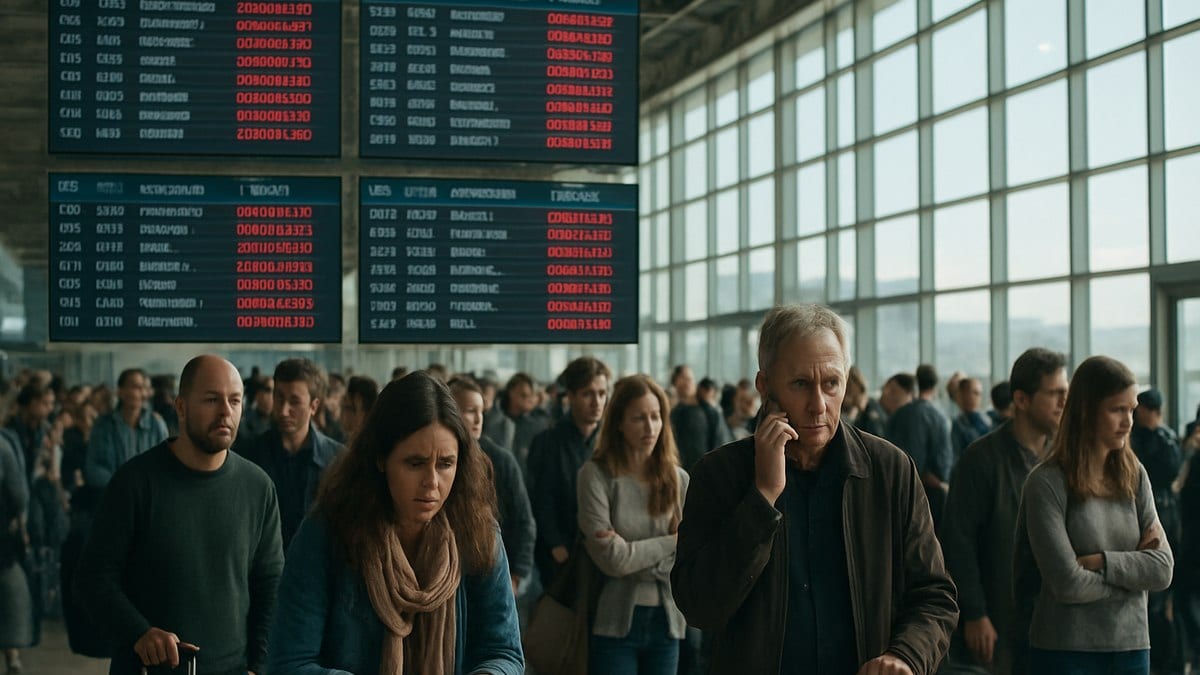
A new wave of severe flight disruptions in early 2026 is drawing fresh attention to what analysts describe as a long-building systemic crisis in global aviation, with economic losses tied to delays and cancellations now widely estimated at around 34 billion dollars a year in the United States alone and much higher worldwide.
Get the latest news straight to your inbox!
A Global Network Straining Under Repeated Shocks
Recent disruption patterns suggest that aviation’s problems are no longer isolated incidents but symptoms of a system operating at the edge of its capacity. Tracking data compiled by travel-industry analysts show that a rolling crisis in March 2026 alone affected tens of thousands of flights across the Americas, with more than 31,000 combined delays and cancellations reported across the United States, Canada, Mexico, the Caribbean and parts of South America.
Similar stresses have surfaced across Asia-Pacific. On March 11, 2026, monitoring services recorded more than 2,300 flight cancellations and over 18,000 delays worldwide, with 774 cancellations and more than 2,100 delays concentrated in Asia-Pacific. Reports indicate that a convergence of monsoon weather, typhoon activity, airspace restrictions linked to Middle East tensions and aircraft rotation failures overwhelmed network resilience from Tokyo to Dubai.
These regional flashpoints sit on top of a worldwide pattern of volatility dating back several years, from large-scale airspace closures to IT outages and localized staffing crises. Industry research covering the period from 2019 to 2023 describes an “extraordinary wave” of disruption during the COVID-19 shock and recovery, followed by a reset in which flight volumes have largely returned but resilience has not fully recovered.
Large individual events have further exposed systemic weak spots. In July 2024, a major U.S. carrier saw more than 7,000 flights canceled over five days after a global IT incident knocked systems offline, leaving 1.3 million passengers affected and aircraft and crew stranded in the wrong locations. Earlier, national airspace closures in countries such as the Philippines and a 2023 outage in the U.S. Federal Aviation Administration’s safety-notification system highlighted how single points of failure can ripple through the global network.
The 34 Billion Dollar Problem Behind Every Delay
Behind the queues at boarding gates and the social media complaints, a substantial economic story is emerging. A body of research submitted to regulators and summarized in industry and academic papers indicates that delayed and canceled flights generated an estimated 30 to 34 billion dollars in economic impact in the United States in 2022 alone. That figure combines lost time and spending by travelers with additional costs incurred by airlines and knock-on effects in the broader economy.
Publicly available studies drawing on AirHelp data and filings to the U.S. Department of Transportation show that passengers themselves bear a large share of the burden. One recent regulatory submission cited findings that travelers lose an average of 385 dollars per significant disruption once replacement travel, food, lodging and missed work are taken into account. Multiplied across millions of affected passengers, the totals climb rapidly.
For airlines, disruption translates into higher operating costs, from extra fuel burned in holding patterns to overtime pay, aircraft repositioning and maintenance. Research cited in an International Travel & Health Insurance Journal analysis suggests that airline-side costs make up roughly one-third of the total economic impact of disruption across major markets. In Europe, additional layers of compensation in the form of passenger rights regulations add billions more in direct payouts and care obligations each year.
The environmental cost is also attracting closer scrutiny. Regulatory filings referencing AirHelp modeling estimate that disruption-related detours, go-arounds and recovery flying produced an added carbon footprint equivalent to the annual emissions of roughly 2 million passenger cars in 2022 across several key aviation markets combined. Analysts argue that these hidden climate costs further strengthen the case for structural investments aimed at reducing systemic delays.
Staffing Shortages and Aging Infrastructure Converge
Many of the most severe disruption episodes in the past two years share a common thread: chronic staffing shortages and aging infrastructure in air traffic control and airline operations. In the United States, public reports from the Federal Aviation Administration and independent analyses describe a persistent deficit of several thousand air traffic controllers relative to targeted staffing levels, the result of repeated hiring interruptions, training bottlenecks and the impact of past government shutdowns.
The 2025 U.S. federal government shutdown, which stretched for weeks, renewed attention on these gaps. Coverage by national outlets documented how controller shortages forced the FAA to reduce traffic by around 10 percent across dozens of high-volume markets and, in some cases, temporarily close towers. Subsequent FAA updates and industry reporting indicated that hiring and training had resumed, but that bringing new controllers to full proficiency would take years.
Even accelerated hiring has not eliminated short-term pain. A detailed report in a business publication in late 2025 noted that the FAA had hired roughly 2,000 controllers in a year but warned that passengers could still face extended disruption because of training lags, rising traffic volumes and ongoing modernization work on radar, communications and data systems. The report described how outages, runway construction and localized staffing walkouts had all contributed to rolling delays at major hubs.
Airlines face their own parallel challenges. In India, a scheduling crisis at IndiGo in December 2025 resulted in thousands of cancellations after the carrier struggled to adapt to new flight crew time limitations. Regulators temporarily relaxed rules and capped fares while ordering the airline to clear a backlog of refunds. Across markets, pilot, technician and cabin crew shortages, along with tighter duty-time regulations, have left carriers with less flexibility to recover when storms or technical failures knock out large parts of their schedules.
Regulation, Passenger Rights and the Risk of Future Gridlock
As disruption costs mount, policymakers are under pressure to respond, but the shape of intervention varies widely by region. In Europe, carriers continue to navigate strict compensation regimes that require payments and care for passengers in many disruption scenarios, regardless of whether airlines caused the problem. Industry groups argue that this framework concentrates financial responsibility on airlines even when failures occur in air traffic management, airports or energy and IT infrastructure.
In the United States, the policy debate is moving in a different direction, with consumer advocates calling for stronger compensation rules and clearer automatic refund mechanisms, citing the 30 to 34 billion dollar annual hit to the economy. Regulatory dockets published by the Department of Transportation show a surge in submissions from consumer groups, airlines and think tanks discussing the scale of disruption and the distribution of costs among travelers, carriers and the state.
Globally, air navigation service providers and airport operators are pressing for more stable funding to modernize equipment and expand capacity. Analyses published by European air traffic management organizations emphasize the need to balance cost-efficiency targets with the investments required for new digital systems and additional controller staffing. Without this, they warn, capacity shortfalls and legacy technology failures could become more frequent as traffic grows.
Travel-industry research suggests that peak travel periods are functioning as informal stress tests for the system. Spring break and Easter traffic in March 2026, for instance, coincided with severe North American storms and staffing gaps, exposing limited redundancy on complex international networks. With summer 2026 forecast to bring further growth in passenger numbers, analysts caution that, without accelerated reforms, the industry could face repeated cycles of gridlock that extend the economic toll well beyond the current 34 billion dollar benchmark.
A Race Between Demand Growth and Systemic Reform
Forecasts from aviation authorities and industry bodies consistently project robust long-term growth in air travel. FAA planning documents envision U.S. system passenger numbers rising steadily through the 2030s and 2040s, while global industry associations anticipate that worldwide passenger volumes will surpass pre-pandemic highs and continue to climb as middle classes expand in Asia, Africa and Latin America.
That growth trajectory raises a central question for 2026 and beyond: whether modernization and resilience measures can keep pace. Data from oversight agencies and inspector general reports note that key components of the United States’ NextGen air traffic modernization effort have taken far longer and cost far more than initially anticipated, with only a fraction of projected benefits realized so far. Comparable upgrade programs in other regions are also grappling with funding constraints and competing political priorities.
Industry analysts argue that the current disruption patterns effectively represent an early warning system. The combination of multi-day IT failures, regional weather events that cascade globally, labor shortages across multiple safety-critical roles and mounting economic and environmental costs suggests that what appears to passengers as day-to-day inconvenience may, in fact, be evidence of a structural capacity gap.
For now, travelers, airlines and regulators are navigating a fragile equilibrium. Demand for flying remains resilient, supported by business travel recovery and strong leisure demand, but each new disruption episode adds pressure for change. Whether the sector can transform a 34 billion dollar annual liability into a catalyst for coordinated investment and reform will help determine how turbulent the coming decade of global air travel will be.