


More news on this day
Passengers traveling through Queen Alia International Airport in Amman on Tuesday faced significant disruption, with publicly available airport data and industry monitoring showing 21 delayed flights and two cancellations affecting regional and long haul services operated by Royal Jordanian, flydubai, Turkish Airlines, Qatar Airways, Emirates and other carriers.
Get the latest news straight to your inbox!
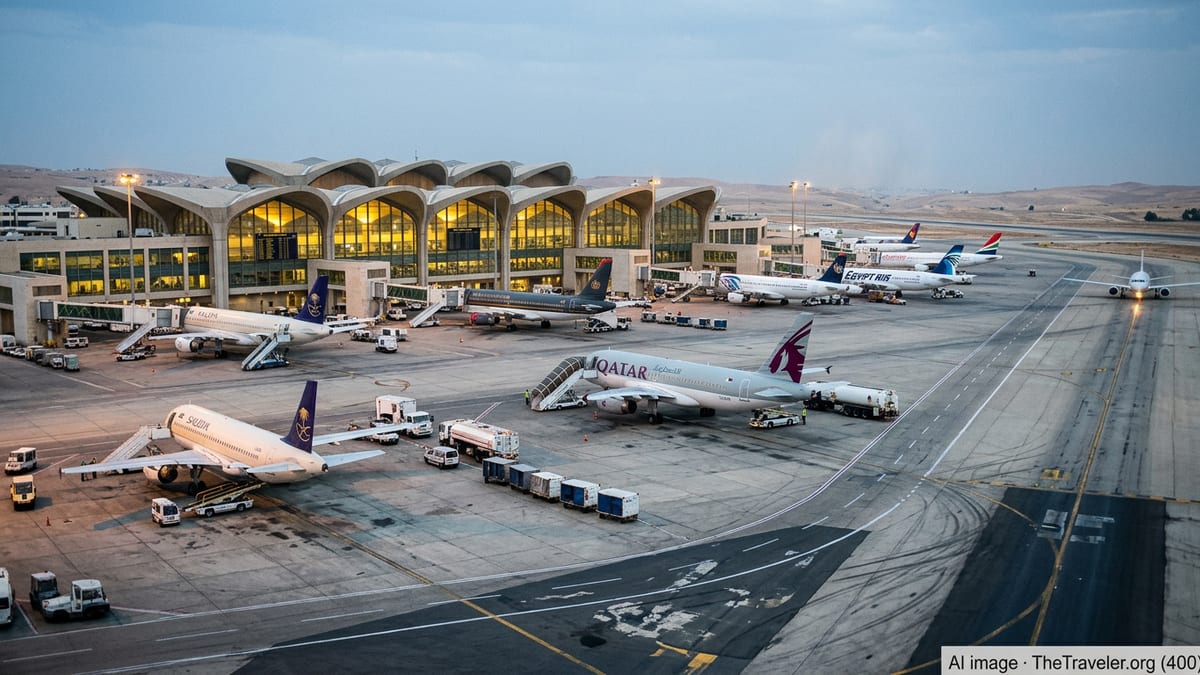
Busy Regional Hub Sees Morning and Evening Peaks Affected
Queen Alia International Airport serves as Jordan’s primary gateway and an important connection point between Europe, the Gulf and wider Asia. On the day of disruption, delays were recorded across both arrivals and departures, with impacts clustering around the busy morning bank of regional flights and the evening wave of services to major hubs such as Dubai, Doha and Istanbul.
According to tracking platforms and the airport’s live departures board, Royal Jordanian flights on core routes, including services linking Amman with Gulf cities and key European destinations, showed revised departure and arrival times, in some cases pushing flights back by more than half an hour. Other affected operations included codeshare services marketed by foreign airlines but operated by Royal Jordanian from its Amman base.
The disruption did not appear to be limited to a single airline. Flydubai and Emirates flights connecting Amman with Dubai, as well as Turkish Airlines and Qatar Airways services on Amman–Istanbul and Amman–Doha routes, were among those listed with revised timings or status changes. While only two flights were fully canceled, the concentration of delays contributed to crowded departure areas and heightened pressure on airline customer service channels.
Queen Alia’s role as a transfer point for passengers traveling between Europe and the Gulf meant that even modest schedule changes created a knock-on effect for those with onward connections, prompting some travelers to seek rebooking options or extended layovers in Amman.
Possible Links to Wider Regional Airspace and Capacity Strain
The issues at Amman have emerged against a backdrop of continued operational strain across several Middle Eastern hubs. Airlines serving Queen Alia rely heavily on routings through busy regional airspace, and recent months have seen elevated levels of disruption across Gulf and Levant corridors, as reflected in repeated schedule adjustments and temporary capacity reductions reported by multiple carriers.
Analysts note that even when airports themselves remain fully open, knock-on effects from congestion, shifting routings and schedule reshuffles at partner hubs can cascade across airline networks. Flights between Amman and Dubai, Doha and Istanbul are deeply integrated into larger global schedules, particularly for airlines like Emirates, flydubai, Qatar Airways and Turkish Airlines, which funnel connecting traffic to Europe, Asia, Africa and the Americas.
Publicly available on-time performance data for some Royal Jordanian services between Amman and major Gulf hubs already indicated average delays in recent months measured in tens of minutes. The latest spike in delayed departures and arrivals at Queen Alia is consistent with this pattern of incremental timetable pressure, rather than a single, isolated outage.
Observers also point to aircraft and crew utilization models that leave limited room for recovery when rotations are disrupted early in the day. When morning flights depart late from Amman or arrive behind schedule from other regional airports, airlines often spend the rest of the operating day attempting to absorb those delays, which can amplify the impact on evening waves.
Impact on Travellers: Missed Connections and Longer Layovers
For passengers, the operational nuances translated into long queues, uncertainty at departure gates and a scramble for updated information. With 21 flights delayed, many travelers reported having to revise connection plans through major hubs such as Dubai International Airport, Hamad International Airport in Doha and Istanbul’s main international airport.
Travelers heading onward to Europe, North America and East Asia via these hubs faced particular challenges. Longer-than-expected ground times in Amman, combined with tight connecting windows on onward flights, increased the risk of missed onward sectors, even when airlines opted to hold some connections or reassign passengers to later departures.
Families beginning holidays and business travelers working to firm schedules appeared especially vulnerable to the cumulative effect of delays. Extended layovers, late-night arrivals and short-notice hotel stays became more likely as airlines worked within limited spare capacity to rebook affected customers.
Public guidance circulating through travel advisories and aviation forums encouraged passengers using Queen Alia to build additional time into itineraries, monitor their flight status frequently on airline apps, and consider flexible ticket options that make last-minute changes or rerouting less costly.
Airlines Emphasize Continuity While Adjusting Schedules
Despite the day’s disruption, the pattern of 21 delayed flights versus only two cancellations suggests that airlines at Queen Alia largely prioritized maintaining operations, even if on a revised timetable. Industry observers view this as indicative of an emphasis on network continuity in a region where demand remains strong and available seats are at a premium on many routes.
Royal Jordanian, as the home carrier and primary user of Queen Alia, has continued to run a dense schedule of regional flights linking Amman with key Gulf and Levant destinations, supported by partnerships and codeshares with global airlines. Flydubai, Emirates, Turkish Airlines and Qatar Airways likewise continue to position Amman as an important spoke in their broader networks, frequently sharing capacity with partner carriers on select routes.
Publicly accessible schedule updates show that, where cancellations have occurred, airlines have generally attempted to consolidate passengers onto later flights or alternative routings rather than withdraw capacity entirely for extended periods. However, rebooking opportunities can still be limited on peak travel days when load factors approach capacity.
Operational updates from tour operators and travel management companies highlight ongoing, incremental timetable adjustments across the region, underlining the need for passengers to check their reservations repeatedly in the days and hours leading up to departure rather than relying solely on original booking confirmations.
What Passengers Traveling Through Amman Should Do Next
Travel experts recommend that passengers with upcoming itineraries through Queen Alia International Airport take several practical steps in light of the latest disruptions. First, travelers are advised to review their ticket conditions and ensure they have access to airline booking management tools that allow seat changes, date shifts or re-routing where permitted.
Given the pattern of delays on key regional routes, many advisers suggest allowing longer minimum connection times when planning journeys that involve transfers at busy hubs such as Dubai, Doha and Istanbul. This can reduce the risk of misconnecting if the initial Amman departure is held on the ground.
Passengers are also encouraged to arrive at Queen Alia earlier than usual, particularly during peak travel periods, to account for possible congestion at check-in, security and immigration, which can further compress boarding timelines when flights are operating close to schedule. Keeping contact details updated in airline profiles can help ensure travelers receive real-time notifications about any last-minute timing changes.
With summer travel demand building and airlines across the region navigating persistent operational headwinds, the situation at Queen Alia International Airport illustrates how even a limited number of cancellations coupled with a cluster of delays can reverberate widely across passenger journeys. For now, those planning to fly to or from Amman are being urged to remain flexible, stay informed and treat schedules as subject to change rather than fixed commitments.