


On paper, Frankfurt Airport looks like the kind of mega-hub that eats nervous travelers alive. Three main terminals, a web of concourses labeled A through Z, a people mover, multiple train stations, and the new EU Entry/Exit System for non-Europeans all merge into one sprawling complex. Before I flew through Frankfurt for the first time, I was convinced I would get lost somewhere between passport control and my gate. The reality on the ground turned out to be very different: once you understand how Frankfurt is laid out and how its transfer systems actually work, the airport becomes far more logical than its reputation suggests.
Get the latest updates straight to your inbox!
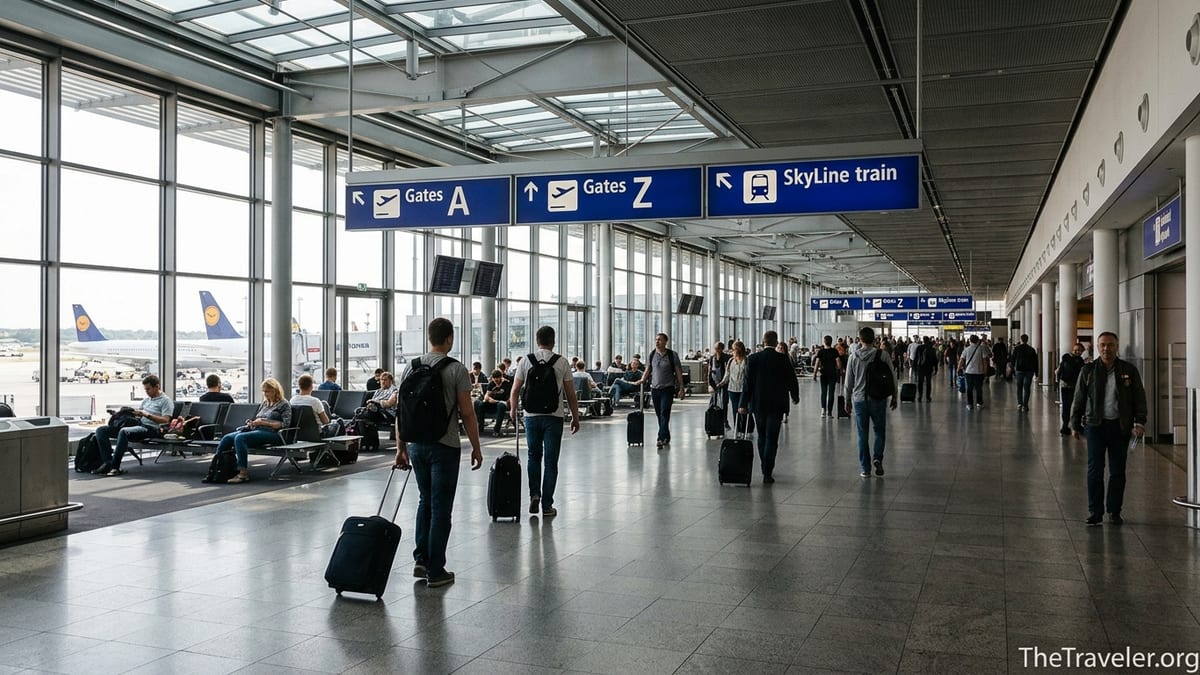
The Reputation vs. The Reality
Frankfurt Airport has a reputation online that ranges from “mildly confusing” to “utter nightmare.” Search threads on travel forums and you will find plenty of stories about tight connections, long passport control lines, and travelers zigzagging from A to Z gates, convinced they will miss their flights. It is easy to see why: Frankfurt handled more than 59 million passengers in 2023 and continues to grow. Its role as a key Lufthansa and Star Alliance hub also means a high proportion of transit passengers with complex routings, often mixing Schengen and non-Schengen flights, which adds procedural steps like border checks and occasional re-screening.
Yet when you look more closely at how the airport is designed, the chaos begins to resolve itself. Terminal 1 is the main Lufthansa and Star Alliance terminal, with concourses A and Z for Schengen and non-Schengen flights on one long pier, and concourses B and C on another. Terminal 2 serves many non-Star Alliance carriers. Terminal 3, the newest, primarily handles additional long-haul operations and is integrated into the same system via a dedicated people mover. What feels labyrinthine on a static map becomes a series of clear paths once you follow the overhead signs and understand which checks you will, and will not, need to clear on a specific connection.
On my first transit through Frankfurt, I had a 1 hour 45 minute connection from a United Airlines flight from Chicago into Terminal 1 to a Lufthansa flight to Athens. I had read horror stories of people “barely making it” with two hours. In practice, I stepped off the aircraft, followed purple “Transfer / Connecting flights” signs, cleared the new biometric entry check, and walked to my A-gate in about 35 minutes at a normal pace. It was not a shortcut or lucky fluke; it was the result of the airport’s transfers being more structured than many travelers expect.
Decoding the Layout: Terminals, Concourses, and Letters
The biggest mental hurdle with Frankfurt is the alphabet soup of letters: A, B, C, D, E, Z. The key to staying oriented is to think in terms of zones rather than a perfect grid. Terminal 1 is split into two major piers. One pier houses concourses A and Z stacked vertically, handling Schengen (A) and non-Schengen (Z) flights. The other pier houses B and C, primarily non-Schengen. Terminal 2 contains concourses D and E. Terminal 3, opened on the south side of the airfield, has its own concourses but is joined to the rest of the airport by the SkyLine people mover.
Those letters matter because they dictate which checks you will face. A-to-A is typically Schengen-to-Schengen, so you may avoid passport control entirely on a pure intra-EU connection. A-to-Z involves leaving the Schengen area, so you will pass outbound border control but may not be re-screened by security if your arriving flight already met EU screening standards. B or C to Z can be same-zone non-Schengen to non-Schengen, with no border check at all. Many travelers arrive in Frankfurt expecting to go through full immigration and security on every connection, but the airport is designed precisely to avoid that where regulations allow.
Frankfurt displays this logic visually. Overhead signs are color-coded and bilingual in German and English, with clear arrows and distance indicators. It is common to see a sign that says “Gate Z50–Z69: 12 min” with a walking figure. During my most recent transit, connecting from an A-gate to a distant Z-gate, the posted walking time matched reality closely. Even with a brief stop to refill a water bottle and glance at the terminal map, I reached my gate about five minutes faster than the sign suggested. The visual cues do a lot of the mental work for you, reducing the need to “know” the layout in advance.
The SkyLine People Mover: Your Shortcut Between Worlds
Much of Frankfurt’s perceived complexity comes from the idea of switching terminals. On older maps this looked like a trek across roadways and parking lots. In practice, the free SkyLine people mover connects Terminals 1, 2, and 3 in a matter of minutes. The system, originally opened in the 1990s and expanded with the new Terminal 3, runs elevated above the terminal complex. Trains run every few minutes from early morning to late evening, and a shuttle bus fills the overnight gap. The new SkyLine routing links the long-distance and regional train stations at Terminal 1 directly to Terminals 2 and 3, essentially turning the whole airport into one integrated unit rather than three separate islands.
On a recent evening arrival from Madrid, I tested just how much of a hassle a terminal change would be by timing a hypothetical transfer from Terminal 1 to Terminal 3. After following “SkyLine / Terminals 2–3” signs for less than five minutes, I reached the glass-walled platform above the check-in halls. Within two minutes a train slid in. The ride to the Terminal 3 station took roughly eight minutes, passing above the terminal roofs and the Autobahn. Doors opened directly into the departures area used for long-haul flights. From a traveler’s perspective, it felt more like stepping between concourses than switching terminals.
For passengers arriving by rail, the people mover integration is particularly helpful. A traveler coming from Cologne on a Deutsche Bahn ICE train can arrive in the long-distance station under Terminal 1, ride escalators up to the SkyLine station, and be on the way to a terminal 3 departure within a matter of minutes. It is easy to imagine this going wrong when you see the airport’s footprint on a planning map, but in reality the transition is linear and well signposted, with almost no ambiguity about where to go next.
How Tight Is Too Tight? Connection Times in Practice
Frankfurt’s role as a major hub means that airlines schedule what can seem like aggressive connection times. Official minimum connection times vary depending on the combination of flights. Industry data in 2026 suggests that intra-Schengen to intra-Schengen itineraries at Frankfurt can have minimum published connection times of around 30 minutes, while Schengen-to-non-Schengen pairings often sit at around 60 minutes. When you add in more complex routings such as non-Schengen to Schengen or two non-Schengen flights requiring security and immigration checks, realistic minimums creep toward 90 minutes or more.
In real-world terms, this means a 1 hour 20 minute connection might be entirely feasible if you are flying from a Schengen country like Spain into a Schengen connection to Italy, all within Terminal 1 A-gates. In contrast, the same 1 hour 20 minute connection could feel extremely tight if you are arriving from the United States into a Z-gate, need to clear the new biometric entry procedures for the Schengen area, and then connect onward to a Schengen domestic flight. Travelers have reported that while a 70 to 90 minute connection has worked for them in non-Schengen to non-Schengen pairings within the same concourse, they would personally choose closer to two hours when a full border crossing is involved.
My own rule of thumb after several transits through Frankfurt is simple. If a connection involves entering the Schengen zone for the first time on that trip, I aim for at least two hours, ideally closer to three in peak summer or holiday periods. When my flights keep me within the non-Schengen side of Terminal 1, and both flights are on Lufthansa or another Star Alliance carrier, I am comfortable booking a 75 to 90 minute connection. That window has consistently allowed me time to walk between far-flung gates, even when my inbound flight arrived 20 minutes behind schedule.
EU Entry/Exit System and Passport Control: The New Wild Card
The biggest recent change for many travelers connecting through Frankfurt is the rollout of the EU Entry/Exit System for non-EU nationals. The system captures biometric data such as fingerprints and facial images for travelers entering the Schengen area. At Frankfurt this has translated into new automated kiosks and, at times, longer and more unpredictable queues at passport control. Reports from summer 2025 and early 2026 describe non-EU queues backing up for close to an hour during peak morning and evening banks when several long-haul flights land at once.
On my last transit from New York to Frankfurt, I arrived expecting the worst. Instead, I found a structured two-step process. First, non-EU travelers were directed to automated EES kiosks, where fingerprints and facial data were captured and passports scanned. This took roughly three minutes. Then we joined a secondary line where border officers conducted brief checks and stamped passports. Door to door, the process took about 25 minutes early on a weekday morning. It was longer than pre-EES days but nowhere near the horror stories I had read in advance. The key difference seemed to be time of day and staffing levels.
What matters for planning is that EES has added variability. A traveler landing from Chicago at 6 a.m. in Terminal 1 may breeze through biometric checks in under 30 minutes one day and wait 50 minutes on another if a bank of Asia and U.S. flights lands simultaneously. This uncertainty is why so many frequent flyers now recommend allowing extra buffer time when Frankfurt is your first point of Schengen entry. Crucially, if you are connecting from a non-Schengen country to another non-Schengen destination and remain in the non-Schengen departure area, you normally do not go through EES at all on that connection, which makes some routings much smoother than others.
On-the-Ground Wayfinding: Why It Feels Easier Than the Map
The first thing I noticed when I actually walked Frankfurt’s corridors was how consistent and repetitive the signage is. Every major decision point has the same blue-and-white icons: planes for gates, train symbols for the railway stations, suitcase icons for baggage claim, passport silhouettes for border control. English appears alongside German on virtually all operational signs. Rough walking times help reduce anxiety. When a sign tells you “Gate B48–B69: 10 min,” it transforms what might look like an endless hallway into a concrete, manageable stroll.
The second factor is the staff presence. Frankfurt is not an airport where you wander for 20 minutes without seeing a uniform. On my first connection, I reached a confusing fork between transfer security and a corridor marked for “Exit / Baggage claim.” A transfer assistant in a bright vest stood precisely at that intersection, asking passengers whether they had checked bags and where they were flying onward. Within 10 seconds he had pointed me down the right corridor toward a passport control area I had nearly missed. Those small human touchpoints counterbalance the intimidating scale of the building.
A third, underrated element is the availability of real-time information. Frankfurt publishes live security and passport control wait times via its own channels, and large monitors in the terminal show estimated waits at different checkpoints. During one connection from a Schengen inbound to a non-Schengen outbound, screens near the main corridor flagged a 20 minute wait at one passport control zone and a 5 minute wait at another a short walk away. Following the signage to the lighter queue saved me at least 15 minutes and provided that most precious commodity on a layover: breathing room.
Making Long Layovers Work For You
If your connection time in Frankfurt stretches beyond three or four hours, the airport shifts from something to be managed into a base you can actually enjoy. Terminal 1 offers a wide range of cafés, bakeries, and restaurants, from grab-and-go pretzels and coffee to sit-down meals and German beer. Prices vary, but you can expect to pay in the region of 3 to 4 euros for a filter coffee or soft drink at a landside café, around 5 to 7 euros for a sandwich or salad, and from 12 to 20 euros for a hot meal in a mid-range restaurant inside the terminal. Many outlets accept contactless card payments, which simplifies life for travelers passing through without local currency.
Frequent flyers on Lufthansa and Star Alliance carriers particularly value the lounge network in Terminal 1. Lufthansa’s Senator and Business lounges in the A and Z concourses offer quiet spaces, showers, and a rotating buffet of hot and cold items. On an extended layover, a quick shower between long-haul flights can do as much for your comfort as an extra hour of sleep. Even if you do not have status or a premium ticket, pay-per-use lounges in both Terminals 1 and 2 allow access for a fixed fee. Travelers report entry prices that typically sit around several dozen euros, which buys you several hours of food, drinks, Wi-Fi, and seating away from the main concourse.
For those with truly long daytime layovers and the proper visas, Frankfurt’s integrated rail links open up the city itself. Regional trains from the station under Terminal 1 reach Frankfurt Hauptbahnhof, the city’s main station, in roughly 15 minutes. From there you can walk to the riverfront, explore the Altstadt, or simply sit at a café and reset your body clock before returning for your onward flight. While this type of excursion is best suited to layovers of at least six hours gate to gate, it demonstrates how the airport’s complexity actually translates into connectivity rather than obstacle.
The Takeaway
Frankfurt Airport’s intimidating reputation comes from maps, message boards, and the very real stress of tight connections combined with new border controls. On a schematic diagram, the complex of Terminals 1, 2, and 3, doubled letters, and overlapping flows looks like a puzzle designed to trip people up. In practice, once you are walking its corridors, Frankfurt behaves more like a well-signposted railway station with some very long platforms. The SkyLine people mover, clearly defined Schengen and non-Schengen zones, and an abundance of staff and signage do most of the heavy lifting for you.
That does not mean every connection is easy. The new EU Entry/Exit biometric system can add unpredictable time to the first Schengen entry on a journey, and short connections that look legal on paper may be stressful if your inbound flight runs late. Yet the airport gives travelers more tools than most hubs to make good choices: live wait time displays, time-stamped gate signage, and route options like the SkyLine that shrink the apparent distances. With a realistic buffer and a basic understanding of how its terminals fit together, Frankfurt is far less confusing than it appears at first glance.
My own nervousness before that first Frankfurt transit turned out to be misplaced. I stepped off my long-haul aircraft expecting a maze and found, instead, a clear set of corridors, frequent signs, and staff who seemed used to reassuring anxious passengers. By the time I reached my connecting gate, I understood why so many frequent flyers grumble about Frankfurt online yet continue to route their trips through it: underneath the stories, the system works. If you know what to expect, you may find, as I did, that Frankfurt is not the enemy of your itinerary but one of its most dependable allies.
FAQ
Q1: How much connection time do I really need at Frankfurt Airport?
For simple Schengen-to-Schengen connections in the same concourse, around 60 to 75 minutes can be workable. For connections that involve entering the Schengen area from a non-Schengen flight, especially with the new biometric checks, aiming for 2 hours or more provides a safer buffer.
Q2: Will I always have to go through security again when connecting at Frankfurt?
Not always. If you arrive from a country whose security standards the EU recognizes as equivalent and remain in the same secure zone, you may avoid re-screening. However, changing terminals, switching between Schengen and non-Schengen areas, or arriving from certain regions can trigger another security check.
Q3: Is the SkyLine people mover free and easy to use?
Yes. The SkyLine is a free automated train that links Terminals 1, 2, and 3, as well as the area near the train stations at Terminal 1. Trains run every few minutes during operating hours, and signage to the platforms is clear from the main concourses.
Q4: How bad are passport control lines with the EU Entry/Exit System?
Wait times vary widely. At quieter times, non-EU travelers may clear the biometric kiosks and border check in 20 to 30 minutes. During busy banks of long-haul arrivals, queues can stretch toward an hour. This variability is why a generous buffer is recommended for first Schengen entry connections.
Q5: Can I leave the airport on a long layover in Frankfurt?
Yes, provided you meet visa requirements for entering Germany. From Terminal 1’s regional train station, you can reach central Frankfurt in roughly 15 minutes, which makes a quick visit to the city center feasible on layovers of six hours or more.
Q6: What happens if I miss my connection at Frankfurt?
If your flights are on a single ticket and you meet the airline’s minimum connection time, the operating carrier is generally responsible for rebooking you on the next available flight. Go directly to your airline’s transfer desk or customer service counter inside the secure area for assistance.
Q7: Are signs and announcements in English at Frankfurt Airport?
Yes. Operational signage is consistently bilingual in German and English, and most flight announcements are made in both languages. Many staff members also speak English, particularly at information counters and transfer points.
Q8: Is Frankfurt Airport suitable for travelers with reduced mobility?
Frankfurt provides elevators, ramps, and accessible restrooms throughout the terminals, and airlines can arrange wheelchair assistance between gates. Because walking distances can be long, requesting assistance in advance is wise if you have limited mobility or are concerned about tight connections.
Q9: How expensive is food and drink during a layover at Frankfurt?
Prices are comparable to other major European hubs. Expect to pay roughly the equivalent of a few euros for a coffee or soft drink, more for sandwiches and hot meals, and higher prices in sit-down restaurants and bars inside the secure areas.
Q10: Is Frankfurt really more confusing than other large hubs?
Perception plays a big role. Frankfurt’s map looks complex, but the combination of clear signage, the SkyLine train, and multiple staff checkpoints makes it more manageable than many travelers expect. For most people, once they have navigated it once, it feels no more confusing than other large hub airports.