


More news on this day
France has moved into line with Spain and Poland in calling for greater flexibility over Europe’s new biometric Entry/Exit System at external borders, as aviation groups warn that summer holidaymakers could face multi-hour queues and missed flights unless checks are eased during the peak season.
Get the latest news straight to your inbox!
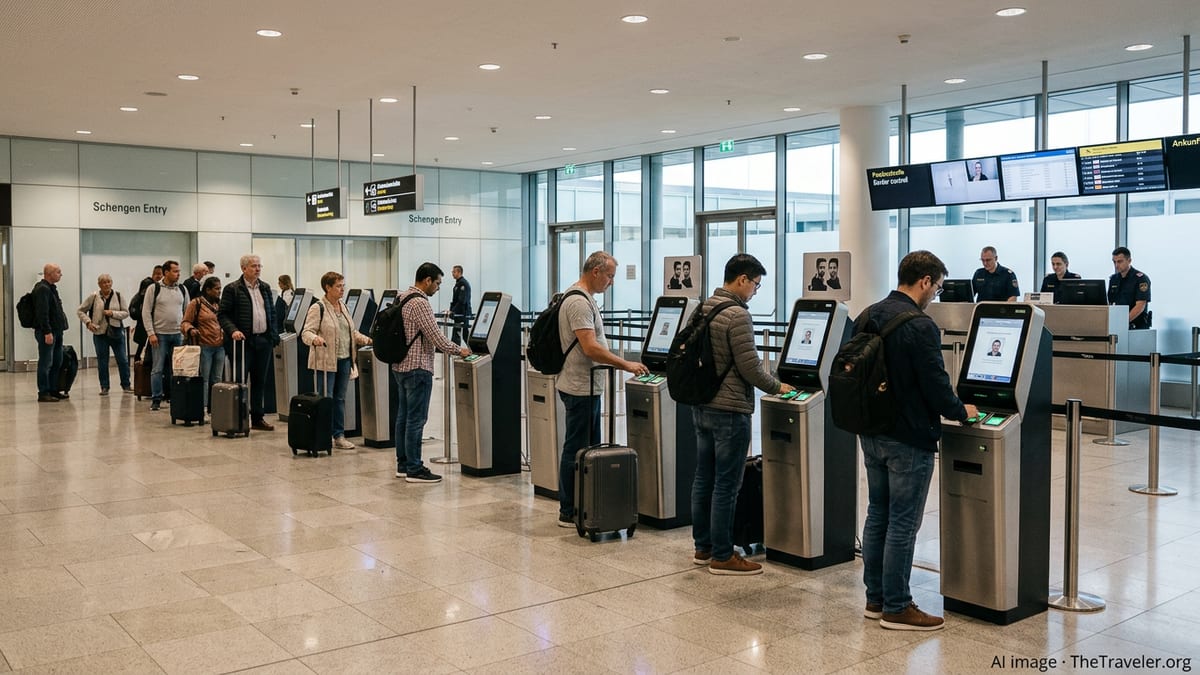
What The New Biometric Border System Actually Does
The European Union’s Entry/Exit System, known as EES, is a digital border database designed to record when non-EU nationals enter and leave the Schengen area. Instead of stamping passports, border officials capture fingerprints, facial images and basic travel details, storing them for several years in a central system intended to track overstays and combat identity fraud.
According to publicly available EU documentation, the system began operating in phases from October 2025, with member states gradually increasing the share of travellers processed through biometric kiosks before full functionality was reached in April 2026. The goal is to automate much of the border-control process and, over time, reduce manual checks at passport booths.
For travellers, especially those from visa-exempt countries such as the United Kingdom, the United States and Canada, the most visible change is an initial registration at the first Schengen entry point after the rollout date. That first encounter can take several minutes per person while fingerprints and a facial scan are captured. On later trips, the process is supposed to be faster, with biometric verification replacing full re-enrolment.
European institutions promote EES as a way to speed up border crossings in the long term. However, the early months of operation have highlighted a significant gap between the system’s theoretical benefits and the realities of airports and ferry ports already running close to capacity at peak times.
France Aligns With Spain And Poland On Summer Flexibility
France, Spain and Poland are now among the countries pushing hardest for the ability to scale back or temporarily suspend full EES processing at pressure points during the northern summer. Reports from industry-focused outlets indicate that these governments are increasingly concerned about long queues at popular holiday gateways, including Paris, Madrid, Barcelona, Málaga, Alicante, Tenerife South, Kraków and Warsaw.
Aviation coverage this spring showed Spain lobbying in Brussels for a delay in the full rollout to avoid bottlenecks at major tourist airports, while Polish officials highlighted the strain on land border crossings used by workers and holidaymakers alike. France has taken a similar line, with Paris-region airport operators warning that summer traffic volumes, combined with the slower biometric checks, could push wait times beyond levels considered acceptable for international hubs.
Under the phased approach agreed at EU level, member states have been allowed to operate the system at reduced capacity and to request permission for partial suspensions at specific locations. Recent reporting by specialist border-technology publications notes that this flexibility period can run for up to 90 days, with an option for a further 60 days that is explicitly aimed at covering the busiest holiday weeks.
By aligning with Spain and Poland on the need to use that flexibility to the fullest this summer, France is sending a signal to both Brussels and the travel industry that avoiding spectacular queues is now a political as well as an operational priority.
Evidence Of Early Strain At Airports And Ports
In the months since EES moved from limited trials to broader use, passenger accounts and industry briefings have described a patchy picture across Europe. Some airports with extensive self-service infrastructure have reported only modest increases in processing times. Others, particularly where space is tight and staffing constrained, have seen queues stretching for hours.
Travel coverage in European media has highlighted cases in Italy, Portugal and Spain where non-EU arrivals waited two to four hours at passport control after the biometric checks were introduced. Reader reports compiled by newspapers describe missed flights, abandoned connections and aircraft departing with empty seats because passengers were still stuck at border-control lines even after clearing security and check-in.
Trade groups representing airports and airlines have issued several joint statements since late spring, warning that the combination of EES enrolment and record passenger numbers is already creating what they describe as systemic stress at some border posts. In one recent assessment cited by airport organisations, processing times at certain Schengen external borders were estimated to have increased by up to 70 percent during busy periods compared with pre-EES conditions.
While not every gateway is experiencing severe disruption, the uneven rollout has complicated network planning. Airlines have begun adjusting schedules, allowing more ground time at high-risk airports and recommending that travellers build additional buffers into their itineraries in case of EES-related hold-ups.
What Summer Holidaymakers Should Expect In 2026
For travellers heading to France, Spain, Poland or other Schengen countries this summer, the most important practical point is that experiences may differ sharply by airport, time of day and nationality. Non-EU visitors who have not yet been enrolled in EES should plan for a longer first encounter with border control, especially if arriving at a major holiday airport during weekend peaks.
Published guidance from airlines and airports generally recommends arriving earlier than usual for departures to or from the Schengen area, with some carriers advising non-EU passengers to budget up to three hours for airport formalities where EES is in active use. Travel insurers quoted in recent consumer reporting have cautioned that policies may not cover missed flights caused by border-control queues, treating them similarly to immigration delays rather than airline disruption.
At the same time, the push by France, Spain and Poland for the option to ease biometric processing during crunch periods means that not every journey will involve a full EES experience. Where national authorities invoke the allowed flexibility, border officers may rely more heavily on traditional passport checks and manual stamping, at least temporarily. That can reduce the time per passenger, though it also means progress toward full automation slows.
Travellers making connections within Europe should pay particular attention to minimum transfer times when moving from a non-Schengen to a Schengen flight. Industry analyses suggest that the riskiest scenarios involve tight connections where all inbound passengers must clear EES enrolment before re-boarding, something that is more likely at smaller airports with fewer staffed booths.
How Longer-Term Changes Could Reshape Border Control
Despite the current turbulence, European policymakers continue to frame EES as part of a broader digital transformation of the external border. Alongside the biometric database, work is advancing on the European Travel Information and Authorisation System, or ETIAS, a pre-travel authorisation that will eventually apply to most visa-exempt visitors to the Schengen zone.
According to EU legislative timetables, ETIAS is expected to follow EES, with a soft launch currently envisaged from late 2026. Together, the two systems would bring the European model closer to those used in countries such as the United States, where advance authorisation and biometric checks are already standard for many international arrivals.
For now, however, the immediate concern for France, Spain, Poland and their European partners is managing the 2026 summer peak without a repeat of the most disruptive scenes seen at some borders earlier in the year. Industry bodies are urging the European Commission to keep open the possibility of further adjustments if queues worsen, while travel advocates argue that clearer public information is needed so passengers know what to expect before they reach the airport.
How effectively governments and operators use the available flexibilities over the next two months will shape perceptions of EES among millions of holidaymakers. For travellers planning trips to Europe, the safest assumption is that border checks may take longer than before and that careful timing, generous connection windows and realistic expectations will be essential parts of any summer itinerary.