

More news on this day
Hundreds of passengers were left stranded at Frankfurt International Airport on Wednesday after 93 flights were delayed and 15 canceled, snarling operations for Lufthansa, Emirates, Qatar Airways and other major carriers on routes linking Frankfurt with Dubai, Munich and wider global networks.
Severe Disruptions Hit Germany’s Busiest Hub
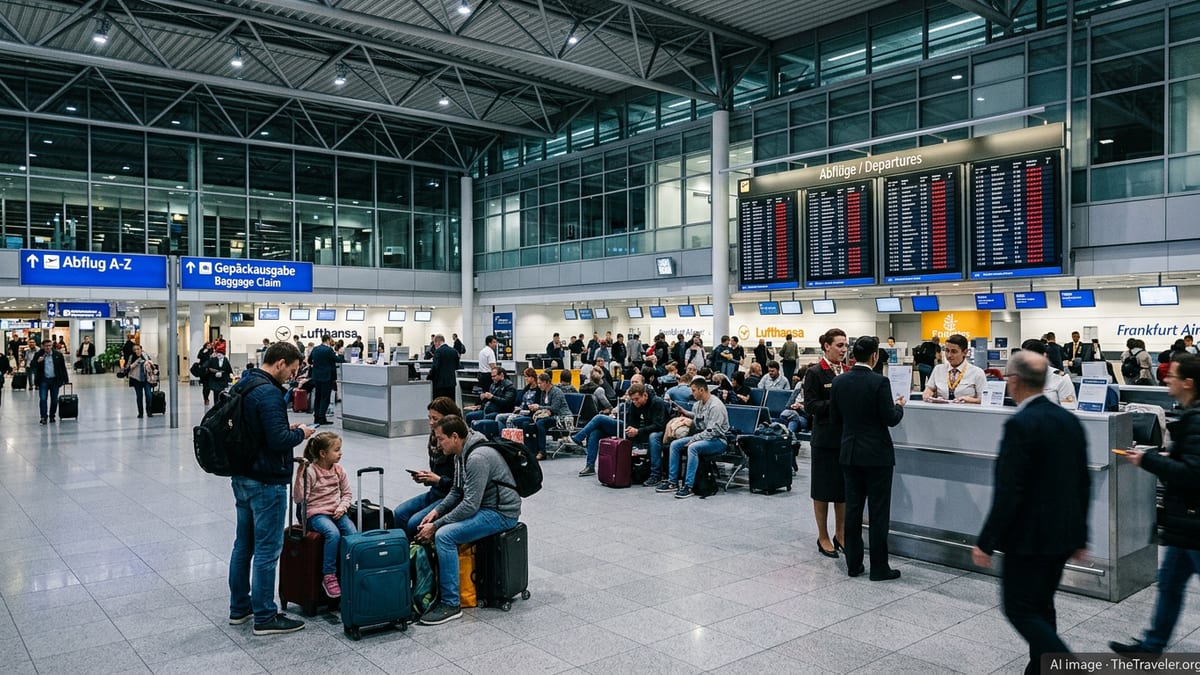
The disruption unfolded at Frankfurt International Airport, Germany’s largest aviation hub and a key gateway for intercontinental traffic. Long queues formed at departure halls as departure boards filled with red delay and cancellation notices, affecting both short haul and long haul traffic. Ground staff struggled to rebook passengers amid ongoing operational constraints linked to the wider airspace shutdown over the Middle East.
Airport officials reported that a total of 93 flights experienced significant delays while 15 services were canceled outright, forcing some travelers to sleep in terminal seating areas or nearby hotels. The figures add to an already bruising week for German aviation, with earlier days marked by rolling disruptions across Frankfurt, Munich, Berlin and Düsseldorf as airlines adapted to rerouted flight paths and reduced capacity.
Lufthansa, which operates a major hub at Frankfurt, was among the most affected. Delays rippled through its European and intercontinental network as aircraft and crews were displaced from their usual rotations. Smaller partner carriers, including regional operators feeding into Frankfurt, also reported knock-on delays as aircraft waited for available slots and connecting passengers.
Airport staff emphasized that safety remained the overriding priority as they worked within restrictions shaped by the Middle East airspace crisis. With traffic flows altered across Europe, even flights not directly serving the region felt the impact, further complicating efforts to return to normal timetables.
Gulf Carriers Bear Brunt of Cancellations
Gulf airlines including Emirates and Qatar Airways accounted for a large share of full flight cancellations at Frankfurt, reflecting the ongoing closure or heavy restriction of key airspace corridors in the Middle East. Several departures to Dubai and Doha were pulled from the schedule at short notice, leaving passengers bound for Asia, Africa and Australasia suddenly without viable onward connections.
Some Emirates services that had been scheduled between Dubai and German cities, including Frankfurt and Munich, were again unable to operate as authorities in the Gulf limited outbound traffic and prioritized evacuation and recovery flights. Passengers arriving in Germany on special or diverted flights often found that their onward connections within Europe were also delayed, compounding the sense of uncertainty.
Qatar Airways passengers reported short notice messages about cancellations or rerouted services, with flights between Frankfurt and Doha among those affected. Many of these travelers were transit passengers aiming to connect to long haul routes to Bangkok, Singapore, Sydney and other major destinations, highlighting how localized disruptions can quickly cascade through global networks.
Other international airlines serving Frankfurt, including carriers from the wider Middle East and Asia, also trimmed schedules or rerouted operations. Industry analysts noted that hub-and-spoke systems are particularly vulnerable when a single region’s airspace is constrained, because aircraft and crews cannot easily be repositioned without disrupting multiple onward sectors.
Ripple Effects Felt in Dubai and Munich
The disruption at Frankfurt was mirrored by continued turbulence at Dubai International Airport, one of the world’s busiest intercontinental hubs. After an initial period in which Dubai suspended most normal operations, only a limited number of arrivals and departures have been permitted, with priority often given to repatriation flights and essential services. This has sharply reduced the number of Emirates aircraft able to feed European gateways such as Frankfurt and Munich.
Passengers who did manage to leave Germany for Dubai in recent days frequently found themselves in congested terminals with scarce onward options. Travel forums and social media were filled with accounts of travelers waiting many hours for rebooking updates or hotel vouchers as airlines struggled to match limited outbound capacity with thousands of stranded customers.
Munich, Germany’s second major international hub, also reported a wave of delays and cancellations closely linked to the Gulf disruptions. Several flights between Munich and Dubai or Doha faced schedule changes, while connecting services within Europe were held back for late-arriving passengers or aircraft. This created bottlenecks in security and departure lounges and increased pressure on airport staffing and ground handling teams.
As both Frankfurt and Munich are key points for travelers heading to and from central and eastern Europe, the operational strain extended beyond Germany’s borders. Nearby airports reported elevated passenger loads as some travelers sought alternative routings through Amsterdam, Paris, Vienna or Zurich to bypass the most heavily impacted hubs.
Stranded Passengers Face Long Waits and Limited Options
For passengers caught in the middle of the turmoil, the experience was defined by long queues, limited information and a shortage of immediate alternatives. Many travelers reported waiting hours at service counters only to be told that the next available seat to their destination might be days away, particularly for long haul routes that depend on Gulf connections.
Families with young children, elderly passengers and those with medical conditions were especially vulnerable as hotel capacity around Frankfurt filled up quickly. Some airlines distributed meal vouchers and arranged overnight accommodation, but others advised passengers to arrange their own lodging and seek reimbursement later, an option not feasible for every traveler.
Consumer advocates urged passengers to keep all receipts for food, transport and accommodation, and to document their interactions with airlines. They stressed that while the airspace shutdown may qualify as an extraordinary circumstance that limits cash compensation under European passenger rights rules, carriers still have obligations to provide care, assistance and rerouting where possible.
With phone hotlines overwhelmed and airline apps under strain, many travelers turned to airport information desks and in-person ticket counters. Airport officials encouraged passengers to monitor departure boards and airline notifications closely, warning that flight statuses could change rapidly as new airspace guidance and operational slots became available.
Uncertain Timetable for Recovery
Looking ahead, aviation experts warned that the disruption is unlikely to clear quickly, even if restrictions over the Middle East are gradually eased. Aircraft and crews remain out of position across multiple continents, and rebuilding stable schedules will require careful coordination among airports, airlines and air traffic control authorities.
Frankfurt Airport operator staff indicated that they expect elevated levels of delays and isolated cancellations to continue over the coming days, particularly on routes that typically cross or connect through the affected region. Passengers with nonessential travel were urged to consider postponing trips or exploring rail alternatives for shorter journeys within Europe.
Airlines including Lufthansa, Emirates and Qatar Airways have begun publishing rolling updates and temporary schedules in an effort to give travelers more visibility. However, industry observers cautioned that all such plans remain subject to sudden change, depending on geopolitical developments and evolving airspace restrictions.
For now, the sight of crowded terminals and departure boards filled with delays at Frankfurt International Airport has become a visible symbol of how quickly global aviation can be thrown off course. With hundreds of passengers still waiting for a way out and many more facing uncertain itineraries, the full extent of the disruption is only gradually coming into view.