


More news on this day
Italy’s state rail holding FS Group has secured a new long-term high-speed train depot on the outskirts of Paris, a strategic move that aims to turn the French capital into the main operational base for Trenitalia’s next phase of European high-speed expansion.
Get the latest news straight to your inbox!
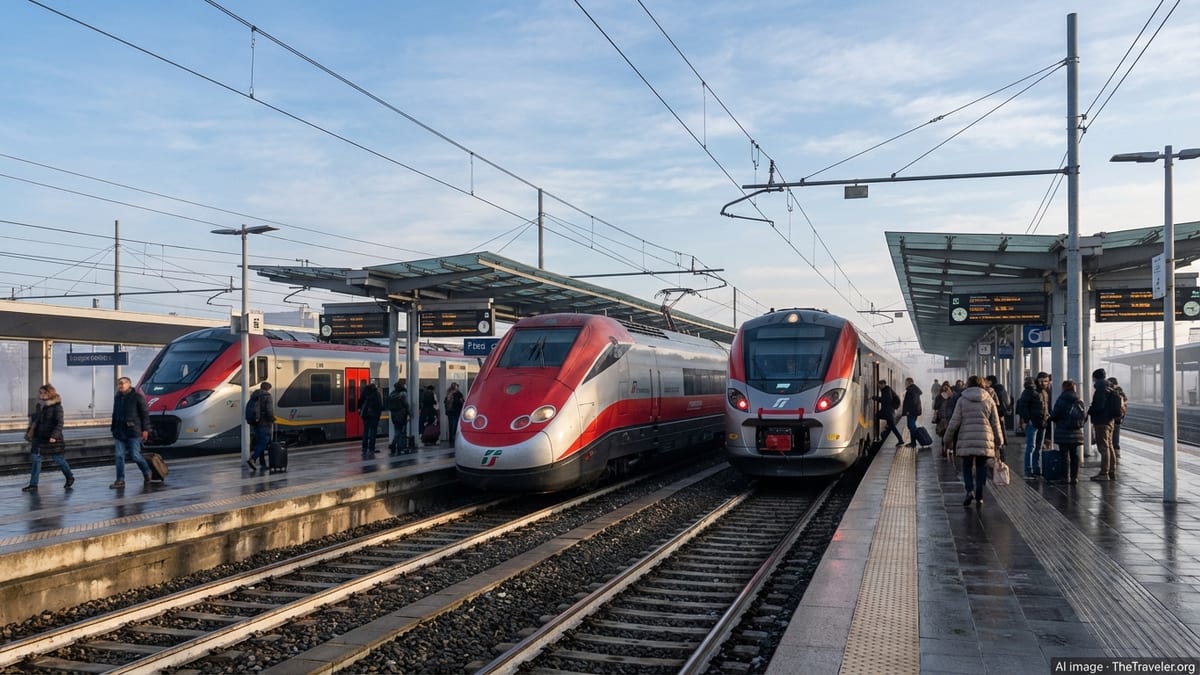
Paris maintenance hub anchors FS in the French market
Publicly available information indicates that Trenitalia France has agreed a multi-decade lease on a new maintenance facility in the Maisons-Alfort Pompadour rail corridor, south of central Paris. The site is positioned close to Paris Gare de Lyon, the starting point for existing Frecciarossa services, allowing high-speed sets to reach heavy maintenance and overnight stabling tracks without long non-revenue runs across the wider network.
The depot is expected to act as the main base for Trenitalia’s current French Frecciarossa fleet, which already serves the Milan–Paris corridor and newer domestic routes between Paris, Lyon and Marseille. Industry coverage describes the facility as conceived from the outset for high-speed operations, with space and access designed to handle long trainsets and intensive turnround patterns that characterise open-access competition on busy intercity corridors.
Reports suggest that FS Group views the facility not only as a servicing point for existing trains but as a long-term operational anchor. The 35-year lease structure signals an intention to be a permanent player in the French high-speed market, where liberalisation has opened key routes to new entrants alongside incumbent operator SNCF.
The Paris hub follows several years of incremental growth by Trenitalia France, from the launch of the Milan–Paris Frecciarossa service in late 2021 to subsequent additions on the Paris–Lyon and Paris–Marseille axes. With the depot in place, the company gains greater control over maintenance, reliability and fleet allocation on these routes.
From Channel Tunnel setback to mainland “Plan B”
The decision to lock in a Paris-area depot follows a period in which FS Group explored, but did not secure, access to existing maintenance capacity linked to the Channel Tunnel and High Speed 1 in Britain. Rail industry reporting describes how competition for limited depot space on the UK side of the Tunnel constrained new entrants’ ability to mount full-scale London services.
Rather than retreat from its ambition to operate through the Tunnel, FS has shifted toward what analysts describe as a France-centred operating model. Under this approach, the Paris depot becomes the central hub for a future Frecciarossa fleet that could serve not only French domestic routes and Italy–France links, but also potential cross-Channel and northbound services deeper into northwest Europe.
By situating heavy maintenance in the Île-de-France region, FS can prepare trainsets for any future London services without relying entirely on scarce British depot slots. This Paris-first strategy is seen by sector observers as a way to keep the Channel Tunnel option open while also supporting expansion on mainland routes where new capacity and platforms may be easier to secure.
The pivot illustrates how infrastructure constraints such as depot and station capacity are increasingly shaping the competitive landscape in European high-speed markets. For operators like FS that are looking beyond their home country, having a strategically located base with guaranteed long-term access has become as crucial as obtaining train paths on the main lines.
Frecciarossa fleet growth underpins expansion plans
The Paris depot move coincides with a renewed burst of rolling-stock investment by Trenitalia, which public documents present as central to FS Group’s 2025–2029 strategic plan. Recent announcements detail a programme to acquire dozens of additional Frecciarossa 1000 trainsets, with total investment in high-speed and long-distance rolling stock running into several billion euros.
Specialist rail publications report that the new trains are configured for international operation and equipped with onboard systems compatible with multiple European signalling and power standards. This technical flexibility is intended to allow Frecciarossa sets to operate not only in Italy and France but also on networks in Spain, Germany, Austria, Switzerland, the Netherlands and Belgium, subject to national approvals.
FS has also highlighted the role of green and sustainability-linked financing in supporting its fleet renewal, with recent bond placements earmarked in part for high-speed train acquisitions. The group positions these investments as aligned with European climate and mobility goals, arguing that additional high-speed capacity can shift passengers away from short-haul flights and private cars on key corridors.
Observers note that having a growing pool of interoperable rolling stock based at a single high-capacity depot near Paris gives FS flexibility to rebalance trains between markets as demand evolves. This could prove important if new routes ramp up more slowly than expected, or if regulatory conditions accelerate liberalisation in particular countries ahead of others.
Positioning against Eurostar and other incumbents
With a Paris hub secured and new trains on order, FS Group is increasingly portrayed by analysts as a potential challenger to entrenched operators on Europe’s most lucrative international corridors. In the cross-Channel market, any future Frecciarossa services from Paris to London would compete directly with Eurostar, which currently dominates traffic through the Channel Tunnel.
At the same time, Trenitalia’s Frecciarossa services already compete with SNCF’s TGV and Ouigo brands between Paris, Lyon and Marseille. The new depot is expected to support a higher level of reliability and more efficient train rotations, factors that can be critical in winning over passengers in markets where frequencies and journey times between operators are similar.
The timing also intersects with developments elsewhere in Europe’s liberalised high-speed sector. In France and Spain, reports from industry media describe how another state-backed operator, Renfe, has adjusted its own international ambitions, including a pause on some planned services to Paris. This reshaping of competitive plans could create openings for FS to strengthen its foothold on key cross-border routes.
Market watchers suggest that the combination of a long-term Paris base, a growing interoperable fleet and experience gained on Italian high-speed lines gives FS a credible platform from which to participate in the next wave of European rail liberalisation. However, they also point out that access charges, border controls and station capacity constraints will continue to shape how quickly any new services can be launched.
Implications for passengers and Europe’s rail map
For travellers, the consolidation of Trenitalia’s operations around a dedicated Paris depot is likely to translate over time into a broader range of direct high-speed options linking France, Italy and potentially other countries. Travel industry commentary suggests that more competition on routes such as Paris–Lyon–Marseille and Paris–Milan can put downward pressure on fares, while encouraging operators to improve onboard comfort and digital services.
The move also fits into wider European transport policy, which promotes rail as a lower-carbon alternative to air travel on medium-distance corridors. By expanding its Frecciarossa presence out of a major European capital, FS aligns its strategy with initiatives aimed at shifting passengers to rail on journeys of a few hundred to about one thousand kilometres.
In network terms, the Paris depot can be seen as a physical anchor point for a more interconnected high-speed grid that stretches from northern France through the Alps to Italian cities and, potentially, beyond to the Benelux countries and the UK. If FS succeeds in turning its France-centred model into new cross-border services, the result could be a denser mesh of direct links between major European cities.
Much will depend on how quickly approvals, infrastructure access and commercial partnerships can be secured. Yet the decision to lock in long-term depot capacity in Paris signals that FS is committing material resources to a vision of Trenitalia as a European, rather than solely Italian, high-speed operator, with the French capital as both workshop and gateway.