


Germany is frequently assessed as one of the more family-supportive destinations in Europe, but suitability for relocating families depends on several structural and social factors rather than reputation alone. This briefing evaluates Germany’s family relocation suitability through a structured scoring lens, focusing on education, childcare, safety, social environment, and long-term family prospects to support evidence-based relocation decisions.
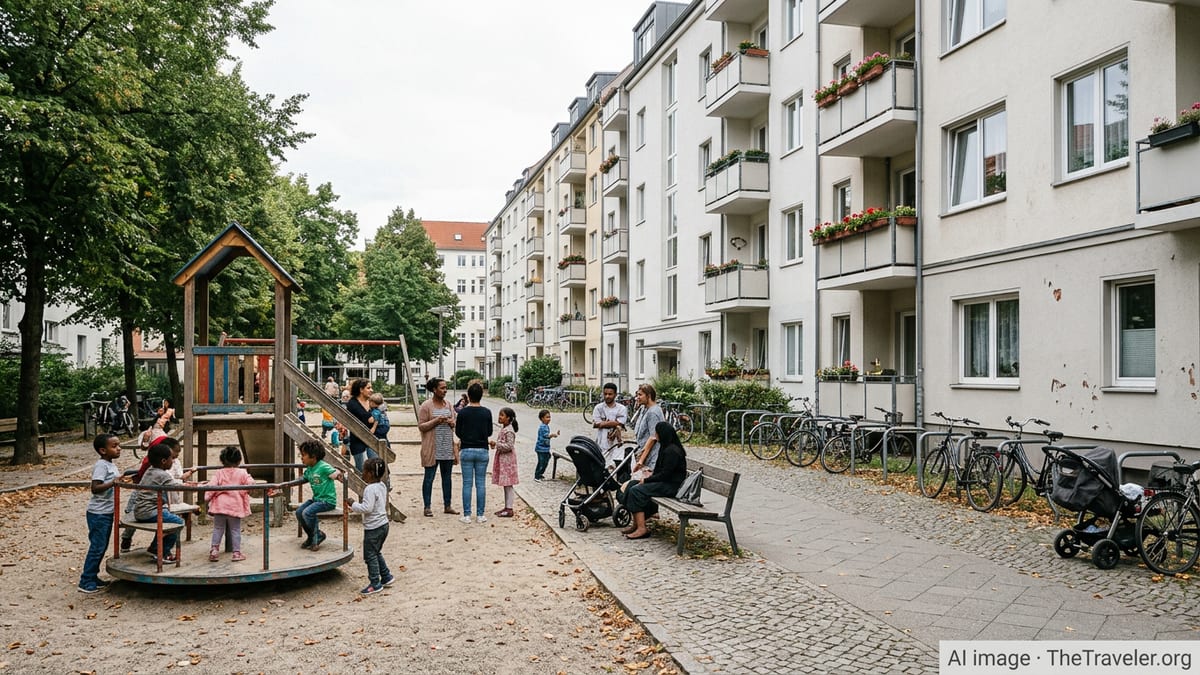
Framework for Germany’s Family Relocation Suitability Score
Germany’s family relocation suitability can be viewed across five core dimensions: education quality and accessibility, childcare coverage, personal and social safety, integration conditions for foreign families, and long-term family development prospects. Each dimension contributes to a consolidated qualitative score that multinational employers and relocating families can use as a comparative benchmark against other destinations.
On a broad qualitative scale from 0 to 10, where 0 represents structurally unsuitable conditions for foreign families and 10 reflects highly supportive, inclusive, and predictable conditions, Germany generally falls in the 7 to 8 range for most globally mobile middle-income and professional families. This reflects strong public systems and infrastructure, with some friction points around language, bureaucracy, and childcare availability in major cities.
The suitability evaluation assumes families with at least one working adult, school-age or pre-school children, and a medium to long planning horizon. Short-term assignees or highly mobile contractors may experience certain factors differently, particularly integration and language demands, which can influence the perceived score.
It is important to note that Germany is not uniform. Conditions differ between large metropolitan regions, mid-sized university cities, and rural areas. As a result, a family relocating to Munich or Berlin may face different waiting times for childcare or school places than a family in smaller cities, even though they are operating under the same national frameworks.
Education System Suitability for Relocating Families
Germany offers a comprehensive public education system with compulsory schooling generally starting at age six and lasting at least nine years, varying slightly by federal state. Public schools do not charge tuition and typically run from primary levels through various secondary tracks. For relocating families, the combination of cost-free access and generally high standards of academic achievement contributes positively to the family suitability score.
However, there are structural characteristics that require careful evaluation by global mobility planners. Germany operates a tracked secondary system in many states, where students are streamed into different school types often after grade four or six. For foreign children arriving later in the schooling journey, placement and track selection can become complex, particularly if their previous education does not align neatly with local expectations. This can be a stress factor for families targeting international higher education pathways.
International and bilingual schools are present in major cities such as Berlin, Munich, Frankfurt, Hamburg, and Düsseldorf. These institutions can provide smoother transitions for children educated in English or other major languages and often follow international curricula. Capacity, however, is finite. Waiting lists are common, and tuition fees can be substantial if not covered by an employer. This dual structure of free public schooling and costly but transition-friendly international schooling creates an uneven experience depending on employer support and personal resources.
Language of instruction is a central consideration. Public schools predominantly operate in German. While many regions provide preparatory language classes for newly arrived children, full academic integration in German typically requires a transition period of one to three years depending on age, prior exposure, and individual aptitude. Families who prioritize continuity of non-German curricula may rate this dimension lower without access to international schools.
Childcare Availability and Early Childhood Support
Early childhood education and care is a critical determinant of family relocation suitability, especially for dual-career households. Germany offers subsidized childcare through day-care centers and childminders, with legal entitlements to a childcare place beginning from age one, though practical access can lag behind legal provisions in high-demand urban areas. Fees are income-related and can be significantly lower than in many other developed economies, positively influencing long-term family affordability and work participation.
Coverage and availability vary by region. In some western and southern states, urban centers report capacity bottlenecks, leading to waiting lists even for children who are formally entitled to a place. This can limit the immediate practicality of relocation for families with very young children, particularly if both parents intend to work full-time shortly after arrival. In smaller cities and some eastern states, coverage tends to be more comprehensive, with higher full-day care rates and better alignment with full-time employment patterns.
Operating hours and flexibility are another dimension of Germany’s childcare suitability. Many facilities offer core hours that may not fully match longer working days in certain sectors, requiring parents to rely on flexible work arrangements, after-care services, or informal support networks. For relocated families without extended family nearby, limited hours can be a constraint, especially in the first years before networks are established.
Overall, when combining entitlement frameworks, cost levels, and pedagogical standards, Germany’s childcare environment scores favorably. The main deduction in suitability arises from availability and waiting time issues in popular metropolitan areas and from the need to navigate fragmented local application procedures, which can be challenging for newly arrived families unfamiliar with the language and administrative systems.
Safety, Stability, and Everyday Security for Families
Relative to global standards, Germany maintains a high level of public safety and institutional stability, which is an important pillar of its family relocation suitability. Violent crime rates are comparatively low, and most residential neighborhoods in mid-sized and large cities are considered safe for daily family life, including commuting to school and use of public spaces by older children.
Public infrastructure, including public transport, pedestrian zones, and cycling infrastructure, is widely used by families and schoolchildren, particularly in urban and suburban areas. This supports a level of independence for older children that many families value. For younger children, playground density, local parks, and organized youth activities contribute to a sense of secure everyday routine in most communities.
Civil and political stability is high, and institutions tend to operate predictably. Public services such as schools, childcare centers, and municipal offices are structured and rule-bound, which reduces volatility but can also introduce inflexibility. For most relocating families, this predictability contributes to a strong sense of security and long-term planning confidence, which in turn supports a higher overall suitability score.
From an employer risk perspective, Germany is generally rated as a low-risk destination for families when measured against criteria such as political unrest, systemic instability, and abrupt policy swings affecting daily life. Occasional localized demonstrations or public debates do not usually translate into disruptions for family routines, and contingency planning for family safety is typically limited to standard prudent measures rather than high-intensity mitigation efforts.
Social Environment, Integration Climate, and Language Factors
The social and integration climate is a nuanced but critical component of Germany’s family relocation suitability. The country has a long history of immigration and includes sizable communities of foreign-born residents in major metropolitan areas. This increases the likelihood of encountering other international families, multilingual environments, and support networks, particularly in global business hubs.
At the same time, integration in everyday life is strongly influenced by German language proficiency. Outside specific international bubbles, German remains the primary language for school communication, administrative matters, and many community activities. Adult language acquisition can be managed through structured courses, but meaningful participation for parents in school governance, local clubs, and parent networks typically requires at least intermediate proficiency. Children tend to adapt more quickly at school, but this transition period should be factored into expectations.
The social climate towards foreigners and visible diversity can vary by region and neighborhood. Large cities and university towns tend to be more accustomed to international residents and may provide more established networks for expatriate and binational families. Smaller towns and rural areas can be friendly but less experienced with foreign families, which can slow integration or require more proactive engagement from newcomers. For some families, this can reduce the perceived suitability if social inclusion is a high priority.
Overall, Germany’s integration climate for families can be evaluated as moderately to strongly positive, with structural support through language courses and integration programs in many regions. The main downward adjustment in the family suitability score comes from the relatively high reliance on German language skills for deep social integration and from the fact that many public-facing systems are not fully optimized for non-German speakers.
Family Time, School Schedules, and Work-Life Alignment
School schedules and work patterns play an important role in family life quality and daily logistics. In many parts of Germany, especially for younger children, school days historically ended around midday or early afternoon, with separate afternoon care options. While there has been a gradual expansion of all-day schooling, the picture remains mixed across federal states and school types. For relocating families where both parents work full-time, the need to coordinate separate after-school care can add complexity.
Holiday calendars are generous by international standards, with multiple school breaks throughout the year and significant summer holidays. This provides families with extended time together but also requires childcare planning if parents do not have matching leave or flexible work arrangements. Many German employers, particularly in knowledge and office-based sectors, offer some level of flexibility, but this is far from universal and often depends on company policy and role seniority.
At the same time, Germany’s cultural emphasis on boundaries between work and private life can indirectly benefit families. Late evening work expectations are less normalized in many sectors compared with some other major economies, and weekend work requirements are often strictly regulated. For many relocating families, this environment can support predictable family time once initial integration and childcare logistics are under control.
Considering these factors together, Germany’s alignment between school structures, childcare frameworks, and typical work patterns is broadly positive but still involves more logistical management for families of young children than in destinations with fully standardized full-day schooling from early grades. This slightly moderates the overall family suitability score while still keeping Germany in the attractive range for many professional households.
Long-Term Family Prospects and Stability
When families relocate, they often evaluate not only immediate living conditions but also long-term prospects for their children. Germany offers a relatively stable long-term environment, with pathways into vocational training, higher education, and diverse labor markets. Public universities charge minimal or moderate tuition for many residents compared with global norms, and vocational training enjoys structured industry links, which can be appealing for families planning multi-decade stays.
Children raised in Germany and educated in German-language schools are likely to emerge with recognized qualifications and language skills valued in the European labor market. For binational or expatriate families, this can create strong regional employability for their children over the long term. However, it also means that transitioning later back to entirely different school systems may require deliberate planning to manage curriculum and qualification differences.
From a family stability perspective, Germany’s emphasis on predictable legal frameworks, regulated labor markets, and strong tenant protections in many regions contributes to long-term planning security. Families can usually make multi-year decisions about schooling, housing, and employment without expecting abrupt systemic shocks. This long-term predictability is a central contributor to Germany’s high family relocation suitability.
Overall, considering education trajectories, youth employment prospects, and systemic stability, Germany scores strongly as a destination for families looking beyond short assignment cycles and considering where children will complete significant stages of their education and early careers.
The Takeaway
Germany’s family relocation suitability score can be broadly placed in the upper tier among major global destinations, with an indicative qualitative rating around 7 to 8 out of 10 for many professional, globally mobile families. Key strengths include cost-free public education, subsidized childcare frameworks, high levels of safety and institutional stability, and solid long-term prospects for children’s education and employment.
Balancing these strengths are meaningful friction points. These include childcare and school capacity constraints in large cities, the requirement to navigate a tracked education system in a second language, administrative complexity for newcomers, and a strong dependency on German language skills for full social integration and parental engagement in school life. Families that are well supported by employers and prepared for these realities are likely to experience Germany as a highly suitable and stable environment.
For decision-makers in global mobility and for families themselves, Germany emerges as a structurally sound choice for mid- to long-term family relocation, especially when there is clear planning for language acquisition, early childcare registration, and school placement strategies. With realistic expectations and proactive preparation, the country’s systemic strengths can be leveraged to create a resilient and supportive family life environment.
FAQ
Q1. Is Germany generally a good destination for families with school-age children?
Germany is widely regarded as a strong option for school-age children due to cost-free public education, safe environments, and relatively predictable long-term education and career paths.
Q2. How challenging is it for children to enter German public schools without speaking German?
Children are usually accepted into local public schools, but most require a one to three year transition period with language support before they are fully comfortable in mainstream classes.
Q3. Are international schools widely available for relocating families?
International and bilingual schools are concentrated in major cities and financial hubs, often with limited places and significant tuition costs that may require employer sponsorship.
Q4. What are the main childcare challenges for newly arrived families?
The primary challenges are securing a place in a childcare facility in high-demand areas and coordinating limited operating hours with full-time work, particularly during the first year after arrival.
Q5. How safe is everyday life for families in German cities?
Everyday life in most German cities is considered very safe by international standards, with low violent crime rates and widely used public infrastructure suitable for children.
Q6. Does limited German language ability significantly affect parents’ integration?
Yes, limited German can restrict parents’ ability to fully engage with schools, administrative offices, and local networks, though basic daily tasks are manageable in many urban areas.
Q7. How compatible are German school schedules with dual-career families?
Compatibility is mixed, as many schools have shorter core hours for younger children, making after-school care and flexible work arrangements important for dual-career households.
Q8. Are long-term education prospects in Germany favorable for children of expatriates?
Long-term prospects are generally favorable, with access to low-cost higher education and structured vocational pathways, provided that children successfully integrate into the German system.
Q9. Do social attitudes toward international families vary across Germany?
Yes, large cities and university towns tend to be more accustomed to international families, while smaller towns may offer fewer established networks, although they can still be welcoming.
Q10. Overall, how does Germany rank for family relocation compared with other developed countries?
Germany typically ranks in the upper range for family relocation among developed countries, driven by safety, public education, and stability, with language and capacity constraints as the main caveats.