


The United Arab Emirates has positioned itself as a family-oriented destination, with cities such as Abu Dhabi and Dubai frequently ranked among the safest and most liveable globally. For relocating households, the key question is how well the UAE supports day-to-day family life, child development, and long-term stability. This report develops a structured UAE Family Relocation Suitability Score and examines the underlying conditions that matter most to families considering a move in 2026.
Framework for the UAE Family Relocation Suitability Score
The UAE Family Relocation Suitability Score in this briefing is an analytical construct designed to evaluate how conducive the country is to raising children as an expatriate or binational family. It focuses on structural conditions for family life rather than short-term lifestyle appeal or tourism value. The score aggregates several core dimensions that are consistently referenced in global rankings and relocation decisions.
For analytical clarity, the framework groups family-relevant factors into six pillars: (1) physical safety and child security, (2) education ecosystem, (3) childcare and early years support, (4) family-supportive labour regulations, (5) social environment and inclusion, and (6) urban environment and daily living with children. Each pillar is assessed qualitatively using recent legislation, survey results and observable trends as of early 2026, while avoiding over-precision where official statistics are limited.
On a qualitative scale from 0 to 10, the UAE’s overall Family Relocation Suitability Score can cautiously be placed in the high range, around 7.5 to 8.5 for typical professional households, with variation between emirates and between higher and lower income brackets. Abu Dhabi and Dubai tend to deliver stronger outcomes due to better infrastructure, schooling choice and public space, while smaller emirates often provide a quieter but less service-rich family environment.
The sections below unpack each pillar in detail, highlighting practical implications for relocating families and where conditions are most favourable or potentially challenging.
Physical Safety and Child Security
Physical safety is a primary driver of family relocation decisions, and the UAE performs strongly on this dimension. International safety indices consistently rank Abu Dhabi and Dubai among the safest cities globally, with reported safety scores often in the high 80s out of 100 and very high proportions of residents stating they feel safe walking alone at night. Such perceptions are reflected in low levels of street crime and violent crime relative to many large urban centres.
For children, the combination of strict policing, extensive CCTV coverage in urban areas, and social norms that discourage public disorder contribute to a low-risk environment in daily activities such as commuting to school, visiting malls and using community facilities. Public harassment of children and teenagers is reported at comparatively low levels, and incidents involving weapons or gang activity in residential areas remain rare by international standards.
Road safety remains the main residual concern in the safety domain. Although enforcement has tightened and speed management has improved on major roads, the UAE historically records higher traffic accident rates than many Western European and East Asian countries. Families typically mitigate this by relying on private cars, school buses and avoiding unsupervised road crossings. Overall, safety and security would typically score in the 8.5 to 9.5 range for family suitability, with road culture being the primary factor that prevents a near-perfect score.
Importantly, political stability and low levels of civil unrest add a further layer of predictability. Demonstrations are tightly controlled and rarely impact residential districts, reducing exposure of children to political violence or instability compared to some other regional hubs.
Education Ecosystem and Schooling Options
Education is a decisive variable for families and a critical component of the UAE Family Relocation Suitability Score. The UAE has built an extensive private education market that serves expatriate and Emirati children with multiple curricula, including British, American, International Baccalaureate and Indian CBSE, alongside national system schools. Abu Dhabi and Dubai host the largest concentration of international schools, with hundreds of institutions spanning early years to Grade 12.
Quality indicators are mixed but generally positive in the main hubs. Regulatory bodies such as Dubai’s knowledge authority and Abu Dhabi’s education department conduct regular inspections and publish performance bands, with a growing number of schools rated in the good to outstanding range. International benchmarking shows that some UAE schools achieve results comparable to high-performing OECD systems, although quality can vary significantly between schools and fee levels.
Availability of school places is a notable consideration. Popular high-performing schools in central districts can have waiting lists, particularly in early years and lower primary grades. Families arriving mid-year or with multiple children may have to compromise on location or curriculum, especially in fast-growing suburbs. Planning admissions several months in advance and being flexible on preferred schools is often necessary to secure consistent quality for sibling groups.
Overall, the education ecosystem scores strongly on variety and availability in major cities, plausibly in the 7.5 to 8.5 range, but the cost and competition for top-tier schools mean outcomes depend heavily on employer schooling allowances and household budgets. Families without strong education benefits may find that affordable options are more limited, particularly at secondary level.
Childcare and Early Years Support
Childcare and early years provision are central to the family experience, especially for dual-career households. The UAE has a sizable nursery and early learning sector, particularly in Dubai and Abu Dhabi, where many nurseries accept children from around 6 weeks to 4 years of age. These facilities typically operate extended hours aligned with working schedules and offer English or bilingual programs, which is attractive to expatriate families.
Formal government subsidies for early childhood education remain limited for expatriates, so affordability depends largely on employer benefits and household income. Monthly nursery costs can represent a substantial share of income for middle-earning families, especially when combined with private school fees for older siblings. Some companies offer childcare or education allowances, but this is far from universal and has reportedly been scaled back in some sectors.
Domestic help is a defining feature of family life in the UAE. Many families employ live-in or live-out nannies and housekeepers, which can provide flexible childcare coverage at costs that, while significant, are often lower than equivalent full-time childcare in North America or Western Europe. This arrangement can greatly ease daily logistics, but it also requires careful management of employment contracts, cultural expectations and privacy boundaries inside the home.
In terms of structured support for early childhood development, there is a growing focus on quality standards and safety regulations for nurseries. Licensing requirements cover staff qualifications, ratios and premises safety, which has helped professionalize the sector. Nevertheless, families still need to perform careful due diligence on individual providers. On balance, childcare and early years support would typically score in the 7 to 8 range, with strong practical availability but limited financial support from the state for non-nationals.
Family-Supportive Labour Regulations and Work Patterns
Labour law conditions directly shape how sustainable family life is over time. The UAE has overhauled its federal labour legislation in recent years, including changes effective from 2022 onward that improved maternity and parental leave provisions in the private sector. As of 2026, private sector mothers are generally entitled to a paid maternity leave period measured in weeks, with extended unpaid options in certain circumstances, while either parent is entitled to a short paid parental leave of around five working days within the first six months of a child’s birth.
In addition, nursing mothers are entitled to reduced working hours or dedicated breastfeeding breaks for several months after returning to work, without reduction in pay. Public sector entitlements can be more generous and vary by emirate and employing authority, with some Abu Dhabi and federal entities offering longer fully paid maternity leave or slightly different parental leave durations.
Beyond statutory leave, the broader work culture influences family life. The standard private sector work week is typically around 40 to 48 hours, often spread across five working days, with a legal weekly rest day now aligned to the Saturday and Sunday weekend in most sectors. Many white-collar roles in multinational companies and government-related entities operate on predictable schedules, but long hours and evening availability remain common in some industries such as consulting, construction and hospitality.
Flexible work arrangements, including remote or hybrid models, have expanded since the pandemic but are not yet universal. Employers in knowledge-based sectors are more likely to offer partial flexibility, which can substantially improve family balance. Overall, family-supportive labour regulations would typically score in the 6.5 to 7.5 range: more progressive than many regional peers but still less generous in leave duration and flexibility than leading European family-policy countries.
Social Environment, Inclusion and Support for Families
The social environment in the UAE is highly international, with expatriates forming a large majority of the population. This results in a multicultural ecosystem of schools, neighbourhoods and social networks, where families from many countries interact on a daily basis. For children, this diversity can support cross-cultural awareness, multilingual exposure and a relatively inclusive experience in international schools.
Public policy in several emirates, especially Abu Dhabi and Dubai, has increasingly emphasised family cohesion and child wellbeing. Strategic plans and programmes have been launched to strengthen parenting support, encourage higher birth rates among nationals, and improve the overall quality of life for families. These initiatives include parenting programmes, financial incentives and awareness campaigns about child development, although most direct benefits are targeted at Emirati citizens.
For expatriates, informal networks often act as the primary support structure. Community groups, school parent associations and faith-based organisations create social infrastructure that helps newcomers navigate childcare options, school choices and extracurricular activities. Social media groups and neighbourhood-based networks are particularly important in orienting families during the first year after relocation.
At the same time, the temporary nature of many expatriate assignments means that social circles can be transient. Friends and classmates may depart on short notice, which can be challenging for children who must repeatedly adapt to changing peer groups. The lack of an automatic pathway to permanent residence or citizenship for most expatriates reinforces a sense that long-term future prospects may lie elsewhere, which some families find difficult when considering their children’s university and early career plans. Overall, the social environment scores in the 7 to 8 range, with high day-to-day inclusiveness but structural transience.
Urban Environment and Daily Living with Children
Urban form and infrastructure play a central role in the lived experience of families. The UAE’s major cities are characterised by car-oriented planning, extensive highway networks and large master-planned communities. For families, this brings both advantages and trade-offs. Access to air-conditioned malls, indoor play areas and community facilities provides year-round options for children, especially during the very hot summer months when outdoor activities are constrained.
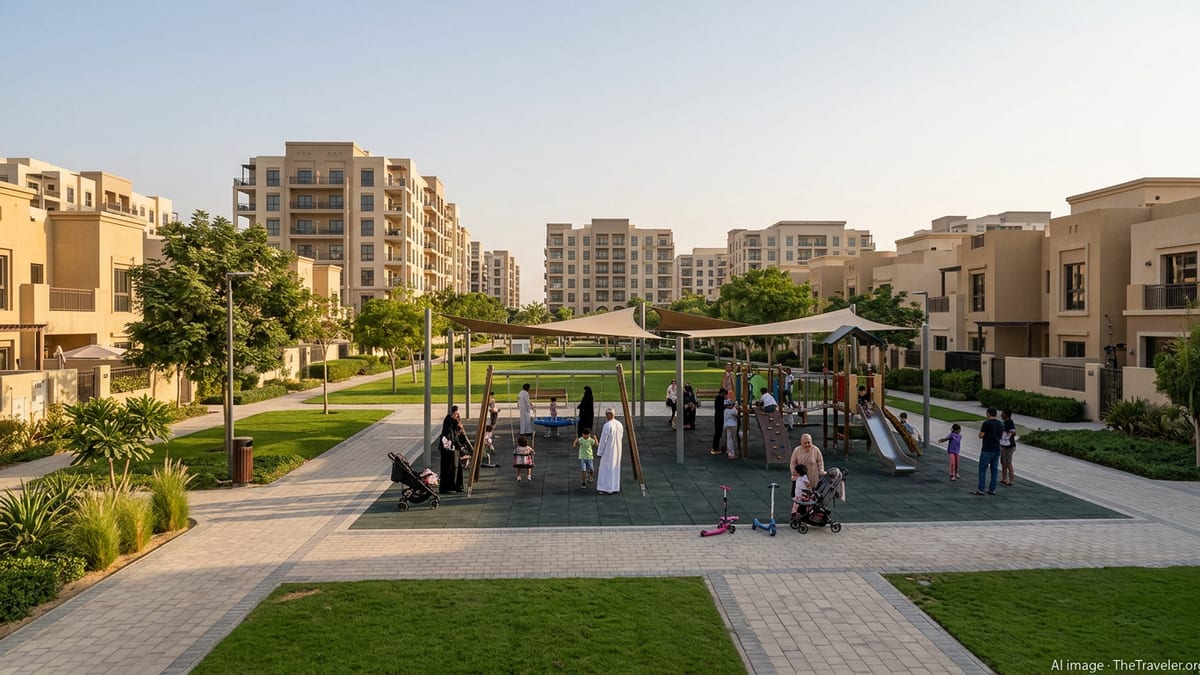
Many newer residential communities, particularly in Abu Dhabi and Dubai, are explicitly designed for families, with features such as gated compounds, shared swimming pools, playgrounds, landscaped parks and cycling paths. These developments aim to compensate for the lack of walkable mixed-use neighbourhoods in older districts and can offer a high quality of life for children, albeit often at higher housing costs.
Climate is a structuring factor. For much of the year, high daytime temperatures limit outdoor play to early mornings and evenings, and sun exposure must be carefully managed for younger children. As a result, families depend heavily on cars for commuting to school and activities, and on indoor recreational options. This can restrict spontaneous outdoor independence for older children compared to temperate countries where walking or cycling to school is common.
Public transport infrastructure is improving, especially in Dubai, but remains less central to family routines than in dense European or East Asian cities. Many families consider driving an essential skill and plan their daily schedules around traffic conditions, which can be significant during peak school run hours. In aggregate, the urban environment and daily living dimension scores in the 7 to 8 range: highly serviced, clean and predictable, but less conducive to independent child mobility and outdoor lifestyles.
The Takeaway
Bringing these dimensions together, the UAE offers a strong overall proposition for families considering relocation, especially for professional households posted to Abu Dhabi or Dubai with solid employer support. High levels of personal safety, a broad international school ecosystem and widespread availability of childcare and domestic help combine to create a practical and secure environment for raising children.
At the same time, the Family Relocation Suitability Score is moderated by several structural factors. Education and childcare costs can be significant, formal parental leave benefits are modest by the standards of top-ranking family-policy countries, and the urban and climatic context reduces children’s independent outdoor mobility. The inherently temporary nature of most expatriate residence can also influence long-term planning for older children approaching higher education.
For families with robust housing and education allowances, the UAE’s family suitability is likely to fall in the upper segment of the estimated range, around 8 to 8.5 out of 10. For households with tighter budgets and more rigid work schedules, the effective experience may be closer to 7 to 7.5, primarily due to financial pressure around schooling and the need to manage demanding work patterns.
Relocating families evaluating the UAE should therefore focus due diligence on three practical questions: the extent of employer support for schooling and childcare, the predictability of working hours, and the specific urban context of their chosen emirate and neighbourhood. When these align positively, the UAE can provide a safe, structured and opportunity-rich environment for children over the typical medium-term assignment horizon.
FAQ
Q1. How safe is the UAE for raising children compared with other countries?
The UAE is generally considered very safe for families, with low rates of street crime and violence, especially in Abu Dhabi and Dubai, though road traffic risk remains higher than in some developed countries.
Q2. Are there enough international schools for expatriate children?
Yes, major emirates have a wide range of international schools offering multiple curricula, but places at top-rated schools can be competitive and fees are substantial.
Q3. What is the typical class size in UAE international schools?
Class sizes vary by school and curriculum, but many international schools operate with mid-20s to low-30s student numbers per class, with smaller groups in premium or early years settings.
Q4. How supportive is UAE labour law for working parents?
Recent reforms have improved maternity and parental leave provisions and provide breastfeeding breaks, but leave durations and flexible work rights are generally shorter than in leading European systems.
Q5. Is domestic help commonly used by families in the UAE?
Yes, many families employ live-in or live-out nannies and housekeepers, which can significantly ease childcare and household tasks, though it adds to monthly costs and requires careful management.
Q6. How does the hot climate affect children’s daily routines?
High temperatures for much of the year limit outdoor activities to early mornings and evenings, so families rely heavily on indoor play areas, malls and air-conditioned community facilities.
Q7. Are there government subsidies for expatriate families’ schooling or childcare?
Direct subsidies for expatriates are limited; most financial support comes through employer education allowances or private arrangements rather than state programmes.
Q8. How stable is family life given that most expatriates are on temporary status?
Day-to-day life is stable and predictable, but long-term residence is usually tied to employment, so families often plan with a medium-term horizon and retain options in their home country.
Q9. Is the UAE suitable for single-parent families?
The UAE can work for single-parent families, particularly where income is sufficient for domestic help and school fees, but limited formal welfare and high costs require careful financial planning.
Q10. Which emirates are most suitable for families?
Abu Dhabi and Dubai generally offer the broadest range of schools, healthcare providers and family-oriented communities, while smaller emirates may provide quieter environments but fewer options.