

More news on this day
Air Canada has joined a widening roster of global airlines suspending or curtailing flights across the Middle East and parts of North America, as the fast‑moving Iran war continues to disrupt airspace, close key hubs, and force last‑minute cancellations for travelers bound for Israel, Jordan, Saudi Arabia, the United Arab Emirates, Qatar, and even New York State.
Get the latest news straight to your inbox!
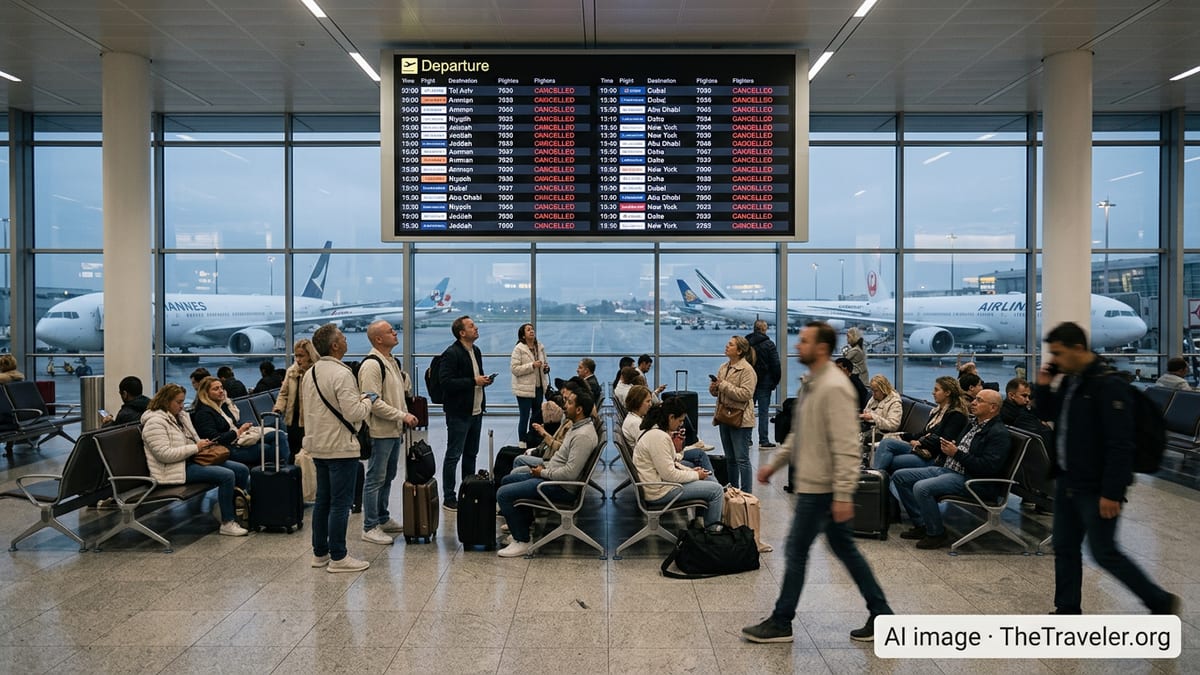
Air Canada Adds to Wave of Cancellations Across Conflict Zone
Publicly available airline alerts and travel‑management bulletins show Air Canada aligning with peers in sharply reducing exposure to the conflict zone, including suspensions affecting routes to Israel and key Gulf gateways. The carrier has been rerouting or cancelling services that would ordinarily pass through or near restricted airspace, reflecting both operational constraints and evolving risk assessments tied to the 2026 Iran war and associated missile and drone activity.
Industry summaries of the disruption indicate that Air Canada’s actions mirror decisions by European and Middle Eastern airlines that have already halted or slimmed down operations to Tel Aviv, Amman, and major Gulf hubs. In practice, this means fewer one‑stop options from North America into the region, longer travel times for itineraries that can still operate, and greater reliance on secondary hubs outside the immediate conflict area.
Travel management advisories circulated to corporate clients in early March describe Air Canada’s approach as cautious and incremental, with schedules adjusted as new government advisories and airspace notices are issued. Passengers with existing bookings are generally being offered rebooking on alternative routings where possible, or refunds when itineraries can no longer be operated safely.
European Carriers Tighten Suspensions to Israel, Jordan and the Gulf
European airlines have been among the most visible in announcing formal suspensions, with Air France, British Airways, KLM, Aegean Airlines and others publishing date‑specific cancellations to Israel, Jordan and the Gulf states. According to recent reporting carried by Reuters and other outlets, Air France has extended the suspension of flights to Tel Aviv and Beirut through mid‑March, and has halted services to Dubai and Riyadh until at least mid‑March as risk analyses are updated day by day.
British Airways has introduced some of the most sweeping changes among European network carriers. Published coverage notes that the airline has cancelled all flights to Abu Dhabi until later in the year, and paused flights to Amman, Bahrain, Doha, Dubai and Tel Aviv until later in March. While the specific restart dates may shift as the situation evolves, the pattern underscores how entire route groupings around the eastern Mediterranean and Gulf are being temporarily removed from schedules.
Greece’s Aegean Airlines, which relies heavily on regional connectivity, has also taken significant steps. Travel advisories and regional media reports indicate that Aegean has cancelled flights to Tel Aviv and several other high‑risk points such as Erbil, Baghdad, Beirut, Dubai and Abu Dhabi, citing the recent escalation and associated airspace closures. For leisure travelers heading from Europe to popular winter‑sun destinations, this has meant abrupt changes to itineraries that often used Athens as a convenient connection point.
Gulf, Jordanian and Saudi Networks Disrupted by Airspace Closures
Beyond individual airline decisions, broad airspace restrictions have forced carriers based in the Middle East to curtail operations throughout the region. A recent operational alert circulated by a multinational travel‑management firm describes ongoing closures or heavy restrictions affecting the skies above the United Arab Emirates, Bahrain, Qatar, Israel, Iran and Iraq, severely limiting overflight options and placing pressure on remaining corridors.
Regional carriers in Saudi Arabia, Jordan and the Gulf have responded with rolling cancellations and trimmed schedules. According to recent factbox‑style coverage summarizing airline moves, Saudi operators have suspended flights on key regional routes serving Amman, Kuwait, Abu Dhabi, Doha and Bahrain, as well as selected services beyond the Middle East, reflecting both airspace limitations and risk to aircraft on the ground. Jordan‑focused reports have highlighted the cancellation of multiple charter flights to Aqaba, directly attributing the pullbacks to war‑related conditions and the unpredictability of missile and drone activity.
Qatar and UAE‑based airlines, meanwhile, have adopted mixed strategies that combine partial cancellations with limited resumptions where safe corridors can be guaranteed. Industry updates describe some carriers resuming carefully controlled services from Abu Dhabi or Doha to select long‑haul destinations, while keeping most Iran‑related routes offline and accepting that short‑haul links across the Gulf and Levant will remain heavily constrained for the foreseeable future.
Ripple Effects on Transatlantic and New York–Area Operations
The impact of the conflict is no longer confined to the Middle East. Aviation analyses and airline customer notices indicate that knock‑on effects are reaching transatlantic routes and major North American hubs, including the New York metropolitan area. Extended detours around closed or high‑risk airspace have increased flight times and fuel costs, and in some cases contributed to schedule thinning on services touching New York State, particularly where aircraft and crews are shared with disrupted Middle East rotations.
Advisory documents focusing on passenger rights note that some long‑haul flights connecting through Doha, Abu Dhabi or Dubai to New York airports have been cancelled outright or converted into irregular repatriation services, depending on daily airspace conditions. In parallel, reports examining the broader aviation landscape describe how ground stops and changing security requirements at key U.S. gateways can compound disruptions that began thousands of miles away in the Gulf or Levant.
For travelers starting or ending their journeys in New York State, the result has been an unusual level of volatility on itineraries involving carriers such as Air Canada, Delta and major European partners. Schedules that, on paper, still appear to offer one‑stop journeys to destinations like Tel Aviv, Amman or Dubai are frequently being adjusted within days or even hours of departure as airlines react to evolving notices to air missions and shifting diplomatic dynamics.
Delta and Other Global Airlines Adjust Networks and Passenger Policies
Delta Air Lines and other major transatlantic carriers are likewise reshaping their network plans around the conflict. Industry round‑ups and airline statements compiled by financial and aviation news outlets show Delta coordinating closely with European partners in the Air France‑KLM and Virgin Atlantic joint ventures, fine‑tuning capacity on North America–Europe legs while relying more heavily on connections that avoid the most affected Middle Eastern hubs.
Across the alliance landscape, publicly available information points to a combination of schedule reductions, aircraft swaps and longer routings as airlines prioritize safety and regulatory compliance. Joint‑venture partners have introduced more flexible rebooking options, allowing customers headed to suspended destinations such as Tel Aviv, Dubai, Riyadh or Doha to reroute via alternative cities or postpone travel without standard change fees. Refund policies are also being relaxed when flights are cancelled or significantly delayed because of the conflict.
Analysts following the sector note that these measures are being introduced against the backdrop of a wider economic hit to global aviation from the Iran war, with thousands of flights in the region cancelled each day at the height of airspace closures. For now, airlines including Air Canada, Air Europa, Air France, British Airways, Aegean and Delta appear to be planning for an extended period of uncertainty, maintaining contingency schedules that can be dialed up or down as conditions allow, and advising travelers to monitor their bookings closely right up until departure.