


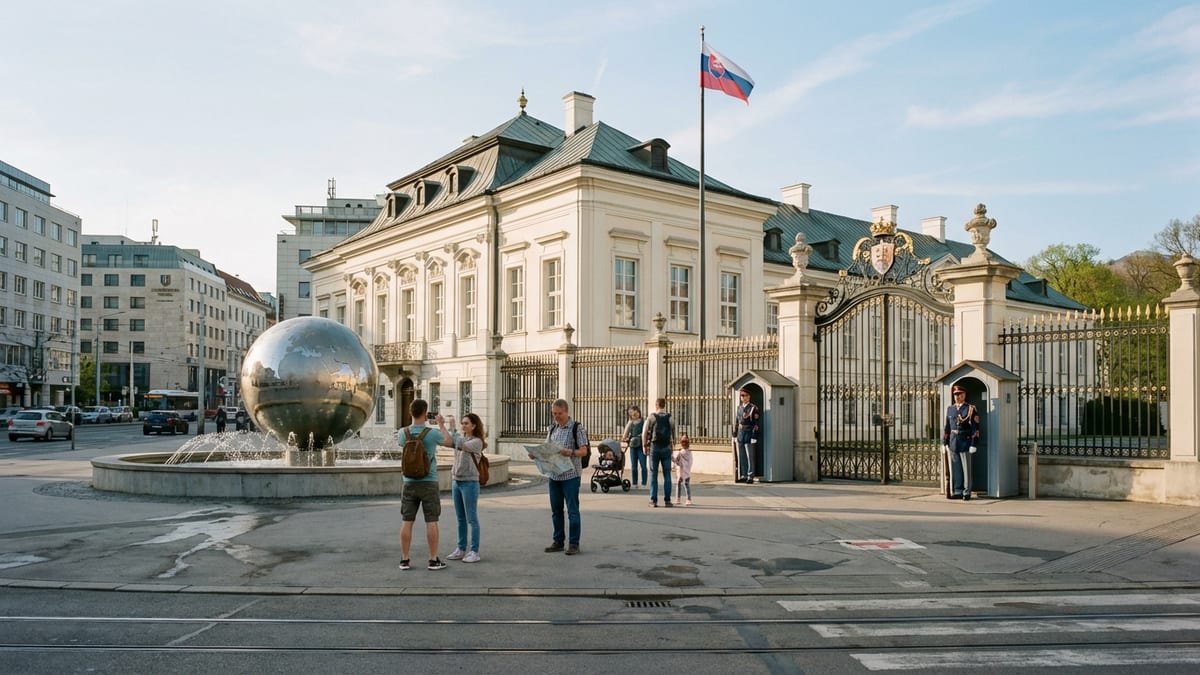
Grassalkovich Palace is one of Bratislava’s most photographed buildings, yet for many visitors it remains something of a mystery. Known today as the Presidential Palace of Slovakia, it serves as the official seat of the head of state and is usually viewed only from behind security railings or through the leafy screen of its French gardens.
This has led to a recurring question among travelers: can you actually tour Grassalkovich Palace, and if so, what will you really see? Understanding how access works, what the guided and semi-guided experiences look like, and how to make the most of the surrounding grounds will help you plan a realistic and rewarding visit.
Understanding Grassalkovich Palace Today
Grassalkovich Palace was built around 1760 as the summer residence of Count Antal Grassalkovich, a powerful Hungarian aristocrat in the service of Empress Maria Theresa. Set just beyond Bratislava’s medieval core, it quickly became a fashionable venue for court balls and concerts, with the empress herself reportedly attending events here. The palace’s Rococo and late Baroque architecture, grand enfilades, and expansive French-style garden reflected the ambitions of a noble family closely embedded in Habsburg politics.
In the 20th century the palace experienced decline, damage and changes of use, before a major reconstruction in the 1990s restored its facades and interiors. Since 1996 it has been the official residence and workplace of the President of the Slovak Republic. That role has direct consequences for how visitors experience the site. Unlike many European palaces that function purely as museums, Grassalkovich remains a working seat of power where cabinet meetings, diplomatic receptions and state ceremonies routinely take place.
This contemporary political function explains the unusually strict limitations on public access. Regular, bookable guided tours of the interior do not operate in the way they do at Bratislava Castle or the Old Town Hall. Instead, the palace opens selectively, for specific events or national celebrations, and the gardens act as the primary space that ordinary visitors can explore daily. When planning a trip, it is essential to distinguish between what you will always be able to see and what is only available during rare open days.
The surrounding city also shapes the visitor experience. Grassalkovich Palace stands on Hodžovo Square at the edge of Bratislava’s Old Town, within easy walking distance of Michael’s Gate and the main shopping streets. The location makes it a convenient landmark to incorporate into a walking tour, whether or not you manage to secure access inside. Even travelers just passing through the city for a day can comfortably include the palace facade and gardens in a short itinerary.
Can You Tour the Interior? How Access Really Works
The most important fact for visitors to understand is that Grassalkovich Palace does not offer routine public interior tours. The building is effectively closed to tourists on ordinary days, functioning instead as a presidential office and ceremonial venue. For those used to touring stately homes in Western Europe, this can come as a surprise and sometimes a disappointment, especially given the palace’s prominence in city marketing materials.
Interior access is possible, but only in tightly controlled ways. The most predictable opportunity is the annual open-door day, typically held in mid-June. On this date, the Presidential Office opens selected state rooms to the general public for several hours. Visitors queue outside the main gate, pass through security checks, and are then guided along a set route through the most representative spaces. The timing and format may vary slightly from year to year, but the concept remains consistent: a single day when Slovak residents and tourists alike can see behind the facade.
Occasionally, additional special openings are organized in connection with national holidays, cultural festivals or European heritage initiatives. These may include guided or semi-guided tours for registered groups, student delegations or foreign guests. However, such events are not guaranteed each year and are usually announced only on official government and city tourism channels. As of early 2026, there is no standing booking system for individual travelers to reserve regular guided tours of the interior on arbitrary dates.
For trip planning, the practical implication is clear. If visiting the inside of Grassalkovich Palace is a priority, you must time your stay around the known open-door date or be prepared to adapt your itinerary at short notice if additional openings are announced. Travelers should also be prepared for long lines and crowd controls during such events. If your visit falls at any other time of year, you should assume that your experience of the palace will be limited to its exterior, ceremonial forecourt and gardens.
Inside the Palace: What Visitors See on Open Days
On the rare occasions when Grassalkovich Palace opens its doors, visitors follow a structured route that highlights key state rooms while keeping working areas off limits. After passing through the main gate and security control in the courtyard, guests typically enter the foyer, where a sweeping staircase sets the stage for the ceremonial interiors above. This grand staircase, one of the visual highlights of the building, conveys the palace’s aristocratic origins as much as its modern presidential role.
One of the principal spaces shown is the Grand Hall, sometimes referred to historically as the Main Hall. Originally conceived as a ballroom and concert hall in the 18th century, it retains the proportions and decorative program typical of late Baroque taste. Period-style chandeliers, elaborate stucco work, mirrors and rich textiles lend the room an opulent atmosphere. Today it serves as the main venue for high-level ceremonies such as the swearing-in of officials, receptions for heads of state and important cultural events. During open days, visitors are usually allowed to walk through the room and, in quieter moments, to linger briefly to take photographs.
In addition to the Grand Hall, the route often includes representative salons and corridors used for formal meetings and press events. These may display portraits of Slovak presidents, historical paintings, or works by contemporary Slovak artists, underlining the palace’s dual identity as heritage monument and living institution. Depending on the year and the program, docents or staff may provide short commentaries on the significance of each room, while printed or digital materials explain the history of the building and its restoration.
Another destination on open days is the palace chapel. Once a separate structure open to the city’s inhabitants, it is now integrated into the complex and used primarily for occasional religious services linked to major state or church events. Visitors entering the chapel encounter a more intimate space, with devotional artworks and architectural details that contrast with the grandeur of the main ceremonial rooms. The chapel provides a reminder that elite residences like Grassalkovich Palace once combined secular and sacred functions under a single roof.
The Role and Reality of Guided Tours
Given the limited accessibility of the interior, the phrase “Grassalkovich Palace guided tour” can be misleading if not clearly defined. For most of the year, there are no guided tours of the palace itself in the usual commercial sense. Tour operators in Bratislava cannot sell guaranteed interior visits except when official open days or specific group appointments have been confirmed. Any brochure or online listing that promises routine inside access should be treated with caution and checked carefully against current official information.
What does exist year-round are guided tours of Bratislava that feature the palace as a major exterior stop. These walking tours, often run by local guides or city organizations, bring groups to Hodžovo Square to view the facade, observe the ceremonial guard and learn about the palace’s history. The guide’s commentary serves as an interpretive tour even though the group does not cross the security barrier. In this context, “visiting” Grassalkovich Palace means seeing and understanding it from the outside rather than walking through its corridors.
During the annual open day and certain special events, the experience moves closer to a conventional guided tour. Palace staff or volunteer docents may accompany groups through the interior, explaining architectural features and state functions. However, time pressures and large crowds often limit how detailed these explanations can be. The format tends to be a continuous flow of visitors rather than small, intimate groups lingering in each room. For foreign tourists, language availability can also be an issue, as commentary may be primarily in Slovak with limited translation.
Travelers interested in a deeper understanding of the building’s history and political role often combine an exterior visit with museum experiences elsewhere in the city, such as the exhibitions at Bratislava Castle or the Old Town Hall. These institutions provide broader context on the Habsburg era, the Kingdom of Hungary and modern Slovak statehood, which in turn enriches the interpretation of Grassalkovich Palace when viewed from the square or gardens.
The Presidential Gardens: The Part Everyone Can Explore
If the interiors of Grassalkovich Palace remain largely off-limits, its formal gardens provide a generous and accessible alternative. Stretching behind the palace, the grounds are laid out in a French-inspired plan of straight avenues, clipped hedges, lawns and ornamental plantings. Unlike the palace itself, the gardens operate as a public park under municipal administration, with free daily entry and long opening hours that vary seasonally. They are as much a space for local residents as for visitors, hosting joggers, families, office workers on lunch break and tourists taking photos.
The gardens have a colorful history of their own. In the 18th century they formed the backdrop to aristocratic entertainments, including performances by musicians associated with the Esterházy court. Later, the grounds became the site of a technological first when electric lighting was introduced here in the late 19th century. After a long period of neglect in the 20th century, the gardens underwent major restoration at the end of the 1990s, with further upgrades completed in 2024. These projects sought to recover the original Baroque geometry while adapting the space to the needs of a modern city park.
Visitors entering the gardens today encounter a mix of historical references and contemporary symbolism. A key feature is the Avenue of Presidents, where trees have been planted by visiting heads of state as gestures of friendship with Slovakia. Other plantings pay tribute to national figures and international partners, such as roses named for Slovak hero Milan Rastislav Štefánik and beds of tulips donated by the Netherlands. Sculptural elements, including a fountain known as Joy of Life and a charming group of girls playing in water, add focal points that invite photography and quiet contemplation.
For travelers, the gardens offer several practical advantages. They provide a restful green space very close to the historic center, making them an ideal pause between sightseeing stops. The flat, paved paths and benches support slow strolls and accessibility for visitors with limited mobility. Entry is free, and there is no need to reserve or join a group. Even without access to the palace interior, time spent in the gardens can provide a sense of the aristocratic leisure for which the residence was originally built, reframed through the lens of contemporary civic life.
What You Will Actually See on a Typical Visit
Most travelers encounter Grassalkovich Palace in three main ways: the facade and forecourt on Hodžovo Square, the ceremonial guard activity, and the gardens behind the building. Understanding how each of these elements works in practice helps set expectations and informs how much time to allocate to the site when planning a day in Bratislava.
Approaching from the Old Town, the first view is usually of the palace’s pale, elongated facade across the busy traffic circle of Hodžovo Square. In front of the building stands a large spherical fountain symbolizing the Earth, sometimes called the Planet of Peace. The fenced forecourt is fronted by a central gate whose black and gold detailing often draws comparisons to the railings at Buckingham Palace. From the square, you can photograph the palace, the fountain and the surrounding urban landscape, including modern office buildings that underline the contrast between historical monument and contemporary city.
A highlight for many visitors is the presence of the presidential guard. Uniformed soldiers stand watch at the entrance, and at set times a brief ceremonial change of the guard takes place near the gate. The exact schedule can evolve, but midday on weekdays is often recommended as the most likely time to see the choreographed routine. Watching the guard ceremony from the public side of the railings has become a small but memorable performance in Bratislava’s tourist repertoire, especially appealing for families and photographers.
After taking in the facade, many visitors walk around the block to reach the gardens, entering from adjacent streets at the rear of the property. Once inside, the atmosphere shifts dramatically from the traffic of Hodžovo Square to a tranquil park. You can follow the central alleys toward the palace to glimpse its rear elevation over lawns and trees, then continue your walk along the perimeter paths, shaded benches and monuments. On fine days, locals spread out on the grass, read on benches or walk dogs, making the gardens feel less like a formal attraction and more like a lived urban space.
Planning Your Visit: Practical Tips and Timing
To get the most from a visit to Grassalkovich Palace, it helps to align expectations with the rhythms of the site and the city. The palace’s exterior and the gardens can be visited year-round, but your experience will differ depending on the season and the day of the week. Spring and early autumn often provide the best combination of mild weather, greenery and manageable crowds. Summer brings longer opening hours for the gardens and livelier street life, but also higher temperatures and more visitors. Winter can be atmospheric if snow dusts the palace roof, though garden plants are less prominent.
Because the palace stands at a busy traffic node, timing your stop outside rush hours can make photography more pleasant. Early morning or late afternoon light tends to flatter the facade and reduce glare from the square. If seeing the guard ceremony is important, aim to arrive close to midday on a weekday, allowing for some flexibility in case of schedule changes or official events that may temporarily alter the routine.
For those hoping to access the interior, the most important planning step is to monitor announcements from the Presidential Office and the city’s official tourism channels in the months before your trip. The annual open-door day has historically fallen in mid-June, but exact dates and hours can shift. If you discover that your visit coincides with an open day, be prepared for security checks, potential waiting times and crowd management measures. Arriving earlier in the day often reduces queuing times and allows for a more relaxed experience inside.
Logistically, reaching the palace is straightforward. From the Old Town, it is a short walk uphill from Michael’s Gate along streets that are well signposted. Public transport lines converge on Hodžovo Square, and trams stop a short distance away. Parking in the immediate vicinity is limited and often crowded, so most visitors rely on walking or public transport rather than driving. Because of the central location, Grassalkovich Palace is easy to combine with visits to Bratislava Castle, the Old Town Hall and riverside promenades in a single day.
The Takeaway
Grassalkovich Palace occupies a distinctive position in Bratislava’s cultural landscape. Architecturally, it is a fine example of an 18th-century aristocratic residence. Politically, it stands at the core of modern Slovak statehood as the seat of the presidency. For travelers, this dual identity explains both the building’s allure and its inaccessibility. The palace is visually central yet functionally closed, an emblem of the country that can be admired from outside most of the time and entered only occasionally.
Understanding this reality is key to avoiding disappointment. On a typical day, a “visit” to Grassalkovich Palace means appreciating its exterior from Hodžovo Square, watching the presidential guard if timing allows, and then wandering through the restored French gardens that unfurl behind the building. These experiences are free, easily accessible and rewarding in their own right, especially when framed by an awareness of the palace’s history and contemporary political role.
For those lucky enough to be in Bratislava on an open-door day or during a specially announced event, the palace’s interior offers a brief but memorable window into the world of official state ceremonies. The grand staircase, glittering chandeliers, representative salons and serene chapel confirm that the building was designed for spectacle as much as for administration. Yet even then, access is structured, time-limited and shaped by security needs, reminding visitors that this is first and foremost a working institution.
Ultimately, Grassalkovich Palace is best approached with informed expectations and a flexible mindset. Rather than fixating on the rarity of interior tours, travelers can embrace what the site reliably offers: a striking facade at the heart of the capital, a glimpse of Slovak political ritual in the guard ceremony, and a revitalized garden that connects Baroque design with contemporary civic life. Framed this way, the palace becomes not a missed opportunity, but a nuanced highlight of any stay in Bratislava.
FAQ
Q1. Can I tour the inside of Grassalkovich Palace on a regular visit?
The interior is not open for routine public tours. Access is generally limited to one open-door day each year and occasional special events announced by official authorities.
Q2. What can I see if the palace interior is closed?
You can view the palace facade from Hodžovo Square, watch the presidential guard at the main gate if you time it right, and freely explore the French-style gardens behind the building.
Q3. When is the annual open-door day usually held?
The open-door day has typically taken place in mid-June, but the exact date and times are set each year. Travelers should check current information from the Presidential Office or city tourism channels before planning around it.
Q4. Are there guided tours available on the open-door day?
Yes, but they are often more like supervised walkthroughs than small-group tours. Staff or docents direct visitors along a set route through key rooms and provide basic commentary, usually in Slovak, with limited time in each space.
Q5. Do I need a ticket to enter the gardens?
No, garden access is free of charge. The grounds operate as a public park with daily opening hours that vary by season, and no reservation is required.
Q6. Is the changing of the guard daily and at a fixed time?
The ceremonial guard is present at the palace throughout the day, and a short changing-of-the-guard routine most often takes place around midday on weekdays. Exact scheduling can change, especially during official events, so treat it as likely but not guaranteed.
Q7. How much time should I plan for a typical visit?
If you are only viewing the facade and strolling the gardens, 30 to 60 minutes is usually sufficient. If you like to photograph, linger on benches or combine your stop with a guided city walking tour, you might spend up to 90 minutes in the area.
Q8. Is Grassalkovich Palace accessible for visitors with limited mobility?
The palace interior may present barriers due to its historic architecture and security arrangements, and it is rarely open. However, the surrounding square and the palace gardens offer paved paths and benches, making the exterior experience relatively accessible.
Q9. Can I visit Grassalkovich Palace on my own, or do I need a tour?
You can easily visit the exterior and gardens independently. Many travelers simply walk up from the Old Town to see the facade and then continue to the gardens. Guided city tours add historical context but are not required to access the public areas.
Q10. Is it worth visiting if I cannot go inside?
Yes. The palace is a key landmark of Bratislava, the ceremonial guard and fountain make for engaging photo opportunities, and the gardens provide a pleasant green refuge close to the Old Town. Even without interior access, it is a worthwhile stop on any city itinerary.