


More news on this day
Major Gulf and Middle Eastern carriers are maintaining selected route suspensions and diversions as the US Iran conflict keeps regional airspace volatile, forcing Dubai and neighboring hubs to recalibrate flight schedules ahead of the late‑summer travel peak.
Get the latest news straight to your inbox!
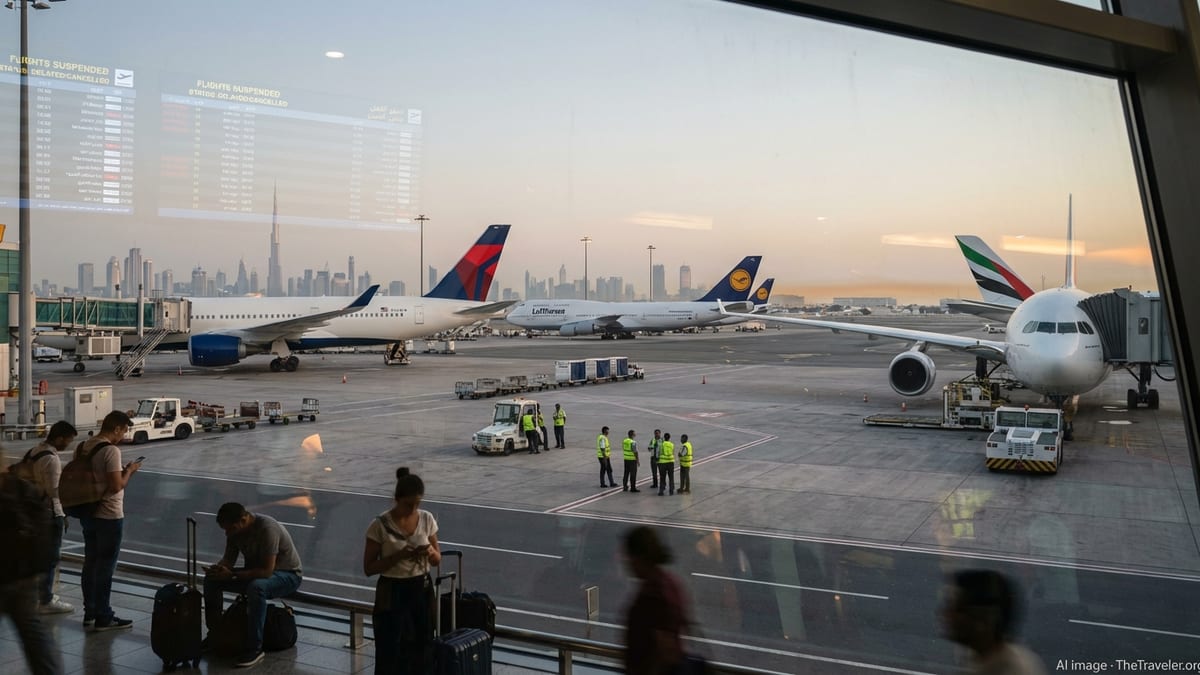
Prolonged turbulence for Gulf hubs
Dubai, Abu Dhabi and Doha, three of the world’s most important aviation hubs, continue to experience rolling disruption months after the latest escalation in hostilities between the United States and Iran triggered temporary airspace closures and missile alerts across the Gulf region. Industry assessments indicate that while full shutdowns have eased, restrictions on overflying parts of Iran and Iraq, along with intermittent closures in Kuwait and along the northern Gulf, are still reshaping how airlines schedule and market their networks.
Analysts tracking the conflict’s impact on aviation report that the March shock, when thousands of flights were canceled or diverted in a matter of days, marked the most severe disruption to Middle East air travel since the pandemic. Although operations at Dubai and Abu Dhabi have largely resumed, the region’s role as a seamless east west transit bridge has been undermined by longer routings, narrower schedules and persistent caution from both regulators and airlines.
Aviation consultancies note that airspace restrictions remain in place across a belt of countries stretching from the eastern Mediterranean through the Gulf, limiting flexibility for carriers that once relied on dense, high-frequency banks of connections. This environment has encouraged airlines to trim marginal routes, especially overnight and secondary-city services that are most exposed to sudden curfews or military activity.
Selective suspensions by Emirates, Etihad and Qatar Airways
Publicly available schedules and industry reporting show that leading Gulf carriers have opted for targeted suspensions rather than blanket cuts as they navigate the evolving security picture. Emirates, based in Dubai, has kept its core trunk routes to Europe, Asia and North America in operation but has continued to suspend or thin out services on some regional links where airspace closures or demand volatility remain acute.
Etihad Airways from Abu Dhabi has followed a similar pattern, maintaining key long haul routes while keeping certain services to conflict-adjacent markets on hold or at reduced frequency. Network data indicate that flights requiring routings close to Iranian or Iraqi airspace have been the most affected, with planners favoring more southerly tracks via Saudi Arabia and the Arabian Sea, even when this adds time and fuel burn.
Qatar Airways, whose Doha hub sits near the northern Gulf, has leaned on its experience from earlier diplomatic crises to reconfigure routings quickly. Even so, the carrier has kept a number of flights curtailed, particularly those to airports that have faced repeated, short-notice closures. Schedules suggest a preference for consolidating capacity on major gateways while pausing some secondary destinations until a more durable de-escalation is evident.
Kuwait and northern Gulf routes remain fragile
The most visible impact of the conflict on everyday travelers in recent weeks has been on Kuwait and neighboring northern Gulf destinations. Regional media coverage indicates that airlines across the United Arab Emirates and Saudi Arabia have repeatedly adjusted Kuwait-bound services in response to intermittent airspace and airport closures tied to heightened security alerts.
Reports from Gulf-based outlets describe Emirates, Air Arabia and several Saudi carriers canceling or rescheduling flights to Kuwait City and select Saudi cities during spikes in tension, often with limited advance notice. Kuwait Airways and Jazeera Airways have in turn reshaped their own timetables, temporarily suspending some services and running others only when local authorities reopen airspace.
This stop-start pattern has discouraged airlines from fully restoring pre-conflict capacity on northern Gulf routes. Instead, carriers appear to be adopting a “watchful waiting” stance, operating reduced schedules that can be scaled up if diplomatic efforts around the US Iran confrontation gain traction, or pared back again if missile alerts or drone incidents re-emerge.
Airspace closures push longer routings and higher costs
Even where flights are still operating, the closure or restriction of key flight information regions across Iran, Iraq and parts of the Gulf has forced airlines to adopt longer, more southerly routings. Industry analyses of flight-tracking data highlight how services linking Europe and Asia via Dubai, Abu Dhabi or Doha have been diverted over Saudi Arabia, the Red Sea and, in some cases, the eastern Mediterranean, adding significant distance to traditional great-circle paths.
Aviation economic studies released this year suggest that these detours are increasing fuel costs, crew time and air traffic control charges for Gulf and Middle Eastern carriers. While many airlines initially absorbed part of the extra expense to protect demand during the immediate shock of the conflict, recent fare patterns on some long haul routes hint at a gradual pass-through of higher operating costs to passengers.
The rerouting has also compressed airline schedules, particularly at night when much of the region’s connecting traffic traditionally peaks. With aircraft spending longer in the air and turnaround windows tightening, carriers have less slack to recover when airspace restrictions suddenly intensify, reinforcing the rationale for trimming more marginal routes and preserving resilience on core sectors.
Travelers face uncertainty as peak season nears
For travelers transiting or originating in Dubai and other Gulf hubs, the continuation of selective suspensions and detours means planning remains more complex than during previous summers. Travel management alerts and airline advisories consistently urge passengers booked on Middle East itineraries to monitor their flight status closely, arrive early at airports and allow ample connection times, especially when routing through Kuwait or other northern Gulf points.
Consumer-facing reports note that many airlines are offering flexible rebooking options for itineraries touching higher-risk routes, including waivers for date or routing changes when schedules are revised because of airspace decisions. Some corporate travel programs are temporarily steering staff away from routings that rely on airports subject to abrupt closures, favoring more southerly paths through the Gulf or even alternative hubs outside the immediate conflict zone.
With negotiations around the US Iran conflict still in flux, aviation analysts broadly expect a prolonged period of elevated operational risk for the region’s airlines. For Dubai and its Middle Eastern peers, the priority in the months ahead will likely remain the same: keep global connectivity intact while accepting that a subset of routes, particularly those near active flashpoints, will stay suspended or constrained until the strategic picture becomes clearer.