


More news on this day
Dubai and Abu Dhabi remain open to visitors, but the risk picture has shifted again in September 2026 as reports of renewed Saudi Arabia Houthi strikes add to wider regional volatility. For travelers, the biggest immediate concerns are the possibility of sudden flight disruptions and a low-probability but high-impact risk from drone or missile activity, alongside the UAE’s strict local laws and security environment.
Get the latest news straight to your inbox!
What the latest Saudi-Houthi flare-up means for travelers
Published coverage this week describes a new spike in cross-border incidents involving Houthi launches toward Saudi Arabia and Saudi-linked military activity affecting Yemen, part of a broader regional security picture that has already produced periodic airspace restrictions and travel disruption across the Gulf in 2026.
While Dubai and Abu Dhabi are not the focus of the reported exchanges, the UAE sits within a region where escalation can travel fast through airspace controls, heightened security postures, and disruptions to aviation corridors. For travelers, that means the most likely “on the ground” impact is not day-to-day crime, but short-notice operational changes around airports, flight routings, and occasional limits on movement near sensitive sites.
The UAE has also taken public diplomatic positions tied to the renewed Saudi-Houthi tension, reflecting how closely Gulf states track these incidents. That does not automatically translate into restrictions for tourists, but it can coincide with stepped-up security measures around key infrastructure and high-visibility locations.
Official travel advisories: what the US, UK, Canada, and Australia say
As of August 29, 2026, the US Department of State lists the United Arab Emirates at Level 3, “Reconsider Travel,” citing terrorism and armed conflict, and referencing an ongoing threat of drone and missile attacks and the potential for commercial flight disruption following the outbreak of US-Iran hostilities earlier in 2026.
Canada’s guidance has also been tightened. As of September 15, 2026, publicly available Government of Canada advice for the UAE is “Avoid non-essential travel,” citing a volatile security situation in the region and noting that missile and drone attacks have resumed and struck targets in the region.
In the UK, the Foreign, Commonwealth and Development Office travel advice for the UAE includes warnings about regional tensions and the possibility of sudden travel disruption, including flight cancellations and periodic airspace closures. Its safety guidance also highlights terrorism risk in the UAE and notes that, amid rising regional tensions, certain sites linked to specific communities could face elevated risk.
Australia’s Smartraveller currently advises “Reconsider your need to travel” to the UAE, with recent updates emphasizing that military strikes and reprisal attacks have occurred in parts of the Middle East and that airspace can open or close with little notice, affecting flights at Abu Dhabi and Dubai.
Air travel realities: airports are operating, but disruption can be sudden
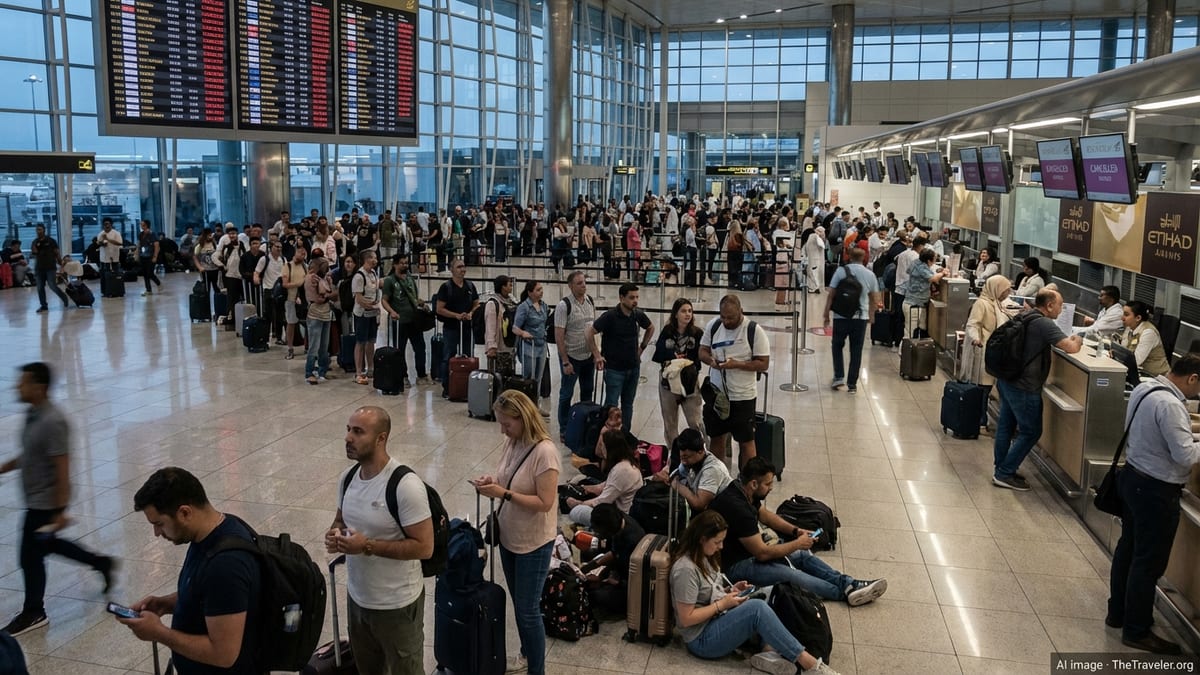
Dubai International (DXB) and Abu Dhabi’s Zayed International (AUH) have continued operating through this year’s regional volatility, and UAE aviation messaging in 2026 has repeatedly stressed operational continuity as restrictions ease and capacity returns. At the same time, multiple government advisories now explicitly warn that airspace controls and flight cancellations can happen quickly, even if airports are functioning normally at the moment you depart.
For travelers, that translates into planning for resilience rather than panic: allow extra time for connections, avoid tight same-day onward plans, and consider routing choices if you are transiting through the region. If your itinerary includes a connection through Dubai or Abu Dhabi, it is worth checking both your airline and the operating airport on the day of travel, because schedule changes can occur even when terminals remain open and crowded.
If you are traveling for a fixed event, a cruise, or a once-only tour, the key practical risk is the “stranded traveler” scenario: delays, rebookings, or last-minute cancellations driven by airspace restrictions elsewhere along your route. This is also where travel insurance details matter most, particularly exclusions tied to armed conflict, warlike events, and government travel advisories.
What “safe” looks like on the ground in Dubai and Abu Dhabi
For most visitors, Dubai and Abu Dhabi continue to present a relatively controlled security environment compared with many major global cities, with a heavy visible security presence at airports, malls, and event venues. The main near-term safety focus, however, is not street crime but situational awareness: knowing where you are, understanding how to respond to emergency alerts, and avoiding areas that could be considered sensitive.
Multiple advisories emphasize keeping distance from military sites and critical infrastructure, which may not always be clearly marked. Travelers should also avoid photographing security personnel, government buildings, and sensitive facilities. Even ordinary sightseeing can become risky if it brings you close to restricted areas, especially during periods of heightened alert.
Tourists should also remember that the UAE enforces local laws strictly. Behavior that might be overlooked elsewhere can cause serious problems in the Gulf, including issues related to public conduct, social media posts, alcohol, and drug offenses. Those legal risks exist regardless of the regional security situation and can become more consequential if tensions lead to tighter enforcement or added scrutiny in certain areas.
How to decide whether to go, and how to reduce risk if you do
Whether it is “safe enough” to travel depends on your personal risk tolerance and your flexibility. Travelers with non-refundable, time-sensitive plans should weigh the possibility of disruption against the current advisory environment. If you do go, consider choosing bookings that can be changed, and make sure you can afford last-minute rerouting if conditions change.
It is also worth aligning your plan to the realities of the moment: keep your itinerary centered on established tourist zones, avoid unnecessary travel near industrial areas and ports, and limit side trips that bring you close to international borders. If you are combining the UAE with nearby destinations, keep in mind that advisory levels can differ significantly across the region, and a short hop on a map can be a major jump in risk.
Finally, check your insurance policy carefully. In a period when multiple governments are advising travelers to reconsider or avoid non-essential travel, some policies may restrict coverage for cancellation, disruption, or certain incident types. If you cannot confirm coverage in writing through your insurer’s published policy terms, plan as if you may be handling extra costs yourself.