


More news on this day
Hundreds of airline passengers have been left stranded across the Gulf and wider Middle East as a fresh wave of flight cancellations and delays disrupts travel through major hubs including Dubai, Doha, Jeddah and Cairo.
Get the latest news straight to your inbox!
Targeted Cancellations Hit Key Gulf Routes
Publicly available flight-tracking data and regional aviation coverage indicate that at least 53 flights were cancelled and around 125 delayed in recent hours across the Gulf and neighboring states, affecting services operated by Gulf Air, FlyDubai, Emirates and a range of other regional and international carriers. The disruptions are concentrated on short- and medium-haul routes linking Bahrain, the United Arab Emirates, Qatar, Kuwait, Saudi Arabia, Egypt and Jordan, where many passengers rely on dense frequencies and rapid connections.
The pattern of cancellations shows particular strain on Bahrain-based Gulf Air’s network, with flights routed via its hub experiencing extended ground times and rolling schedule changes, and some services reportedly withdrawn at short notice. Low-cost operators such as FlyDubai are also adjusting timetables in and out of Dubai, trimming frequencies on routes to Kuwait City, Doha and select Saudi destinations, while long-haul carrier Emirates has reduced or retimed services on certain sectors as it works around regional constraints highlighted in recent industry reports.
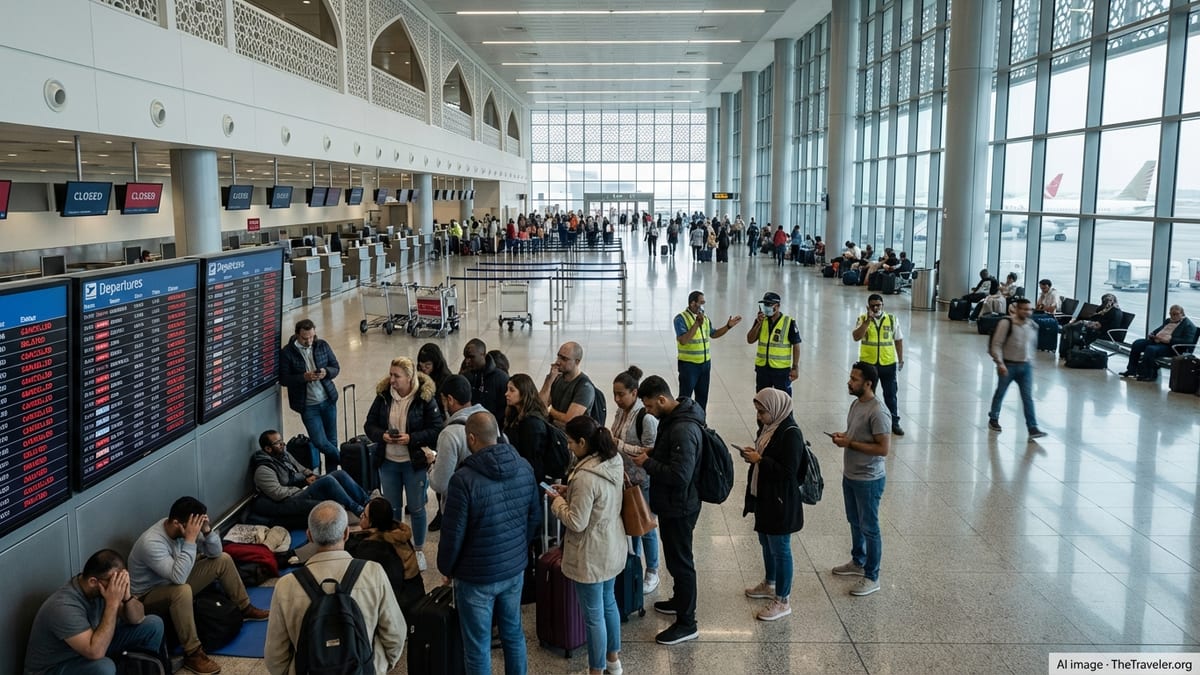
Travel outlets in the region describe scenes of crowded departure halls and long customer-service queues as passengers attempt to understand whether their flights are operating and how to rebook when they are not. With schedules still being updated throughout the day, many travellers are only learning of cancellations shortly before departure, compounding frustration and making it harder to secure alternative options at short notice.
The overall number of affected services remains a fraction of the region’s usual daily movements, but the impact is magnified because many itineraries depend on tight connections through one or two major hubs. When a single link in that chain is cancelled, entire journeys from Asia or Africa to Europe and North America can unravel, leaving passengers stuck in transit cities or unable to begin their trips at all.
Regional Tensions and Airspace Constraints Add Pressure
Travel and business publications across the Middle East continue to link the latest wave of disruption to a combination of heightened regional tensions, intermittent airspace restrictions and already-stretched airline operations. Coverage indicates that recent closures and capacity limits in parts of Gulf airspace have forced carriers to reroute or temporarily suspend select services, particularly those passing closest to conflict-affected areas.
Analysts cited in recent aviation industry briefings note that even limited airspace closures can cause a cascading effect on schedules. Aircraft and crew may be left out of position, turnarounds lengthen and buffers built into timetables are quickly exhausted. When airlines try to compress revised routes into already busy airport slots, further delays can follow, especially at major hubs such as Dubai International and Doha’s Hamad International.
Operational updates published by some carriers show a focus on maintaining core trunk routes while trimming marginal frequencies and select regional sectors. Emirates, for example, has been operating a reduced schedule to more than 100 destinations in recent weeks, while FlyDubai and other Gulf-based airlines have repeatedly urged travellers to monitor flight status closely and to avoid heading to the airport without a confirmed departure time.
Industry observers also point to the lingering effects of earlier mass cancellations that followed airspace closures and military activity over parts of Iran and surrounding areas in March 2026. Although many long-haul corridors have since been partially restored, schedules remain more fragile than before, increasing the likelihood that new disruptions will quickly ripple through outbound and inbound networks.
Hubs from Dubai to Cairo Face Stranded Passenger Backlogs
Airports from Bahrain and Kuwait City to Dubai, Doha, Jeddah, Riyadh, Cairo and Amman are now managing rolling backlogs of stranded travellers as they work through the latest round of cancellations. Reports from regional travel news outlets describe overnight queues at check-in counters and transfer desks, with many passengers attempting to secure seats on a shrinking pool of available onward flights.
In the United Arab Emirates, Dubai International has been a focal point for disruption since earlier airspace closures sharply curtailed operations. While a limited and fluctuating schedule has resumed, local coverage indicates that both Emirates and FlyDubai continue to prioritise passengers whose previous flights were cancelled, limiting opportunities for new bookings on some high-demand routes.
Similar scenes are being reported at Doha’s Hamad International Airport, where Qatar-based services are adapting to changes in regional routings, and at Saudi and Egyptian gateways where connecting passengers are attempting to reroute via alternative hubs. In Cairo and Jeddah, airline desks have reportedly seen spikes in rebooking requests from travellers whose original journeys depended on Gulf connections that are no longer operating as planned.
Travel advisories compiled by regional media stress that passengers should not assume that operations have fully normalised despite the appearance of flights on departure boards. With some services running on ad hoc or emergency schedules and others still awaiting regulatory clearance, travellers are being urged to verify details on official airline channels immediately before leaving for the airport.
Limited Alternatives and Rising Costs for Rebooking
For many travellers, finding an alternative route out of the region has proved challenging. Publicly available booking data and fare snapshots show sharply reduced seat availability on flights that avoid the most heavily affected airspace, with remaining options often involving longer routings through secondary hubs in Europe, South Asia or East Africa.
Passengers trying to bypass Gulf hubs altogether are encountering higher prices as demand concentrates on a handful of unaffected corridors. Analysts following regional aviation trends note that carriers outside the Gulf, including European and Asian airlines, have seen a surge in last-minute demand on routes that allow travellers to skirt restricted skies, with some itineraries selling out days in advance.
Travel guidance published by corporate mobility and risk advisory firms recommends that organisations with staff in the region review contingency plans, including the possibility of routing employees via Saudi airports or other alternative gateways where schedules are more stable. However, those options are not always feasible for leisure travellers or those with limited budgets, many of whom are opting to wait in place for their original carriers to restore services or offer rebooking on later dates.
At the same time, customer-service channels at several major airlines remain under heavy pressure. Online comments and regional consumer reports describe long hold times and backlogs in refund and voucher processing, reflecting the sheer volume of passengers seeking new arrangements after multiple rounds of schedule changes in recent weeks.
What Impact Travellers Should Expect in the Coming Days
Aviation experts quoted in recent regional analyses suggest that, while a complete shutdown of Gulf air travel is not anticipated, passengers should prepare for several more days of irregular operations. Airlines are expected to continue fine-tuning timetables as airspace conditions evolve, gradually restoring some frequencies while keeping contingency plans in place for further disruptions.
Travellers booked on Gulf Air, FlyDubai, Emirates and other carriers operating through Bahrain, the UAE, Qatar, Kuwait, Saudi Arabia, Egypt and Jordan are being advised by publicly available guidance to treat departure times as provisional until they have been reconfirmed close to travel. Same-day monitoring of flight status, ensuring up-to-date contact details with airlines and allowing extra time at the airport are all being highlighted as essential steps.
Industry commentary also indicates that airports may retain stricter access controls for some time, limiting terminal entry to ticketed passengers and encouraging those without confirmed departures to stay away to ease congestion. As a result, the experience for travellers transiting through major hubs may remain slower and more tightly managed than pre-disruption norms.
While the current tally of 53 cancellations and 125 delays represents just one snapshot in a fluid situation, it underscores how sensitive Gulf aviation remains to any shift in regional dynamics. For passengers, that means building more flexibility into itineraries, considering alternative routings where possible and staying closely informed as airlines and regulators continue to adjust operations across one of the world’s busiest travel corridors.