


More news on this day
A fast-spreading wildfire in northeast Florida has disrupted Amtrak service across the state, leaving hundreds of passengers trapped on at least one northbound train for more than 20 hours as crews worked to contain the blaze and assess track conditions.
Get the latest news straight to your inbox!
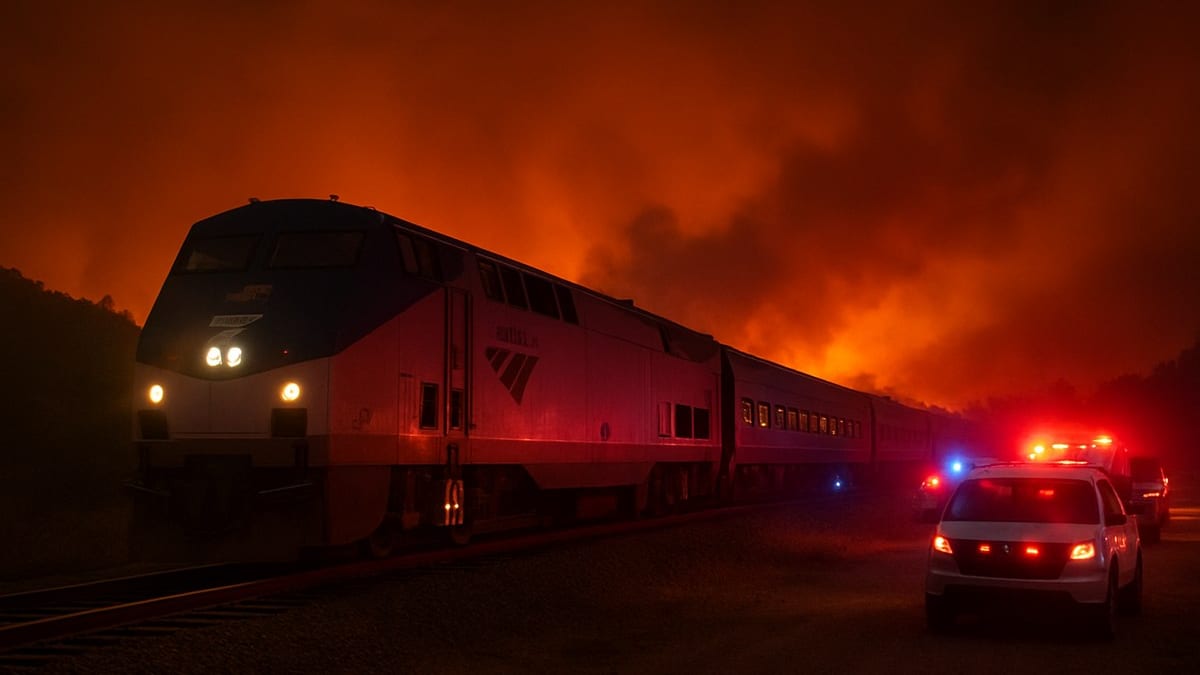
Wildfire Near Putnam and Clay Counties Halts Rail Traffic
Publicly available information shows that a wildfire complex burning along the border of Putnam and Clay counties, south of Jacksonville, forced Amtrak to suspend portions of its service beginning on April 20, 2026. State forestry updates describe a fire that rapidly grew to several thousand acres, sending smoke and flames close to busy rail corridors.
News reports indicate that one Amtrak train traveling through the area was ordered to stop for safety reasons as conditions deteriorated near the tracks. The train, believed to be part of Amtrak’s Silver Service operating along Florida’s east coast, remained in place for many hours while railroad staff awaited clearance to move.
Coverage from regional outlets and national broadcasters describes how the halted train eventually became a focal point of the disruption, with images and passenger accounts circulating widely on social media. The incident highlighted how quickly wildfire activity in a drought-stricken region can cascade into transportation gridlock for residents and visitors alike.
According to published coverage, the wildfire zone also affected freight operations and other passenger movements through northeast Florida, contributing to broader congestion on the rail network as dispatchers rerouted or parked trains away from the active fire line.
Passengers Report Over 20 Hours Stranded On Board
Local television segments and online reports describe passengers on the affected Amtrak train spending more than 20 hours on board while the route remained blocked. Some accounts reference delays stretching closer to a full day as the train waited for a safe window to move or for an alternative plan to be arranged.
Publicly available passenger descriptions point to growing frustration as time passed, with particular concern about food, water and restroom access during the extended stop. Social media posts and user-generated content on transit forums reference dwindling supplies and crowded conditions, underscoring the practical challenges of sheltering in place on a fully booked long-distance train.
Several reports note that air circulation and onboard comfort became an issue for some riders as the stop dragged on, especially for families traveling with children and older adults. These accounts have fueled renewed debate about what contingency protocols should look like when trains are immobilized for long periods due to external hazards such as wildfires.
While the number of affected passengers has varied by outlet, available coverage consistently characterizes the stranded train as carrying several hundred riders, including tourists, seasonal residents and travelers connecting to destinations beyond Florida.
Auto Train and Other Long-Distance Routes Disrupted
The wildfire’s impact extended well beyond a single stranded train. Service advisories cited in news reports indicate that Amtrak canceled at least one Auto Train departure between Sanford, near Orlando, and Lorton, Virginia, on April 20 and 21 as conditions remained volatile in the region. The Auto Train, which normally carries passengers and their vehicles overnight between Florida and the Washington, D.C. area, is a key link for travelers seeking to avoid a lengthy drive along the East Coast.
According to published coverage, Amtrak also truncated some of its Silver Meteor trips, with trains beginning and ending in Jacksonville instead of continuing to or from South Florida while wildfire activity threatened sections of the route farther south. In addition, the long-distance Floridian route was temporarily shortened to operate between Savannah and points north, reducing direct rail options into Florida.
Public information from transportation updates shows that Amtrak arranged limited bus connections in parts of the state, helping some travelers bridge gaps between Jacksonville, central Florida and South Florida. However, capacity on these buses was constrained, and schedules were fluid as conditions around the fire shifted.
For visitors, the evolving service pattern created a puzzle of partial routes, canceled trips and last-minute substitutions. Travel planners and rail advocates have pointed out that these cascading disruptions demonstrate both the vulnerability of long-distance rail to climate-related events and the importance of clear, timely communication to passengers during service interruptions.
Travelers Scramble for Alternatives Amid Uncertainty
As news of the halted train and wider rail cancellations spread, travelers already in motion or preparing to depart Florida rushed to secure backup plans. Airline search data and anecdotal reporting suggest a bump in last-minute flight bookings from Jacksonville, Orlando and Tampa as passengers abandoned rail trips in favor of air travel.
Other riders turned to rental cars and intercity buses, according to regional travel coverage, often facing higher prices and limited availability due to the sudden spike in demand. For those with vehicles aboard the canceled Auto Train, rebooking to a later departure or driving the full distance themselves became the primary options.
Travel-focused outlets have noted that the wildfire disruption arrived during a busy spring period for Florida, when snowbirds, international visitors and families on school holidays keep transportation networks crowded. The timing heightened the ripple effects, stretching call centers, station staff and online support channels as travelers sought refunds, rebookings or guidance.
Publicly available commentary from transportation analysts frames the episode as a case study in how climate-exacerbated events can compound existing strains on long-distance travel infrastructure. With drought conditions contributing to heightened fire risk in parts of the Southeast, some experts argue that rail and highway operators will need more robust contingency planning for sudden, large-scale closures.
Questions Raised Over Preparedness and Passenger Care
In the aftermath of the incident, travel and consumer reporters have focused on the experience of passengers stranded on board for more than 20 hours, particularly around access to basic necessities. Accounts shared on social platforms and in local newscasts describe shortages of potable water, limited food options and restrooms struggling to keep up with continuous use during the extended stop.
These reports have fueled broader questions about what minimum standards should apply when trains are immobilized by circumstances outside an operator’s control. Commentators in transportation forums and consumer columns are asking how quickly emergency supplies can be replenished, whether temporary evacuations to buses or safe nearby facilities are viable, and how medical needs are addressed when delays stretch into many hours.
Rail advocates quoted in previous coverage of service disruptions have long argued that investing in more resilient equipment, better redundancy in routes and stronger coordination with local emergency managers can reduce the likelihood that passengers remain stuck on board for such long periods. The Florida wildfire incident is likely to intensify those calls, especially among travelers who rely on trains as a less carbon-intensive alternative to driving or flying.
For now, publicly available information indicates that most Amtrak service in and out of Florida has gradually resumed as containment improves and inspections clear the tracks. Yet for many riders who spent a full day or more waiting in stalled railcars, the episode has become an unsettling reminder that extreme weather and wildfire risks are increasingly shaping the realities of long-distance travel across the United States.