


The phrase “Gulf of Alaska cruise” gets thrown around a lot in brochures, but it can be surprisingly hard to picture what that actually means once you are on the water. Will you be sailing in open ocean or narrow fjords? How many glaciers will you really see?
And what is the difference between a “Gulf of Alaska” itinerary and an “Inside Passage” cruise that also goes to Alaska? This guide breaks down the main Gulf of Alaska cruise routes in plain language and walks you, day by day, through what you are likely to see from the rail and in port.
Gulf of Alaska vs. Inside Passage: The Route in Simple Terms
Most large-ship Alaska cruises follow one of two big patterns. The first is a round-trip Inside Passage route, usually sailing from Seattle or Vancouver through the sheltered channels and islands of southeast Alaska and back again. The second is a one way Gulf of Alaska route, which adds a stretch of open Gulf sailing and typically begins or ends in a port on Alaska’s south-central coast, usually Seward or Whittier, with the other end in Vancouver or sometimes Seattle.
On a true Gulf of Alaska itinerary, your ship will still travel through a big portion of the Inside Passage, especially early in the voyage. That is where you get steep-sided fjords, dense temperate rainforest and classic southeast Alaska towns such as Ketchikan, Juneau and Skagway. The difference comes at the top end of the route. Instead of looping back south, your ship continues northwest past the northern tip of British Columbia and crosses a section of the Gulf of Alaska to reach the Kenai Peninsula or Prince William Sound region.
Practically, that means you get a mix of protected inland sailing and at least one day of more exposed, open ocean conditions. You also reach a different set of glaciers and landscapes than round-trip Inside Passage cruises, including famous tidewater glaciers like Hubbard Glacier or the ice fields of Prince William Sound and College Fjord, as well as easier access to Anchorage and interior Alaska.
Northbound vs. Southbound: How the Experience Feels Different
Gulf of Alaska cruises are usually sold in two directions. Northbound sailings depart from Vancouver (or occasionally Seattle) and end in either Seward or Whittier. Southbound sailings do the reverse. The port list on paper may look nearly identical, but the rhythm of the days and how the scenery unfolds can feel very different depending on which direction you choose.
On a typical northbound voyage, you ease into Alaska. The first day or two may be at sea along British Columbia’s inside channels, with broad forested slopes and distant snowcapped ranges. Then you step deeper into the fjord world: Ketchikan with its cling-to-the-hillside houses and totem heritage, Juneau framed by the Coast Mountains, and often Skagway at the end of dramatic Lynn Canal. These early stops give you a taste of frontier towns and easy-access glaciers such as Mendenhall near Juneau or the White Pass & Yukon Route from Skagway.
Mid-cruise, a full day of scenic cruising is often devoted to a headline glacier area, such as Glacier Bay, Hubbard Glacier or Tracy Arm or Endicott Arm, depending on the line and permits for that year. Only after these classic southeast Alaska vistas does the ship angle west-northwest, cross the Gulf itself and end in south-central Alaska. By the time you disembark in Seward or Whittier, you are well positioned for land tours to Anchorage, Denali and the interior.
Southbound itineraries reverse this arc. Many travelers say a southbound sailing feels like the drama happens up front. You might board in Seward with the Kenai Mountains rising above Resurrection Bay or in Whittier surrounded by the steep walls of Prince William Sound. Within a day you could be at Hubbard Glacier or cruising College Fjord. Only afterward do you continue into the string of southeast ports and, finally, the gentler green of coastal British Columbia. It can feel like a soft landing after the rawer landscapes of the Gulf and interior.
The Inside Passage Section: What You Actually See Day to Day
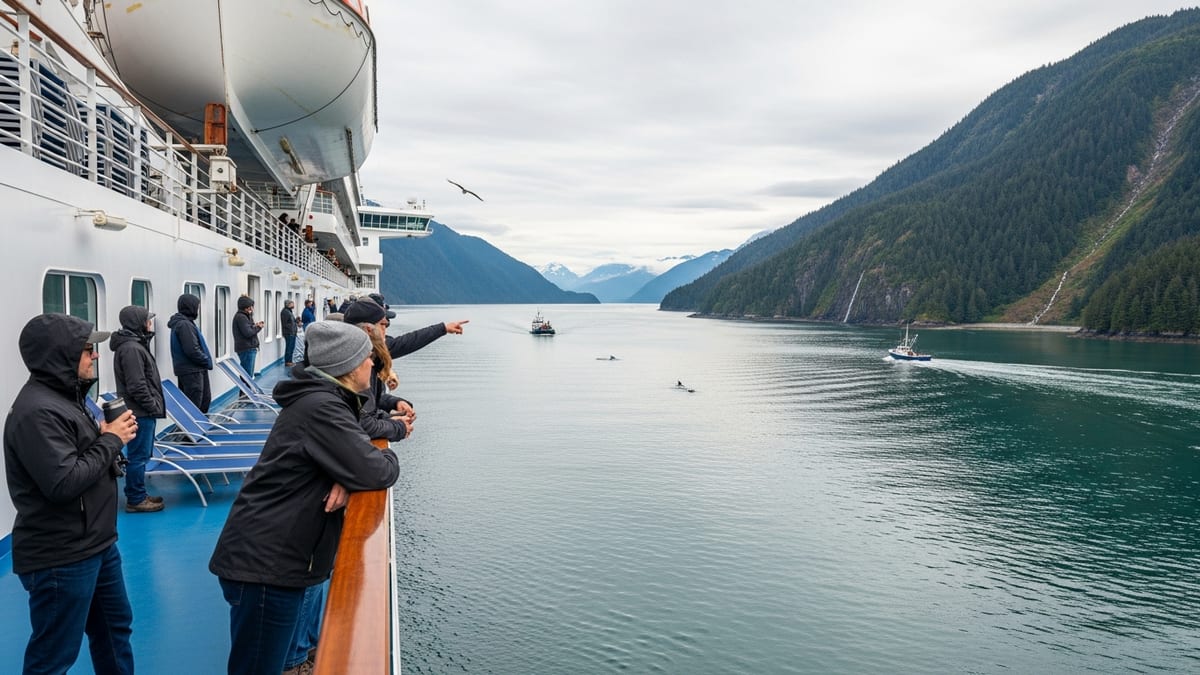
Whether your Gulf of Alaska cruise is northbound or southbound, several days are spent in the Inside Passage. These days tend to be what many first-time travelers picture when they think of an “Alaska cruise”: calm water, wooded islands, and mountains rising directly from the sea. Because you are sailing between islands and along channels, the seas are usually relatively smooth compared with open ocean, though strong winds or tidal currents can still be felt.
Visually, this part of the voyage is dominated by shades of green and grey and blue. Spruce and hemlock forest lines the shores. In early season, snow may reach down low on the hillsides; later in summer, the slopes look greener, though high peaks often keep snowfields all season. You will likely see working boats: tugs shoving barges of freight, small commercial fishing vessels, ferries, and sometimes local water taxis that shuttle residents around a region still heavily dependent on marine travel.
This is also where your chances of spotting marine wildlife from the ship are strong, particularly in the heart of the season from June through August. Passengers frequently see humpback whales spouting or breaching in the distance, Dall’s porpoises racing in the bow wake, sea lions hauled out on navigation buoys and rocky islets, and bald eagles perched in shoreline trees or spiraling overhead. Because the ship’s path often threads through narrower passes, you can comfortably scan with binoculars from the decks and pick out waterfalls, glacier-fed rivers and occasional tiny settlements along the way.
Most Gulf of Alaska cruises include port days in at least two and often three of the southeast “big four”: Ketchikan, Juneau, Skagway and sometimes Sitka. While these are busy cruise ports, what you see around them is very real Alaska: fishing fleets in harbor, steep rainforested mountains rising straight behind town, and a weather pattern that often cycles from blue sky to mist to steady drizzle and back again in a single day. Excursions here focus on salmon fishing, flightseeing over glaciers, guided hikes, bear viewing in season, totem and Native cultural sites, and a range of active options from sea kayaking to zip lines.
The Gulf Crossing and South-Central Alaska: Open Water and Big Landscapes
After or before the Inside Passage section, a true Gulf of Alaska cruise spends roughly a day at sea in more open waters as the ship crosses the northern Gulf. Here the land may be out of sight for periods, or appear as a low blue line far on the horizon. Swell can be more pronounced than in the sheltered Inside Passage, though modern ships are built with stabilizers and adjust speeds and routes to seek the most comfortable ride possible.
On clear days, this Gulf segment offers broad, cinematic views instead of close-in fjord walls. Off to one side you may glimpse the long white spine of Alaska’s coastal ranges, including volcanoes in the distance. On the water itself, look for the telltale misty blows of whales, especially if you are sailing mid-season when humpbacks and other species are feeding heavily in the Gulf waters. Albatross and other pelagic birds can sometimes be seen gliding low over the waves, a very different cast of characters than the gulls and eagles common closer to shore.
The payoff for crossing the Gulf is access to Alaska’s south-central coast. If you end or begin in Seward, your first impression is often Resurrection Bay, a fjord-like inlet bracketed by steep, often snow-streaked mountains. Whittier offers an even more enclosed feel inside Prince William Sound, where glacier-etched walls rise sharply from the water and hundreds of tidewater and hanging glaciers cloak the surrounding peaks. These landscapes feel rawer and more heavily glaciated than many of the forested islands of southeast Alaska.
From a practical standpoint, Seward and Whittier are gateways to very different adventures than southeast ports. From Seward, entry to Kenai Fjords National Park by small boat brings you closer to actively calving tidewater glaciers and seabird colonies. From either Seward or Whittier, road or rail access leads to Anchorage and, beyond that, to Denali and the interior. This is why many Gulf of Alaska cruises are paired with land packages: the route itself positions you for a more comprehensive Alaska trip that can include tundra, big river valleys and the Alaska Range in addition to the coastal fjords.
Glacier Days: Hubbard, Glacier Bay, College Fjord and More
For many travelers, the highlight of any Gulf of Alaska cruise is the day the ship spends lingering in front of glaciers. These “scenic cruising” days are not about covering distance. Instead, the ship slows and often pivots in place so guests on all sides can see a massive wall of ancient ice dropping into the sea. The exact glacier or fjord you visit depends on the cruise line, permits and the specific itinerary, so it is worth reading your route description carefully.
Hubbard Glacier is one of the signature sights on many northbound and southbound Gulf routes. It is the largest tidewater glacier in North America that cruise ships regularly visit, with an ice face about six miles wide and more than 30 stories high in places. Approaching Hubbard, the water fills with blue-white icebergs and smaller chunks of ice, often dotted with harbor seals resting. You will hear deep cracks and thunder-like booms as the glacier calves. Because the ice front is so wide, the ship can usually rotate slowly so that guests on different decks and sides get clear, direct views.
Another classic glacier experience on some Gulf itineraries is Glacier Bay National Park. Access is limited by permit and usually associated with specific cruise lines, but if your route includes Glacier Bay your ship will spend most of a day inside the park. Rangers often board to provide commentary as you pass multiple major glaciers, including Marjerie and Grand Pacific, and sail through broad fjords with rounded mountains showing clear signs of past ice coverage. Even when fog hangs low, the sense of vastness is striking, with layers of peaks fading into the distance.
Some Gulf of Alaska routes, particularly those using Whittier as a terminus, focus their scenic glacier time in Prince William Sound and College Fjord. These areas are dense with glaciers pouring off the Chugach Mountains. In College Fjord, a line of glaciers all named for Ivy League colleges descends in parallel. Farther out in the Sound, you may see multiple tidewater glaciers in a single day along with floating ice, sea otters on their backs in the kelp and rafts of seabirds. Compared with the single main ice wall of Hubbard, Prince William Sound can feel like a gallery of glaciers unrolling one after another.
Ports, Excursions and What You See Ashore
Although the sailing days and glacier viewing are memorable, a Gulf of Alaska cruise is also defined by what you do when the ship ties up to a pier. The mix of ports on these routes is fairly consistent across major cruise lines, with individual variations. The common denominator is that you will visit at least one or two southeast Alaska communities and finish or start in a south-central gateway.
Ketchikan, often the first or last Alaska port on a Gulf itinerary, sits where the Tongass National Forest crowd’s right down to the waterfront. From the ship, you see a long waterfront of wooden buildings on pilings, backed by steep, forested slopes crisscrossed by stairways. Shore excursions here focus on Alaska Native totem heritage, floatplane sightseeing over Misty Fjords, salmon fishing, and walks along salmon streams during late-season runs where black bears may be feeding.
Juneau, Alaska’s capital, cannot be reached by road, so everything and everyone arrives by plane or boat. From the harbor, you look up at mountains where the Juneau Icefield spills out in a dozen different glaciers. Many visitors take a quick shuttle or tour out to Mendenhall Glacier, which you can see from an easily accessible viewpoint or get closer to by guided hike or paddle outing. Flightseeing options let you land on remote glaciers by helicopter or fixed-wing aircraft. Whale watching from Juneau is a major draw, with operators often finding cooperative groups of humpbacks feeding in nearby channels.
Skagway offers a different kind of landscape again. The town’s historic false-front buildings sit at the head of a long fjord and are overshadowed by high, bare rock faces and peaks that catch snow early and hold it late. The famous White Pass & Yukon Route narrow-gauge railway climbs from sea level up into alpine country, tracing the path stampeders followed during the Klondike Gold Rush. On a clear day, the rail journey provides big, open views down the valley and across to distant glaciers and tarns.
At the Gulf end of the route, Seward has the feel of a working harbor and small town rather than a purpose-built cruise stop. Fishing boats, tour boats bound for Kenai Fjords, and occasional cargo vessels share the waterfront with the cruise pier. Beyond town, you can visit Exit Glacier, one of the most accessible road-side glaciers in the region, or join a smaller vessel tour into Kenai Fjords National Park to see steep cliff walls, seabird rookeries, sea stacks and tidewater glaciers at much closer range than a large ship can manage. Whittier, by contrast, feels more like a tiny outpost tucked into a dramatic mountain bowl, with a short, scenic rail or bus transfer linking it to Anchorage.
Seasonality: How Timing Shapes What You Will See
Gulf of Alaska cruises operate within Alaska’s broader cruise season, which generally runs from late April through September. When you sail has a big impact on what you actually see from the ship and in port. Early in the season, in May and early June, mountains often carry more snow down to lower elevations, waterfalls gush with meltwater, and there may be fewer ships in port at once. Wildlife is active as bears emerge from hibernation, moose and other animals tend to their young, and migratory birds move through.
During the core of summer in June, July and much of August, days are long, temperatures are at their mildest along the coast, and marine life viewing is typically at its most consistent. Humpback whales feed heavily in both Inside Passage and Gulf waters, salmon runs attract bears to rivers and shorelines, and sea lions and harbor seals are a common sight on rocks and ice floes. Forested slopes are fully green, and there is enough twilight to enjoy late-evening views from deck as the ship glides along channels that still feel wild despite the presence of other vessels.
By late August and September, a Gulf of Alaska route can take on a different visual character. High tundra and alpine areas begin to show fall color, especially if you add a land tour north of Anchorage. Some coastal hillsides pick up yellowing patches of foliage amid the conifers. Days shorten, and there is a small but real chance of seeing the aurora borealis on the darkest nights if skies and solar activity cooperate, particularly on northbound sailings that end in south-central Alaska. Shoulder-season cruises in May and September can also be less crowded and sometimes more attractively priced, though you may encounter cooler, wetter weather and a narrower menu of shore excursions.
Glacier viewing itself is strong throughout the season. Calving activity can be spectacular on warm, sunny days when ice fronts are under stress, but it is also common in cooler conditions. The main seasonal differences you will notice around the glaciers involve the amount of floating ice and snow on surrounding slopes. Earlier in the season, the surrounding mountains and the glacier surface may appear cleaner and whiter; later in the season, exposed rock bands and streaked ice become more pronounced as seasonal snow melts away.
Choosing a Route for Your Priorities
Once you understand the basic pattern of a Gulf of Alaska route, it becomes easier to match an itinerary to your priorities. If you want a cruise that feels like the beginning of a bigger journey into interior Alaska, a northbound route that ends in Seward or Whittier can be ideal. You can step off the ship and, within hours, be riding the Alaska Railroad along Turnagain Arm toward Anchorage and onward to Denali. The visual arc of your trip moves from forested islands to enormous mountains and open tundra.
If your primary goal is the coastal scenery itself and you like the idea of the biggest landscapes coming early, a southbound Gulf route might suit you better. You will start among steep, glaciated mountains and then gradually transition into the island mazes of southeast and finally the calmer temperate forests of coastal British Columbia. This direction can feel like a gentle unwinding, especially if you prefer to fly into Anchorage and fly home from Vancouver or Seattle.
Specific glacier priorities may also steer your decision. If seeing Hubbard Glacier is non-negotiable, look for itineraries that name it explicitly in their scenic cruising day rather than listing only “glacier viewing” or “Endicott Arm.” If you are drawn more to Prince William Sound and College Fjord, note that these are more commonly associated with routes using Whittier and with particular cruise brands that have a long history in the region. Some travelers even choose back-to-back northbound and southbound itineraries to experience both directions and a wider range of glacier areas and ports.
Ship size is another factor that shapes what you will actually see and feel on a Gulf of Alaska cruise. Larger mainstream ships offer more onboard amenities and tend to follow the most popular ports and glacier areas. Smaller ships and expedition-style vessels, including those that specialize in Alaska, may be able to enter narrower inlets, linger longer in wildlife-rich coves, or anchor near smaller communities. The trade-off is usually fewer dining and entertainment options but a deeper focus on natural history and off-ship exploration.
The Takeaway
A Gulf of Alaska cruise is not a single fixed route but a family of itineraries that share a spine: Inside Passage fjords on one end, a crossing of the open Gulf in the middle, and the rugged, glaciated coast of south-central Alaska on the other. What you actually see along the way depends on your direction of travel, the time of year, and the specific glacier areas and ports your ship visits. Yet certain experiences are common to almost all these routes. You will watch island forests and steep mountains slide past for hours at a time. You will likely spend at least one unhurried day in front of a huge tidewater glacier, listening for the crack and roar of calving ice. You will step ashore in towns that still work the sea for a living and in harbors where floatplanes lift off for the backcountry.
Understanding how the Gulf of Alaska segment fits into the bigger picture of an Alaska cruise helps you read between the lines of brochures and online listings. Instead of just seeing a string of names, you can picture the real days behind them: the calm, narrow channels of the Inside Passage, the wider horizon of the Gulf, the glacier-choked bays of Prince William Sound or Glacier Bay, and the link to interior Alaska that makes a one way Gulf route such a natural choice for travelers who want a deeper look at the state. With those pieces in mind, you can pick an itinerary that matches your appetite for open water, your glacier wish list, and your broader plans on land.
FAQ
Q1. What is the main difference between a Gulf of Alaska cruise and a round-trip Inside Passage cruise?
On a Gulf of Alaska cruise you still sail through part of the Inside Passage, but instead of turning back you cross a section of the open Gulf and begin or end in south-central Alaska, usually Seward or Whittier, which gives you access to different glacier areas and easier connections to Anchorage and interior Alaska.
Q2. Will the Gulf of Alaska section be rougher than the Inside Passage?
It can be. The Inside Passage is mostly sheltered by islands so seas are often calmer, while the Gulf segment is more exposed and can have a noticeable swell. Modern ships use stabilizers and adjust routes for comfort, but if you are prone to motion sickness it is wise to come prepared with remedies and to choose a midship, lower-deck cabin when possible.
Q3. Do all Gulf of Alaska cruises visit Glacier Bay National Park?
No. Access to Glacier Bay is regulated by permit and only certain cruise lines and ships visit on specific days. Others may feature Hubbard Glacier, Tracy Arm or Endicott Arm, or glacier areas in Prince William Sound and College Fjord instead. To know what you will actually see, check that your specific itinerary names the glacier area rather than just promising generic “glacier viewing.”
Q4. Which direction is better: northbound or southbound?
Neither direction is universally better; they simply unfold differently. Northbound sailings build gradually from British Columbia to southeast Alaska and then on to the Gulf and south-central coast, which can be ideal if you plan a land tour afterward. Southbound sailings deliver the biggest mountains and glaciers at the beginning and then ease into the Inside Passage and coastal British Columbia, which some travelers prefer for a more relaxed finish.
Q5. What wildlife am I likely to see from the ship on a Gulf of Alaska route?
In season you have good chances of seeing humpback whales, orcas, sea lions, harbor seals, Dall’s porpoises, bald eagles and a variety of seabirds. Bears are usually spotted on shore excursions rather than from the ship, although you may occasionally see them along beaches or rivers. Wildlife sightings are never guaranteed, but June through August generally offers the most consistent activity.
Q6. Is a Gulf of Alaska cruise suitable for a first-time cruiser?
Yes, many first-time cruisers choose Gulf of Alaska routes, but you should be comfortable with at least one day of potentially livelier seas on the Gulf crossing. If you prefer the calmest possible ride, a round-trip Inside Passage itinerary may be a better introduction. If you are excited about accessing interior Alaska and seeing a wider variety of coastal landscapes, a Gulf cruise is a strong choice even for a first cruise.
Q7. How many glaciers will I see on a typical Gulf of Alaska itinerary?
You will almost certainly have at least one dedicated glacier viewing day where the ship lingers at a major tidewater glacier, and you may see additional glaciers from a distance while sailing or on shore excursions. The exact count depends on the route: some itineraries focus on one or two headline glaciers like Hubbard or a day in Glacier Bay, while others in Prince William Sound and College Fjord pass multiple distinct glaciers in a single day.
Q8. Can I combine a Gulf of Alaska cruise with a land tour to Denali?
Yes. One of the main advantages of a Gulf route is that it naturally pairs with land packages that continue by rail or coach from Seward or Whittier through Anchorage toward Denali and, in some cases, farther north. Many cruise lines sell bundled cruise-tour combinations, or you can arrange your own overland travel using scheduled trains, buses and local tour operators.
Q9. What is the best time of year to take a Gulf of Alaska cruise?
The main season runs from late April to September. May and September offer fewer crowds and shoulder-season pricing, with cooler temperatures and the possibility of spring blooms or early fall color. June, July and early August bring longer days, milder coastal temperatures and usually the most reliable marine wildlife viewing, though ports and ships are busier at this time.
Q10. How should I read an itinerary description to understand what I will truly see?
Look beyond marketing phrases and focus on specifics: whether the route is one way or round trip, which embarkation and disembarkation ports are used, which glacier areas are named, and how many sea days appear between ports. If the listing specifies Hubbard Glacier, Glacier Bay, Tracy Arm, Endicott Arm, College Fjord or Prince William Sound, you can research photos and maps of those places to get a realistic picture of the scenery you will encounter along your Gulf of Alaska cruise.