


More news on this day
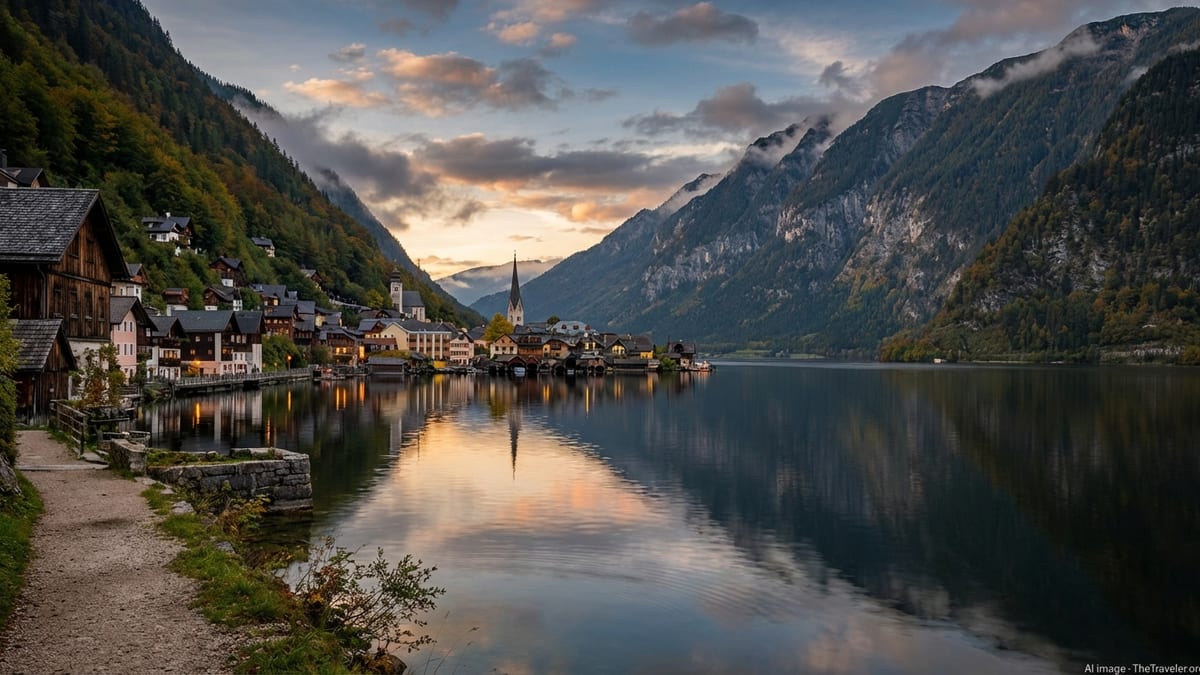
Ringed by steep Alpine peaks and mirrored in the still waters of Lake Hallstatt, the small Austrian village of Hallstatt has become a global symbol of Old World charm, where ancient salt mining heritage, pastel facades and a dramatic mountain setting combine to captivate visitors in search of a storybook escape.
Get the latest news straight to your inbox!
An Alpine Setting That Feels Suspended in Time
Hallstatt lies in Austria’s Salzkammergut region, squeezed between the dark waters of Lake Hallstatt and the sheer rock walls of the Dachstein mountains. Publicly available tourism data describes a settlement of barely 700 to 800 residents, its steep lanes stacked with 16th‑century houses, small churches and wooden balconies overflowing with flowers. The compact scale means that almost every vantage point reveals the same striking composition of lake, spire and mountain that has made the village instantly recognisable in images around the world.
The wider Hallstatt‑Dachstein/Salzkammergut Cultural Landscape has been recognised by UNESCO since 1997 for its blend of natural and cultural value. The designation highlights not only the aesthetic appeal of the lakes and high limestone peaks, but also centuries of human adaptation to a difficult environment, from terraced building plots along the narrow shoreline to historic paths that once linked isolated farms and hamlets across the surrounding slopes.
Travel features published in recent years point out that the village’s setting can feel dramatically different depending on the time of day and season. On autumn mornings, low fog lifts slowly off the water to reveal the church tower and steep roofs, while winter snows quiet the waterfront and accentuate the contrast between colored facades and white mountains. After sunset, when day‑trippers depart, reports suggest that Hallstatt reverts to a quieter, more contemplative atmosphere that many visitors consider closest to its traditional character.
Seven Millennia of Salt and the Birth of a Culture
Beneath Hallstatt’s picturesque surface lies one of Europe’s oldest industrial stories. Archaeological and heritage documentation shows that salt has been mined in the area for around 7,000 years, with intensive underground extraction dating back at least to the late Bronze Age. Finds from the high‑lying mine galleries, including textiles, tools and wooden structures, offer a rare record of early Alpine life and long‑distance trade networks.
The richness of those discoveries led scholars to name an entire Iron Age cultural horizon after the village. The so‑called Hallstatt Culture, dated roughly from the 8th to the 5th century BC, is associated with complex social hierarchies, elaborate burial goods and far‑reaching commercial links that extended across much of central and western Europe. According to heritage reports, Hallstatt’s cemetery and mining remains were key in identifying this cultural sphere.
Today, visitors encounter that legacy in curated rather than industrial form. Museums and interpretation centers present artifacts recovered from the mines and burial sites, while guided tours transport travelers into parts of the still‑operational salt works. From there, many continue to a panoramic platform high above the village, where information panels connect the glittering lake views with the geological and human forces that shaped the landscape below.
Tourism analysts note that this fusion of deep history and contemporary Alpine leisure has broadened Hallstatt’s appeal. Travelers interested in archaeology can combine site visits with hiking or lake cruises, while those initially drawn by social media images often discover a more layered story about Europe’s early development once they arrive.
Postcard Fame in the Age of Social Media
In recent decades Hallstatt has shifted from a relatively obscure Alpine village to one of Austria’s most photographed destinations. Media coverage traces a sharp uptick in international attention to a combination of UNESCO recognition, a feature on South Korean television, and viral social media posts that framed the lakeside skyline as one of Europe’s most “Instagrammable” views.
Published travel accounts describe how a single angle, taken from the north side of the village looking back toward the main church and traditional houses, has become a near‑mandatory shot for visitors. This repeatable viewpoint, easily accessed by foot, has reinforced Hallstatt’s image as a place where reality aligns perfectly with the storybook photographs circulating online.
Reports in European outlets and travel magazines indicate that this image‑driven popularity has reached far beyond Europe. For a time, rumors that the village inspired a fictional Alpine kingdom in an animated film contributed to a notable rise in day trips from parts of East and Southeast Asia. Tour operators began offering tightly scheduled itineraries that delivered thousands of visitors daily for brief stops focused largely on photographs, snacks and souvenir purchases.
Despite the intensity of short‑stay tourism, recent firsthand travel reports suggest that overnight visitors can still experience a slower pace. Early mornings and evenings are frequently described as moments when the village’s timeless qualities return to the foreground, with fishing boats crossing the lake, church bells echoing off the cliffs and narrow streets lit softly by traditional facades.
Overtourism Concerns and Emerging Management Measures
Hallstatt’s rapid rise in global visibility has created challenges for a village of its size. Research on overtourism and local media coverage report that on peak days as many as 10,000 visitors may pass through, vastly outnumbering residents. Narrow streets, limited parking and the concentration of tour groups in a small historic core have raised concerns about crowding, noise and pressure on local infrastructure.
Residents and regional observers have for several years debated how to balance the economic benefits of tourism with the protection of everyday life and heritage values. According to news reports, proposals have included stricter limits on tour buses, potential digital reservation systems for day visitors and more active enforcement of existing traffic and parking rules. Discussions have also touched on the need to encourage longer stays, which research suggests are more likely to support local businesses outside the most crowded hours.
World Heritage monitoring documents underline the importance of preserving Hallstatt’s historic townscape and cultural landscape while accommodating visitor interest. Recommendations frequently highlight careful planning of visitor flows, maintenance of traditional building fabric and collaboration between local authorities, heritage experts and tourism operators to avoid irreversible impacts on the village’s character.
For travelers, these debates translate into practical guidance. Travel advisories and guidebooks now often encourage visits outside peak times, emphasize respectful behavior in residential streets and suggest exploring lesser‑known parts of the Salzkammergut region as part of a broader itinerary. Such approaches aim to distribute tourism’s benefits more evenly while easing the strain on Hallstatt’s compact core.
A Living Village Beyond the Iconic View
Behind the famous lakefront postcard lies a working community with schools, farms and year‑round routines shaped by the mountain climate. Publicly available information shows that many residents still engage in traditional occupations, seasonal hospitality work or commuting to nearby towns such as Bad Ischl and Salzburg for services and employment not available within the village itself.
Travel writers who have spent longer periods in Hallstatt note that stepping away from the main waterfront quickly reveals quieter corners: small chapels perched above the roofs, steep stairways connecting terraced houses, and gardens tucked between rock walls and alleyways. These spaces, often missed on fast‑paced tours, reinforce the sense that Hallstatt is more than a backdrop and remains, in significant ways, a lived‑in place.
Regional tourism strategies increasingly present Hallstatt as a gateway rather than a stand‑alone attraction. Information campaigns and planning documents point visitors toward hiking routes into the Dachstein massif, boat connections across the lake and rail links that open up the broader Salzkammergut. By situating the village within a wider network of Alpine culture and nature, promoters hope to sustain Hallstatt’s allure while encouraging travelers to look beyond a single iconic view.
For now, Hallstatt continues to occupy a rare position in European travel: a village that feels at once timeless and intensely contemporary, its wooden balconies and church spires reflected not only in a mountain lake but also across millions of digital screens. How it manages that dual identity in the years ahead will help determine whether its blend of beauty, history and scenery remains as captivating on the ground as it appears in photographs.