

More news on this day
Hapag-Lloyd Cruises is expanding its expedition program into warmer waters for winter 2027/28, unveiling new small-ship discovery voyages through the Seychelles and Madagascar aboard the Hanseatic Nature.
Warm-Climate Focus for Hanseatic Nature
For the 2027/28 winter season, Hapag-Lloyd Cruises is repositioning its expedition ship Hanseatic Nature to the western Indian Ocean, where it will operate a series of warm-weather voyages between October 2027 and March 2028. The move marks a strategic shift that balances the line’s traditional polar itineraries with new tropical expeditions designed for travelers seeking softer climates during the Northern Hemisphere winter.
Ten voyages are scheduled across the season, linking West Africa, South Africa, the Seychelles and Madagascar, with itineraries built around remote islands, coral atolls and sparsely visited coastlines. While Hanseatic Inspiration and Hanseatic Spirit continue to serve Antarctica and other classic cold-water expedition regions, Hanseatic Nature will focus on low-latitude routes that still emphasize exploration over conventional cruising.
Hapag-Lloyd Cruises positions these sailings as true expeditions despite their warm settings, highlighting flexible routing, frequent Zodiac operations and extensive time ashore as defining characteristics. The company is targeting experienced cruisers who may already be familiar with polar voyages and are now looking for new expedition frontiers without the sub-zero temperatures.
Managing director Isolde Susset has framed the new program as an evolution rather than a departure from the brand’s roots, stressing that the essence of expedition travel lies in the mindset of discovery and respect for fragile ecosystems rather than in the climate alone.
Premiere Seychelles Itinerary Highlights Tropical Island Exploration
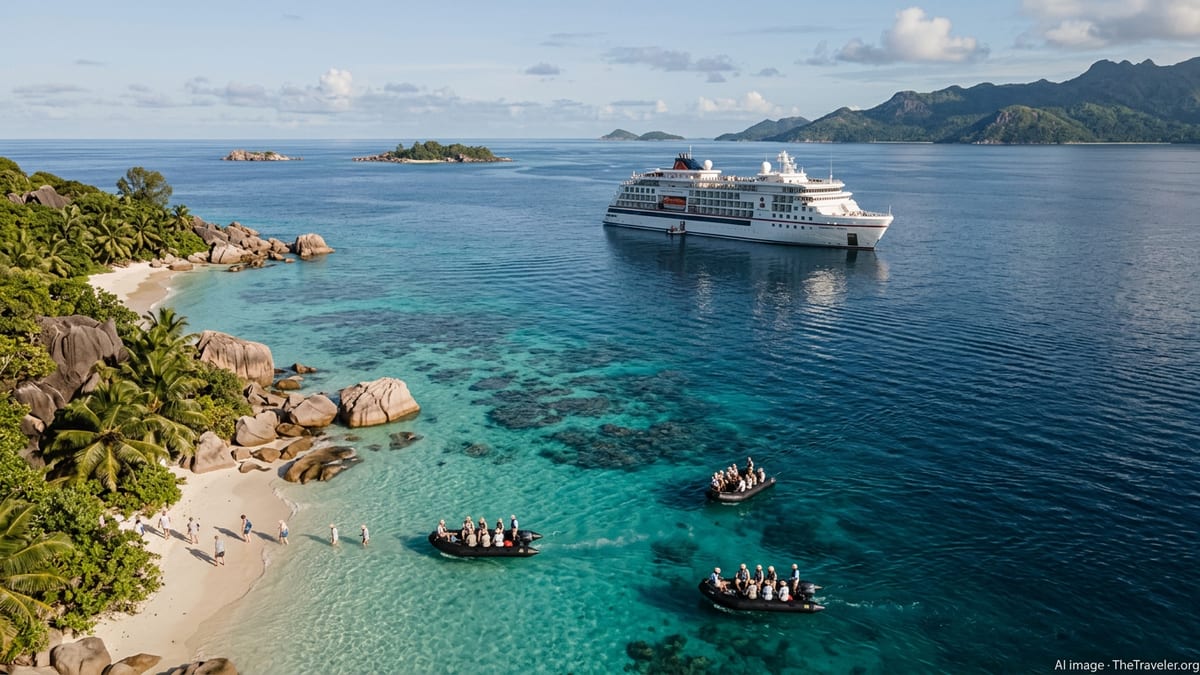
Headline addition to the program is the itinerary titled “Expedition Seychelles: Premiere – A Warm Winter on Tropical Islands,” a December 2027 voyage scheduled to sail from Mahé to Mauritius. Over 12 days, the cruise is set to call at remote Seychelles islands and protected marine reserves that are typically beyond the reach of larger ships, combining reef-fringed beaches with opportunities for guided snorkeling and nature walks.
The route is expected to showcase some of the Indian Ocean’s most pristine archipelagos, with an emphasis on small-group Zodiac landings that bring guests directly to uninhabited or lightly inhabited shores. Expedition leaders and marine biologists are anticipated to accompany landings, interpreting the region’s coral ecosystems, seabird colonies and turtle nesting sites.
By structuring the Seychelles program as a point-to-point voyage between Mahé and Mauritius, Hapag-Lloyd Cruises broadens access for international travelers connecting via major air hubs. The warm-water setting and relatively short sailing distances between islands are being positioned as a comfortable introduction to expedition cruising for guests who may be hesitant about more physically demanding polar regions.
The Seychelles departures are also designed to dovetail with adjacent segments in the broader winter 2027/28 schedule, allowing guests to combine itineraries into longer journeys that trace wider arcs across the western Indian Ocean.
Madagascar Voyages Spotlight Biodiversity Hotspot
Complementing the Seychelles program, Hapag-Lloyd Cruises has announced “Expedition Madagascar: One of Evolution’s Most Beautiful Gifts,” operating in January 2028 between Mahé and Mauritius via Madagascar. The itinerary is planned as a 15-day voyage that concentrates on Madagascar’s extraordinary biodiversity, from lemur-rich forests to mangrove-fringed bays.
Madagascar is widely regarded as one of the world’s most significant biodiversity hotspots, with a high proportion of endemic species found nowhere else. The Hanseatic Nature’s small size and expedition hardware are expected to allow access to lesser-visited anchorages where guests can come ashore by Zodiac for guided hikes, wildlife viewing and cultural encounters in coastal communities.
Hapag-Lloyd Cruises is also continuing its exploration of Madagascar ahead of the 2027/28 season, with two earlier expeditions scheduled aboard sister ship Hanseatic Spirit in November and December 2026. These prior voyages are intended to deepen the line’s operational experience in the region, fine-tuning landing sites and guest experiences that will inform the later Hanseatic Nature program.
Across all Madagascar sailings, the line is emphasizing careful crowd management and small landing groups to minimize impact on sensitive habitats. The expeditions are being positioned as an alternative for travelers who value immersive nature experiences but prefer warmer temperatures and different wildlife to that found in polar regions.
Expedition Concept in a Warm-Weather Setting
Although the new itineraries unfold under tropical skies, Hapag-Lloyd Cruises is maintaining its established expedition framework. Daily plans on board are expected to remain flexible, with the bridge and expedition team adjusting routes in response to wildlife sightings, local conditions and weather. Announced highlights include Zodiac cruises through lagoon systems, beach landings on uninhabited islands and visits to conservation areas that restrict access to smaller vessels.
The line continues to frame its voyages as educational as well as recreational, with lectures, briefings and expert-led excursions central to the onboard experience. Guests can expect talks on Indian Ocean ecology, island geology and regional culture, along with practical guidance on low-impact exploration, such as biosecurity procedures before landings and rules for wildlife viewing.
Hapag-Lloyd Cruises has long marketed its expedition ships as platforms for in-depth discovery rather than resort-style entertainment. The warm-climate program extends that philosophy into a new geography, placing less emphasis on traditional cruise amenities and more on time spent off the vessel. This approach is designed to appeal both to German-speaking core markets and to a growing international audience interested in small-ship expeditions.
Operationally, the western Indian Ocean offers calmer seasonal conditions than many polar regions, which may broaden the demographic able to participate. The company expects that lower weather-related disruption, combined with shorter Zodiac transfers in warm seas, will make the expeditions accessible to guests who might find Antarctic operations too demanding.
Strategic Pivot in an Evolving Expedition Market
The expansion into Seychelles and Madagascar for winter 2027/28 comes as the global expedition cruise sector diversifies beyond its traditional focus on the Arctic and Antarctica. Operators across the industry are increasingly adding warm-water discovery routes in regions such as the Indian Ocean, South Pacific and West Africa, responding to rising demand for year-round expedition options.
By assigning Hanseatic Nature to the western Indian Ocean while keeping two sister ships on polar duty, Hapag-Lloyd Cruises is seeking to maintain its presence in core expedition markets while capturing growth in emerging ones. The new program also helps balance the company’s seasonal deployment, smoothing demand across Northern Hemisphere winters when many travelers are actively searching for warmer destinations.
For destinations such as the Seychelles and Madagascar, the arrival of a small, high-end expedition vessel brings both economic opportunity and increased scrutiny of sustainability practices. Hapag-Lloyd Cruises is under pressure to showcase careful environmental management, from fuel consumption and waste handling to strict adherence to local conservation rules.
As bookings open for the winter 2027/28 voyages, the line is betting that its blend of five-star small-ship comfort and rigorously managed expedition access will resonate with travelers who want to explore some of the world’s most biologically rich tropical regions without sacrificing environmental responsibility.