


Most travelers ride the Monte Solaro chairlift for a quick selfie over the Faraglioni, then hurry back to Capri town. Yet this 589 meter peak above Anacapri is far more than a viewpoint. In its stone walls, tiny hermitage and silent paths are stories that even many repeat visitors never hear. Look a little closer, and Monte Solaro reveals a quieter Capri of sailors’ vows, forgotten forts and rare plants clinging to the limestone.
Get the latest updates straight to your inbox!
The Mountain That Catches Clouds
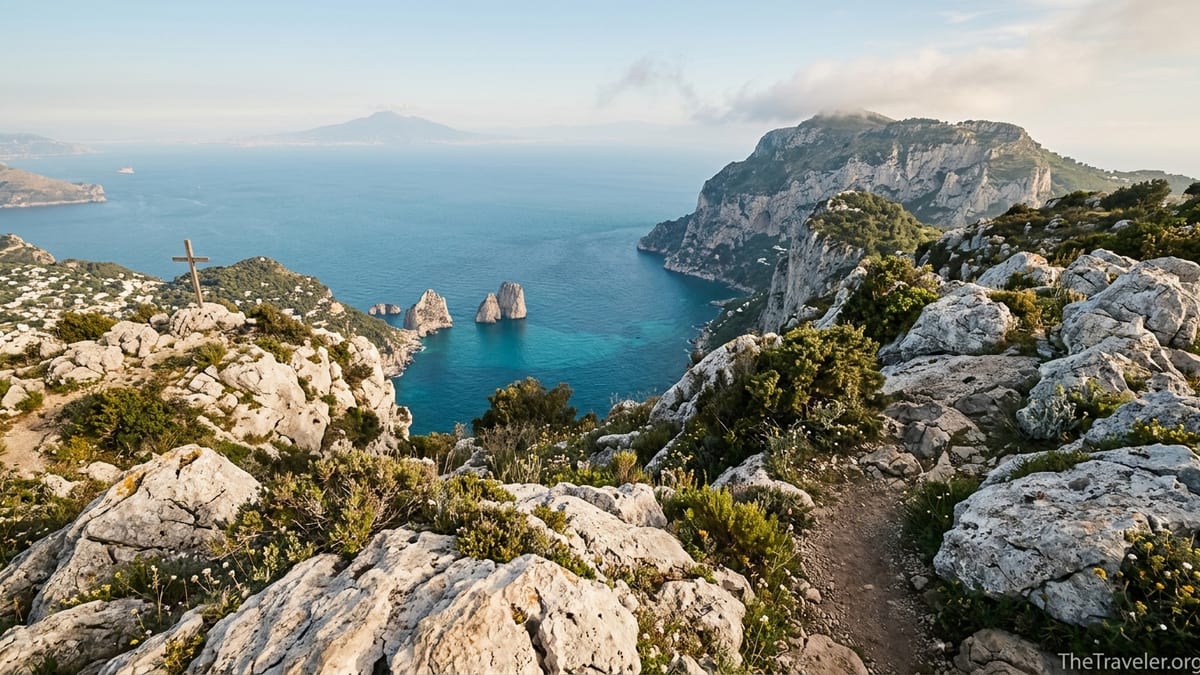
Guides usually introduce Monte Solaro as the highest point on Capri, but they often skip its local nickname: “Acchiappanuvole,” the cloud catcher. Islanders use this name because of a quirk of weather you can watch in real time if you know to look for it. On spring and autumn mornings, as ferries from Naples approach the island, you can sometimes see a ring of mist wrapped only around the mountain summit while the rest of Capri sits in sun. The warm, damp sea air hits the colder rock after the night, condenses and forms a crown of clouds that seems to cling to Monte Solaro alone.
Many visitors arrive around midday, when the sky is usually clear, and never notice this phenomenon. If you take one of the first buses up to Anacapri and catch the chairlift between about 9 and 10 in the morning, you may actually ride through this soft haze. On lucky days, the mist opens in patches, framing sudden, cinematic cuts of the Faraglioni below or the Sorrento Peninsula in the distance before closing again. It feels almost like the mountain is deciding how much of its view to show you at once.
Even on bright days, the cloud catcher nickname makes sense when you pay attention to the breezes at the top. Sit for a few minutes on the rocks near the main terrace and you may feel cool drafts sweep up one side of the ridge, carrying the smell of thyme and pine. Those currents are the same invisible forces that pile fog here in colder seasons. Most people snap a photo and move on, but if you linger long enough to notice those shifting winds, you begin to understand why local sailors once read Monte Solaro’s cloud patterns like a weather report.
The Chairlift: More Than a Scenic Ride
The single-seat chairlift from Piazza Vittoria in Anacapri is usually described as a simple 12 minute ascent. In practice it is one of the most intimate ways to understand the island’s verticality, and it is full of subtle details that regular visitors miss. For one, pay attention to how quickly the human world drops away. After passing a few tiled terraces and gardens, the line swings out over abandoned stone walls and wild maquis that were once cultivated vineyards. Old retaining walls appear in the brush, half swallowed by mastic trees and broom. These traces show how far up the slopes island farmers once worked before tourism took over the coastline.
Prices change periodically, but in recent seasons the chairlift has generally cost a little under the price of a simple sit-down lunch in Capri town for a round trip, with a modest saving if you buy a one way ticket and hike back. At the ticket booth, ask specifically for “solo andata” if you want the downhill walk option, something many travelers do not realize is possible until they reach the summit. Staff are used to last minute changes and will often explain the combination that suits you if you mention you plan to stop at the Cetrella hermitage on the way down.
As you float upward, look down at the poles of the lift. Several carry small plaques and maintenance dates, quiet reminders that this system has been operating for decades and is still a lifeline for residents as well as tourists. Locals use it to reach small plots and to take visiting relatives to the top without a strenuous hike. If you glance back toward Anacapri itself, you will also notice how the town is laid out around Piazza Vittoria like a fan of white cubes with flat roofs and small citrus gardens. The chairlift gives perhaps the clearest sense of how compact Anacapri really is compared with busy Capri town.
Finally, listen as you ride. The soundtrack is not just camera shutters. On quieter days, you may hear the bells of a distant church in Anacapri, the rustle of wind in pines below, and, occasionally, the cry of a peregrine falcon that nests in the cliffs. That layered soundscape is part of Monte Solaro’s character, one that disappears as soon as you rejoin the crowds in the square.
Hidden Corners at the Summit
Most visitors arrive at the top, step out of the chairlift and walk straight to the large panoramic terrace beside the café La Canzone del Cielo. The view from here does merit its reputation. On clear days you see the Faraglioni directly below, the Marina Piccola side of Capri to your left, and beyond that Mount Vesuvius and the curve of the Bay of Naples. What many people miss is that this is only one slice of the 360 degree panorama and not even the most atmospheric part of the summit.
If you turn your back to the main terrace and walk a couple of minutes along the dirt paths that snake through low scrub, you reach quieter lookouts where the view unfolds differently. One narrow track leads to a modest stone cross on a knoll. From here you can see both the Gulf of Naples and, if the air is clear, the Gulf of Salerno at the same time. Another unmarked path heads toward a rocky outcrop with rusted railings, a reminder of earlier tourism projects. These paths are not difficult, but they are uneven, so sturdy sandals or trainers are better than beach flip-flops.
Look closely at the rocks themselves. The summit is made of pale limestone carved by thousands of years of wind and rain. In the pockets where dust gathers, you will notice small cushions of wild thyme, dwarf broom and low, spiky shrubs clinging to the stone. In late spring tiny orchids appear here, often no taller than a coin, and many visitors stomp right past them. The official signage tends to highlight only the sweeping panorama, but Monte Solaro is also one of Capri’s richest areas for native flora, with hundreds of plant species recorded in the wider massif. Without turning your visit into a botanical survey, simply slowing down enough to notice these miniature gardens changes how you experience the peak.
The café itself hides some small curiosities. La Canzone del Cielo has an understated retro feel, with simple white chairs and old fashioned rocking chairs along its terraces. Prices for drinks are higher than in Anacapri, as you would expect at the top of the island, but sitting with a basic espresso or a glass of mineral water while you watch private yachts trace white arcs in the sea far below can feel luxurious. At busy times, instead of joining the queue at the bar, check the side terrace to the right where a secondary counter sometimes opens, a detail regulars use to avoid the main crowd.
The Forgotten Hermitage of Santa Maria a Cetrella
About halfway between the summit and Anacapri, tucked into a hollow of the mountain, lies one of Capri’s most atmospheric sites: the hermitage and chapel of Santa Maria a Cetrella. Many guidebooks mention it briefly; in reality it is the spiritual heart of this side of Monte Solaro, and most visitors never see it because they ride the chairlift round trip without hiking. The path from the summit takes around 25 to 30 minutes, descending through pines and low oaks before the whitewashed buildings appear, wedged improbably into the cliff above Marina Piccola.
The name “Cetrella” probably comes from an herb with a lemon scent that grows in these slopes, sometimes identified as a type of melissa or citronella. You can still smell this note in the air on warm afternoons. The hermitage itself dates back to the late Middle Ages, with later additions in the 16th and 17th centuries. Its tiny church, simple bell tower and sacristy cluster around a small courtyard. Step inside, and you find a cool, low vaulted interior with painted altars and a much venerated image of the Madonna. Local fishermen and coral divers once climbed here before long voyages to ask for protection, and ex-voto offerings once lined the walls.
Outside the chapel, a pergola covered in wisteria shades a rustic table and benches, and a narrow terrace clings to the cliff edge, looking straight down to the Marina Piccola side of the island. This is one of the most quietly dramatic viewpoints on Capri, and yet it is common to find only a handful of hikers here, even on crowded summer days. The silence is broken mainly by wind and the distant sound of boat engines, a stark contrast to the lively marina below.
The hermitage keeps irregular opening hours, often run by volunteers and religious communities, so you may find the interior closed. Even so, the walk and the setting are worth the detour. If you plan to hike, ask at the Anacapri tourist office whether Santa Maria a Cetrella is likely to be open that week. They often have up to date information from the caretakers, something many independent visitors do not realize they can request. Taking a small snack or a sandwich to eat quietly on the terrace, while respecting the religious nature of the site, turns a rushed summit visit into a half day of slow exploration.
Silent Traces of Forts, Watchpoints and Writers
Monte Solaro has not always been a peaceful lookout. On various ridges and promontories around the massif, especially on the seaward sides, you can still see remains of small military fortifications dating from the Napoleonic era, when British and French forces fought for control of Capri in the early 19th century. One of these, Fortino di Bruto, lies on a spur not far from the mountain’s slopes. From the summit, if you look west along the coast toward the Fortini coastal path, you can spot low stone structures that once housed cannons aimed at enemy ships approaching the island.
These forts are rarely discussed when people talk about Monte Solaro, yet they help explain why Capri was so strategically important. The same height that today offers tourist views once allowed soldiers to watch shipping lanes across both the Gulf of Naples and the waters toward Salerno. When you stand at the summit and turn slowly, you can imagine that almost any movement in the surrounding seas would have been visible from here, long before radar.
Cultural history has also left quieter marks. Below the main peak, in the Cetrella valley, sits Casa Mackenzie, a modest house where Scottish writer Edwin Cerio’s contemporary, the British writer Compton Mackenzie, is remembered to have stayed in the early 20th century. The house itself is simple, but the path he helped promote, linking Monte Solaro down toward the sea, still carries his name in some local itineraries. When you pass the house on the way to or from the hermitage, you are walking into a landscape that inspired novels and travel writing about Capri in an earlier, less crowded era.
Pay attention, too, to older stone markers and small shrines along the paths. In several places, modest crosses or painted tiles of the Madonna tuck into rock faces. They mark old routes farmers and muleteers once used to cross the mountain long before the chairlift opened in the 20th century. Today many visitors stride past them while checking their phones for the next bus schedule, but pausing to notice these signs reconnects the mountain with the people who lived and worked here year round, not just those who visit for a few sunny hours.
A Living Laboratory of Capri’s Flora and Fauna
Monte Solaro is one of the best places on Capri to see how Mediterranean nature adapts to height and exposure, yet this side of the mountain is rarely treated as more than a scenic backdrop. If you walk even a short distance away from the main terrace at the summit, you step into a natural classroom. The vegetation here changes in tight bands. On the more sheltered slopes and in the Cetrella valley you find taller oaks, pines and arbutus trees. Higher up and on exposed ridges, the plants hunker low against the wind: juniper, myrtle, wild thyme, broom, rock roses and many species of tiny orchids and bulbs.
In recent years, local groups and guides have begun to highlight this diversity with small panels and guided walks, but casual visitors often miss them entirely. If you are hiking, you might consider carrying a simple pocket field guide to Mediterranean plants or using an identification app on your phone. When you realize that the blue flower at your feet is a type of Lithodora that has adapted to carbonate rock, or that the spicy scent on your hands comes from crushed wild oregano growing naturally in crevices, the summit experience becomes more textured and memorable.
The fauna is discreet but present. Early in the morning or late in the afternoon, birdwatchers sometimes glimpse peregrine falcons riding thermals along the cliffs. Smaller birds, from warblers to finches, flit between the shrubs. In the Cetrella woods, if you walk quietly, you may hear the call of a scops owl around dusk or notice beetles and butterflies specific to this microclimate. None of this requires specialized equipment. Simply slowing your pace and alternating between looking at the horizon and at the ground under your feet reveals a parallel Monte Solaro that has nothing to do with souvenir stands.
There is also a growing awareness of environmental pressures. On popular days, hikers sometimes stray from marked trails, trampling delicate vegetation and increasing erosion on the limestone slopes. When you choose to stay on existing paths, carry your rubbish back to town, and avoid picking wildflowers, you become part of a quiet movement among visitors who want Capri’s wild side to remain intact. Guides in Anacapri often appreciate when travelers ask about low impact options and can suggest routes where your presence supports small local businesses without overburdening sensitive areas.
How to Experience Monte Solaro Differently
For many Capri day trippers, time is tight. They arrive mid-morning from Sorrento or Naples, queue for the blue grotto, squeeze in a quick visit to Anacapri and ride the Monte Solaro chairlift if the line is short. Under that schedule, it is understandable that the visit becomes a ticked box. Yet with a few small adjustments, you can see the same mountain through a much richer lens, even on a short stay.
One approach is to invert the usual order. Instead of visiting Capri town first, take the early bus from Marina Grande straight up to Anacapri and ride the first or second chairlift of the day. The light is softer, crowds are thinner, and you are more likely to notice details like the cloud ring around the summit or the changing bird calls as the slopes warm up. Plan from the outset to walk at least part of the way down, stopping at the hermitage of Santa Maria a Cetrella or following one of the signed trails toward the Fortini coastline if you have several hours and good footwear.
Another strategy is to give Monte Solaro the better part of a full day if you are staying overnight on Capri. Morning can be devoted to the summit and Cetrella, with a simple picnic of bread, cheese and fruit bought in Anacapri eaten under the pergola or on a quiet rock platform. Afternoon could be spent descending slowly toward the coast, linking paths to reach quieter stretches near the lighthouse of Punta Carena or the Fortini path, where you encounter traces of fortress walls and old artillery positions facing the sea. Ending the day with a swim there, then taking the bus back up to Anacapri, connects the high and low edges of the island in a way few visitors experience.
Throughout, small practical choices make hidden details easier to spot. Wear shoes you can comfortably walk an hour in. Carry a refillable water bottle, as summit prices are higher and shade limited outside the hermitage valley. Bring a light scarf or thin jacket even in summer: at almost 600 meters, wind at the top can be surprisingly sharp compared with the beaches. Most importantly, budget a little extra time. Monte Solaro rewards detours and silences more than rushed itineraries.
The Takeaway
Monte Solaro is often sold as a viewpoint, a 12 minute chairlift ride to a postcard panorama. Yet the mountain holds far more than a photogenic terrace. It is a place where weather writes visible stories in rings of cloud, where an almost hidden hermitage still anchors old maritime devotions, where abandoned vineyard walls and crumbling forts recall centuries of hard work and conflict, and where rare plants and birds cling to the limestone just below tourists’ feet.
By riding the chairlift with attention instead of distraction, by following side paths to quiet crosses and pergolas, by listening for falcons rather than only for camera shutters, you begin to see the same landscape that locals, monks, soldiers and writers have read in different ways over the centuries. None of this requires special access or insider contacts, only curiosity and an extra hour beyond the usual schedule.
If you arrive in Capri and treat Monte Solaro as more than an item on a checklist, you will carry away more than a digital photo. You will remember the smell of lemon-scented herbs near Cetrella, the feel of cloud damp on your skin during the ascent, the outline of old fort walls against late afternoon light and the improbable quiet above Marina Piccola. Those are the hidden details that turn a high viewpoint into a deep experience.
FAQ
Q1. How long should I plan for a visit to Monte Solaro if I want to see these hidden spots?
For a basic round trip by chairlift and a few photos, 1 to 1.5 hours is enough, but if you want to include the Cetrella hermitage and some quiet paths around the summit, plan at least 3 to 4 hours. Travelers staying overnight on Capri often dedicate half a day, which allows time for unhurried pauses at viewpoints and the option to walk part of the way down.
Q2. Is the walk to the Santa Maria a Cetrella hermitage suitable for beginners?
The path from the summit down to the hermitage is a moderate downhill walk of about 25 to 30 minutes on uneven terrain. It does not require advanced hiking skills, but you should wear comfortable closed shoes and be steady on your feet. Families with older children who are used to walking generally manage it well, while those with very young kids or mobility issues may prefer to ride the chairlift both ways and skip the detour.
Q3. Are there any entrance fees for the hermitage or the trails around Monte Solaro?
Access to the trails and the hermitage of Santa Maria a Cetrella is typically free, though you may find a donation box at the chapel to support its upkeep. The main cost associated with Monte Solaro is the chairlift ticket from Anacapri. Exact prices change over time, so it is best to check locally at the ticket office or the Anacapri tourist information point on the day of your visit.
Q4. Can I visit Monte Solaro if I am afraid of heights?
Many travelers who are mildly uncomfortable with heights still ride the chairlift, as it is not extremely high above the ground and moves quite slowly. If you know you will not be comfortable, you can walk up or down instead via the well marked trail that starts near Anacapri’s cemetery. At the summit, some viewpoints are close to steep drops, but there are also more recessed terraces where you can enjoy the panorama without standing near the edge.
Q5. What time of day is best to see the “cloud catcher” effect on Monte Solaro?
The ring of mist around the summit is most likely to appear in the cooler months of spring and autumn, particularly in the morning when the sea air meets the cooler rock. Early chairlift rides in these seasons give you the best chance of seeing the clouds form and break around the peak. In high summer, the air is often clearer, so the cloud crown is less common, but early and late hours still offer softer light and fewer people.
Q6. Is there food and water available on Monte Solaro and along the paths?
At the summit, the café La Canzone del Cielo serves drinks and light snacks, though prices are generally higher than in town. There are no shops along the paths or at the hermitage, so it is wise to bring a bottle of water and a small snack from Anacapri, especially in warm weather. If you plan a longer hike toward the Fortini coastal path or Punta Carena, carrying extra water is important, as shade can be limited on exposed stretches.
Q7. How do I find the quieter lookouts away from the main summit terrace?
From the chairlift exit, instead of following the crowd directly to the large terrace, look for smaller dirt paths branching off through low shrubs in the direction opposite the café. These short trails lead to rocky knolls and simple stone crosses with fewer people and wide views in both directions. The paths are not long or difficult, but they are informal and uneven, so walk carefully and avoid approaching unprotected edges.
Q8. Are guided walks available that focus on Monte Solaro’s nature and history?
Yes, several local guides based in Anacapri offer walks that combine the summit, the Cetrella hermitage and sometimes the forts along the coast. These tours typically last half a day and may include explanations of local plants, birds, historic fortifications and religious traditions tied to the hermitage. You can ask at the Anacapri tourist office or at small hiking and guiding outfits in town for current options and schedules.
Q9. What should I wear and bring if I plan to hike down from Monte Solaro?
Wear sturdy walking shoes or trainers with good grip, comfortable clothes suited to the season and a light jacket or scarf for the wind at the top. Bring water, sun protection such as a hat and sunscreen, and a small snack if you expect to be out for several hours. A simple map or offline navigation app is also helpful, particularly if you plan to link different trails, such as from the summit to Cetrella and on toward Punta Carena or the Fortini coastal path.
Q10. Is Monte Solaro worth visiting if I only have a single day on Capri?
Even on a tight schedule, Monte Solaro can be one of the most rewarding experiences on the island. A focused visit that takes the chairlift up, allows 30 to 45 minutes at the summit, and includes at least a short walk away from the main terrace will give you a sense of Capri’s geography and quiet side that you will not get from the marina or the shopping streets. If you can stretch your stay to include the Cetrella hermitage as well, the mountain often becomes the highlight of a short trip.