


Mandelieu-la-Napoule sits quietly between Cannes and Théoule-sur-Mer, often treated as a day-trip add‑on rather than a destination in its own right. Look a little closer, however, and this pocket of the French Riviera reveals secret coves, fragrant hill walks and lived-in neighbourhoods that most visitors to the coast never take the time to find. This is where you can still buy fruit from the same vendor who serves the local grandmothers, swim off rocks known only to people from the next bay, and watch the sunset from a medieval ruin instead of from a crowded beach bar.
Get the latest updates straight to your inbox!
Why Mandelieu-la-Napoule Rewards Curious Travelers
Wedged between high-profile Cannes and the wild red cliffs of the Estérel, Mandelieu-la-Napoule is easy to overlook. Many people whizz through on the coastal road or come just to visit the waterfront château before heading back to bigger-name resorts. That relative anonymity is precisely what keeps many of its most interesting corners pleasantly low-key, even in peak summer.
The town grew around two strong characters: the sea, with a string of small ports and sandy beaches, and the volcanic hills that rise steeply behind. Official tourism materials play up the marinas and the famous golf course founded in the late 19th century, but beyond those headline sights lie shaded canal paths, hilltop ruins, tiny beaches at the end of unmarked alleys and residential districts with a village feel. With a bit of curiosity, you can still find places where menus are written only in French and coffee is cheaper than a deckchair rental in Cannes.
Because many of these discoveries are outside the usual coach-drop radius, it helps to plan slightly differently. Instead of hugging the main seafront the entire time, consider using local buses, following signs to "parc" and "sentier" rather than just "plage," and allowing pockets of unstructured wandering. In Mandelieu-la-Napoule, some of the best moments happen when you turn away from the obvious beach and follow the locals disappearing up a side street or into the pine trees.
The Secret Coast: Little Beaches and Coastal Corners
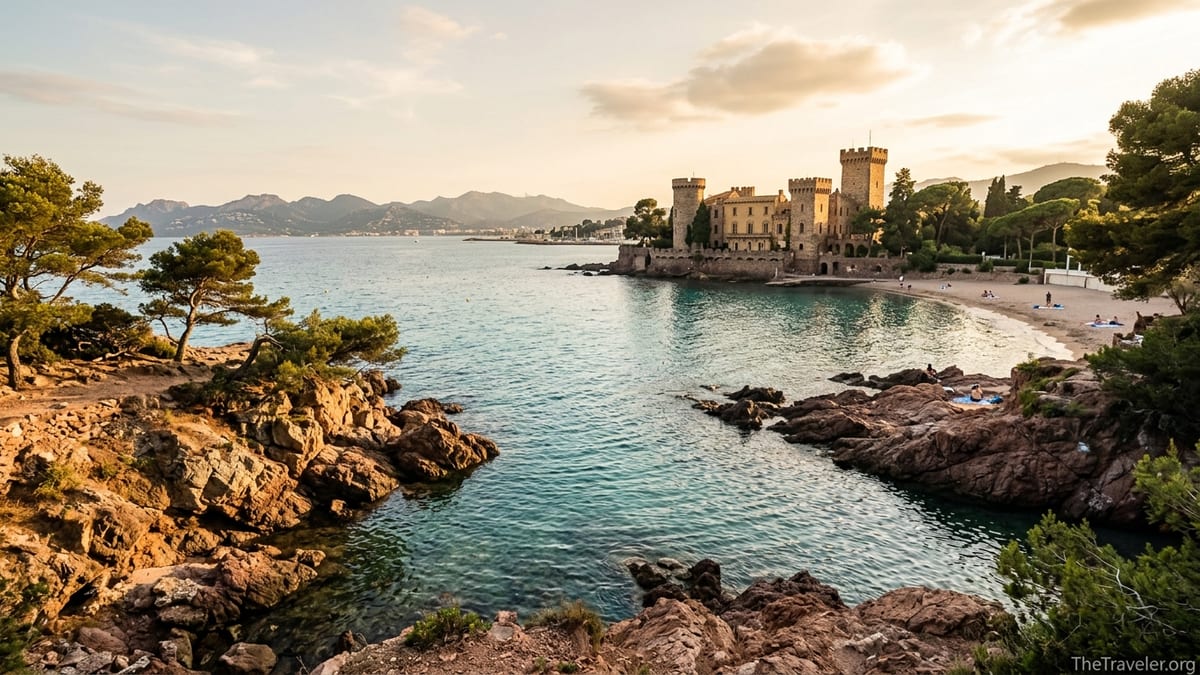
Most visitors stop at the broad main sands in front of Château de la Napoule, where sun-loungers fill quickly on summer mornings. For a more discreet experience, follow the coastal path west toward the small ports. Rague Beach, for example, sits in a gentle curve beneath the road and is partially hidden by rocks and pines. It does have a small public area, but outside of French school holiday periods you can often still spread out your towel without feeling like you are in a beach club advertisement.
Late afternoon is when this part of the coast comes into its own. As the sun drops behind the Estérel hills, the water takes on deep blue and copper tones, and locals drift down for a quick swim after work. You might see teenagers jumping from the rocks on the eastern side, and older residents swimming slow laps parallel to the shore. Bring your own picnic picked up earlier from a bakery or the village supermarket and you can stay until the streetlights start to flicker on the coastal road above.
Another understated spot sits closer to the château, where the coastal path slips between garden walls and the sea. From the official beach near the castle, small side tracks lead down to flat rocks and miniature coves completely overlooked by people who stay on the sand. These are not places with facilities or lifeguards, so they suit confident swimmers and those happy to perch on warm stone rather than a sun-lounger, but the reward is clear water and open views across the Bay of Cannes with fewer conversations carried out in tour-bus English.
Mont San Peyre: A Hilltop Sanctuary Above the Sea
Rising only around 130 metres above sea level, Mont San Peyre does not look like a major summit, yet this modest volcanic cone is one of the most atmospheric viewpoints on this stretch of coast. The hill is protected as an 18-hectare departmental park, criss-crossed with a looped walking trail of roughly 3 to 4 kilometres. The path begins from a quiet residential area near the coast road and quickly slips into pine and cork oak forest, with the scent of wild herbs and, in season, mimosa blossom underfoot.
The climb is gentle, making it accessible to most reasonably fit walkers, including families. Interpretive signs along the way point out native plants, and glimpses open up toward the Siagne river and the marinas below. Near the top you pass the low stone remains of the old Villeneuve castle, now more of a romantic ruin than a formal attraction. The final reward is a near-360-degree panorama taking in the Gulf of La Napoule, the Lérins Islands off Cannes and the jagged red outline of the Estérel Massif to the west.
What keeps Mont San Peyre a hidden gem is that you cannot drive to the summit or buy anything once you are on the trail. Come prepared with water, sun protection and suitable shoes. If you start early, around 8 or 9 in the morning between late spring and early autumn, you might share the paths only with joggers using the marked fitness loop on the ascent. Evening walks are equally magical, especially on warm, clear days when the light softens over the bay and the noise from the coastal road seems to fall away far below.
Château de la Napoule’s Quieter Side: Gardens, Art and Oddities
Many people see Château de la Napoule purely as a photogenic backdrop to the beach, yet behind its thick sea-facing walls lies one of the Riviera’s more unusual artistic legacies. The medieval fortress was painstakingly restored in the early 20th century by American sculptor Henry Clews Jr. and his wife Marie. While group tours come for the romantic story and the terrace views, relatively few visitors linger in the gardens, which blend formal French layouts, intimate courtyards and a more relaxed English-style landscape, all threaded with whimsical sculptures and carved inscriptions.
The couple used the grounds as a kind of open-air gallery. As you wander, you might notice strange faces peering from columns, fantastical beasts crouched on balustrades and the words "myth," "mystery" and "mirth" worked into the stonework. These personal touches give the site a lived-in, almost eccentric feel compared with grander but more impersonal Riviera villas. Garden enthusiasts will recognise classic design features such as clipped hedges guiding the eye to the sea, long alleys framing views toward the bay, and quiet seating areas tucked under old trees.
Today the château operates as a museum and arts centre under a foundation, with rotating exhibitions and occasional artist residencies, yet you can still find tranquil corners even on busy days. If your schedule allows, plan to visit outside peak hours, for instance mid-morning on a weekday, when tour groups are thin on the ground. After exploring the interiors, resist the urge to rush off the property and instead take a slow circuit of the seaside terraces and upper garden paths. You will often find yourself almost alone, listening to waves hitting the rocks below and catching an entirely different mood from the one experienced at the busier entrance courtyard.
Everyday Mandelieu: Markets, Backstreets and Local Tables
While nearby Cannes often feels curated for visitors, Mandelieu-la-Napoule still has areas where day-to-day life unfolds with minimal concern for the tourist gaze. One of the most rewarding ways to tap into this atmosphere is to time your stay to coincide with a market morning. In the La Napoule quarter, stalls typically set up a short walk back from the seafront, selling seasonal fruit and vegetables, olives, local cheeses and ready-to-eat items such as roast chicken and socca-style chickpea dishes. Prices here tend to be more grounded than in the glitzier resorts, and regulars chat with vendors as much as they shop.
Beyond market hours, simply wandering the backstreets inland from the port can reveal family-run bakeries and modest cafés with simple daily menus. Expect classic French Riviera staples such as salade niçoise, grilled fish of the day and tarte tropézienne, often served on shaded terraces where the soundtrack is local radio rather than curated lounge music. These are the kinds of places where lunch formulas with starter and main or main and dessert are often comparable in price to a single cocktail at a waterfront bar in Cannes.
Residential districts like Capitou, perched slightly inland, hint at the town’s older village roots. Here you find narrow lanes, small squares and everyday services: butchers, pharmacies, tabacs and unpretentious bars where people stop for a morning coffee or an early-evening pastis. Visitors rarely make it this far from the sea, but a short bus ride or drive rewards you with a sense of how residents actually live and socialise, far from yacht marinas and resort branding.
Rivers, Canals and the Green Heart of the Old Course
At first glance, the Golf Old Course Cannes-Mandelieu might not sound like a hidden gem, given its reputation as one of the oldest clubs in France. Yet the wider area around the course, spread over roughly 70 hectares of pine forest beside the Siagne river, offers a distinctly different feel from the built-up seafront. Even if you do not play golf, strolling near the riverbanks or along adjoining paths lets you experience a striking contrast between thick umbrella pines, manicured greens and the gentle flow of the water as it approaches the Mediterranean.
The course is famous among golfers for an unusual feature: to reach some holes, players cross the river on a small ferry platform rather than a bridge. While this quirk is mostly reserved for paying golfers, it hints at the slightly offbeat, almost island-like atmosphere in this pocket of Mandelieu-la-Napoule. On quieter days you can often hear nothing but the wind in the pines and distant thud of golf balls, even though you are only a short distance from busy roads and holiday apartments.
For non-golfers, the Siagne itself can be the focus. Paths and small roads follow sections of the river inland, where you may spot houseboats, waterside gardens and anglers trying their luck from the banks. Renting a bicycle or simply walking along these quieter stretches provides a cooling alternative to the exposed beachfront, especially in the heat of summer. It is also a reminder that, despite its relatively modest size, Mandelieu-la-Napoule is not just a linear strip of sand but a place of rivers, trees and layered landscapes.
Exploring the Ports and Marinas Beyond the Gloss
Mandelieu-la-Napoule is sometimes described as a "city of marinas," with several small ports lined up along its coastline. On paper these can sound interchangeable, but on the ground each has its own personality, and some reward a slower look. Away from the busiest yacht pontoons you find small fishing boats, practical chandlers and unassuming cafés serving early-morning workers long before most visitors have left their hotels.
In the smaller harbours, it is common to see owners tinkering with their boats, mending lines or chatting across the water. Sitting on a bench with a takeaway coffee from a nearby bakery, you can watch this choreography of everyday maritime life: deliveries arriving, divers checking hulls, sailing-school dinghies mustering before heading out. It feels a world away from the carefully polished image of larger Riviera ports, even though the same bay connects them all.
Some marinas have simple waterfront paths open to the public. Following these in the early evening, you may pass modest apartment blocks and boatyards on one side and rows of bobbing masts on the other. From certain angles, the view back toward Mont San Peyre or across to Cannes is superb, yet you will often share the scene only with dog walkers and residents getting in a short stroll after dinner. For travellers willing to step a few minutes beyond the restaurant cluster on the main promenade, these edges of the marinas become places to breathe and observe rather than to pose.
The Takeaway
Mandelieu-la-Napoule will never compete with Cannes or Nice for spectacle, and that is precisely its charm. This is a town of smaller gestures: a shaded bench above a quiet cove, the smell of pine needles warming on a hillside trail, the sound of a market stallholder greeting regular customers by name. Many of its most rewarding experiences are accessible only to those prepared to walk five minutes further, climb a modest hill or step into a neighbourhood that does not appear on the average visitor’s itinerary.
For travellers who enjoy a slower, more observant style of exploration, Mandelieu-la-Napoule offers an appealing balance. You can dip into classic Riviera pleasures, from castle views to soft-sand beaches, then retreat to lesser-known marinas, riverside paths and village corners where daily life carries on much as it has for years. Approach the town with curiosity rather than a checklist, leave space in your schedule for detours, and you will discover a version of the Côte d’Azur that still feels, at least in parts, like a local secret.
FAQ
Q1. Is Mandelieu-la-Napoule a good alternative to staying in Cannes?
Yes. Mandelieu-la-Napoule offers easier access to beaches, generally calmer evenings and more local-feeling neighbourhoods, while Cannes is only a short drive or public transport ride away for day trips.
Q2. How difficult is the walk up Mont San Peyre?
The main loop is relatively short, with a steady but not extreme incline. Most reasonably fit adults and children manage it comfortably in around an hour including photo stops, provided they wear proper shoes and bring water.
Q3. Are the smaller coves and rock beaches suitable for families?
They can be, but they suit confident swimmers and children used to uneven terrain. There are no lifeguards, and access may involve rocky paths, so families with very young children may prefer the main supervised sandy beaches.
Q4. Can non-golfers enjoy the area around the Old Course?
Yes. Even if you do not play, the surrounding pine forest, river views and nearby paths create a pleasantly green environment for walking or cycling away from the most built-up seafront sections.
Q5. Do you need a car to explore Mandelieu-la-Napoule’s hidden spots?
A car gives flexibility, especially for reaching hilltop viewpoints and inland districts, but many coastal paths, the château, Mont San Peyre trailhead and local markets are reachable on foot or by local bus from central areas.
Q6. When is the best time of year to avoid crowds?
Outside the main French holiday periods, particularly in late spring and early autumn, you will find fewer visitors on the beaches, trails and in the gardens while still enjoying mild to warm weather.
Q7. Are there affordable places to eat compared with other Riviera towns?
Yes. Away from the immediate seafront, especially in residential quarters like Capitou or streets behind the ports, you can find bakeries, cafés and bistros with prices closer to what local residents pay.
Q8. Is the Château de la Napoule interesting if I am not usually a museum person?
Many visitors who are not regular museum-goers enjoy the château because of its gardens, sea views, eccentric sculptures and romantic history, which together create more of an atmospheric experience than a traditional gallery visit.
Q9. Can I swim near the marinas?
Swimming is generally concentrated on designated beaches and rocky coves rather than within the marina basins themselves, but some coastal paths run close to the water, with signed access points to nearby bathing areas.
Q10. How much time should I plan to discover Mandelieu-la-Napoule’s lesser-known side?
Allow at least two full days. That gives enough time to explore Mont San Peyre, visit the château and its gardens, sample local markets and cafés, and enjoy a couple of the quieter beaches or marina strolls at a relaxed pace.