


On paper, Mandelieu-la-Napoule should feel as hectic as its glamorous neighbors. It sits just a few kilometres from Cannes on the same golden curve of the French Riviera, with a castle on the sea, a historic golf course and a string of marinas. Yet the first time I stepped off the train and walked down to the water, what surprised me most was how relaxed it felt. The crowds, the traffic and the self-conscious glamour of the coast seemed to evaporate, replaced by something gentler and thoroughly local.
Get the latest updates straight to your inbox!
A Riviera Address Without Riviera Pressure
The contrast usually hits as soon as you arrive. If you come by TER train from Nice or Cannes, Mandelieu-la-Napoule is often just another stop on the coastal line, a place commuters hop off with beach bags and shopping totes. The small station is a world away from the designer storefronts of central Cannes. Instead of taxis jockeying for position, you are more likely to find residents walking home or heading toward the sea with their dogs trotting beside them.
Walk ten minutes down Avenue Henry Clews and the mood stays resolutely low-key. The traffic is lighter, the buildings shorter and the tempo slower than in the neighboring resort towns. Cafés around Port La Napoule tend to be simple brasseries and ice cream stands rather than champagne terraces. At lunchtime you will see office workers in short sleeves, parents with strollers and retired couples chatting over a carafe of house rosé, not Instagrammers chasing the next perfect backdrop.
What makes this surprising is the setting. Mandelieu-la-Napoule shares the same mild Mediterranean climate, with beach weather stretching roughly from late May to late September, but it has largely avoided the hyper-luxury branding that defines parts of the Riviera. Hotel prices, while not cheap, are often lower than those in central Cannes during festival season, and short-term rentals tend to be geared to French and European families rather than bachelor parties or yacht week crowds. The result is a coastal town where tourism coexists with ordinary life rather than overwhelming it.
This balance becomes especially clear in the evenings. While Croisette traffic in Cannes can back up and restaurant reservations involve careful planning, Mandelieu’s waterfront remains within the realm of the spontaneous. You can usually sit down at a pizzeria or neighborhood bistro near the port without weeks of advance booking, even in July, and still enjoy views across the bay toward the islands off Cannes and the red cliffs of the Estérel.
The Castle Beach That Still Feels Like a Local Secret
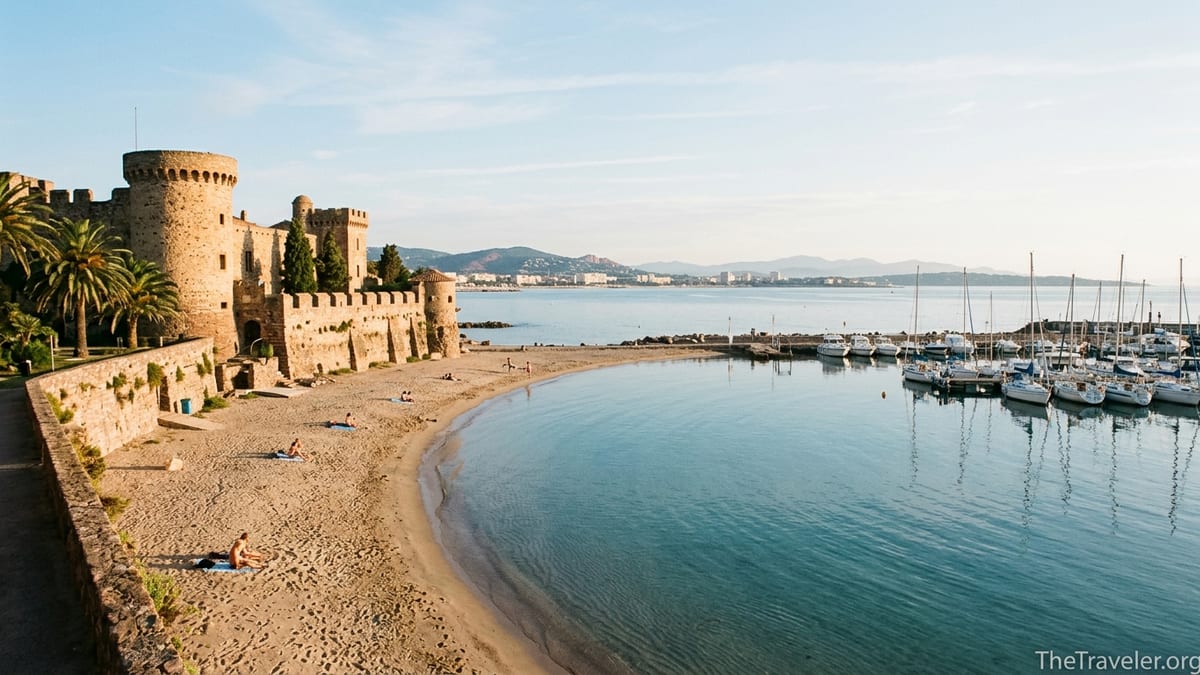
Plage du Château is arguably Mandelieu-la-Napoule’s star attraction, yet it rarely feels overwhelmed. The sandy curve stretches for roughly half a kilometre between the walls of Château de la Napoule and the yachts of Port La Napoule, with open views toward the Lérins Islands and the skyline of Cannes across the water. Even on warm weekends, you are more likely to share the sand with local families and couples than with long lines of rental sunbeds.
The beach itself is straightforward and unpretentious. There are showers, basic facilities and patches of public sand where you can simply lay down a towel. In summer, you might rent a pair of loungers and an umbrella from one of the regulated beach concessions, but these are modest compared with the elaborate beach clubs further along the coast. Vendors stroll by selling cold drinks and ice creams, though many people simply stop at a nearby bakery on the way down and arrive with paper bags of still-warm baguette sandwiches.
At the western end of the beach, a coastal path slips around the base of the castle. It hugs the rocks, ducking under stone arches and past small coves where the water turns a deep, clear turquoise on calm days. You can follow it to a smaller, more secluded patch of sand on the far side of the headland, the sort of place where you spread out a sarong on the rocks and watch paddleboarders glide past. The only soundtrack tends to be waves on stone and the occasional gull, with the castle’s stone towers rising above you.
Simple, practical details add to the relaxed character. Parking along the road behind the beach is often a mix of paid and free spaces in marked bays, and early birds regularly find a spot without circling for half an hour. The short distance from the train station makes it realistic to arrive with just a small day bag, swim, stroll the path and be back on the platform in time for an evening train without ever feeling rushed.
Château de la Napoule: History in Slow Motion
From a distance, Château de la Napoule can look like a classic Riviera photo opportunity: crenellated towers, ochre stone and manicured gardens right on the sea. Up close, it tells a more intimate story that suits Mandelieu’s gentle rhythm. The castle’s medieval origins are only part of the tale. In the early 20th century, American artist Henry Clews Jr. and his wife Marie restored and reimagined the property, turning it into their home and a whimsical artistic project. Today, it houses a foundation that hosts resident artists and small-scale cultural events.
Visiting the château does not require the logistical choreography of a major museum. Entry fees are modest compared with headline Riviera attractions, and guided tours are usually offered at set times in both French and English, often by staff who live locally. On a midweek morning, you might find a group of ten rather than fifty following a guide through the stone halls and out to the sea terrace, where waves break just below the walls.
The gardens typify Mandelieu’s sense of calm. Rather than being vast, they are a sequence of smaller, interconnected spaces: clipped hedges, shaded courtyards, pergolas draped with greenery and benches facing the water. Artists in residence sometimes sketch quietly in a corner, and it is common to see local residents who hold annual passes strolling through with visiting friends. The atmosphere is closer to a neighborhood park with serious history than to a tourist site that you tick off a list.
Practical touches encourage lingering. A small café space or kiosk might serve coffee, soft drinks and simple snacks, and ticket staff are generally happy to outline walking options along the coastal path or suggest where to find a quiet cove for a swim afterward. It all contributes to the sense that you are not being hurried through a set experience, but invited to fold the château gently into the rhythm of your day.
Old Course Fairways and Pine Shadows
Another surprise lies slightly inland along the Siagne River: the Old Course golf club at Cannes-Mandelieu. Established in 1891 and associated with European royalty and Riviera regulars, it could easily feel exclusive. Instead, the atmosphere is more like a long-established country club than a velvet-rope venue. Tall parasol pines shade the fairways, and on breezy days the scent of resin and cut grass drifts across the course toward the sea.
The Old Course is notable as one of the earliest golf courses in France, set over tens of hectares of relatively flat land close to the shoreline. Players walk between holes with glimpses of the surrounding hills and, in some sections, cross a small stretch where the course approaches the river. Green fees are in line with other serious courses on the Riviera, but the clubhouse terrace is equally popular with non-golfers who come simply for a leisurely lunch or coffee in the sun.
For visitors, this provides an alternative way to experience Mandelieu’s relaxed side. You might not play a full 18 holes, but you can book a short lesson at the academy or simply sit under the pines with a drink while watching groups progress across the fairway at an unhurried pace. Staff are used to a mix of local members, visiting regulars who return every year and occasional drop-ins from nearby Cannes who come to escape the busier seafront for an afternoon.
Nearby, another course at Barbossi and a scattering of tennis courts and riverside walking paths round out the sporting offer. However you spend the day, the feeling is more about slow enjoyment of the landscape than about performance. Even in high season, tee times are spaced in such a way that the course rarely feels jammed, and the surrounding pine forest muffles the sound of traffic to a distant hush.
Everyday Life by the Marina
Port La Napoule might host sleek motor yachts and sailing boats, but it is also where you are most likely to see the area’s everyday life unfold. Early in the morning, small fishing boats ease out toward the bay, while marina workers roll trolleys of supplies down the pontoons. By nine or ten, café terraces that circle the port begin to fill with locals who order expressos at the counter or settle into wicker chairs facing the water.
Prices here reflect the town’s mixed clientele. A coffee might cost only a little more than in inland Provence, and ordering a daily menu at a port-side brasserie is usually more affordable than a three-course lunch in central Cannes. Typical dishes lean heavily on Mediterranean staples: grilled sea bream, salade niçoise, plates of socca or pissaladière and simple pasta with seafood. Many establishments rely on repeat business from nearby apartment complexes, so portions remain generous and service familiar.
In the late afternoon, the marina often feels like a communal living room. Children ride scooters along the quay, stopping at a glacier for a cone, while older residents linger over a glass of pastis. The backdrop is photogenic, with the castle’s towers rising at one end and the Estérel hills just visible in the distance, but the activity remains quietly domestic. Rather than a parade of fashion statements, you see sun hats, linen shirts and the sort of flip-flops that have clearly seen several summers.
Evenings can be as lively or as low-key as you like. Some restaurants set tables almost at the water’s edge and offer set-price menus that include a starter, main and dessert, while wine bars serve regional rosés by the glass. Yet nightlife rarely runs late into the night with loud music. Many places close at reasonable hours, and the town slips into a peaceful hush, punctuated only by the clinking of halyards against masts and the sound of waves slapping gently at the harbor walls.
Walking, Transport and the Luxury of Simple Logistics
Much of Mandelieu-la-Napoule’s relaxed character comes from how easy it is to move around without elaborate planning. The coastal TER rail line connects the town to Cannes in just a few minutes and to Nice in under an hour, with trains running regularly throughout the day. From the small station, you can walk to the castle, marina or Plage du Château in roughly ten to fifteen minutes on mostly level pavements.
Local bus services, operated under the Palm Bus network, link different neighborhoods of Mandelieu and nearby Cannes, making it realistic to stay a little inland yet still reach the sea and marina without a car. In practice, many visitors combine the two options: train for regional travel and bus for short hops between residential areas, shopping zones and the coast. Ticketing is increasingly digital, with reloadable cards and contactless payments, which keeps queues at kiosks short outside of peak commuting times.
For those who prefer to drive, the logistics are manageable by Riviera standards. Mandelieu sits just off the A8 motorway, and while summer weekends can still bring slow traffic on the coastal approach, reaching a hotel or rental apartment is generally more straightforward than navigating the one-way systems of larger towns. Street parking and municipal lots around the port and main beaches are often a mix of time-limited free spaces and modestly priced paid zones, encouraging turnover without creating a sense of scarcity.
Walking routes add another layer of slow pleasure. In addition to the coastal path around the castle, trails climb San Peyre hill, a volcanic outcrop just inland, offering panoramic views across the bay to Cannes and the Estérel range. The ascent is short but steep in places, and locals treat it as an evening or weekend workout rather than an ambitious hike. From the top, you can trace the coastline with your eyes and appreciate how compact Mandelieu really is, a pocket of green and terracotta framed by sea and hills.
Seasonal Rhythms and the Mimosa Glow
Visiting Mandelieu-la-Napoule outside the traditional summer peak helps explain its gentle reputation. In February, the town becomes one of the focal points of the Route du Mimosa, a scenic route connecting several Riviera communities that celebrate the vivid yellow blossoms of the mimosa trees. Mandelieu markets itself as a sort of mimosa capital, and hillside groves around the town burst into color when much of Europe still feels wintry.
During this period, the atmosphere is festive but still manageable. Parades, markets and guided walks draw visitors, yet the scale is far smaller than the crowds that descend on Nice for carnival or Cannes for major festivals. Local hotels may offer weekend packages that include guided mimosa walks or tastings of regional specialties, and restaurants lean into seasonal menus that pair seafood with citrus and early spring vegetables.
Spring and autumn are perhaps the most rewarding times to experience Mandelieu at its most relaxed. From late April to early June, the water begins to warm, wildflowers appear along footpaths and restaurant terraces reopen fully after winter. September and early October bring softer light, lingering warmth and a calmer sea, while families return home and the beaches regain a more local feel. Shoulder-season prices for accommodation often drop compared with August, making longer stays more accessible.
Even in high summer, the town’s layout diffuses the intensity. Guests split between campsites set in wooded areas, apartment complexes built back from the frontline and a handful of seafront hotels. This spreads beachgoers across several strands, from Plage du Château to smaller coves near Port de la Rague, so no single spot bears the full weight of the season. A midday stroll might still be busy, but it rarely feels like the crush that can descend on more famous Riviera locations.
The Takeaway
Mandelieu-la-Napoule surprised me not because it was spectacular, although red cliffs, castle walls and views toward the islands certainly help, but because it refused to rush me. Everything about the town encourages a slower pace: the unfussy castle beach, the easy train ride from Cannes, the pine-shaded golf fairways and the marina cafes where regulars greet each other by name.
For travelers, this makes Mandelieu less of a showpiece and more of a base, a place to unpack for several days and alternate between seawater swims, castle visits and quick trips to more famous neighbors. You can spend a morning on Plage du Château, an afternoon wandering the château gardens, then sit at the port with a glass of something cold while the sky shifts from gold to deep blue. The sense of being on the Riviera remains, but the pressure to perform the Riviera lifestyle fades.
If you have ever left the coast feeling slightly exhausted by its glamour, Mandelieu-la-Napoule offers a different experiment: what if the French Riviera were primarily about breathing a little easier? Here, the answer plays out quietly in the shade of mimosa trees, on stone paths under castle walls and in the simple pleasure of watching the last light catch the masts in the marina as the town settles in for another calm night.
FAQ
Q1. Is Mandelieu-la-Napoule a good base instead of staying in Cannes?
Yes. Many visitors choose Mandelieu-la-Napoule as a quieter base with easier parking and more local feeling, then take short train or bus rides into Cannes for specific events or day trips.
Q2. How long do I need to visit Château de la Napoule and its gardens?
Plan around two hours to tour the interior and wander the gardens at an unhurried pace. If you like photography or sketching, allow longer to sit and enjoy the sea views.
Q3. Is Plage du Château suitable for families with children?
Yes. The gently shelving sand, lifeguard presence in peak summer and nearby facilities make it practical for families. Arriving earlier in the day helps secure a comfortable spot on the sand.
Q4. Do I need a car to enjoy Mandelieu-la-Napoule?
Not necessarily. The town is on the coastal train line, and local buses link most neighborhoods with the sea and marina. A car can be helpful for exploring the wider Estérel area, but is not essential for a short stay.
Q5. When is the best time of year to experience Mandelieu-la-Napoule at its most relaxed?
Late April to early June and September to early October usually offer warm weather, swimmable seas and fewer crowds than the peak August holiday period.
Q6. Can non-golfers visit the Old Course at Cannes-Mandelieu?
Yes. Even if you do not play, you can typically access the clubhouse terrace for a drink or meal, and some visitors book beginner lessons to enjoy the pine-shaded setting without committing to a full round.
Q7. Are there walking trails with good views near town?
San Peyre hill, just inland from the coast, has marked trails leading to a panoramic viewpoint over the bay. The coastal path around Château de la Napoule also offers scenic sea-level walks.
Q8. How busy does Mandelieu-la-Napoule get in summer?
July and August are busy, particularly at weekends, but the town’s beaches and marinas are more dispersed than in some resorts, so crowds tend to spread out rather than concentrate in one small area.
Q9. Is Mandelieu-la-Napoule suitable for travelers without strong French language skills?
Yes. While the town feels distinctly local, staff in hotels, many restaurants and major sights like the château are used to international visitors and can usually assist in English.
Q10. How does Mandelieu-la-Napoule compare in price to nearby Riviera hotspots?
Prices for accommodation and everyday meals are often somewhat lower than in central Cannes or Nice, especially outside major festival dates, though it is still very much a Riviera destination rather than a budget beach town.