


On a coastline dominated by big names like Nice, Cannes, and Saint-Tropez, it is surprisingly easy to glide past Mandelieu la Napoule without a second thought. Trains slow briefly at its modest station, drivers stay locked on the highway toward flashier resorts, and cruise excursions barely mention it. Yet for travelers who care more about sea views, red-rock hikes, and an authentic everyday Riviera rhythm than about VIP rope lines, skipping Mandelieu la Napoule may mean missing one of the Côte d’Azur’s most underrated corners.
Get the latest updates straight to your inbox!
A Riviera Base Hiding in Plain Sight
Mandelieu la Napoule sits just southwest of Cannes, between the Siagne River and the red cliffs of the Esterel Massif. With a population of a little over twenty thousand, it feels more like a lived-in town than a pure resort, and that is precisely its charm. You still get palm trees, yacht masts, and Mediterranean light, but on a scale that feels human rather than theatrical. Walking from the small La Napoule train station to the waterfront takes about five minutes, past boulangeries and neighborhood cafés that serve locals as much as visitors.
For many travelers, location is the first pleasant surprise. From Mandelieu la Napoule you can drive or bus into central Cannes in roughly twenty minutes, yet room rates in mid-season are often noticeably lower than on the Croisette. A simple but comfortable hotel within walking distance of the beach can cost less than a comparable room in Cannes or Antibes, particularly outside the July and August peak. That price difference makes Mandelieu a smart base for travelers who want to explore the wider Riviera while avoiding the most inflated addresses.
Access is also easier than it looks at first glance. Most international arrivals still land at Nice Côte d’Azur Airport, from which regional trains and buses connect to Cannes and onward to La Napoule. Closer still is Cannes–Mandelieu Airport, a hub for private and business aviation located a short drive east of town, which underscores how this quiet corner quietly caters to a mix of everyday tourism and discreet high-end visitors.
Once you arrive, what stands out is the pace. Where central Nice buzzes late into the night and Cannes fills with trade shows and festivals, Mandelieu la Napoule keeps a softer rhythm. You see families walking home with baguettes at dusk, paddleboarders crossing the calm bay at sunrise, and office workers grabbing a quick espresso at the counter before catching the train. It feels like the Riviera as locals actually use it, not just a backdrop for events.
Beaches With Character, Not Crowds
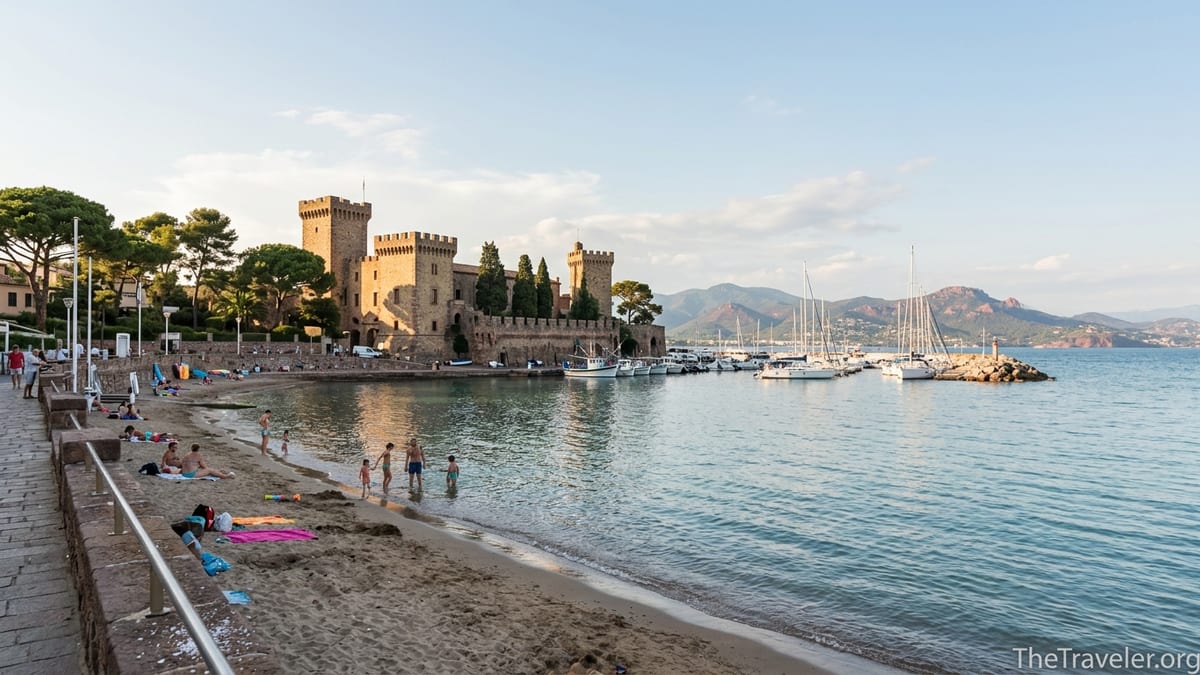
Mandelieu la Napoule has a string of sandy beaches along its compact coastline, and they feel markedly different from the packed promenades further east. One of the best known is Plage du Château, a public beach tucked between Port La Napoule and the fortified walls of Château de la Napoule. On a typical summer morning, you might see a mix of local families under striped parasols, couples reading in the shade of the stone ramparts, and a few paddleboard rentals gliding past the harbor entrance.
The practical details matter here. Plage du Château is a true town beach: lifeguards in season, public toilets, a nearby bus stop, and free or inexpensive street parking within a few minutes’ walk. Snack bars and small restaurants line the promenade, so you can pick up a pan bagnat sandwich or a scoop of lemon sorbet without paying resort-hotel prices. For travelers used to the private beach clubs of Cannes, the open and straightforward feel is a welcome surprise.
Just around the headland, Plage de la Rague offers a slightly wilder setting, framed by a small marina and the arches of a railway viaduct. The atmosphere is quieter, with more locals arriving in the late afternoon after work. Parking here is typically paid, but the reward is a sheltered cove where the water often stays calm even on breezy days. In summer, the town occasionally stages open-air film screenings on this beach, so you could, for example, watch a recent French blockbuster projected under the stars while the waves lap at the shore.
Further along the coast toward Théoule-sur-Mer, the sand gives way to smaller coves backed by red rock and garrigue. These stretches rarely appear in glossy brochures, but for travelers who are willing to walk a little along the coastal path, they can feel like a private discovery. You might spread a towel on a flat rock with room for just a few people, looking back toward the distant glitter of Cannes while feeling very far from its bustle.
Château de la Napoule: Storybook Walls, Serious Art
The centerpiece of Mandelieu la Napoule’s shoreline is Château de la Napoule, a fortified seafront castle whose crenellated towers look almost too picturesque to be real. Originally a medieval fortress, it was extensively reimagined in the early twentieth century by the American artist Henry Clews Jr. and his wife Marie. Today it houses the La Napoule Art Foundation, which runs artist residencies and exhibitions while also opening the site to visitors.
For travelers, the château offers much more than a quick photo stop. A typical visit might start with a guided tour through the whimsical rooms and courtyards, where carved stone figures peer from arches and stained glass casts colored light onto worn tiles. In the gardens, sculpted cypress trees frame sea views and tucked-away benches invite lingering. Depending on the season, you may encounter contemporary art installations nestled among the old stones, part of ongoing residency programs.
Because the château sits right at the water’s edge beside the village, it easily anchors a full half-day in La Napoule. You can arrive by train from Cannes, visit the castle in the late morning, then walk a couple of minutes to a café by Port La Napoule for a seafood lunch. Some visitors time their visit to coincide with evening concerts, small-scale music festivals, or temporary exhibitions that bring in a mixed local and international crowd. The result is a cultural experience that feels intimate in comparison with the large venues in nearby cities.
Even those who are not usually drawn to art spaces tend to respond to the ambiance here. Watching the late-afternoon light strike the castle walls, with sailboats entering the harbor in the background and children playing on the adjacent beach, you get a layered sense of the Riviera: history, everyday leisure, and creative energy sharing the same small patch of coastline.
Gateway to the Red Rocks of the Esterel
Look west from the beaches of Mandelieu la Napoule and the coastline quickly turns dramatic. The Esterel Massif, a chain of low volcanic mountains rising directly from the sea, begins practically at the town’s edge and stretches toward Fréjus and Saint-Raphaël. Its iron-rich rocks glow deep red, especially in late-afternoon light, and create one of the most distinctive landscapes on the Riviera.
For hikers and casual walkers, this is where Mandelieu’s location becomes exceptional. From the town you can be on a marked trail within a short drive, or even by bus in some cases, climbing through cork oak forests and aromatic scrub toward viewpoints over the Mediterranean. Local tourism information highlights more than twenty signposted walking circuits across the Esterel and neighboring hills, ranging from easy one-hour loops suitable for families to strenuous full-day hikes.
One particularly accessible option is the coastal Sentier du Littoral, a seaside path that starts near the Château and follows the shore past small coves and viewpoints. Families push strollers along the easier sections, while more ambitious walkers continue toward Théoule-sur-Mer and its rugged headlands. A typical morning outing might involve walking for an hour or two, stopping to swim in a rocky inlet, then catching a bus or making a leisurely walk back into town for lunch.
Drivers should not overlook the Corniche d’Or, the scenic road that threads between the Esterel cliffs and the sea. Departing from Mandelieu la Napoule, you can follow this route past plunging red headlands, tiny beaches accessed by steep paths, and occasional roadside viewpoints where photographers set up tripods. Compared with the crowded coastal strip between Nice and Monaco, traffic here can feel relatively light outside high summer weekends, and many visitors report pulling over repeatedly simply to stand and take in the views.
Sport by Nature: Golf, Sailing, and Simple Pleasures
Mandelieu la Napoule likes to describe itself as a land of sport, and the claim has substance. Golfers, in particular, know the town better than many casual tourists do. The Old Course Cannes-Mandelieu, just inland from the beach, is one of the oldest golf courses on the Côte d’Azur. Its fairways are shaded by umbrella pines, and part of the course even requires players to cross a small canal by ferry to reach another section, an eccentric touch that regulars love.
Alongside the Old Course, the Barbossi Riviera Golf winds through hills with sweeping views of the Esterel and, in places, of vineyards belonging to the Barbossi estate. These courses attract a mix of local members and visiting players who might structure an entire long weekend around tee times in Mandelieu, meals in the port, and perhaps a day trip into Cannes. Green fee prices fluctuate with season and time of day, but many travelers find them competitive compared with prestige courses further along the coast.
The sea offers a different sort of active escape. Port La Napoule and nearby Port de la Rague host sailing schools, diving outfits, and rental companies that provide everything from sea kayaks to small motorboats. A family might, for instance, rent a stable open-deck boat for a couple of hours to putter along the coast toward Théoule-sur-Mer, dropping anchor in a calm cove for a swim. Conditions in the bay are often moderate, especially in the morning, making this stretch suitable for beginners under local guidance.
Not every activity needs equipment or instruction. One of the underrated pleasures of Mandelieu la Napoule is simply walking or cycling along the riverside paths by the Siagne, where plane trees and palms line the banks and fishermen set up along quieter stretches. Markets and seasonal festivals bring life to public spaces such as Parc Robinson, where you might stumble on an evening Latin dance event one week and a craft market the next. These are the small-scale, community-focused experiences that can be hard to find in more overtly touristic towns.
Everyday Riviera Life: Markets, Seasons, and Costs
What many visitors remember about Mandelieu la Napoule is not a single postcard sight but the texture of everyday life. The twice-weekly markets mix sunhats and beach toys with local produce, scented soaps, and the occasional stall selling socca or fougasse. At small cafés along Avenue Henry Clews, regulars argue over football while visitors plan their day trips with guidebooks open on the table. Even in peak summer, there are quiet, residential backstreets where the loudest sound in the evening might be cicadas.
Seasonality plays a real role here. In February, Mandelieu is strongly associated with the mimosa bloom that brightens the surrounding hills. Spring and autumn bring milder temperatures that suit hikers and cyclists, along with lower accommodation prices and more availability at restaurants popular with locals. July and August, of course, see the beaches at their busiest, but even then the crowds feel different from the dense lines of rented loungers that dominate the central strips of some larger resorts.
From a budget perspective, many travelers find Mandelieu la Napoule a useful compromise. Dining options range from simple pizzerias and creperies to higher-end bistros with sea views, and you can choose whether to splurge or save on any given night. A couple might share a reasonably priced plat du jour at a café near the harbor one evening, then book a table at a more refined restaurant overlooking the marina on another. Supermarkets and bakeries make it easy to self-cater breakfast or assemble a picnic for the beach, which keeps daily costs under better control than in destinations where on-the-go options are limited to high-priced hotel venues.
Public transport links keep day-trip costs manageable too. Regional trains connect La Napoule station with Cannes, Antibes, and Nice in one direction and with Fréjus and Saint-Raphaël in the other, typically at fares that compare favorably with parking fees in those cities. Travelers without a car can still comfortably spend a week here, mixing local days on the beach or the hiking trails with train excursions to more famous neighbors.
The Takeaway
On the French Riviera, it can be tempting to chase the greatest hits: the biggest festivals, the most photographed beaches, the highest-profile hotels. Mandelieu la Napoule offers a quiet counterpoint to that instinct. It is a place where a medieval castle doubles as an art center, where beach days still feel casually local, and where the red rocks of the Esterel rise within easy reach of a modest train station.
Skipping Mandelieu la Napoule on a Riviera itinerary might seem logical at first glance, especially if your mental map centers on Nice, Cannes, and Monaco. Yet travelers who do stop here often report that it becomes the part of their trip they talk about most: the early-morning swim beneath castle walls, the sunset drive along the Corniche d’Or, the impromptu meal in a portside restaurant where the staff recognize regulars by name. In a region famous for spectacle, Mandelieu’s particular magic lies in how effortlessly it combines beauty with normal life.
For those willing to trade a bit of glamour for a deeper sense of place, Mandelieu la Napoule is less a detour than a quiet key to understanding the Riviera as more than a backdrop. It is a reminder that some of the coast’s richest experiences unfold not in front of the biggest crowds but in the underrated corners you might otherwise pass by.
FAQ
Q1. Where exactly is Mandelieu la Napoule on the French Riviera?
Mandelieu la Napoule lies just southwest of Cannes on the Mediterranean coast, between the Siagne River and the Esterel Massif, with a small train station in the La Napoule district close to the sea.
Q2. Is Mandelieu la Napoule a good base without a rental car?
Yes. The La Napoule train station connects to Cannes, Antibes, Nice, Fréjus, and Saint-Raphaël, and local buses serve beaches and nearby hills, so you can explore comfortably using public transport.
Q3. How busy do the beaches get in summer compared with Cannes or Nice?
July and August are busy, but beaches like Plage du Château and Plage de la Rague usually feel less crowded and more local than the most central stretches in Cannes or Nice, especially on weekdays.
Q4. What is special about Château de la Napoule for visitors?
The château combines medieval architecture with early twentieth-century artistic flourishes and today hosts the La Napoule Art Foundation, offering guided tours, gardens by the sea, and occasional exhibitions or concerts.
Q5. Are there easy hiking options near Mandelieu la Napoule?
Yes. The coastal Sentier du Littoral offers accessible seaside walking, and short drives or bus rides bring you to marked trails in the Esterel Massif with routes suitable for a range of fitness levels.
Q6. Is Mandelieu la Napoule suitable for families with children?
Very much so. Sandy beaches with lifeguards in season, family-friendly seaside paths, casual restaurants, and seasonal events in parks make it practical and relaxed for families.
Q7. How does the cost of staying in Mandelieu la Napoule compare with Cannes?
Accommodation and everyday dining are often more affordable than in central Cannes, particularly outside peak season, while you still remain close enough for easy day or evening trips into the city.
Q8. What kind of water activities are available?
Local ports offer sailing lessons, diving outings, boat and kayak rentals, and stand-up paddleboard hire, with conditions in the bay typically suitable for beginners under local supervision.
Q9. When is the best time of year to visit Mandelieu la Napoule?
Late spring and early autumn offer warm seas and milder temperatures with fewer crowds, while winter and early spring appeal to hikers and those interested in the region’s mimosa bloom.
Q10. How many days should I plan to spend in Mandelieu la Napoule?
A minimum of two to three days lets you enjoy the beaches and the château, but many travelers stay a week and use the town as a calm base for exploring the wider Riviera.