


Hilo, on the lush east coast of Hawaii Island, has quietly become one of the country’s most intriguing Thanksgiving getaways. Google’s latest holiday travel data for 2026 shows Hilo at the top of rising domestic searches for Thanksgiving trips, ahead of mainland favorites such as Buffalo and Columbus. Travelers are drawn by a rare combination: access to an active volcano, year-round waterfalls framed by rainforest, and a slower-paced local town that still feels lived in rather than built purely for visitors.
Get the latest updates straight to your inbox!
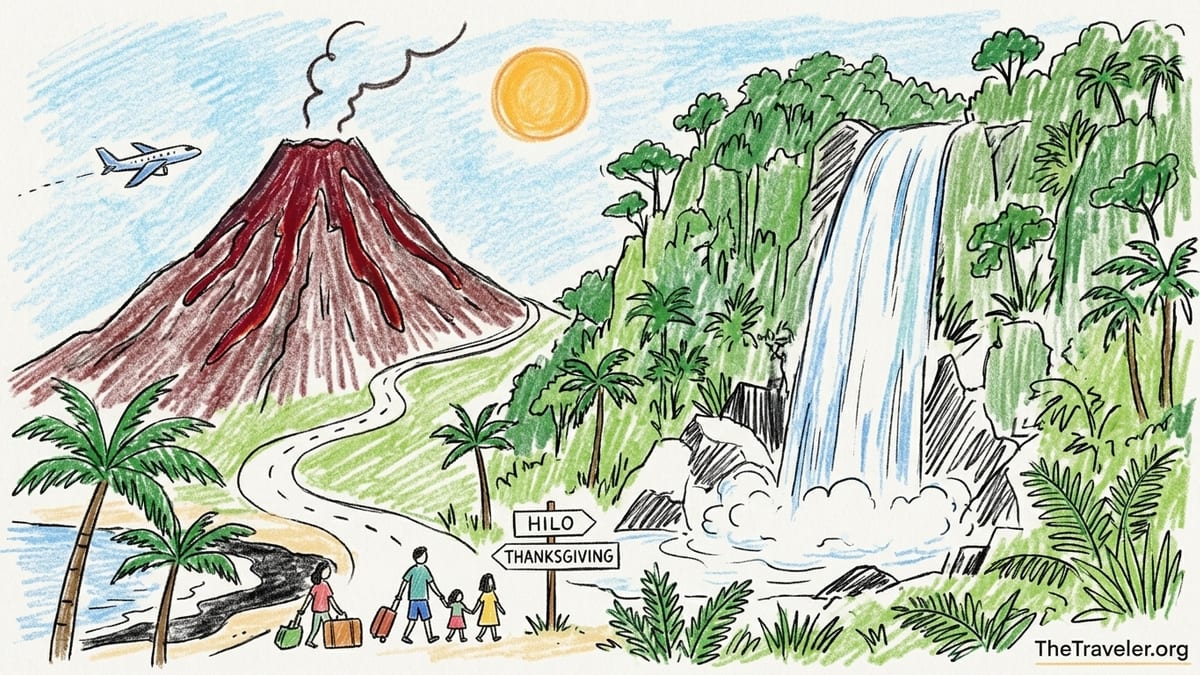
Why Hilo Is Suddenly a Hot Thanksgiving Destination
Hilo has long been the practical gateway for visiting Hawaii Volcanoes National Park and the island’s wet, waterfall-rich northeast coast, but it has rarely topped national wish lists. That changed this year. Google’s 2026 holiday travel trends highlighted Hilo as the leading domestic riser for Thanksgiving searches, putting this modest port town in the same data set as major mainland cities and signaling a surge of curiosity from U.S. travelers planning late November escapes.
Part of the appeal lies in timing. Late November in Hilo usually brings daytime highs around the upper 70s Fahrenheit, warm enough to swim at black sand beaches yet cool enough for long hikes along the Kilauea summit or through rainforest valleys. While Hawaii News Now and other local outlets have reported packed airports statewide around Thanksgiving in recent years, Hilo’s smaller airport and lower resort density often translate into a calmer on-the-ground experience compared with Honolulu or Kona, especially if you book flights and rental cars several weeks in advance.
Cost is another factor. While Hawaii will never be a budget destination, travelers comparing tours find that Hilo-based excursions to Hawaii Volcanoes National Park are often cheaper than similar trips departing from Kona, simply because of shorter driving or flight times. A comparison site tracking 2026 prices lists a Hilo helicopter adventure over the park starting around 389 dollars per person for a 30 minute flight, versus higher prices for comparable tours that depart from the west side of the island. For families eyeing Thanksgiving break, that difference can add up quickly.
Equally important is Hilo’s character. This is a working town with a historic bayfront, a daily farmers market, and cafés serving plate lunches to office workers as often as to visitors. For Thanksgiving travelers seeking more than a resort pool, that mix of volcano drama, everyday local life, and rainforest scenery makes Hilo feel like a complete destination rather than a single-attraction side trip.
Chasing Fire: Volcanoes From Hilo
For many visitors, Hilo’s biggest draw is its proximity to living geology. Hawaii Volcanoes National Park sits about a 45 minute drive uphill from town, along a highway that climbs from sea level through dense ʻōhiʻa and fern forest to the Kilauea summit. Most of the park is open in 2026, although a handful of roads and trails remain closed following past eruptions and seismic damage. Before setting out, travelers are wise to check the National Park Service alerts and the Hawaiian Volcano Observatory updates, which recently documented renewed eruptive activity at Kilauea in September and October 2026.
A straightforward day trip might start with a morning arrival at the park’s Kilauea Visitor Center, followed by a drive along Crater Rim Drive. Even when surface lava is not visible, overlooks such as Kilauea Overlook and Keanakakoi offer views into the broad summit caldera, where new vents have opened in recent months according to Hawaiian Volcano Observatory bulletins. In the afternoon, many visitors continue down the Chain of Craters Road, a winding drive that descends through old lava flows to a sea cliff where waves crash against dark basalt.
Travelers who want a more curated experience often book guided tours that combine Hilo hotel pickup with park highlights. A 2026 military leisure price list for Hawaii shows organized "Hilo Volcano" day tours priced a little under 180 dollars per adult at rack rate, including transport and guiding, with discounted rates offered to service members. Typical itineraries stop at viewpoints, short crater rim walks, and lava-tube style caves where conditions allow. For a splurge, combination packages that include a helicopter segment over Kilauea and nearby waterfalls can approach or exceed 550 to 600 dollars per adult.
Even independent travelers should plan for holiday crowds. On Thanksgiving week, parking at the visitor center and popular viewpoints can fill by midmorning. Arriving when the park opens or visiting later in the afternoon after the biggest bus tours have left often leads to quieter trails. Because food service inside the park is minimal, many repeat visitors recommend packing a picnic in Hilo, buying fresh fruit and snacks at the Hilo Farmers Market or a local supermarket before heading up the mountain.
Waterfall Country: Rainbow Falls, ʻAkaka Falls and Beyond
Hilo sits at the bottom of one of the wettest slopes in the Pacific, and that constant rainfall feeds a chain of photogenic waterfalls within an easy drive of town. Wailuku River State Park, just a few minutes from downtown Hilo, is home to Rainbow Falls, known in Hawaiian as Waiānuenue. The falls drop about 80 feet over a lava cave into a broad pool framed by banyan trees. A short paved path leads from the parking area to a viewing platform, so it is a realistic early stop on a rainy morning or a quick outing between flights.
For a more dramatic single-drop cascade, many travelers drive roughly 25 minutes north to ʻAkaka Falls State Park. Updated guides in 2026 describe a paved loop of about 0.4 miles that winds through bamboo, wild ginger, and taro to a lookout over the 442 foot ʻAkaka Falls, one of the tallest and most photographed falls in the islands. There is a state parking and entry fee for non-residents, charged per vehicle and per person, which visitors pay at a self-service kiosk. Scenes of tour buses filling the small lot in late mornings during peak weeks are common, so arriving early or closer to sunset can make the walk feel more tranquil.
Those who want to go beyond roadside viewpoints can join small-group tours that combine short hikes and swimming stops at private or less-visited waterfalls along the Hamakua Coast. Price lists used by military ticket offices in Hawaii show "Historic Hilo Bay Waterfalls by Kayak" outings at about 140 dollars per person, including gear and guiding for a two hour paddle to cascades that pour into Hilo Bay. In nearby Hakalau, a "Zipline Waterfall Adventure" markets runs where participants fly above streams and smaller falls on multiple cables strung through rainforest valleys, with rates typically in the low to mid 200 dollar range per person depending on promotions and transportation.
Holiday visitors should be realistic about the weather. The same clouds that feed the waterfalls can obscure views or bring brief downpours without warning. Many experienced Hilo travelers carry a compact rain jacket or light poncho in a daypack, accept that shoes may get muddy, and embrace the mist as part of the experience. On the upside, rainy days often deepen the greens of the surrounding jungle and strengthen the flow of the falls, making for striking photographs once the light breaks through.
Into the Rainforest: Gardens, Trails and Canopy Adventures
Beyond its headline waterfalls, Hilo offers some of the easiest access in Hawaii to lowland tropical rainforest. Garden estates north of town showcase curated versions of this ecosystem. Travel writers and visitor forums frequently praise a botanical garden set in a former valley plantation, reached via the Old Mamalahoa Highway, where visitors descend into a folded ravine filled with orchids, heliconias, and towering palms, with framed views of the surf and small coastal waterfalls. Tickets are usually in the 25 to 30 dollar range for adults, with discounted children’s entry and limited parking along the narrow approach road.
Closer to town, Liliʻuokalani Gardens and the Banyan Drive shoreline offer a more manicured version of Hilo’s greenery. Here, flat walking paths wind between Japanese-style bridges, carp ponds, and monumental banyan trees planted in the early 20th century. These free public spaces make an easy late-afternoon stroll or a way to stretch legs after a long travel day, and they remain open throughout the Thanksgiving period, although holiday weekend mornings may see more joggers and families.
For travelers seeking more adrenaline, several outfitters base zipline and ATV operations within an hour’s drive of Hilo. A cruise excursion brochure widely circulated for Hawaii ports describes a "Rainforest Zipline and Waterfall Adventure" near Hilo, featuring a seven-stage zipline course over streams and tree canopies with glimpses of the Pacific. Depending on the operator, standalone zipline tours typically price between about 180 and 230 dollars per adult before taxes and fees. Given the physical nature of these outings, participants should confirm weight limits and medical restrictions when booking, particularly for multigenerational Thanksgiving groups.
Independent hikers, meanwhile, can explore short rainforest trails off the main highway between Hilo and Volcano or along side roads near the coast. Many paths pass through wet ʻohiʻa forests carpeted with hāpuʻu ferns and native understory plants. Because trail conditions and access can change after storms or volcanic events, visitors are encouraged to check county and state park announcements in the week before arrival rather than relying on outdated guidebooks printed before 2024.
Seeing Hilo by Air and Sea
Hilo’s compact size makes it walkable, but some of its most dramatic views come from the air and from the water. Helicopter companies operating from Hilo International Airport sell two main categories of flights. The first focuses on Hawaii Volcanoes National Park, usually 30 to 40 minutes of air time, circling above Kilauea’s summit, older Mauna Loa lava fields, and any accessible active flows. A tour comparison site updated for early 2026 cites a common starting price of about 389 to just over 400 dollars per person for these shorter volcano flights.
The second major category emphasizes waterfalls and coastal rainforest. "Hilo Waterfalls Experience" style tours, listed around 500 to 510 dollars per person on recent comparison charts, range up the Hamakua Coast and into deep, roadless valleys where thin white streams fall from cliffs into fern-covered amphitheaters. Visitor reviews on platforms such as Tripadvisor often describe these flights as a highlight of their Big Island trip, particularly on days when ground-level weather is overcast but clear at flight altitude. Seating is typically assigned by weight, and passengers over specific weight thresholds may be asked to purchase an extra seat for safety, a policy that should be reviewed before booking.
On the water, outfitted kayak tours from Hilo Bay give a different perspective on the town and its surroundings. Two hour guided paddles visit rocky shorelines, small waterfalls entering the bay, and views back toward Mauna Kea and Mauna Loa when the peaks are free of clouds. With recent military and local price sheets listing these outings near 140 dollars per person, they sit in the midrange of Hilo activities. Independent travelers who prefer to rent stand up paddleboards or kayaks for self-guided exploration can find small rental stands near the bayfront, usually at lower hourly rates but without the navigation support of a guide.
Cruise passengers arriving for a single day in port often combine these aerial or water-based adventures with a quick walking loop of downtown Hilo, checking off Rainbow Falls, the Pacific Tsunami Museum, and the farmers market before reboarding in the evening. Thanksgiving-week cruise calls can make key sights busier in the late morning, so overnight visitors may want to time volcanic or waterfall explorations for early or late in the day when ships are not in port.
Staying, Eating and Getting Around in Hilo
Hilo’s lodging scene is modest compared with resort zones on the Kona side of the island. Travelers will find a handful of midrange hotels near Banyan Drive and the bayfront, several small inns near the university and historic district, and a growing inventory of legal vacation rentals scattered in nearby neighborhoods and along the coast road. Because Thanksgiving is peak demand, properties that normally list double rooms around 180 to 230 dollars per night may see rates climb higher, particularly for bookings made in the final few weeks before arrival.
Most visitors rent a car at Hilo International Airport, where major national brands operate counters. Public transit exists in the form of Hele-On buses, but schedules are limited and not designed for sightseeing itineraries that combine the national park, waterfalls, and remote gardens in one day. For those reluctant to drive, packaged tours that bundle transportation are the most realistic option for getting to Hawaii Volcanoes National Park or north coast waterfalls effectively.
Dining in Hilo reflects its role as a local hub rather than a resort zone. The Hilo Farmers Market, especially lively on Wednesdays and Saturdays, offers prepared foods such as poke bowls, laulau plates, and fresh fruit smoothies built from local pineapple, lilikoi and mango. Around the market and in the blocks inland, cafés and bakeries serve breakfast plates that might pair Portuguese sausage, eggs and rice for under 20 dollars, while small Japanese, Filipino, and Hawaiian restaurants handle lunch and dinner service with daily specials scrawled on chalkboards. On Thanksgiving Day itself, a few hotels and larger restaurants may offer set holiday menus, but many smaller spots close so staff can spend time with family.
Travelers with dietary restrictions or those arriving on the holiday should plan accordingly. Stocking up on groceries at supermarkets in Hilo the day before Thanksgiving not only provides picnic supplies for park outings but also ensures backup meals if restaurant options are limited. In the evenings, especially after long hikes or drives, many visitors enjoy simple bayfront takeout eaten along the seawall as outrigger canoes train in the harbor and rain clouds edge down the flanks of Mauna Kea.
Planning a Thanksgiving Week Itinerary
With only a week or less to work with, Thanksgiving travelers benefit from focusing their Hilo stay around a few anchor experiences. One common structure is to devote at least one full day to Hawaii Volcanoes National Park, one day to waterfalls and botanical gardens along the Hamakua Coast, and one flexible day for bayfront walks, museums, and contingency planning if weather or volcanic conditions prompt last minute changes. Families traveling with children often schedule the highest-energy activities, such as ziplining or longer hikes, earlier in the trip before travel fatigue sets in.
Booking logistics deserve early attention. Google’s own analysis of holiday airfares, based on several years of flight data, suggests that the lowest prices for U.S. holiday flights have been occurring earlier each year, often several weeks or even a couple of months before the actual holiday. Applied to Hilo, that means travelers stand a better chance at reasonable fares and rental car rates if they confirm plans by early fall rather than waiting for last-minute deals that may never appear. Online discussions among Hawaii-focused travel agents echo this advice, noting that many Thanksgiving clients lock in flights months in advance.
Travel insurance and flexible reservations can also be prudent in a volcanic environment. While the park has managed eruptions safely for decades, renewed activity in 2026 around Kilauea’s summit has already prompted periodic changes in viewing access, trail closures, and heightened alert levels for aviation. Lodging or tour bookings that allow date changes without heavy penalties provide a cushion if the situation evolves in the weeks before departure. Checking official park and observatory updates in the days before travel helps set realistic expectations about whether visitors are likely to see glowing lava, fuming craters, or only the broader volcanic landscape.
Finally, it is worth remembering that much of Hilo’s appeal lies in moments that cannot be tightly scheduled. That might mean watching an evening rainbow form over Hilo Bay after a passing shower, talking story with a vendor at the farmers market about how Thanksgiving is celebrated in their family, or driving a few minutes outside town to a dark turnout to see the Milky Way arch above Mauna Kea if clouds part. Even with Google identifying Hilo as a rising Thanksgiving search star, the town still rewards travelers who leave room in their itineraries for the unplanned.
Conclusion: A Holiday Between Lava and Rain
Hilo’s new prominence in Google’s Thanksgiving travel rankings reflects something travelers on the ground have known for years. This is a place where dramatic volcanic landscapes, accessible waterfalls, and authentic local life intersect in a compact, approachable package. In late November, when much of the mainland United States has turned cold and gray, Hilo hums along under drifting showers and bright tropical light, offering both adventure and a quieter pace of holiday escape.
From daybreak walks at Rainbow Falls to crater rim drives above active vents at Hawaii Volcanoes National Park, from helicopter circuits over rainforest valleys to simple sunset picnics by the bay, Hilo allows visitors to shape Thanksgiving around experiences rather than obligations. Rising search interest will almost certainly bring more visitors in the coming seasons, but with thoughtful planning, early bookings, and a willingness to lean into the rain, travelers can still find the sense of discovery that makes Hilo feel like a secret shared among friends.