


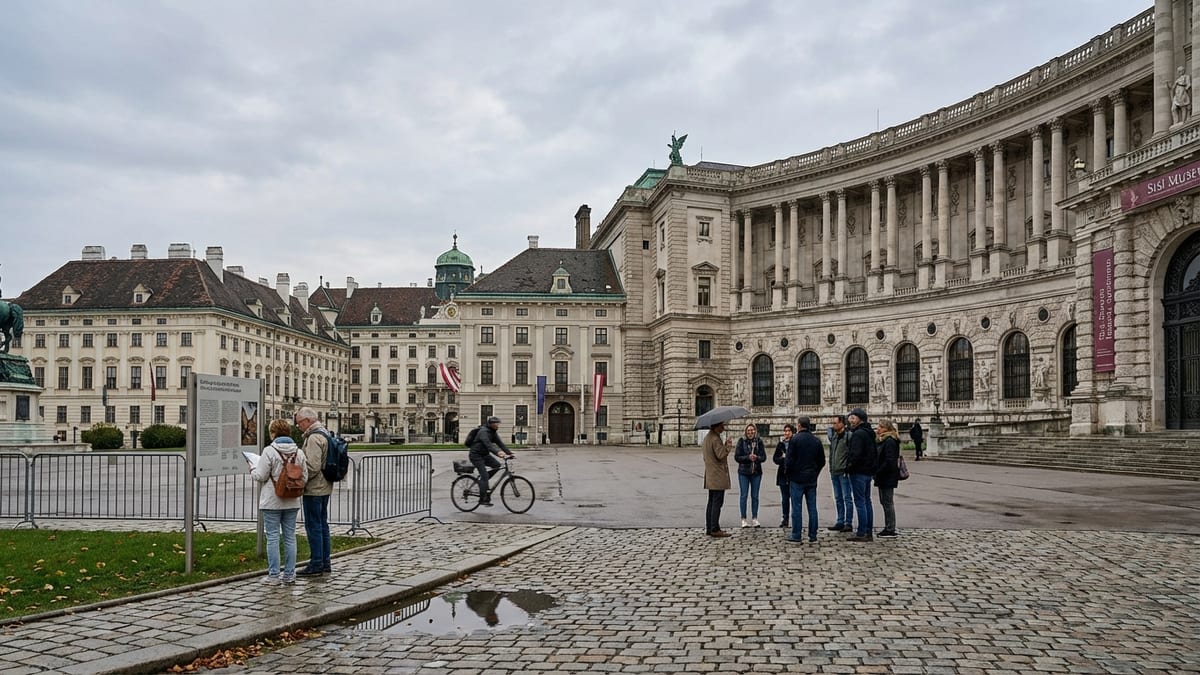
Few places in Europe allow you to walk so clearly through centuries of power as Vienna’s Hofburg Palace. From medieval fortress to glittering imperial residence and finally the workplace of Austria’s modern president, this vast complex distills the story of the Habsburg dynasty and the country it once ruled. For travelers, understanding how the Hofburg evolved is the key to seeing more than grand facades and gilded rooms. It lets you read the stones as a living record of empire, war, diplomacy and reinvention.
From Medieval Fortress to Habsburg Stronghold
The Hofburg’s story begins in the 13th century, long before it became synonymous with imperial Vienna. Around this time, a fortified residence rose on what is now the palace’s Swiss Court, or Schweizerhof. The early castle, associated with rulers such as Ottokar II of Bohemia, was defensive and compact: a square layout with towers at the corners, surrounded by a moat and accessed by a drawbridge instead of the ceremonial gateways visitors see today.
When the Habsburgs secured their grip on Austria in the late 13th century, they inherited this stronghold and, crucially, its location. The Hofburg lay at the heart of Vienna’s old town, within easy reach of trade routes and the Danube. In 1279 it became the documented seat of government, a role the site has never really relinquished. What began as the residence of local dukes gradually became the administrative center of a dynastic empire.
The oldest surviving parts of the complex, now called the Swiss Wing, retain traces of these medieval origins. Behind later Renaissance and Baroque ornament, you can still sense the outline of the early fortress. Within this wing are the Gothic chapel, or Burgkapelle, dating to the 15th century, and rooms that once guarded the Habsburgs’ most prized possessions. Where tourists now queue for tickets and wander between courtyards, soldiers once patrolled walls and watched for threats beyond the city.
As the Habsburgs’ power expanded, the Hofburg’s function shifted from simple defense to representation. By the late Middle Ages, this was less a castle under siege and more a seat of a dynasty that was steadily amassing titles, territories and influence across Europe. The transformation in the palace complex mirrored that political ascent.
Imperial Center of a Multiethnic Dynasty
The true flowering of the Hofburg’s political role came with the Habsburgs’ domination of the Holy Roman Empire. From 1438 to 1583, and again from 1612 until the empire’s dissolution in 1806, Vienna was the principal residence of Habsburg emperors. The Hofburg was not only a royal home but the nerve center from which a sprawling, multinational realm was administered.
To house imperial councils, court offices and a swelling retinue of nobles, clerics and servants, the Habsburgs repeatedly expanded the palace. New wings were grafted onto the medieval core, until the Hofburg became a city within a city: a tangle of courtyards, galleries, stables, chapels and ceremonial halls. Each generation added more. The Swiss Wing was joined by the Amalienburg residence in the 16th century, the Leopoldine Wing in the later 17th century, and a series of Baroque additions that turned the complex into a showcase of imperial style.
Architecture served politics. The palace was designed to impress visiting envoys, princes and clerics, projecting the image of a dynasty ordained to rule. In the Hofburg’s Imperial Treasury, known as the Schatzkammer, the Habsburgs stored tangible proof of their claims: the crown, orb and scepter of the Holy Roman Empire, relics associated with Charlemagne, and later the regalia of the Austrian Empire. Today these items are exhibited as museum pieces, but they once symbolized a living order in which the Hofburg stood at the top.
Life at court revolved around highly choreographed rituals that unfolded in the Hofburg’s halls and chapels. From morning levees to evening balls, every movement of the emperor, empress and their entourages was governed by protocol. Marriages arranged in these rooms could redraw maps, and audiences granted or denied could change the fate of entire regions. When you walk through the complex today, you are crossing the stage on which much of Central European history was played.
Rooms, Wings and Ceremonies: Inside the Imperial Residence
For modern visitors, the Hofburg can feel like a maze. Understanding its main components helps turn a confusing sprawl into a legible story. The Schweizerhof, or Swiss Court, is the oldest core, marked by the ornate Swiss Gate. This Renaissance portal dates from the 16th century and bears Habsburg coats of arms that once underlined the dynasty’s reach. Just inside lies the Imperial Treasury, where centuries of accumulated regalia and religious treasures are now displayed behind glass rather than locked away for the exclusive gaze of rulers.
North of the Swiss Wing stands the Amalienburg, a four-story residence with a distinctive clock tower. Built in the 16th century and later used as a dower residence by Empress Wilhelmine Amalia, it eventually became the domain of Empress Elisabeth, better known as Sisi. Her private apartments here, full of personal objects and carefully preserved interiors, form the heart of today’s Sisi Museum. Together with the Imperial Apartments, they offer a rare, human-scale view of life behind the rigid façade of court etiquette.
To the south lies the Leopoldine Wing, an early Baroque addition built between 1668 and 1680 under Emperor Leopold I. In the 18th century, Empress Maria Theresa made this wing her main residence. Its grand apartments later became state rooms used for ceremonial receptions until the end of the monarchy. Today they form part of the Austrian president’s offices, a telling example of how spaces of hereditary rule were repurposed for republican government.
Equally important is the area around Josefsplatz, one of the Hofburg’s most elegant courtyards. Here the monumental State Hall of the Austrian National Library occupies a lavish Baroque wing, its soaring dome and frescoes a testament to the Habsburgs’ desire to cast themselves as patrons of learning and culture. Nearby, the Stallburg, originally a Renaissance residence for Archduke Maximilian and later an art gallery, now houses the Spanish Riding School’s Lipizzaner stallions in arcaded courtyards.
Baroque Splendor, Enlightened Reforms and Everyday Life
The 18th century was the Hofburg’s Baroque golden age, when both the palace and the state were reshaped by a series of powerful rulers. Chief among them was Maria Theresa, who reigned from 1740 to 1780 and left a deeper mark on the complex than any other individual. Under her, the Hofburg became at once a family home, a court theater of ritual, and an administrative machine negotiating the pressures of war, reform and Enlightenment ideas.
Maria Theresa expanded and modernized many parts of the residence, refurbishing apartments and introducing new comforts without sacrificing grandeur. Her family life was lived largely within these walls, which saw the upbringing of 16 children, including future queen Marie Antoinette of France. At the same time, ministers and advisers moved in and out of rooms where far-reaching decisions on education, taxation and military affairs were made. The Hofburg thus embodied the paradox of enlightened absolutism: a courtly world still attached to tradition but forced to innovate in order to survive.
After Maria Theresa’s death, her successors adjusted the palace to changing tastes. Neoclassical and later historicist touches appeared, especially during the long reign of Emperor Franz Joseph I in the 19th century. Under him, the Hofburg became closely associated with a more restrained, duty-bound style of monarchy, in contrast to the Rococo exuberance of earlier decades. Franz Joseph maintained a strict daily routine in his Hofburg offices, rising before dawn and working long hours, an image carefully cultivated to bolster the monarchy’s legitimacy amid nationalism and calls for reform.
For the thousands of people who lived and worked within or around the complex, the Hofburg was less a symbol than a workplace. Stable hands tended horses in the Stallburg, tailors and cooks served an army of courtiers, clerks copied documents in chilly offices, and musicians prepared for performances in the chapel or Redoutensäle. Though few of these individuals left names that echo in history books, their lives kept the machinery of empire turning inside the palace walls.
Empire’s End: Revolution, War and the Fall of the Monarchy
The Hofburg also witnessed the unraveling of the imperial system it had so long embodied. The 19th century brought revolutions, nationalist movements and wars that repeatedly shook the Habsburg monarchy. Although Vienna remained the dynastic capital, the relationship between ruler and ruled was no longer unquestioned. Demonstrations and uprisings periodically rattled the city, undercutting the aura of invincibility that had surrounded the palace for centuries.
The assassination of Archduke Franz Ferdinand in 1914, which triggered the First World War, marked a turning point that reverberated in the Hofburg’s corridors. As the conflict dragged on and the empire faltered, the palace became a place of anxious briefings and grim audiences. By 1918, after military defeat and the disintegration of Habsburg rule in Central and Eastern Europe, the monarchy itself collapsed. Emperor Charles I, the last Habsburg ruler, left the Hofburg as the old order gave way to a republic.
The fall of the monarchy transformed the Hofburg’s legal and symbolic status. Former imperial properties, including the palace, passed into state ownership. Many ceremonial rooms were closed or repurposed, and what had been a private residence became in part a monument to a vanished world. Yet the complex did not become a frozen relic. Offices of the new republican government moved in, and plans developed to open more of the former imperial space to the public as museums and cultural institutions.
Interwar Austria’s political instability left its own traces on the Hofburg, culminating in 1938 with one of the palace’s most infamous moments. From a balcony of the Neue Burg, the monumental wing completed only a few decades earlier, Adolf Hitler addressed a jubilant crowd to proclaim Austria’s annexation to Nazi Germany. The image of a dictator using imperial architecture to legitimize a different form of authoritarian power remains one of the building’s most haunting historical snapshots.
Occupation, Reconstruction and the Birth of Modern Austria
The Second World War did not spare the Hofburg. While Vienna avoided the total devastation seen in some European capitals, air raids and fires damaged parts of the complex. The Redoutensäle, the elegant halls long used for operas, balls and concerts, suffered in a serious fire in 1992 as well, reminding Austrians that preservation of such an extensive complex is an ongoing task rather than a completed project.
After 1945, Austria found itself occupied by Allied powers and grappling with its role in the Nazi era. The Hofburg became part of a wider debate about national identity. On the one hand, it was a potent reminder of imperial grandeur; on the other, it had been used as a backdrop for the Anschluss. In the early years of the Second Republic, founded in 1945, the palace symbolized both continuity and rupture in Austrian history.
In 1946, the Hofburg formally became the official residence and workplace of the President of Austria. The move was more than practical. Installing the head of a democratic republic in the former imperial palace sent a clear message: the state was new, but it would make use of its architectural inheritance rather than reject it. Over subsequent decades, parts of the complex were restored, modernized and adapted for administrative functions, while others were opened to visitors as museums.
This period also saw the Hofburg’s increasing role as a venue for international diplomacy and conferences. By hosting events such as the General Conference of the International Atomic Energy Agency in 1958 and later offering office space to organizations like the Organization for Security and Co-operation in Europe, the palace reemerged as a stage for political negotiation. Where Habsburg emperors once received envoys, today diplomats and experts debate issues ranging from human rights to security cooperation.
The Hofburg Today: Museums, Horses and Statecraft
For travelers to Vienna in the 21st century, the Hofburg is at once a museum quarter, a place of work and a living link to the city’s past. Several major museums anchor the visitor experience. The Sisi Museum and Imperial Apartments present the personal world of Empress Elisabeth and Emperor Franz Joseph, using original furnishings, clothing and everyday objects to humanize figures long wrapped in myth. Nearby, the Imperial Silver Collection showcases tableware and ceremonial services that once graced their banquets, illustrating the elaborate etiquette of dining at court.
Within the Schweizerhof, the Imperial Treasury displays some of Europe’s most significant regalia and relics. Here you can see the Imperial Crown of the Holy Roman Empire, associated with medieval coronations, and the later Austrian imperial crown, orb and scepter. The collection also features religious objects, coronation robes and gifts accumulated over centuries. Taken together, these items reveal how the Habsburgs used sacred and secular symbols to bolster their authority.
The Spanish Riding School, one of the Hofburg’s most distinctive institutions, occupies the Stallburg and the Winter Riding School across the street. Morning training sessions and carefully staged performances by the Lipizzaner stallions showcase a classical equestrian tradition that dates back to the 16th century. Watching riders guide their horses through precise, balletic movements beneath a Baroque ceiling, visitors glimpse a strand of court culture that has survived into modern tourism without losing its sense of ritual.
At the same time, parts of the complex remain very much in daily use. The Austrian National Library, with its grand State Hall on Josefsplatz, functions as a working research library as well as a visitor attraction. The offices of the Federal President occupy sections of the Leopoldine Wing, where modern staff now move through rooms once reserved for imperial audiences. Conference centers within the Hofburg host everything from scientific congresses to high-level political meetings, ensuring that the palace stays integrated into Austria’s present, not only its past.
Reading the Stones: How Visitors Can Experience the Hofburg’s History
Understanding the Hofburg’s layered history can transform a visit from a simple sightseeing stop into a richer exploration of Austria’s story. One way to approach the complex is chronologically, starting in the Swiss Court to absorb the medieval and early modern origins, then moving through the Baroque wings and finally ending at the early 20th century Neue Burg on Heldenplatz. This route traces the arc of Habsburg power from uncertain beginnings to confident display and eventual crisis.
Another approach is thematic. Travelers fascinated by court life might focus on the Imperial Apartments, Sisi Museum and Silver Collection, piecing together the rituals and private realities of imperial existence. Those intrigued by politics can emphasize the Treasury, the National Library and the spaces now used by the presidency and international organizations. For many visitors, the Spanish Riding School provides a vivid entry point into the continuity of tradition across centuries.
Because the Hofburg is still intertwined with Austrian state functions, not every area is accessible at all times. Guided tours can offer access to certain ceremonial rooms and the presidential section when schedules permit, while individual tickets allow flexible exploration of the museum components. Planning ahead and allowing enough time to move between scattered entrances is wise, as the complex covers a sprawling area and includes multiple distinct inner courtyards.
Above all, travelers should remember that the Hofburg is not a single palace but an evolving architectural palimpsest. Each façade and courtyard corresponds to a different phase of Habsburg ambition, from the sober lines of the Leopoldine Wing to the sweeping curve of the Neue Burg. To stand in Heldenplatz, glance back at the monumental colonnades and recall both imperial parades and Hitler’s 1938 speech is to understand how architecture can be reinterpreted by each political era it survives.
The Takeaway
The Hofburg Palace is far more than a cluster of photogenic buildings in central Vienna. It is the material biography of Austria itself, written in stone and stucco across more than seven centuries. From a fortified medieval residence to the primary seat of a dynasty that once ruled much of Central Europe, the palace chronicles how power was claimed, legitimized, celebrated and finally surrendered.
In the 20th century, this same complex witnessed the collapse of the Habsburg Empire, the trauma of the Anschluss and the emergence of a modern Austrian republic seeking to reconcile pride in its cultural heritage with a critical understanding of its past. Today, the Hofburg balances these roles: a workplace for elected leaders, a stage for international diplomacy, a museum of imperial life and a performance venue where classical traditions endure.
Visitors who look beyond the ornate ceilings and gilded mirrors will find that each room frames a chapter in a larger narrative of survival and reinvention. The Hofburg’s evolution from Habsburg power base to the centerpiece of modern Austria’s identity makes it one of Europe’s most compelling palaces, and one of the best places to grasp how history, politics and architecture intertwine.
FAQ
Q1. What is the Hofburg Palace and where is it located?
The Hofburg is a vast palace complex in the historic center of Vienna, Austria. It served for centuries as the principal residence and seat of government for the Habsburg dynasty and today houses museums, the offices of the Austrian president and several cultural and political institutions.
Q2. How old is the Hofburg Palace?
The earliest parts of the Hofburg date back to the 13th century, when a fortified residence was first constructed on the site. Over the following seven hundred years, successive rulers expanded and rebuilt the complex, so its architecture spans from the Middle Ages to the early 20th century.
Q3. What role did the Hofburg play in the Habsburg Empire?
The Hofburg was the political and symbolic heart of Habsburg power. From the 15th century until 1918, it served as the main residence of emperors, the location of key government offices and the setting for major state ceremonies, diplomatic audiences and dynastic marriages.
Q4. Is the Hofburg still used by the Austrian government today?
Yes. Since 1946 the Hofburg has been the official residence and workplace of the president of Austria. Parts of the complex are used for offices, state receptions and international conferences, while other sections are open to the public as museums and cultural venues.
Q5. What can visitors see inside the Hofburg Palace?
Visitors can tour the Imperial Apartments, the Sisi Museum, the Imperial Silver Collection and the Imperial Treasury, as well as visit the Austrian National Library’s State Hall and attend performances or training sessions at the Spanish Riding School. Access to specific areas depends on ticket type and event schedules.
Q6. How is the Hofburg connected to the Spanish Riding School?
The Spanish Riding School, home to the famous Lipizzaner stallions, occupies the Stallburg and the Baroque Winter Riding School, both integrated into the Hofburg complex. Horses are stabled in the Stallburg’s arcaded courtyard and perform in the indoor arena across the street.
Q7. What happened at the Hofburg during the 20th century’s political upheavals?
After the First World War, the fall of the Habsburg monarchy turned the Hofburg from an imperial residence into state property. In 1938 Adolf Hitler used the palace’s Neue Burg wing as a backdrop to proclaim Austria’s annexation to Nazi Germany, and after 1945 the complex was gradually repurposed for the institutions of the modern Austrian republic.
Q8. How long should I plan to spend visiting the Hofburg?
To see the main highlights, including the Imperial Apartments, Sisi Museum, Silver Collection and a visit to the Treasury, most travelers should allow at least half a day. Those wishing to add the National Library, riding school events or additional exhibitions may want to dedicate a full day.
Q9. Is the Hofburg Palace fully preserved in its original state?
The Hofburg has been altered many times and has undergone restoration after damage from wars, fires and everyday use. While many historic interiors and façades are carefully preserved or reconstructed, the complex also includes modernized areas adapted for offices, conferences and contemporary museum standards.
Q10. Why is the Hofburg important for understanding modern Austria?
The Hofburg embodies the continuity between imperial and republican Austria. It reflects the Habsburgs’ long rule, the trauma of the monarchy’s collapse and the country’s effort to build a democratic identity while engaging critically with its past. Visiting the palace offers insight into how Austrians navigate their complex history today.