


More news on this day
Behind every on-time departure, a growing array of aviation software is working in the background to predict bottlenecks, rebalance traffic and keep knock-on delays from spiraling across the network.
Get the latest news straight to your inbox!
From Static Schedules to Real-Time Optimization
Historically, airline schedules were built months in advance using averages and buffers, with limited tools to adjust when weather, congestion or maintenance disrupted the plan. Once a morning bank of flights ran late, the impact could cascade all day, with aircraft and crews stranded in the wrong places. Today, operations centers are turning to data platforms that ingest live flight positions, airport capacity information and weather feeds to forecast problems before they materialize.
According to publicly available information from industry analytics providers, modern delay-prediction systems now combine historical patterns with live operational data to estimate the probability and length of a delay for each flight. This allows airlines to preemptively retime departures, swap aircraft, or adjust crew pairings while there is still time to avoid cancellations. In practice, that means fewer last-minute surprises at the gate and more opportunities to absorb disruption earlier in the journey.
Airlines are also deploying specialized tools that track how delays propagate from one leg to the next as an aircraft flies multiple segments in a day. Research published in recent academic work highlights platforms that model these aircraft “rotation chains,” allowing operations teams to identify where one delayed inbound could jeopardize several subsequent departures. By simulating alternative routings and swaps, software can point planners toward choices that minimize total network delay rather than focusing only on a single flight.
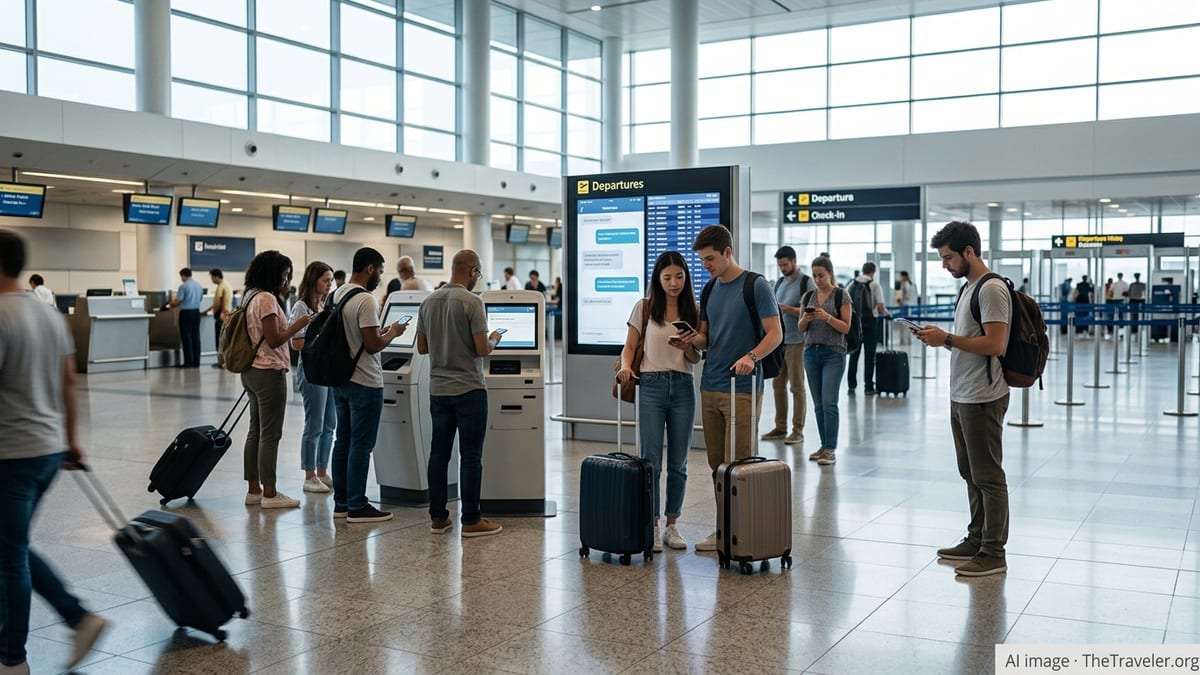
At the passenger level, this shift to predictive operations is increasingly visible through apps that flag likely schedule issues long before departure. Flight-tracking and airline applications now draw on machine learning models that warn travelers about high-risk flights and possible missed connections, even when the official status still shows on time. While these tools do not eliminate disruption, they give both airlines and passengers a longer runway to adjust plans.
Network-Level Tools Tackle Congestion in the Skies
Much of the work to reduce delays happens not just at individual airlines, but at the network level where air traffic flows are managed. In Europe, Eurocontrol’s Network Manager uses digital platforms to balance demand and capacity across crowded airspace, supported by tools that forecast sector loads and airport traffic hours or even days ahead. Public documentation describes how these systems compare demand forecasts to capacity and propose measures such as rerouting flows or slightly adjusting departure times to avoid overloads.
One example is Eurocontrol’s use of artificial intelligence for Air Traffic Flow and Capacity Management delay prediction. Reports on its Forecast of ATFM Delay Evolution tool describe how it predicts how regulatory constraints will affect flights throughout the day, giving airlines better visibility into likely holding patterns and slot movements. This kind of information allows carriers to make informed decisions about whether to keep passengers on board, adjust flight plans, or delay boarding to avoid unnecessary time on the tarmac.
Network tools are also improving the accuracy of traffic predictions by integrating multiple data sources, from airport intentions to airline flight plans. Eurocontrol’s ongoing digital network management initiatives aim to refine demand forecasts in short time windows, so that flow-control measures can be tuned more precisely. Better prediction of how many flights will pass through a piece of airspace at a given time helps controllers avoid conservative restrictions that can generate avoidable delay minutes.
These developments mirror efforts in other regions to modernize air traffic management. As traffic grows and weather patterns become more volatile, software that allows different aviation stakeholders to share a common picture of expected demand and capacity is becoming central to keeping delay levels in check, especially at major hubs where a small capacity shortfall can quickly ripple across continents.
Time-Based Flow Management and Smarter Sequencing
In the United States, the Federal Aviation Administration’s modernization program has focused heavily on tools that change how aircraft are sequenced into busy airports. Public FAA guidance describes Time Based Flow Management as a suite of capabilities that schedules aircraft to key points based on precise arrival times rather than simple first-come, first-served queuing. By calculating when each flight should reach a metering fix or runway threshold, the system can distribute spacing more evenly and reduce the need for holding patterns near the destination.
Instead of absorbing delays only at the end of a flight, time-based systems spread minor speed adjustments and path changes along the route so that aircraft arrive when the runway and airspace are ready. FAA material notes that this approach aims to maximize efficiency and “ensure optimal distribution of any delay,” which in practice means fewer abrupt slowdowns and less low-altitude vectoring around congested terminals. For passengers, that often translates to smoother descents and more predictable arrival times, even on busy travel days.
These flow-management tools are increasingly integrated with weather and surface-operations data. When low visibility, thunderstorms or runway work reduce capacity, software can quickly recompute arrival schedules and share updated times with both controllers and airlines. That coordination reduces the risk that a surge of arrivals will overwhelm an airport during a constrained period, which can otherwise trigger go-arounds and last-minute diversion decisions that add to delays.
On the departure side, similar principles are being applied to manage pushback and taxi queues, with some airports testing systems that assign target off-block times and optimized taxi routes. While these initiatives are still rolling out, early reporting from aviation authorities suggests that they can trim both fuel burn and departure delays by limiting the number of aircraft idling in line when the runway is not immediately available.
AI and Machine Learning Move Into the Cockpit and Control Room
Artificial intelligence and machine learning are increasingly prominent in efforts to tame delays. A growing body of research, summarized in recent systematic reviews of flight delay prediction, shows that models using historical schedules, real-time weather, airspace constraints and airport activity can outperform traditional statistical methods. These systems learn complex relationships between factors such as storm fronts, runway configurations and connection banks, making it possible to anticipate disruptions with greater accuracy.
Industry coverage indicates that airlines are deploying AI both in back-end operations platforms and in tools used directly by staff. Some European projects, for example, are developing applications that give pilots real-time access to network planning data, delay forecasts and recommended actions, while operations centers receive decision-support dashboards that rank flights by risk and potential passenger impact. Similar concepts are emerging in other regions, where machine learning tools highlight which flights are most critical to keep on time to protect long connection banks.
Beyond prediction, AI is being used to generate and compare potential recovery plans. When a thunderstorm shuts down a hub or a technical issue grounds part of a fleet, algorithms can rapidly evaluate thousands of combinations of aircraft swaps, crew reassignments and schedule adjustments. Public descriptions from aviation data providers suggest that such systems can cut the time needed for analysts to understand disruption patterns and identify the least harmful options, reducing the window during which flights operate without a coherent recovery strategy.
Passenger communication is another area where software is reshaping the delay experience. Several large airlines in North America and Europe have promoted new capabilities that combine live operational data feeds with automated message generation, allowing them to send more frequent and detailed delay updates through mobile apps and text messages. While these tools do not directly shorten delays, they lower the risk of missed connections and improve the chances that travelers can rebook or reroute before queues build at customer-service desks.
Challenges, Vulnerabilities and the Road Ahead
Despite the progress, the aviation industry’s growing reliance on software introduces its own vulnerabilities. Recent high-profile disruptions have shown how outages at key IT providers or within airline systems can paralyze operations, leaving carriers temporarily unable to track crews, aircraft locations or gate availability. Public reporting on such incidents has highlighted how legacy infrastructure and fragmented data architectures can limit the resilience of even advanced operations centers.
Experts writing in technical and policy papers also point to the difficulty of integrating new predictive tools into existing workflows. Air traffic controllers, dispatchers and pilots must be able to understand and trust the recommendations generated by AI systems, particularly when safety margins are involved. Training, human-machine interface design and clearly defined procedures are all critical to ensuring that decision support enhances, rather than complicates, real-time operations.
Regulators and network managers are watching these developments closely, seeking ways to capture the delay-reduction benefits while maintaining oversight of how algorithms affect traffic flows. Publicly available material from aviation authorities suggests that future initiatives will prioritize greater data sharing across airlines, airports and air navigation service providers, alongside robust performance monitoring to ensure that promised delay savings materialize in practice.
For travelers, the impact of aviation software will continue to show up in more incremental ways: slightly fewer missed connections on stormy afternoons, shorter taxi queues at congested hubs, and more accurate information when things do go wrong. As traffic climbs toward pre-pandemic levels and beyond, the combination of predictive analytics, network-wide coordination and smarter flow management is likely to be one of the main tools the industry relies on to keep delays from rising in parallel.