


Chongqing is one of the world’s most dramatic cities to move around in. Wedged between steep hillsides and the junction of the Yangtze and Jialing rivers, the city stacks roads, rail lines, pedestrian paths and entire neighborhoods on top of one another. For first-time visitors, this three-dimensional geography is both the main attraction and the main transport challenge. This guide explains how to navigate Chongqing independently using its rail network, cableway, taxis and ride-hailing, so you can enjoy the city’s energy without getting lost or exhausted on endless stairs.
Get the latest updates straight to your inbox!
Understanding Chongqing’s Three-Dimensional Geography
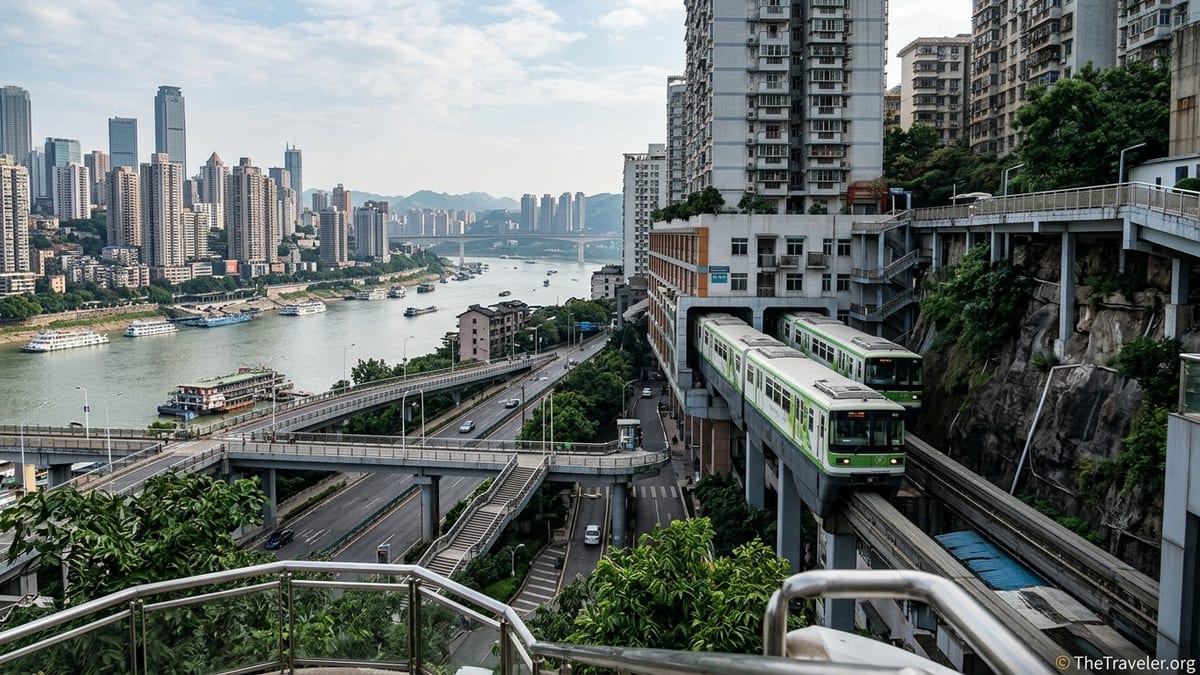
On a flat city map, Jiefangbei pedestrian street and Hongyadong appear to be a straightforward riverside stroll apart. On the ground, that “short walk” can involve multiple levels of flyovers, staircases the height of a ten-story building, and detours around cliffs cut by expressways. Much of central Chongqing occupies a long peninsula of rock high above the water, with districts like Nan’an and Jiangbei rising on opposing hillsides across the Yangtze and Jialing. Bridges span the rivers far above the waterline, while tunnels and lower roads burrow through the rock below. This vertical layering means a destination that looks close on the map may require a long, indirect approach to reach the correct elevation.
Roads in Chongqing often run on two or even three levels stacked on the same hillside. A taxi might drive on a viaduct that floats past your hotel windows while the building’s entrance sits on a narrow side street two levels below. In some places, separate road decks cross each other at different heights, which can confuse standard navigation apps not designed for 3D cities. It is common to exit a metro station, see your destination’s sign straight ahead, and still need to take an elevator or a series of ramps and stairs to actually reach it.
This terrain explains why Chongqing invested heavily in monorails and elevated rail. Chongqing Rail Transit Line 2, for example, runs as a straddle-beam monorail along the steep south bank of the Jialing River, climbing and turning above apartment blocks before diving through the famous Liziba station that passes through a residential building. Instead of forcing passengers to hike up or down steep slopes, many stations open directly onto mid-level plazas or shopping malls at the height where people actually move.
For visitors, the practical lesson is to think in layers, not lines. When you plan a walk, pay attention to which level you are on and where the nearest elevators and escalators are inside complexes like Raffles City or major metro interchanges. When booking accommodation, look closely at whether the “800 meters” to a metro stop is a flat sidewalk or a climb involving several flights of outdoor steps. Reading the land in three dimensions will save both time and energy.
Mastering Chongqing Rail Transit and the Liziba Monorail
Chongqing Rail Transit (CRT) is the backbone of getting around the urban core. The current network includes multiple heavy metro and monorail lines, among them Line 1 running east west through central Yuzhong and Shapingba, Line 2 as an elevated monorail along the Jialing south bank through Liziba, Line 3 and Line 10 connecting Jiangbei International Airport with downtown, Line 6 serving Jiangbeizui and Guanyinqiao, and the Loop Line encircling parts of the central city. Official network diagrams from the municipal transport authorities show a dense web of interchanges across the three main inner-city banks of the rivers.
Key interchange stations anchor most visitor itineraries. Lianglukou connects Line 1 and Line 3 and sits near Chongqing Railway Station. Niujiaotuo links Line 2 with Line 3 and offers sweeping monorail views over the Jialing River. Guanyinqiao and Hongtudi bring together Line 6 and other lines into major commercial areas. Jiefangbei itself is served by closely spaced stations on Line 1 and Line 2, such as Jiaochangkou and Linjiangmen, that together put most central hotels within a few minutes’ walk of a platform.
The most photographed segment of the system runs through Liziba Station on Line 2. Here, the straddle-beam monorail passes through the mid-level floors of a 19-story mixed residential building built into the hillside. Passengers riding between Jiefangbei and Liziba feel the carriage glide into the structure as though entering someone’s living room. Visitors wanting the iconic side-on photo of the train emerging from the building should ride Line 2 to Liziba then exit to the official viewing platform below the tracks rather than attempting to stand on the roadway. City authorities have built a large, dedicated deck with railings and signage specifically to keep photographers away from traffic.
As a first-time visitor, you can think of CRT as both transport and sightseeing. Riding Line 2 between Niujiaotuo and Liziba offers some of the best river and skyline views directly from the train. Line 6 across Jiangbeizui, with its cluster of towers and riverfront plazas, gives another elevated perspective. Using the rail network not just to reach attractions but also as part of the scenic experience will make your days more efficient, since you are combining movement and sightseeing in the same journeys.
Using Stations, Tickets and Mobile Payments
At most Chongqing rail stations, bilingual signs in Chinese and English guide you from the street to platforms. Near the ticket gates you will find large schematic maps of the entire network and detailed diagrams of the specific station exits. Escalators often lead to multiple mezzanines, so pause at the map before exiting to note the exit number and street name nearest your destination. For example, at Liziba, different exits lead either toward the viewing platform area or up into the residential neighborhood behind the station, which can mean a stiff uphill walk if you choose the wrong one.
Ticketing is straightforward. Machines accept banknotes and coins for single-journey tickets, and most lines also support scan payments through Alipay and WeChat Pay on the gates themselves. Fares are generally modest, often between roughly 3 and 7 yuan for trips within the central zones, charged according to distance. If you expect to ride frequently in a day, you can purchase stored-value cards at certain service counters in larger stations, though many local travelers now rely entirely on QR code payment within their mobile wallets.
For international visitors, the expansion of foreign card support inside major Chinese mobile wallets has made independent travel much easier. Both Alipay and WeChat Pay currently allow many foreign-issued Visa, Mastercard and some other cards to be linked directly inside the app after a simple identity check with a passport number. Once linked, you can pay metro fares by presenting the in-app transport QR code at the gate, buy snacks at convenience stores, and pay for taxis or ride-hailing trips without using cash. Approval is not guaranteed for every nationality or bank, and travelers should set this up while connected to reliable Wi-Fi, such as at their hotel, before they begin a day’s travel.
Because mobile payments and foreign card linking still occasionally fail at the gate, you should be ready with a backup. Keep a small amount of cash in 10 and 20 yuan notes to buy single-trip tickets from machines when a QR code does not scan or the wallet app times out. If a ticket machine interface is only in Chinese, staff at the nearby service window can assist if you point to your destination on the map. Some visitors also find it useful to save offline screenshots of the characters for “single journey ticket” and “top up” in their phone gallery to show staff when needed.
When Tech Fails: Cash, Language and Connectivity
Chongqing is heavily optimized for local smartphone users, but it is still possible to move around when the technology does not cooperate. While many small restaurants and shops prefer QR payments, a significant number in busy central districts still accept cash, especially those used to serving older local residents. Larger chains, convenience stores and ticketed attractions normally accept both mobile payments and banknotes at staffed counters. Keeping the equivalent of 200 to 300 yuan in small notes spread between your wallet and a separate pocket is usually enough to handle a half day of transport, snacks and basic admission fees if your apps fail.
Language can be a separate barrier. English signage in the transport system has improved, particularly on current metro maps and train announcements, but many front-line staff, bus drivers and small shop owners speak only Chinese. A translation app that works offline or with minimal data, combined with screenshots of key phrases like your hotel address and “Please use the meter,” will reduce misunderstandings. Some travelers pre-translate phrases into simplified Chinese characters and keep them in a notes app to show taxi drivers directly.
Mobile connectivity is another practical concern. International roaming works for many visitors, but buying a local SIM or eSIM often provides more reliable access for map updates and payments. If you do not have data, consider downloading offline maps of Chongqing in advance and saving pinned locations for your hotel, main metro stations, attractions and viewpoint spots. In a three-dimensional city, even an offline map has limits, but seeing which metro exit cluster or bridge you are actually near helps orient you on the hillside.
Hotel Wi-Fi in the main tourist districts is usually strong enough to download the day’s maps and translation packs. Make a habit of planning key routes each morning while connected, noting both Chinese characters and Pinyin names for your day’s destinations. If your data connection cuts out later in a tunnel or dense neighborhood, you will still have enough information on-screen to read signs, match characters and ask for help.
From Jiangbei Airport to the City: Metro, Taxi and Ride-hailing
Chongqing Jiangbei International Airport sits northeast of the central peninsula and is linked to the city by both metro and road. For independent travelers arriving during the day, the combination of Line 3 and Line 10 of Chongqing Rail Transit provides a predictable and affordable connection to the main accommodation districts. Metro stations are located directly at the airport terminals, and trains connect through major hubs such as Chongqing North Railway Station, Guanyinqiao and Lianglukou before reaching the Jiefangbei area.
To reach Jiefangbei by metro, one common route is to board Line 10 or Line 3 at the airport and transfer to Line 2 or Line 1 closer to the city center, finishing at Linjiangmen or Jiaochangkou stations. Travel time typically falls in the 45 to 60 minute range, depending on waiting times and transfer walking distances, with a fare that is modest by international standards. Guanyinqiao, another popular accommodation area with extensive shopping and dining, is on Line 3 and Line 6, and the metro journey from the airport to Guanyinqiao can be around 30 to 40 minutes under normal conditions.
Official metered taxis queue at designated ranks outside each terminal. Recent local transport information and traveler reports suggest that standard daytime fares from Jiangbei Airport to Jiefangbei usually fall in the range of roughly 60 to 80 yuan when the meter is used, with travel times of around 30 to 40 minutes in moderate traffic. Late at night, when roads are clearer, that journey can be quicker and slightly cheaper. To minimize the risk of overcharging, join the official taxi line, have your hotel name and address written in Chinese characters to show the driver, and confirm the meter is running as you depart.
Ride-hailing services, used through apps on Chinese phones, are another option from the airport to central districts such as Nanbin Road or Guanyinqiao. Prices vary based on demand and vehicle type but are often similar to or slightly less than metered taxis for standard sedans. The main advantages are transparent pricing displayed before booking and in-app navigation. The drawback is that these apps integrate closely with Chinese mobile payment systems, so visitors must have functioning Alipay or WeChat Pay linked to a card to use them easily. If you arrive on a late-night flight and prefer door-to-door comfort, it is worth testing your ride-hailing app connection on the terminal Wi-Fi before you leave the arrivals hall.
Yangtze River Cableway: Transport Icon and Tourist Ride
The Yangtze River Cableway connects the Yuzhong peninsula with the Nan’an district, suspended high above the wide brown waters of the Yangtze. For local commuters, it has long offered a direct cross-river link. For visitors, it has become a photogenic attraction, framing Chongqing’s skyline and the bridges in both directions. The cableway’s upper station on the Yuzhong side sits within walking distance of Jiefangbei, while the Nan’an station connects to local streets and onward taxis or buses.
Tickets for the cableway are typically sold as one-way and round-trip rides, priced higher than a metro journey but still accessible for most international visitors. In recent years, an online reservation system has been used to manage demand at peak times, particularly weekends and public holidays when domestic tourists flock to the city. When reservations are required, visitors either select a time slot in advance through a Chinese-language mini-program or join a separate queue for on-the-spot purchases when available. The precise operating hours and booking rules can vary seasonally, so it is prudent to confirm details through current local information once you arrive.
Queues can be long during the evening golden hour and at night, when many passengers line up to capture the city lights from the cabins. The loading method means passengers are grouped for each car, and in very busy periods staff may prioritize keeping lines moving over securing a clear window view for every visitor. Those who ride earlier in the day or in less popular weather often enjoy shorter waits. For travelers mainly interested in transport rather than photography, off-peak crossings offer a quick, uncrowded way to move between the peninsula and Nan’an while still appreciating the river perspective.
Riding the cableway purely as transport makes most sense if you are already exploring nearby areas on both sides of the river, for example combining a Yuzhong morning around Jiefangbei with an afternoon or evening meal along the Nanbin Road riverside promenade. If your goal is photography, plan for possible queues and consider that visibility can be affected by humidity, rain and river haze. In poor weather, the visual experience may be limited, and you may decide that a riverbank viewpoint or bridge walk offers a better return for your time.
Reaching Key Sights with Minimal Uphill Walking
Many of Chongqing’s best-known sights cluster within reach of a handful of metro stations, but choosing the right exits and approaches can dramatically reduce climbing. Hongyadong, the multi-level complex clinging to the cliffside above the Jialing, sits between the Qiansimen Bridge and the river. Arriving at Jiaochangkou Station on Line 1 or Line 2 and following signs toward the river brings you out on higher streets from which you can enter Hongyadong at an upper level, then explore downward inside via escalators rather than hiking up from the riverside road.
Chaotianmen, the pointed tip of the peninsula where the Yangtze and Jialing meet, is served by Line 1 at Chaotianmen Station and is also walkable from Jiefangbei through descending streets and stairs. Raffles City, the striking complex of towers and the skybridge known colloquially as the “horizontal skyscraper,” stands near Chaotianmen and has direct internal connections from its own metro stop, allowing visitors to move between malls, hotel lobbies and observation areas largely on escalators and elevators. Planning a route that strings together Jiefangbei, Raffles City and Chaotianmen in one downhill sequence is easier on the legs than tackling them separately with repeated climbs.
Shibati, historically famous for its steep stair streets and traditional hillside housing, has undergone significant redevelopment. Some sections now feature reconstructed or modernized versions of the old lanes, with controlled access and new commercial spaces, while other parts of the original neighborhood no longer exist. Access today depends on the specific viewing platforms and heritage segments open at the time of your visit, often reached from nearby metro stations with signed pathways. Longmenhao, another riverside area with older buildings beneath the city’s elevated structures, lies on the Nan’an side and can be reached by metro followed by a short walk downhill, making it a good place to experience Chongqing’s layered urban fabric without an excessively long climb.
For the Liziba monorail viewing platform, the easiest approach is to ride Line 2 directly to Liziba Station from central stops such as Jiaochangkou or Linjiangmen. The train ride itself delivers the through-building experience. Once you disembark, follow signage in Chinese characters for “viewing platform” and head downhill using the marked pedestrian passages and steps that lead safely under the track. This avoids both roadside walking and unnecessary ups and downs in the nearby residential maze. Jiefangbei itself is best accessed via Jiaochangkou or Linjiangmen stations, whose multiple exits surface within a largely flat pedestrian grid of streets and plazas.
Where to Stay: Jiefangbei, Guanyinqiao, Nanbin Road and Transit Hubs
Jiefangbei remains the classic base for first-time visitors. Hotels here range from international chains to local mid-range properties, many within a short, largely level walk of Line 1 and Line 2 stations. Staying in this pedestrian core simplifies evening plans, as you can step out to Hongyadong viewpoints, shopping streets and numerous hotpot restaurants without needing a taxi. The trade-off is noise and crowds, particularly around weekends and holidays, as well as less direct access to riverside promenades at water level without using stairs or elevators.
Across the Jialing in Jiangbei, Guanyinqiao and nearby Jiangbeizui offer a slightly more spacious environment with modern malls and wide streets. Guanyinqiao’s position on Line 3 and Line 6 makes it convenient for both airport access and day trips into Yuzhong by metro. Hotels here are often slightly newer and can be quieter at night than those directly on the Jiefangbei pedestrian grid, though you will usually take the metro or a taxi into the peninsula for Hongyadong, Chaotianmen or the traditional inner-city atmosphere. For some travelers, this balance of easy transport and calmer nights works better than staying in the absolute center.
On the Nan’an bank along Nanbin Road, a growing strip of hotels and riverside promenades caters to visitors who want dramatic skyline views across to the peninsula’s towers. At night, these views can be spectacular. However, walkability from Nanbin Road hotels to metro stations varies, and some properties sit partway up the slope above the river, involving climbs or driveway transfers. Guests here rely more on short taxi trips and ride-hailing rides up to cableway stations and metro stops, accepting that they are trading immediate access for panoramic vistas.
Another strategy is to choose a hotel that sits directly above or beside a major metro interchange, such as those near Lianglukou or Chongqing North Railway Station. This prioritizes luggage convenience, since you can roll bags straight from platforms into lobbies with elevators, and makes day trips by rail simple. The surrounding neighborhoods may feel more utilitarian than touristy, but with the CRT network you are usually one or two stops from more atmospheric streets. Whatever district you choose, examine satellite views and street-level images in advance to check how many stairs stand between the hotel entrance and the nearest station.
Three-Day and Two-Day Itineraries by Line and Neighborhood
A three-day stay allows you to experience Chongqing’s core neighborhoods without rushing. On Day One, base yourself around Jiefangbei and Yuzhong. Spend the morning orienting yourself in the pedestrian streets near Jiaochangkou and Linjiangmen stations, then ride Line 2 to Liziba for the monorail-through-building experience and viewing platform. Return by monorail to Niujiaotuo for elevated river views, then head back to Jiefangbei for an afternoon visit to Hongyadong entered from an upper-level street. As evening falls, walk to the Qiansimen Bridge for night views of Hongyadong and the riverbanks.
Day Two can focus on crossing the rivers. Head from Jiefangbei by foot or short metro hops to the Yangtze River Cableway upper station and ride to Nan’an, taking time to explore Nanbin Road’s riverside promenade and dining options. Use the metro on the Nan’an side to reach Longmenhao or other hillside neighborhoods that reveal the stacked roads and older buildings under the elevated structures. Later, ride back into Yuzhong and continue east to Chaotianmen and Raffles City, exploring the plazas and indoor connections while mostly moving downhill through the day.
On Day Three, shift your attention to the north bank. Take the metro to Guanyinqiao on Line 3 or Line 6 to see a more modern commercial district, then ride the line further to Jiangbeizui for riverside promenades and views back toward Yuzhong’s skyline. If you have an evening flight, this day is also a good time to position yourself closer to Jiangbei Airport by staying your final night in Guanyinqiao or near Chongqing North Railway Station, simplifying the next morning’s transfer. Those with an extra half-day can add a visit to a historic district such as Ciqikou from Line 1, though that lies slightly beyond the central transport focus of this guide.
If you only have two days, concentrate on Yuzhong and one river crossing. On the first day, follow the Jiefangbei, Hongyadong and Liziba sequence, ensuring you ride Line 2 for both the engineering and the scenery. On the second day, start with the Yangtze River Cableway and Nanbin Road, then return to Chaotianmen and Raffles City in the afternoon before an evening stroll through the Jiefangbei area. With careful planning using the metro and cableway, this shorter stay still delivers Chongqing’s characteristic mix of vertical streets, river views and high-tech transit.
Costs, Conditions and a Practical Transport Cheat Sheet
Costs for getting around Chongqing’s inner districts are relatively manageable. Metro fares for typical cross-city rides often fall between roughly 3 and 7 yuan. A standard taxi journey within central districts might cost in the 15 to 40 yuan range depending on distance and traffic. The Yangtze River Cableway charges more than a metro ticket but still within a modest range by international standards for a one-way ride. Budget-conscious travelers who primarily rely on CRT and only occasionally use taxis can keep daily transport spending relatively low compared with accommodation and dining.
Food costs vary with style. Simple noodle shops and casual eateries in local neighborhoods can serve filling bowls and rice dishes in the 15 to 40 yuan range, while hotpot and larger restaurant meals with multiple dishes can scale up rapidly, particularly in popular central areas. Accommodation near Jiefangbei, Guanyinqiao and other key transport hubs spans everything from budget rooms under about 300 yuan per night in smaller properties to mid-range chain hotels in the 400 to 700 yuan range and international brands climbing higher. Checking recent guest reviews for comments about elevator reliability and street noise is wise, since both factors strongly influence rest and transport convenience.
Seasonal and environmental conditions exert a real influence on transport choices. Chongqing summers can be extremely hot and humid, with daytime temperatures often climbing well above 30 degrees Celsius and nighttime heat lingering in the concrete canyons between towers. In these months, limit long outdoor climbs and favor air-conditioned metros, malls and cable cars. Rain is frequent, and narrow stair streets can become slippery. Public holidays, especially around Lunar New Year and the October National Day period, bring heavy domestic crowds to iconic spots like Hongyadong and the cableway, lengthening queues and filling trains.
For practical communication, it helps to remember or keep a small cheat sheet of key place names in both Pinyin and characters along with their main metro stops. For example, Jiefangbei (解放碑) near Jiaochangkou (较场口) and Linjiangmen (临江门); Hongyadong (洪崖洞) between Jiefangbei and Qiansimen Bridge; Liziba (李子坝) on Line 2; Guanyinqiao (观音桥) on Line 3 and Line 6; Nanbin Road (南滨路) reached via Nan’an-side stations and short taxi rides; and Jiangbei Airport (江北国际机场) on Line 3 and Line 10. Showing these characters to staff or taxi drivers, or matching them on metro signage, can be more effective than relying only on English names.
Mobility is a serious consideration in Chongqing. Many streets, older viewpoints and residential lanes are simply not accessible without stairs. While metro stations in newer areas often have elevators and ramps, some exits deposit passengers at the top of long outdoor staircases or down on lower roads. If you or your companions have limited mobility or heavy luggage, prioritize hotels and itineraries that keep you close to elevators and relatively flat pedestrian zones around major stations and malls. In some cases, paying for a short taxi ride to avoid a steep staircase is a worthwhile investment in comfort and safety.
Independent Travel, Common Mistakes and Final Advice
Independent exploration of Chongqing is entirely feasible for first-time international visitors who are comfortable with urban transport elsewhere in Asia and who prepare for the city’s specific challenges. Private guides can add context and smooth over language issues during day trips or for travelers who prefer curated experiences, but they are not strictly necessary for moving between major attractions in the central districts. The combination of CRT, cableway, official taxis and occasional ride-hailing provides sufficient coverage for most short stays when supported by basic Chinese phrases and a good translation app.
Common navigation mistakes revolve around underestimating elevation and over-relying on two-dimensional app directions. Visitors sometimes book hotels that appear “only 1.5 kilometers” from Jiefangbei, only to discover that the route involves dropping to a riverfront road and climbing back up a hillside staircase, turning an easy stroll into almost an hour of exertion. Others exit metro stations by the wrong door and find themselves facing a steep flight of steps when a level mall entrance exists on another side. Taking a moment inside each station to study the exit map and thinking in terms of levels rather than distance helps avoid these surprises.
Another frequent issue is assuming that cash or foreign cards will work everywhere. Chongqing is deeply integrated with QR-based mobile payments, and some venues may struggle to provide change or card processing for small purchases. Setting up Alipay or WeChat Pay with a foreign card where possible, carrying modest cash reserves, and having clear Chinese-language addresses ready for taxis create redundancies that keep your day moving when one system fails. When in doubt, default to the metro for longer hops and save taxis for final connections up or down the hills.
The easiest approach for most short-stay international visitors is to stay within walking distance of Jiefangbei or Guanyinqiao, learn the basic layout of Lines 1, 2, 3 and 6, and build each day around one cluster of neighborhoods rather than zigzagging back and forth. Use Line 2 as both a commute and a moving balcony over the Jialing, take the Yangtze River Cableway at least once for a sense of the river’s scale, and accept that some stairs are part of the Chongqing experience. With reasonable preparation and flexible expectations, navigating this vertical megacity becomes not a problem to solve but a central part of the journey itself.