


More news on this day
As Mediterranean cruise calls surge in Palma de Mallorca, many passengers are quietly opting out of ship-sold shore excursions, finding that a mix of local transport, hop-on hop-off buses and guided walks offers a cheaper, more flexible way to explore the Balearic capital’s cathedral, waterfront and hilltop castle.
Get the latest news straight to your inbox!
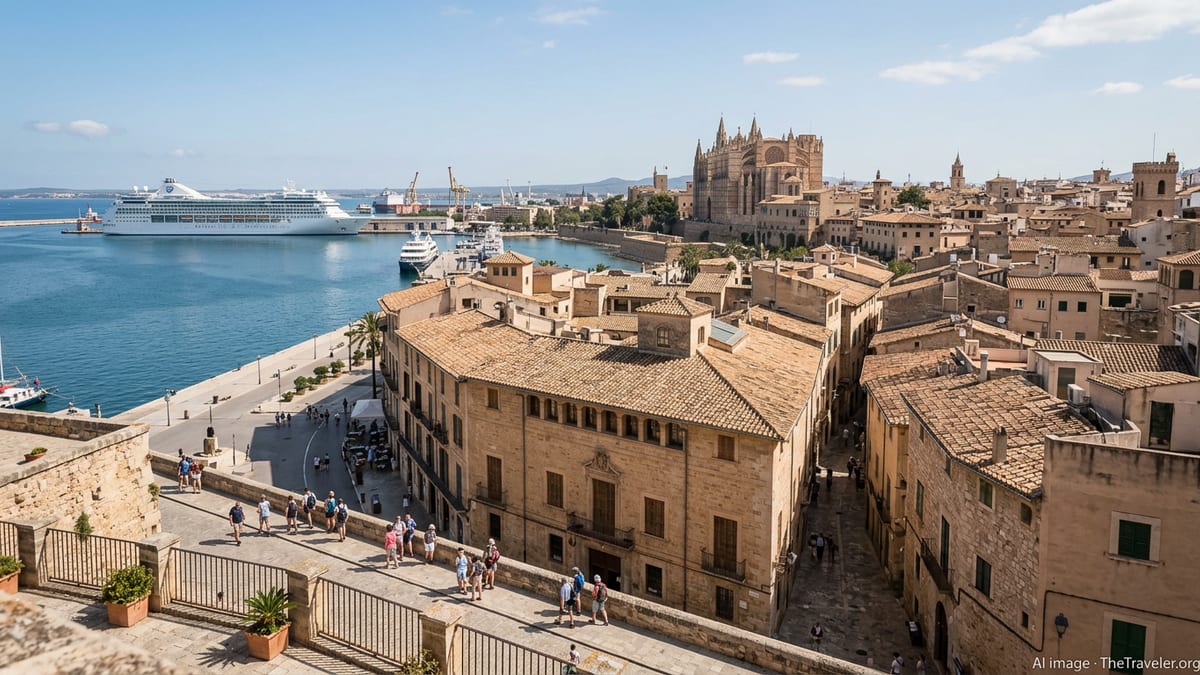
Rising cruise traffic meets demand for DIY exploration
Palma de Mallorca has become a mainstay of Western Mediterranean itineraries, drawing large cruise ships to its port throughout the April to October season. Publicly available data and port schedules show several major lines calling at the city on the same day during peak weeks, creating a competitive market for organized excursions and independent touring options in and around the compact capital.
Traditional cruise excursions in Palma typically bundle coach transport from the pier with guided visits to headline sights such as the Gothic cathedral, the Almudaina Palace and Bellver Castle. Package prices reported by passengers and travel outlets often reach several dozen euros per person for half-day city highlights, with premium experiences costing significantly more. Against that backdrop, travelers increasingly compare those rates with what it costs to move around the city using local services.
Palma’s relatively short distance between the cruise piers and the historic center, alongside a dense urban transport network, means visitors can see many of the same places without committing to a fixed tour schedule. Reports from recent seasons indicate that passengers who are comfortable reading bus stop maps or following a mobile map app are using that infrastructure to build their own day in port, rather than purchasing a seat on a ship-run coach.
From gangway to Gothic cathedral using local transport
On arrival, ships berth at the Estació Marítima cruise terminals along the Bay of Palma. While some cruise lines sell shuttle transfers into the city for an additional fee, information shared by local tourism providers and passenger forums indicates that urban buses operated by Palma’s EMT network serve stops near the port area, connecting to central points including the seafront Parc de la Mar below the cathedral.
For visitors who prefer not to navigate local routes, official documentation from the city’s tourism office highlights a dedicated hop-on hop-off sightseeing circuit that includes a port-area stop. The circular route, typically operating between late morning and early evening, runs at regular intervals and loops past key attractions such as the cathedral, Bellver Castle, the seafront promenade and central shopping streets. Tickets are generally valid for 24 hours, giving cruise passengers scope to disembark and rejoin at multiple points during a single day in port.
This structure has turned the sightseeing bus into a hybrid between a tour and a transit pass. Travel companies that sell the product describe it as a way to step off near the old town, walk through the medieval lanes or stop for lunch, then ride onward to the castle outlook or a contemporary art museum before returning toward the pier. Some tickets, according to recent product descriptions, also bundle discounts at selected attractions and restaurants, further blurring the line between transport and excursion.
For confident walkers, port maps suggest that the waterfront promenade can also be followed on foot, with the distance from some cruise berths to the cathedral area taking under an hour at a steady pace. That choice appeals particularly to passengers seeking a low-cost alternative and a more gradual introduction to the city skyline as it rises across the bay.
Guided walking tours offer deeper insight at lower cost
Once in the historic center, self-guided cruise visitors are turning to another alternative to the standard ship excursion: independent guided walking tours. Several local operators publish schedules for daily group walks focused on Palma’s old town, meeting at central locations such as Parc de la Mar or nearby squares and covering the cathedral exterior, medieval courtyards and key civic buildings.
Many of these walks follow a pay-what-you-want or modest fixed-fee structure, which can reduce outlay compared with a full coach excursion while still providing commentary on the city’s layered history. According to tour descriptions, groups typically last around two hours and are offered in multiple languages, making them accessible to a broad cross-section of cruise passengers who have navigated into town on their own.
Participants retain control over their timing, able to join a morning tour and then continue independently or return to the ship at their own pace. Because Palma’s old town is compact and largely pedestrian, walking tours often cover a high concentration of points of interest in a short distance, from the cathedral’s seafront terraces to narrow shopping lanes and shaded plazas.
Public information on these services emphasizes practical guidance for cruise visitors, including where to find nearby bus stops for the return to the port and approximate travel times. This logistics support has helped make guided walks a realistic choice even for those with only a few hours ashore.
Hop-on hop-off buses as a bridge between bus tour and total DIY
The growth of Palma’s hop-on hop-off sightseeing bus has effectively created a middle option for travelers who want structure without the constraints of a ship’s own tour. The service, operated under an international sightseeing brand, runs a single loop of around 16 to 18 stops, passing the cathedral, Bellver Castle, the Spanish Village open-air museum and several waterfront and commercial districts.
Product information from multiple agents indicates that commentary is delivered through headphones in various languages, while open-top decks allow for panoramic views of the bay and the terraced neighborhoods climbing toward the castle. The bus typically departs every 20 to 30 minutes from its central starting point, with the port-adjacent stops timed to coincide with scheduled arrivals of large cruise ships.
For cruise passengers, one of the main attractions is the ability to tailor the day without worrying about interconnecting local routes. After riding from the port to the old town, for example, visitors can disembark to explore the cathedral precinct on foot, then catch a later bus to ascend to Bellver Castle’s elevated vantage point before circling back through the shopping avenues and eventually returning toward the ship.
This flexibility stands in contrast to many line-run excursions, which often follow a fixed timetable combining several locations into a single outing. Travelers who prefer spontaneous café stops, extended photo breaks or unscheduled detours into side streets are finding that a day ticket on the sightseeing bus replicates the core elements of a city highlights tour at a lower per-person cost.
Cost, control and the changing calculus of shore days
The decision to skip a cruise line excursion in Palma increasingly comes down to a balance of cost and control. Cruise-branded tours commonly promote the reassurance that buses will wait for delayed groups and that logistics are centrally managed. However, price comparisons shared in recent travel coverage show that a family or group can often combine a hop-on hop-off ticket or public bus fares with an independent walking tour for less than the total of a ship-organized outing.
At the same time, digital tools have made independent planning easier. Mapping apps show live walking times from the port shuttle drop-off points, while operators of sightseeing buses and local tours publish schedules, route maps and service notices online. This transparency allows passengers to assess how much time they can safely spend at each stop while still returning to the ship well before its published departure.
Security-conscious travelers remain attentive to the risks of relying solely on local transport, particularly in the rare event of traffic disruption or service changes. For that reason, many independent cruisers aim to be back in the port area at least an hour before the final all-aboard time. Reports from the 2024 and early 2025 seasons suggest that those who build in this margin and choose centrally located meeting points for tours are experiencing smooth days ashore without paying premium excursion prices.
As cruise calls to Palma continue into 2026, the city’s combination of port proximity, integrated urban transport and a choice of flexible, bookable-on-arrival activities is positioning it as one of the easier Western Mediterranean ports for passengers to explore on their own terms. For travelers willing to trade a reserved bus seat for a day of mixing local buses, a sightseeing loop and guided walks, skipping the cruise line excursion is emerging as a practical, and often more rewarding, way to see the Mallorcan capital.