


Roskilde is one of Denmark’s easiest and most rewarding day trips from Copenhagen. Just 30 kilometers west of the capital, it combines a superb Viking ship museum, a UNESCO-listed cathedral full of royal tombs and a compact historic center along the fjord. With frequent direct trains from Copenhagen Central Station and clear ticket options, it is straightforward to visit independently in one long day or as an overnight stop on a wider Zealand itinerary.
Get the latest updates straight to your inbox!
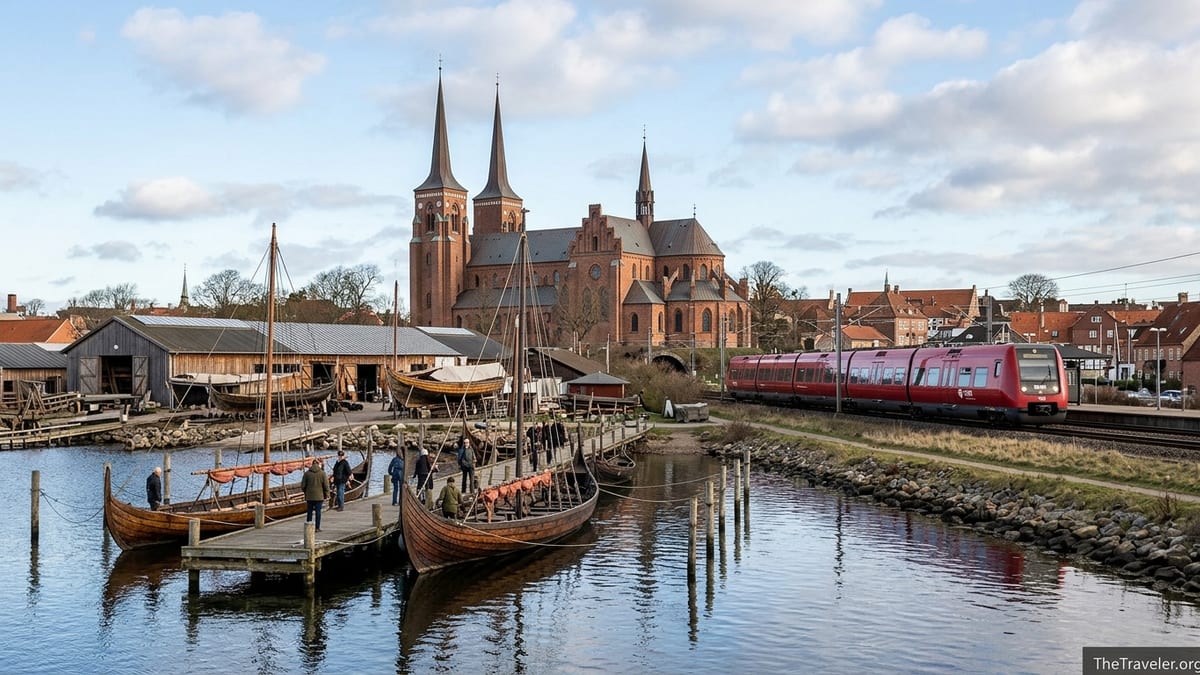
Getting from Copenhagen to Roskilde by Train
The main gateway to Roskilde is the rail line from København H, Copenhagen Central Station. Direct regional trains run throughout the day toward destinations such as Holbæk, Slagelse and Kalundborg, and almost all of them stop at Roskilde Station. Typical journey times are about 20 to 30 minutes, depending on the specific service, and departures usually run several times per hour during the day. An example morning departure might leave København H just after 09:00 and arrive in Roskilde around 09:22, with no changes required.
Standard adult tickets on this route are usually priced in the range of 60 to 70 Danish kroner each way when bought as a regular single through DSB ticket machines or the DSB app, though exact fares vary slightly with future fare adjustments. Travelers who already hold a valid Rejsekort pay a distance-based fare deducted automatically at check in and check out, which for Copenhagen to Roskilde is typically somewhat lower than the full single ticket price. For short visits, most independent travelers either buy simple singles in the station machines or rely on a city pass or Copenhagen Card that includes this route.
The line between Copenhagen and Roskilde is part of the main Zealand rail network, so the services you will use are regular DSB regional trains rather than special tourist trains. Carriages are modern, equipped with luggage racks and space for strollers, and there is level boarding from most platforms, which is useful for visitors with mobility issues. Seats are unreserved, so you simply board and find any available place. Even in summer peak periods, this short hop rarely feels overcrowded outside commuting rush hours.
To plan exact departure times for your travel date, use Denmark’s official journey planner or the DSB app shortly before you travel, since timetables can change slightly with seasonal adjustments and track work. As a rule of thumb, if you aim for a train leaving Copenhagen Central between 09:00 and 10:00, you can expect to be walking into Roskilde’s historic center well before 10:30, which works nicely for a full five to seven hour day.
Tickets, Zones, Rejsekort and the Copenhagen Card
Copenhagen and Roskilde lie within the greater Copenhagen public transport zone system. The journey from København H to Roskilde generally covers eight fare zones. If you buy a paper or app ticket, you simply choose your start and end stations and the system calculates the correct price. For visitors staying in Copenhagen without a Rejsekort, purchasing a standard adult single or 24-hour city pass through the DOT or DSB apps or from station machines is the easiest option. Machines at Copenhagen Central Station have English-language prompts and accept major debit and credit cards.
Rejsekort is Denmark’s reusable smart travel card, which many residents use for buses, trains and metro. Visitors can still buy an anonymous Rejsekort at staffed stations in the Copenhagen area, but the scheme is being phased out in favor of app-based solutions, so it is not essential for a one-off Roskilde day trip. If you already have a Rejsekort, you would check in at Copenhagen Central, check out at Roskilde and pay a slightly discounted distance-based fare compared with paper singles. You do not need cash, since tickets and card top-ups can be paid by card.
The Copenhagen Card Discover is particularly attractive for a Roskilde day trip. Under its current terms, this version of the card includes unlimited public transport in zones 1 to 99, which cover the entire Copenhagen region, including the train line to Roskilde, for the validity period of your card. In addition, it provides included admission to both the Viking Ship Museum and Roskilde Cathedral. This means that once your card is activated, you can ride from Copenhagen to Roskilde and back, visit the cathedral and explore the Viking Ship Museum without paying separate entry fees. Separate sailings on reconstructed boats at the Viking Ship Museum are usually sold as a small add-on even for card holders.
Copenhagen Card prices themselves vary by duration, with options such as 24, 48, 72 or 120 hours. For a traveler planning at least one major day trip plus central-city museums, the combined value can be substantial. For example, adding together two standard rail singles, Viking Ship Museum admission and cathedral entry can easily reach several hundred kroner. If those entries and the transport are already covered by a 24-hour Copenhagen Card, the card will often pay for itself, especially if you also fit in one or two Copenhagen attractions on the same day.
From Roskilde Station to the Historic Center and Waterfront
Roskilde Station sits just south of the historic core. When you exit the main station building, you step onto Jernbanegade, with clear signs toward the cathedral and city center. The walk to Roskilde Cathedral takes around 10 to 12 minutes at an easy pace, roughly 800 meters slightly uphill. The route is straightforward: you continue up the main shopping street, Algade, where you will see pedestrianized sections, shops, bakeries and cafes. The cathedral’s twin spires are visible ahead, so it is hard to lose your bearings.
To reach the Viking Ship Museum from the station, many visitors prefer to stop at the cathedral first, since it lies along the natural route. From the cathedral to the museum is another 10 to 15 minutes on foot, mostly downhill toward Roskilde Fjord, covering approximately 1 kilometer. From the station all the way to the museum is therefore a walk of around 1.8 kilometers, typically 20 to 25 minutes for most adults. Surfaces in the old town vary from smooth pavements to cobblestones, so travelers with limited mobility should allow a little more time and wear appropriate footwear.
Local buses are available for those who prefer not to walk. City bus routes run from near Roskilde Station down toward the harbor area close to the Viking Ship Museum. Tickets on these city buses are covered if you are using a valid Copenhagen Card or a standard zone ticket or Rejsekort that includes Roskilde. Be aware that drivers typically do not accept foreign bank cards directly on board, so it is simpler to rely on your existing transport ticket or buy a mobile ticket in advance. For many visitors, the gradual downhill stroll via the cathedral, Stændertorvet square and the old streets provides a pleasant introduction to the town before arriving at the waterfront.
Accessibility is generally good, though the approach to the cathedral involves a steady incline and some areas of uneven paving. The waterfront path between the Viking Ship Museum and Roskilde harbor promenade is mostly level and wide, suitable for strollers and mobility scooters. The museum itself offers step-free access to its main exhibitions and has accessible toilets, but some outdoor areas of the boatyard use gravel or wooden surfaces that can be trickier in wet weather or for those with wheelchairs.
The Viking Ship Museum: Ships, Workshops and Sailing on the Fjord
The Viking Ship Museum in Roskilde is the highlight for many visitors. It sits directly on the edge of Roskilde Fjord, a short walk from the historic center, and is Denmark’s national museum for Viking-age and early medieval ships. At its heart are five original Viking ships, often referred to as the Skuldelev ships, recovered from the bottom of the fjord where they once formed part of a defensive barrier. Inside the main exhibition hall, these thousand-year-old hulls are displayed against the backdrop of the fjord, with interpretive panels and multimedia helping visitors understand their construction, use and discovery.
Beyond the core exhibition, the museum complex includes an outdoor boatyard where traditional boatbuilding and reconstruction work takes place. Here, craftspeople build and repair full-scale replicas of Viking ships and other traditional Nordic wooden boats using historically informed techniques. In the main summer season, visitors can often watch demonstrations of clinker boatbuilding, rope making or sail repair at set times during the day. Workshops and family-friendly activities invite children to try simple crafts or learn Viking-era skills in a hands-on way.
Current standard admission prices for the Viking Ship Museum for adults are published on the museum’s official information pages and are subject to occasional adjustment. As of the latest update, adult entry in high season is typically in the lower hundreds of kroner, with discounts for children, youths and families, and free admission for young children. Annual passes and combination tickets are also available. The museum is open year-round, but with shorter hours in winter. In summer, opening may run from morning until late afternoon or early evening, while in the low season hours might be concentrated from late morning to mid-afternoon. Visitors planning an autumn or winter trip should consult the museum’s calendar to confirm exact hours on their travel dates.
One of the museum’s most memorable experiences is sailing on the fjord in reconstructed Viking-style or traditional Nordic boats. These sailings are seasonal, usually offered from spring through early autumn, with a peak period roughly from May to late September or into October, weather permitting. Tickets for these boat trips are purchased in addition to the museum entrance, and even holders of Copenhagen Card generally need to pay a separate sailing fee. Trips typically last about 45 to 60 minutes and are subject to age and safety restrictions: children must be accompanied by adults, and there may be minimum age or size requirements for participation. Sailings can be cancelled or altered at short notice in case of strong winds, storms or unsafe conditions on the fjord, so visitors should check the day’s schedule at the museum entrance or harbor office when they arrive.
Roskilde Cathedral and the Historic Heart of Town
Roskilde Cathedral rises on a hill in the center of town and is recognized as a UNESCO World Heritage Site. It has been the main burial place for Danish monarchs for centuries, and inside visitors can see richly decorated royal chapels and sarcophagi from across the eras of Danish history. The building combines brick Gothic exteriors with later chapels in styles ranging from Renaissance to modern, so even visitors more interested in architecture than in royal history will find plenty to appreciate.
To enter the cathedral’s royal chapels and museum areas, there is an admission fee for adults, while access for worship during church services remains free. Current entry prices are displayed at the cathedral visitor desk and on official information materials, and are often included as part of the Copenhagen Card’s list of attractions. For independent adult visitors not using a tourism pass, the admission charge is typically in the low hundreds of kroner, with concessions for students and children. Most visitors find that 60 to 90 minutes is sufficient for a thorough visit, including time to explore the nave, chapels, crypt-like spaces and small exhibition areas explaining the cathedral’s development and its royal tombs.
The cathedral remains an active parish church, so access can be limited during services, funerals, concerts or special events. On such occasions, tourism visits may be paused or restricted to certain parts of the building. It is common practice to advise visitors to check the cathedral’s calendar before traveling or to be flexible on the day. If you arrive during a posted worship time, you can either attend quietly as a guest or return later when tourism visiting hours resume. Photography rules also vary slightly: flash and tripods are usually discouraged, and respectful behavior is expected in all areas.
Immediately around the cathedral lies Roskilde’s old town. Stændertorvet, the main square, sits a short walk away and often hosts markets, small events and outdoor seating in warmer months. Here and along the nearby pedestrian streets you will find cafes offering traditional Danish smørrebrød, bakeries selling cinnamon pastries, and casual restaurants that make convenient lunch or coffee stops during a day of sightseeing. Historic buildings in the area include the old town hall and remnants of medieval structures, giving this compact core a distinct small-city atmosphere that contrasts with central Copenhagen.
Waterfront Walks, Cafés and Additional Cultural Stops
After exploring the cathedral and Viking Ship Museum, many visitors enjoy a gentle wander along Roskilde’s waterfront. From the museum, you can continue along the harbor promenade, where there are views of traditional wooden boats and the calm waters of the fjord. Simple benches and grassy areas provide quiet places to sit, and in summer local ice cream kiosks or casual eateries open near the water. The waterfront is relatively flat and accessible, making it an easy stroll for families with young children or for travelers who have already climbed the old town’s hills earlier in the day.
For refreshments, the café at the Viking Ship Museum offers indoor and outdoor seating with views over the fjord. It typically serves light lunches, cakes and hot drinks, using seasonal ingredients where possible. In town, Stændertorvet and Algade host a range of cafes and bistros where a typical lunch of a sandwich, salad or smørrebrød with a soft drink might cost around 100 to 150 kroner per person, depending on choice. Coffee and pastry breaks are an easy way to punctuate the walk between the station, cathedral and museum, and prices for a coffee and a pastry usually sit in the 50 to 70 kroner range.
Roskilde also offers a handful of smaller cultural attractions that can be slotted into a longer day or an overnight stay without overwhelming the itinerary. Near the cathedral and town center, there are local museums focused on contemporary art and regional history. A bit further away, but still reachable by local bus, stands Ragnarock, a modern museum devoted to rock music and youth culture in Denmark, which often appeals to visitors interested in more recent cultural history. For a first-time day trip, most travelers will be satisfied with the Viking Ship Museum, cathedral and a relaxed wander through town, but those staying longer can add one or two of these secondary sights as time and energy allow.
In poor weather, the Viking Ship Museum’s indoor galleries and Roskilde Cathedral provide strong alternatives to outdoor sightseeing. The main Viking ship hall, auxiliary exhibitions and craft demonstrations under cover allow several hours of exploration even in heavy rain. Cafés in both the museum and the old town offer warm shelter and a chance to linger over lunch. On days when the fjord is too windy or rainy for sailing, the extra time can simply be reallocated to the museum’s interpretive exhibits or to a slow visit of the cathedral’s chapels and galleries.
Sample Day Trips, Overnights and Wider Zealand Options
A realistic independent day trip from Copenhagen lasting five to seven hours might begin with a train leaving København H around 09:00, arriving in Roskilde about 09:25. From the station, you walk up through the town to Roskilde Cathedral, arriving around 09:40. Allow roughly 60 to 90 minutes inside, leaving time to explore chapels, tombs and exhibits. Around 11:00, stroll down through Stændertorvet toward the fjord, perhaps grabbing a coffee on the way, and reach the Viking Ship Museum by 11:30. Spend two to three hours there, including both the main ship hall and the outdoor craft areas, and, in season, a sailing slot if conditions allow. After a late lunch at the museum café or back in the old town, you can walk slowly to the station for a returning train from about 15:00 or 16:00, arriving back in Copenhagen in late afternoon.
Families with children often prefer a slightly slower pace centered on the waterfront. In that case, you might go directly from Roskilde Station to the Viking Ship Museum, arriving mid-morning, and spend a solid three hours between the ship hall, interactive activities and a scheduled sailing on the fjord if the weather is good and age requirements are met. After lunch on site, a shorter visit of perhaps 45 to 60 minutes to the cathedral in the early afternoon can round out the day before returning to Copenhagen. Keeping walking segments shorter and prioritizing hands-on experiences usually makes the day more enjoyable for younger travelers.
History enthusiasts or those particularly fascinated by maritime archaeology might want to extend their visit into an overnight stay. On arrival day, they can devote a long afternoon to the Viking Ship Museum, including time to study the technical exhibits, watch craft demonstrations and peruse smaller displays on ship reconstruction and voyages. The following morning can then be dedicated to an unhurried cathedral visit, a detailed look at royal tombs and architectural features, and perhaps an extra local museum or Ragnarock before returning to Copenhagen in the late afternoon.
With two nights in Roskilde, you could also consider short public transport excursions to nearby Zealand attractions that connect realistically by train. For instance, trains from Roskilde link back through Copenhagen toward Helsingør for Kronborg Castle, or toward other regional towns within the Copenhagen zone system. Such multi-day combinations work well with a longer duration Copenhagen Card, allowing you to base yourself in Roskilde for a calmer atmosphere while still using trains to reach major sights elsewhere on Zealand. When planning these extensions, always check current train timetables to avoid very late returns or awkward changes.
Costs, Accommodation and Seasonal Considerations
For budgeting, a straightforward Roskilde day trip from Copenhagen for one adult might include two standard rail singles between København H and Roskilde at roughly 60 to 70 kroner each, totaling around 120 to 140 kroner. Entry to the Viking Ship Museum in high season can add a little over 150 kroner, while cathedral admission for sightseeing contributes another amount in the lower hundreds. A simple lunch and a couple of coffees or snacks in Roskilde might cost in the region of 200 to 250 kroner, depending on choice. A seasonal sailing on a reconstructed boat at the Viking Ship Museum, if available, typically comes as a separate supplement priced well below the main admission. Combined, this gives a realistic all-in day budget per adult in the mid hundreds of kroner, excluding any discount cards.
Using a Copenhagen Card can significantly change this calculation. Since the card covers both rail transport in the Copenhagen region and admission to the Viking Ship Museum and Roskilde Cathedral, much of the above cost is folded into the card’s flat price. In practice, if you plan a Roskilde day that includes both major attractions plus at least one or two central Copenhagen museums or sights on the same day, a 24-hour card can often be more economical than buying individual tickets. For a family of two adults and two older children, the savings can increase further, especially when factoring in local bus rides and smaller museum entries.
Accommodation in Roskilde is generally somewhat less expensive and more relaxed than in central Copenhagen. The town offers mid-range hotels and guesthouses within walking distance of both the station and historic core, often priced noticeably below equivalent properties near Copenhagen’s main tourist areas. While exact nightly rates fluctuate seasonally and by property, visitors can usually expect to find comfortable double rooms at a lower price point than in the capital, especially outside major event weekends such as the Roskilde Festival. For those who enjoy quieter evenings and shorter walks to the Viking Ship Museum and cathedral, an overnight stay can be an appealing value-for-money alternative.
Seasonal factors strongly influence the Roskilde experience. In summer, particularly around the Roskilde Festival and school holidays, both trains and attractions can feel busier, and waterfront areas are lively well into the evening. The Viking Ship Museum’s outdoor workshops and fjord sailings are in full operation, and long daylight hours make it easy to fit both major sights and relaxed wandering into a single day. In winter, shorter opening hours at the museum and earlier nightfall mean that visitors should plan carefully, aiming for a mid-morning arrival and concentrating on indoor exhibits and the cathedral. The fjord can be cold and windy, but the indoor ship hall and Roskilde’s cafes offer cozy refuges.
Wet weather is always a possibility on Zealand, regardless of season. Light rain does not typically disrupt train services, and both the Viking Ship Museum and the cathedral provide substantial indoor content, but boat sailings on the fjord may be reduced or cancelled if conditions deteriorate. Accessibility at the waterfront can also be affected by slippery surfaces on wooden jetties or paths, so sturdy footwear and cautious walking are recommended in poor weather. Overall, though, Roskilde remains a rewarding destination year-round, provided visitors adjust expectations about outdoor activities and plan around daylight and opening hours.
Is Roskilde a Day Trip, an Overnight or Part of a Longer Itinerary?
Roskilde comfortably earns its place among Denmark’s most worthwhile excursions from Copenhagen. For many travelers, a focused five to seven hour day trip built around the Viking Ship Museum and Roskilde Cathedral is ideal. The direct 20 to 30 minute train journey, short walking distances and compact town center make it easy to combine both major sights with a leisurely lunch and a stroll along the fjord without feeling rushed. This format suits first-time visitors to Denmark who base themselves in Copenhagen but want to see a different side of the country beyond the capital’s canals and palaces.
For visitors with a stronger interest in Viking history, medieval architecture or quieter evenings, an overnight stay in Roskilde can be especially rewarding. It allows for unhurried time at the museum and cathedral, flexibility to work around service times in the church or changing weather on the fjord, and space to add a smaller local museum or the rock and youth culture museum without overloading a single day. The town’s more modest accommodation prices compared with central Copenhagen add to the appeal of using Roskilde as a one- or two-night base.
Travelers planning a broader Zealand itinerary, whether using a Copenhagen Card or standard tickets, will also find Roskilde a convenient hub. Its location on the main rail line west of Copenhagen makes it easy to continue to other regional towns or to return to the capital for further day trips toward castles and coastal landscapes. Because the key attractions are well integrated with the public transport system and the core sights are close together, Roskilde scales well from a half-day visit to a two-night stay, depending on interests and available time.
Ultimately, whether you treat Roskilde as a single highlight-packed day trip, a relaxed overnight stop or one anchor point within a longer journey around Zealand, its combination of Viking ships, royal tombs and fjordside atmosphere justifies a place on almost any Denmark travel plan. Thoughtful use of rail passes or the Copenhagen Card, attention to seasonal museum hours and a realistic walking plan from station to waterfront will ensure that your independent visit is both practical and memorable.