


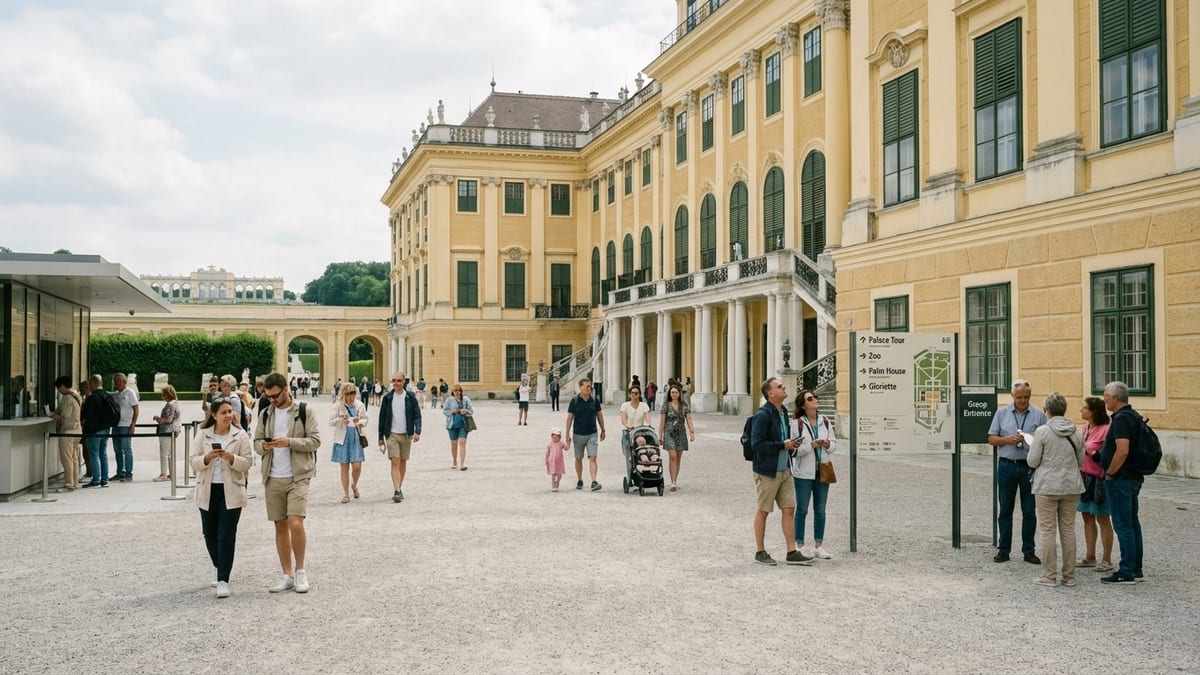
Vienna’s Schönbrunn Palace is one of Europe’s great imperial residences, a place where gilded ballrooms, formal parterres and forested hillsides all merge into a single, sprawling estate. It is also one of the city’s busiest attractions, with timed-entry tickets, seasonal passes and popular guided tours that can confuse first-time visitors. This guide walks you through how to visit Schönbrunn Palace today, with clear explanations of ticket types, what to book in advance, and practical strategies to avoid the worst of the lines.
Understanding Schönbrunn Palace and Its Main Areas
Schönbrunn was the Habsburgs’ summer residence, a Baroque complex of more than a thousand rooms set in vast formal gardens on Vienna’s western edge. When you buy a ticket today, you are really buying access to a defined set of palace interiors and, depending on the option, to selected garden attractions and on-site institutions like the zoo or Palm House. Knowing how the estate is organized helps you decide which ticket level actually matches your interests and time.
The core for most visitors is the state apartments inside the palace itself. Standard tickets route you through a sequence of ceremonial halls and private rooms, many of them shaped by Empress Maria Theresa in the 18th century. Beyond the palace, the formal gardens stretch out around the Great Parterre towards the hilltop Gloriette, with separate ticketed pockets such as the Privy Garden, the Orangery Garden, the Maze and the Children’s Museum dotted across the parkland.
The estate is also home to Tiergarten Schönbrunn, widely considered the world’s oldest continually operating zoo, as well as botanical showpieces like the Palm House and Desert Experience House. Combined tickets and passes bundle these separate attractions together, which is where the planning can get complicated. It is therefore crucial to think of a Schnbrunn visit not as a single attraction but as a menu of experiences that you assemble to fit a half day or full day in Vienna.
Ticket Types and What They Include
The palace’s own ticketing system offers several tiers, each conferring slightly different access and validities. The basic Palace Ticket currently covers the palace interiors with an audio guide or printed description, generally routed through the main floor state apartments. Prices are typically higher for adults than for children aged 6 to 18, and there are concessions for disabled visitors and holders of certain city cards, with small seasonal price variations. This ticket is best suited if you are focused primarily on the historical interiors and have limited time.
Beyond the Palace Ticket, special passes bundle several elements of the estate. The Sisi Pass, valid for one visit to each included attraction over a year from the date of issue, currently offers entry to three imperial sites and includes an audio guide. It is marketed as a way to save compared with individual admission, especially for adults, and is particularly attractive if you will be in Vienna for several days and want to spread your visits out rather than doing them all on a single day.
Seasonal packages like the Classic Pass and Classic Pass Plus concentrate on Schönbrunn itself. The Classic Pass, available from late March 2026, combines a Palace Ticket with audio guide, admission to the Privy Garden, Maze and Labyrinth, Orangery Garden and access to the Gloriette viewing terrace. Official information notes that the pass is designed for a three to four hour visit and claims around 20 percent savings for adults compared with separate entries. The Classic Pass Plus extends this concept further by adding additional attractions such as the zoo, Children’s Museum and Labyrinth in a single, discounted bundle, with the ticket valid for the palace on a chosen date and time and the other elements until the end of the summer season.
During the colder months, the Winter Pass replaces much of the warm season garden offer. Available roughly from early November through late March, it mixes the Palace Ticket with audio guide, entry to the zoo, the Desert Experience House and the Palm House, again at a discount compared with buying those tickets separately. This is a good option for winter visitors who want an indoor-heavy itinerary but still wish to see the animals and botanical collections alongside the imperial interiors.
Skip-the-Line Strategies and How Queues Really Work
One of the most confusing aspects of visiting Schönbrunn is the notion of “skip-the-line” access. At peak times, particularly between June and August or on holiday weekends, wait times for tickets and time-slot allocation can stretch from 60 to 120 minutes. Reports from ticket platforms that track access routinely describe general admission lines snaking outside the Arrival Center, especially in the late morning when many coach groups arrive. This can be frustrating if you have limited time in Vienna.
Most official palace tickets, including the standard Palace Ticket and many passes, are tied to timed entries into the palace. You either choose your time slot when you buy online or you are assigned one when you purchase on-site. Even if you have purchased a pass such as the Vienna Pass, you still need to queue at a dedicated counter to convert it into a time-stamped entry ticket. That means there is often no true “fast track” turnstile that lets you simply walk straight in, only different queues and processing speeds.
Third-party “skip-the-line” products work within this system by securing timed-entry allocations in advance and grouping guests into guided tours. For example, a guided palace and gardens tour may use a separate group entrance and a pre-booked time slot, which typically results in actual waits of about 10 to 20 minutes compared with the general public line that can take up to two hours during the busiest periods. In practice, this is less about bypassing security or access controls and more about pre-arranging your schedule so you are not dependent on same-day availability.
To minimize waiting, the most effective strategies combine timing and pre-booking. Booking any timed-entry palace ticket online in advance is the first step. Arriving when the palace opens in the morning, or planning an early evening slot outside the core mid-day peak, further reduces congestion. If you know you want a guided experience, reserving a structured skip-the-line guided tour on a platform that specifies maximum group size and priority entry can significantly ease your day. Finally, avoid arriving in the late morning without a ticket, especially in high summer, unless you are prepared for extended queues.
Guided Tours vs Audio Guides: Choosing Your Experience
Once your entry is secured, the next big choice is how to explore the interiors. The standard Palace Ticket includes an audio guide or printed description, with commentary available in multiple languages. This format gives you flexibility to move at your own pace through the route, pausing in key rooms such as the Great Gallery or Chinese cabinets as long as the flow of visitors allows. It is ideal if you like to linger over details, travel with children who need a looser schedule, or simply prefer a more independent museum experience.
By contrast, guided tours focus on depth and structure. The palace itself offers a signature guided experience often branded around Maria Theresa, which runs roughly 75 minutes and is offered daily in German and English at set times across the day. This tour starts in her summer apartments on the ground floor before proceeding to the piano nobile, connecting the decorative schemes with personal stories from the Habsburg court. Group sizes are controlled, and commentary tends to be richer in anecdote and context than the audio guide alone.
Independent operators also layer thematic tours onto the basic palace visit. Some combine the palace with an extended garden walk to the Gloriette, while others pair Schönbrunn with panoramic city drives or classical concerts in the Orangery later the same day. Prices vary according to duration and group size, but many of these itineraries advertise priority or fast-entry lanes thanks to their group reservations. If your time in Vienna is limited and you want a curated overview that touches both on architecture and broader imperial history, a well-reviewed guided tour often provides better value than piecing things together on your own.
There is no single right answer, so consider your travel style. If you enjoy museums, are comfortable navigating on your own, and are watching your budget, the Palace Ticket with audio guide is sufficient, especially outside peak season. If you are visiting in August, dislike logistics and want insider stories, then a guided tour that folds in skip-the-line access may be worth the additional cost, particularly if it ensures you can see the highlights without long waits.
Seasonal Passes, City Cards and Combined Tickets
For visitors planning a broader exploration of Vienna’s imperial sites, there are several ways to bundle Schönbrunn with other attractions. The Sisi Pass remains a popular choice, combining Schönbrunn with other residences such as the Imperial Apartments in the city center and the Imperial Furniture Collection, on a single ticket valid for a year. Because it dispenses with time slots at many of these venues, it allows a degree of spontaneity while still providing savings over booking separately.
City passes like the Vienna Pass and Vienna Flexi Pass also include elements of Schönbrunn. Currently, both passes advertise a free State Apartments Tour of the palace with an audio guide and a short immersive pre-show that introduces the site’s history in about 15 minutes. This benefit is subject to capacity, and the official guidance stresses that there is currently no dedicated fast track entry for these passes. Passholders must present their pass at the Arrival Center ticket counter from 8:30 a.m. to receive a free ticket with a fixed entry time, which may be later in the day or even the next day if the palace is near capacity.
Within the estate, combined tickets link the palace to its zoological and family-friendly attractions. A notable example is the combined ticket for Schönbrunn Zoo, the Children’s Museum and the Maze and Labyrinth, typically offered from early April to early November. This bundle targets families, offering around 20 percent savings on individual ticket prices and allowing you to move between the animal enclosures, interactive exhibitions on Habsburg family life and outdoor play spaces in the same visit.
Winter-specific offers like the Winter Pass tie together the palace, zoo and glasshouse attractions during the colder season, ensuring that even when the Maze, certain garden features and the hilltop viewpoints may be less appealing, you still have a full day of activities under one ticket. If you are traveling on a tight schedule, calculate roughly how much time you can realistically spend at Schönbrunn and compare that with the components of any pass; a long list of inclusions is only a good deal if you have time to use them.
Best Times to Visit, Opening Hours and Practical Logistics
Schönbrunn is open year-round, with palace opening times adjusted seasonally. In the warm half of the year, roughly from April 1 to early November, the palace usually opens at 8:30 a.m., with closing times around 5:30 p.m. from April through June and again September through early November, and around 6 p.m. during the peak summer months of July and August. In the colder months, from early November to late March, closing time shifts earlier, typically 5 p.m., with last admission into the palace around 45 minutes before closing.
The gardens themselves are generally accessible earlier and later than the palace interior, but key paid attractions within the park, such as the Maze, Orangery Garden or certain pavilions, operate on their own seasonal schedules. Many garden attractions close during winter, usually from mid November to mid March, so if the Maze or Orangery seating areas are a priority, plan a spring to early autumn visit. Signage on-site and updated notices from the palace and city pass operators indicate precise dates each year.
To avoid crowds, aim for the first time slot of the day, particularly between April and October. Tour coaches and large groups tend to arrive mid-morning, and queues are longest around late morning to early afternoon. Evening slots can be calmer, especially outside high summer when daylight lingers. Weekdays are generally a little quieter than weekends and holidays, although Schönbrunn remains busy throughout the main travel season.
Reaching Schönbrunn from central Vienna is straightforward on public transport. The U4 metro line stops at Schönbrunn, placing you a short walk from the main gate, while tram lines and bus routes also serve the Schloss Schönbrunn stops nearby. Hop-on hop-off sightseeing buses include Schönbrunn as a major stop, integrating the palace into wider city touring circuits. If you are using a Vienna city card, check which transport benefits apply on the days you plan to visit so that your palace itinerary aligns with your pass validity.
What to See Inside and Around the Palace
Inside the palace, the sequence of rooms included in standard tours gives a powerful sense of imperial life. The Great and Small Galleries, richly decorated with stuccowork and ceiling frescoes, once hosted balls, state banquets and family celebrations. Portraits and historical paintings lining the corridors and salons depict key events in Maria Theresa’s long reign, designed both as commemoration and as deliberate messaging about Habsburg power.
More intimate are the private apartments, which show the personal tastes of emperors and empresses across generations. Decorative schemes range from Rococo exuberance to later Biedermeier and historicist styles, and the audio guide or a good tour will draw your attention to recurring motifs and alterations over time. For many visitors, connecting these rooms with famous residents such as Empress Elisabeth (“Sisi”) and Emperor Franz Joseph makes the history feel immediate rather than remote.
Outside, the formal gardens express the same Baroque ambition in a landscape medium. From the palace terrace, the Great Parterre stretches westward in a tapestry of symmetrical flowerbeds, framed by bosquets and sculpture-lined paths. A walk up the hill towards the Gloriette rewards you with a broad view over the palace roofs to central Vienna and the surrounding districts. The Privy Garden and Orangery Garden offer more intimate garden rooms, while the Maze and Labyrinth provide playful diversions that are especially popular with families.
Do not overlook the zoo, Palm House and Desert Experience House if you have a full day. The zoo’s historic pavilions now frame modern habitats for everything from giant pandas to big cats, and it frequently ranks among Europe’s leading zoological parks. The Palm House is a cast-iron and glass structure filled with tropical and subtropical plants, evocative of Victorian-era plant hunting, while the Desert Experience House showcases arid-zone flora and fauna with interpretive displays on survival adaptations. These attractions diversify a Schönbrunn visit, making it not only an architectural pilgrimage but also a day of natural history and outdoor exploration.
Insider Tips for a Smooth Visit
A successful Schönbrunn visit starts with clear priorities. Before you buy anything, decide whether your main interest lies in palace interiors, gardens and views, animal and botanical attractions, or a mix of all three. If you only have two to three hours, focus on a Palace Ticket with audio guide and a stroll through the free sections of the gardens up to the Gloriette. If you have most of a day and are visiting in summer, consider a bundle that includes the zoo and at least one of the specialized gardens or the Maze.
Book timed-entry tickets in advance whenever possible, especially from May through September. Even if you opt not to purchase a guided tour, securing a morning slot online lets you bypass the longest on-the-day ticket queues and build the rest of your itinerary around a fixed starting point. Pair your palace entry with lunch either at one of the cafés in the complex or at a nearby spot along the approach road, then spend the afternoon exploring the gardens, zoo or glasshouses at a more relaxed pace.
If you hold a city pass that includes Schönbrunn, build its constraints into your plan. Because these passes are activated on first use, and because you may be assigned a palace entry time later in the day or even the next day during peak demand, think carefully about when to queue for your time slot. Ideally, do this early on a day when you expect to use the card several times, and have a backup attraction on your list in case you are given a late afternoon palace entry.
Finally, be prepared for weather. Vienna’s summers can be hot, and the exposed walk up to the Gloriette offers little shade. Carry water, wear comfortable shoes and consider a hat or umbrella. In winter, paths may be icy and certain outdoor attractions closed, but the palace interiors and glasshouses are cosy refuges. By aligning your expectations, tickets and timing with the season, you can transform Schönbrunn from a crowded must-see into a highlight of your stay.
FAQ
Q1: Do I really need to buy Schönbrunn Palace tickets in advance?
Buying tickets in advance is strongly recommended, especially between April and October. Online timed-entry tickets or pre-booked guided tours significantly reduce the risk of one to two hour waits in the general ticket queue, and they also help you secure your preferred time of day for visiting the palace interiors.
Q2: Is there a true skip-the-line entrance at Schönbrunn Palace?
There is no universal walk-straight-in entrance for all visitors. Instead, skip-the-line products typically mean you have a pre-arranged time slot and join a faster-moving group queue rather than the general ticket line. You will still pass through the same security and access controls, but the overall waiting time is usually much shorter than for walk-up visitors.
Q3: Which ticket is best if I only have a couple of hours?
If your time is limited to two or three hours, the standard Palace Ticket with audio guide is usually the best choice. It focuses on the main state apartments and private rooms, and you can then stroll quickly through the free sections of the gardens for exterior views without paying extra for additional attractions that you would not have time to enjoy.
Q4: How long should I plan for a full Schönbrunn visit?
For a comprehensive visit that includes the palace interiors, a walk through the gardens up to the Gloriette and at least one other attraction such as the zoo or Palm House, budget a full day of around six to eight hours. If you only intend to tour the palace itself and take a brief garden walk, three to four hours is usually sufficient.
Q5: Are the gardens free, or do I need a ticket?
The main park and avenues around the palace are free to enter, and you can walk up to the Gloriette hill without paying. However, certain sections such as the Privy Garden, Orangery Garden and Maze and Labyrinth require separate tickets or inclusion in a pass. Check which areas are included in your chosen ticket so you are not surprised by additional fees inside the park.
Q6: What is the difference between the Classic Pass and the Winter Pass?
The Classic Pass is oriented to the warm season and bundles the Palace Ticket with attractions like the Privy Garden, Maze and Labyrinth, Orangery Garden and Gloriette terrace, focusing on outdoor experiences. The Winter Pass is available in the colder months and combines the palace with the zoo, Desert Experience House and Palm House, emphasizing indoor and all-weather attractions.
Q7: Does the Vienna Pass let me skip the line at Schönbrunn?
The Vienna Pass includes a State Apartments Tour of Schönbrunn but does not currently provide a dedicated fast track entrance. You must still visit the Arrival Center ticket counter to receive a timed-entry ticket, and in busy periods you may be given a slot later that day or the next. The pass saves you on admission and provides a structured visit, but it does not guarantee immediate entry during peak hours.
Q8: Are guided tours worth it compared to the audio guide?
Guided tours are worthwhile if you enjoy storytelling, want context that connects Schönbrunn to broader Habsburg and European history, or prefer someone else to manage pacing and logistics. The audio guide is informative and flexible, but a good guide can tailor explanations, answer questions and often moves you through less congested routes, which can be especially helpful in peak season.
Q9: Can I visit Schönbrunn Zoo without touring the palace?
Yes, the zoo has its own tickets and entrances within the grounds, and you can visit it independently of the palace interiors. Combined tickets that include both the zoo and palace are available and can be good value if you plan to do both, but it is perfectly possible to spend an afternoon at the zoo alone, especially if you are traveling with children.
Q10: What is the best time of day to visit to avoid crowds?
The first time slot of the day, shortly after the palace opens at 8:30 a.m., is generally the quietest, particularly on weekdays. Late afternoon and early evening can also be calmer than mid-morning, although you need to watch the earlier winter closing times. Avoid arriving without a ticket in late morning during high season, when both ticket lines and palace corridors are at their busiest.