


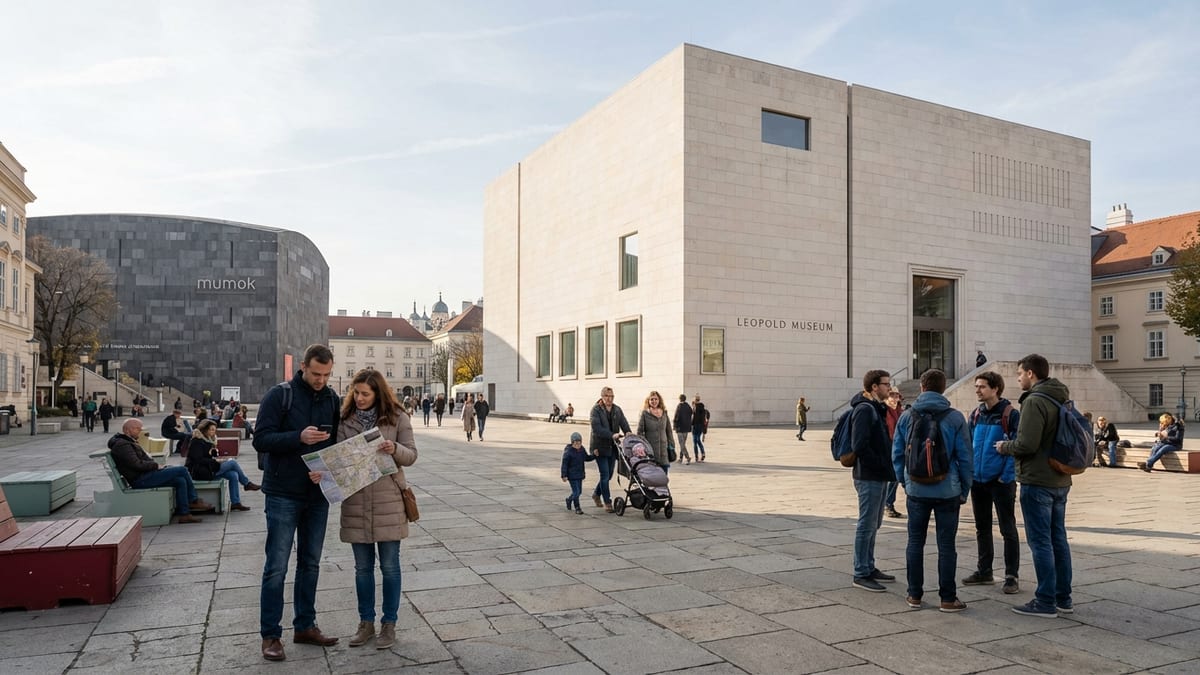
The Leopold Museum is one of Vienna’s essential cultural stops, a bright limestone cube in the MuseumsQuartier that houses the world’s largest collection of works by Egon Schiele and a superb survey of Viennese modernism.
Planning your visit well matters here: ticket types, opening hours, and the museum’s location within the wider MuseumsQuartier can all shape how much you actually see and enjoy. This guide walks you through everything you need to know about tickets, opening hours, how to get there, and practical tips, so you can focus on the art once you step inside.
Why the Leopold Museum Belongs on Your Vienna Itinerary
The Leopold Museum tells the story of how Vienna around 1900 became a crucible of modern art, psychology and design. Its collection grew from the private holdings of Rudolf and Elisabeth Leopold, later turned into a foundation and given a permanent home in the MuseumsQuartier in 2001. Today, visitors can move from decorative Art Nouveau and the golden shimmer of Gustav Klimt to the raw, psychological intensity of Egon Schiele in a single visit, all within a space designed expressly for modern art.
For travelers, the Leopold Museum offers a concentrated way to understand Vienna’s fin-de-siècle spirit. The permanent presentation on “Vienna 1900” traces the city’s transition from the ornate world of historicism to the radical ideas of the Secession and early Expressionism. Paintings, drawings, prints and design objects are set out across multiple levels, supported by clear wall texts and optional audio guides. Even if you are not an art historian, the narrative is accessible and visually striking.
The museum is also manageable in scale compared with some of Europe’s vast national collections. Most visitors spend about two to three hours exploring the galleries, which makes it easy to combine with other MuseumsQuartier institutions or nearby sights in the historic center. Comfortable circulation, good natural light, and well-planned seating areas help combat museum fatigue, especially if you are fitting it into a full day of sightseeing.
Beyond the permanent displays, the Leopold Museum runs changing temporary exhibitions on artists and themes related to Austrian and European modern art. These can provide depth on figures such as Oskar Kokoschka or on topics ranging from design to photography. If a particular exhibition interests you, it is worth checking current listings shortly before your trip and allowing extra time in your schedule.
Location, Opening Hours and the Best Time to Visit
The Leopold Museum stands inside Vienna’s MuseumsQuartier, one of the largest cultural complexes in the world. Its official address is Museumsplatz 1 in the 7th district, just off the Ringstrasse and within walking distance of the historic Innere Stadt. Once you reach the main MuseumsQuartier courtyard, the Leopold is the pale, cube-like building facing the darker, basalt-clad mumok museum.
According to the museum’s current visitor information, the Leopold Museum is open daily except Tuesday, from 10:00 to 18:00. It is closed on Tuesdays but open on public holidays unless otherwise stated. The museum itself notes that opening hours may be subject to change and recommends checking or calling ahead to confirm that the galleries are open at your desired time and that no areas are closed for exhibition changeovers.
In practical terms, the quietest times to visit are typically weekday mornings right after opening, particularly on Mondays and Wednesdays. Weekends, school holidays, and rainy days in Vienna can see significantly more visitors not only in the Leopold but across the MuseumsQuartier. If your schedule is flexible, aim for a visit before lunchtime on a non-holiday weekday, when you will have more space in front of key works and shorter waits at the cloakroom and ticket desks.
The museum recommends allowing around two to three hours for a standard visit. This is usually enough time to explore the main “Vienna 1900” presentation over several floors and see at least one current temporary exhibition. If you are specifically interested in Schiele or Klimt and like to linger, consider planning closer to three hours, with a break in the café or in the MuseumsQuartier courtyard built into your schedule.
Ticket Options, Prices and Money-Saving Combinations
The Leopold Museum offers several ticket categories that are particularly useful for international visitors. A regular adult ticket currently costs 19 euros. Reduced admission of 16 euros is available for visitors under 26, visitors from 65 years of age, people with disabilities, and the unemployed, upon presentation of appropriate identification. Youths under 19 pay 2.50 euros, and children under seven enter free of charge, making it a relatively affordable option for families.
Holders of the Vienna City Card receive a slightly discounted entry price of 17 euros instead of the standard 19 euros. If you plan to use Vienna’s public transport extensively and visit multiple attractions over a few days, combining a Vienna City Card with individual museum admissions can be good value. The museum also sells annual passes, currently around 49 euros for adults and 36 euros reduced, which may appeal if you live in Vienna or anticipate multiple visits during an extended stay.
For groups of at least ten people in the same category, the Leopold Museum offers reduced group rates, with adults paying 16 euros and youths under 19 paying 2.50 euros each. Group visits must be registered in advance, and confirmation is required. This policy applies to both privately organized groups and tour operators. If you are arranging a group trip, locking in a time slot in advance is strongly recommended to avoid queuing and to ensure that the galleries can comfortably accommodate your party.
The museum participates in several combination ticket schemes that can make a difference if you plan a museum-heavy itinerary. A joint ticket with the Kunsthistorisches Museum costs about 37 euros, while a combination with the modern art museum mumok is around 33 euros, or 29 euros for a reduced combined ticket. There is also a combined ticket with the Sigmund Freud Museum priced at approximately 30 euros. These combinations allow you to visit both institutions, usually on different days, and provide a modest saving over buying both tickets separately.
Buying Tickets: Online, On-Site and Guided Experiences
The Leopold Museum strongly encourages visitors to purchase tickets online in advance. Through its official website you can buy standard admission, annual passes, and a set of packages and vouchers. Pre-purchasing gives you a dated ticket and helps manage your time, particularly in high season when the ticket counter can be busy. For on-the-day visits during shoulder seasons or on quieter weekdays, it is still generally possible to buy tickets on-site at the museum’s cash desk.
The museum offers both public and private guided tours. Public tours, which are scheduled on Saturdays, Sundays, public holidays and selected additional days, are usually held in German and carry a modest supplement (around 5 euros) on top of your admission ticket. They provide a structured overview of key parts of the collection and can be a useful entry point if this is your first encounter with Viennese modernism or with Schiele’s work in particular.
Individually organized guided tours can be booked in advance in multiple languages. These are particularly suited to groups or to visitors who want a deep-dive into a specific theme such as “Vienna 1900,” Egon Schiele, or Austrian Expressionism. Private tours must be requested through the museum’s booking channels, and confirmation is required. Fees vary depending on group size and language, so it is advisable to contact the museum directly well before your travel dates.
Audio tours are available in several languages, including English, German, French, Italian, Spanish and Korean. The standard audio guide, a “Take 2” version that allows paired listening, and a smartphone-based guide are all offered at different price points, typically in the 3 to 8 euro range. For independent travelers, an audio guide can be the most flexible way to add context without following a set group schedule. You can pick up devices on-site, and in some cases you may be able to reserve them when buying tickets online.
Getting to the Leopold Museum and Accessibility
Reaching the Leopold Museum is straightforward using Vienna’s excellent public transport network. The MuseumsQuartier has its own stop on the U2 underground line, while the U3 line stops at Volkstheater, a short walk away. From either station, signposting leads you into the MuseumsQuartier courtyard, from which the Leopold Museum entrance is clearly visible. Several tram lines, including 1, 2 and D, stop at Dr.-Karl-Renner-Ring along the Ringstrasse, also within walking distance.
If you are staying in or near the historic city center, walking is often the most pleasant way to arrive. From the Hofburg or the Kunsthistorisches Museum, you can stroll along the Ringstrasse and enter the MuseumsQuartier in under ten minutes, depending on your pace. Cycling is another option, with ample bike parking around the complex. For visitors arriving by car, an underground parking garage is located directly in front of the main entrance of the MuseumsQuartier and operates twenty-four hours a day, although parking in central Vienna can be relatively expensive.
The Leopold Museum is committed to being broadly accessible. The museum notes that access is predominantly barrier-free. Four parking spaces for visitors with disabilities are available within the MuseumsQuartier area, accessible via the main entrance near Volkstheater. An exterior elevator on the rear (east) side of the Leopold Museum allows step-free access up to the main entrance level. The main entrance door is equipped with a EuroKey lock; when used, the left door leaf opens automatically outward to the left, and the entrance is stepless.
Inside the building, the ticket counter includes a wheelchair-accessible area, and two elevators connect the seven exhibition levels, shop, and café. Accessible restrooms are available on the ground floor and at level minus one, both equipped with baby changing tables. Wheelchairs and portable folding stools can be borrowed free of charge from the cloakroom, with prior registration recommended if you know you will need a wheelchair. Assistance and guide dogs are permitted in the museum. Overall, visitors using wheelchairs or with limited mobility can expect to access the main collection and major temporary exhibitions without stairs.
What to Expect Inside: Collections, Layout and Visitor Rules
The Leopold Museum is spread across multiple levels, with around six thousand works of art available to the public in rotation. The permanent presentation focuses on Vienna around 1900 and occupies several floors, while additional levels house temporary exhibitions. The galleries are spacious, with high ceilings and a neutral color scheme designed not to compete with the artworks. Large windows in some areas offer views over the city and the MuseumsQuartier courtyard, providing visual breaks between more intense exhibition rooms.
The museum highlights Egon Schiele, whose drawings and paintings form the world’s largest public collection of his work. Visitors can trace his development from early, Klimt-influenced pieces to the stark, psychologically charged portraits and self-portraits that made him one of Expressionism’s most distinctive voices. Works by Gustav Klimt, such as landscapes and portraits, contextualize Schiele within the broader Viennese Secession movement. Additional galleries feature other modern Austrian artists and designers, offering a richer view of the era.
To protect the artworks and ensure a comfortable environment for all, the Leopold Museum enforces standard visitor policies. Food and drink are not allowed in the galleries, and alcohol is only available in Café Leopold or at designated events. Large bags and backpacks must be left in lockers or at the cloakroom, and umbrellas are usually not permitted in the exhibition rooms. Photography without flash is generally allowed for private purposes in the Leopold Collection, although special exhibitions may have their own rules, posted on-site. Flash, tripods, selfie sticks, and additional lighting equipment are not permitted.
Families will find that strollers are allowed in the museum, and baby care rooms are provided on the ground floor. Children can enjoy the dedicated LEO Kids Studio, where workshops for six to twelve year olds are held on Saturdays and Sundays in the afternoon. These sessions include a short tour of selected works followed by creative activities such as drawing and collage. While the program is conducted in German, many children can still enjoy the hands-on component even without full language fluency.
Planning Your Visit: Practical Tips and Suggested Itineraries
To make the most of your time at the Leopold Museum, start by deciding whether you want to focus on the permanent “Vienna 1900” exhibition, on a specific artist such as Schiele, or on both the permanent holdings and current temporary shows. If your time is limited to around ninety minutes, prioritize the core Vienna 1900 levels and the key Schiele rooms. With two to three hours, you can add at least one temporary exhibition and revisit your favorite sections.
Arrive slightly before or right at opening time if you are visiting on a popular day such as a Saturday or during peak season. This allows you to clear the ticket desk and cloakroom more quickly and gives you quieter galleries for the first hour. If you have purchased tickets online, have your confirmation ready on your phone or printed out to streamline entry. Consider renting an audio guide for additional depth, particularly if you do not plan to join a guided tour.
The MuseumsQuartier location makes it easy to combine the Leopold Museum with other major sights. A classic one-day itinerary might pair a morning at the Leopold with an afternoon at the Kunsthistorisches Museum or the Hofburg complex, with lunch in the MuseumsQuartier courtyard or at Café Leopold in between. Another option is to use a combined ticket with mumok and split your day between modern Austrian art in the Leopold and international modern and contemporary art next door at mumok.
Keep an eye on temporary exhibition dates and any special programs scheduled during your visit. If a particular show is important to you, check its closing date in advance and plan accordingly, as exhibition installations and deinstallations can temporarily close certain galleries. The museum advises that opening hours, as well as the availability of specific exhibits, can change at short notice, so a quick check before you set out from your hotel is a wise step.
Visitor Etiquette and Services on Site
Like most major museums, the Leopold expects visitors to help protect works on display and maintain a pleasant atmosphere. Maintain a respectful distance from paintings and sculptures, avoid touching surfaces unless explicitly encouraged as part of an interactive display, and keep voices low in the galleries. If you are visiting in a group, avoid blocking passages or crowding in front of single works for prolonged periods. Staff and security personnel are present throughout the museum and will intervene if visitor policies are not respected.
Lockers and a cloakroom are available near the entrance to store coats, larger bags, and daypacks. Using them not only protects the art but makes it more comfortable to navigate the galleries. For visitors needing to sit regularly, folding stools are available free of charge and can be carried into the galleries, allowing you to rest while viewing works. These small comforts can extend the amount of time you feel able to spend with the collection.
Café Leopold, located on level two, is accessible both from inside the museum and from the outside, and can be visited without a museum ticket. It provides full meals, lighter snacks, and drinks, as well as a terrace area during warmer months. Taking a break partway through your visit can be especially helpful when dealing with emotionally intense works such as those by Schiele. The museum shop, situated near the entrance, offers exhibition catalogues, art books, design items, and souvenirs related to Viennese modernism.
The Leopold Museum also maintains a reference library that can be used for academic work and research, open by prior arrangement. If you are a student, scholar, or particularly dedicated enthusiast, contacting the museum in advance can secure you time in this quieter space to study catalogues and archival materials. For most visitors, however, the library remains in the background while the galleries, café, and public areas form the core of the experience.
The Takeaway
The Leopold Museum distills Vienna’s turn-of-the-century artistic revolution into a focused, accessible experience. Its world-class holdings of Egon Schiele and Gustav Klimt, its comprehensive presentation of Vienna 1900, and its manageable scale make it one of the city’s most rewarding museums for both casual visitors and serious art lovers. By understanding its ticket structure, opening hours, and combination options, you can integrate the Leopold efficiently into a wider itinerary that might include the Kunsthistorisches Museum, the Sigmund Freud Museum, or other MuseumsQuartier institutions.
With thoughtful planning, a visit to the Leopold can be more than just an hour in front of famous paintings. It can become a key to understanding the wider history of Vienna, from the glittering world of the Habsburg court to the doubts and fractures that surfaced in the early twentieth century. Set aside two or three hours, arrive prepared with a ticket plan, and leave space for both reflection and rest. The art on view rewards close, unhurried looking, and the museum’s calm, light-filled spaces are well suited to it.
FAQ
Q1: What are the current opening hours of the Leopold Museum?
The Leopold Museum is currently open daily except Tuesday, from 10:00 to 18:00. It is closed on Tuesdays and generally open on public holidays, although hours and gallery access can occasionally change, so checking shortly before your visit is recommended.
Q2: How much time should I plan for a visit?
Most visitors spend between two and three hours in the Leopold Museum. This allows enough time to see the main “Vienna 1900” presentation, focus on Egon Schiele and Gustav Klimt, and explore at least one temporary exhibition without rushing.
Q3: How much does a ticket cost, and are there discounts?
A regular adult ticket costs about 19 euros, with reduced admission of around 16 euros for visitors under 26, from 65 years of age, people with disabilities, and the unemployed. Youths under 19 pay 2.50 euros, and children under seven enter free. Vienna City Card holders receive a slight discount, paying 17 euros instead of the full price.
Q4: Should I buy tickets online or at the museum?
Buying tickets online is recommended, especially during peak travel seasons and weekends, because it helps you avoid queues and ensures entry at your preferred time. On quieter weekdays and in shoulder seasons, it is usually possible to purchase tickets directly at the museum’s ticket desk without long waits.
Q5: Is the Leopold Museum included in any combination tickets or city passes?
Yes. The Leopold Museum participates in combination tickets with institutions such as the Kunsthistorisches Museum, mumok and the Sigmund Freud Museum, which offer a modest saving compared with individual admissions. It also offers a reduced price for holders of the Vienna City Card and is included in some multi-museum passes sold by third-party providers.
Q6: How do I get to the Leopold Museum using public transport?
The museum is located in the MuseumsQuartier, easily reached by the U2 underground line (Museumsquartier station) and the U3 line (Volkstheater station). Trams 1, 2 and D stop at Dr.-Karl-Renner-Ring nearby. From these stops, clear signage leads you into the MuseumsQuartier courtyard, where the Leopold’s entrance is visible.
Q7: Is the museum accessible for wheelchair users and visitors with limited mobility?
Yes, access is predominantly barrier-free. There is an exterior elevator to the main entrance, a EuroKey-operated door, wheelchair-accessible ticket desk, elevators connecting all exhibition levels, and accessible restrooms on the ground floor and level minus one. Wheelchairs and folding stools can be borrowed free of charge, with prior registration recommended for wheelchairs.
Q8: Can I take photos inside the Leopold Museum?
Non-flash photography for private use is generally allowed in the Leopold Collection galleries. In special exhibitions, photography rules may differ and are indicated on-site. Flash, tripods, selfie sticks, and additional lighting are not permitted anywhere in the museum, in order to protect the artworks and ensure visitor safety.
Q9: Are there activities or facilities for children and families?
Yes. Strollers are allowed in the museum, baby care rooms are available on the ground floor, and children under seven enter free of charge. The LEO Kids Studio runs creative workshops for children aged six to twelve on Saturday and Sunday afternoons, combining a short introductory tour with hands-on art activities, usually conducted in German.
Q10: What are some good museums to combine with the Leopold on the same day?
Given its location in the MuseumsQuartier, the Leopold pairs naturally with mumok, which focuses on international modern and contemporary art, or with other nearby institutions around the Ringstrasse, such as the Kunsthistorisches Museum. Many visitors spend a morning in the Leopold, take a break in the MuseumsQuartier courtyard or Café Leopold, and then visit a second museum or explore the historic city center in the afternoon.