


Travel eSIMs have gone from niche tech to mainstream essential in just a few years, and Ubigi has quietly become one of the names frequent travelers see again and again. With new competitors and “unlimited” offers popping up in every app store, it is no longer enough to know that a provider works. You need to understand how it compares on coverage, pricing, speed, and real customer experience. This guide looks at how Ubigi stacks up against other major travel eSIM brands such as Airalo, Nomad, Holafly and newer entrants, using concrete examples a typical traveler might face in 2026.
Get the latest updates straight to your inbox!
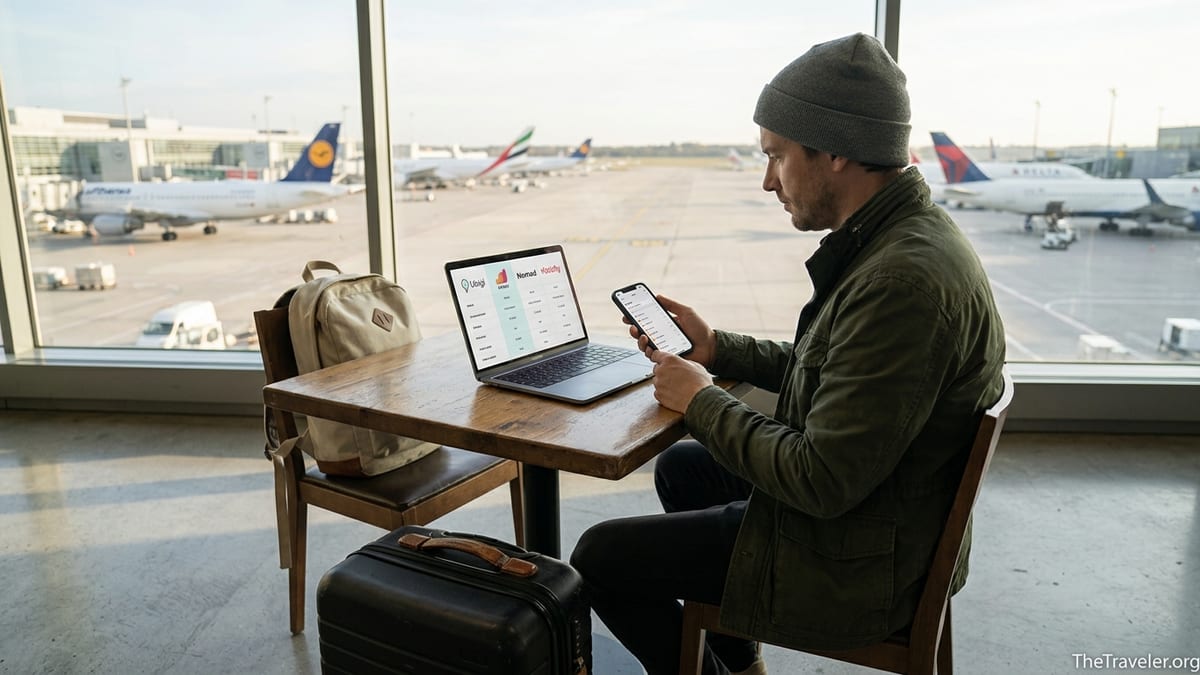
Where Ubigi Sits in the Travel eSIM Landscape
Ubigi is a global travel eSIM provider operated by French telecom group Transatel, which itself runs on major carrier networks rather than small local resellers. In practice, that means Ubigi tends to plug you into tier one networks like AT&T in the United States or NTT Docomo and KDDI in Japan, instead of smaller discount carriers. For travelers who care about signal in rural areas or stable 5G in big cities, this infrastructure pedigree is one of Ubigi’s core strengths compared with some app-only startups.
By contrast, competitors like Airalo, Nomad and Holafly are independent travel tech companies that buy wholesale data from different partner networks and resell it under their own brand. Airalo positions itself as an eSIM marketplace with hundreds of country-level plans, Nomad emphasizes flexible data packages and often sharp pricing, while Holafly is best known for unlimited data offers in popular destinations across more than 160 countries. All of them work with eSIM-compatible phones like recent iPhone, Samsung Galaxy and Google Pixel models, and all are configured entirely through apps without visiting a phone shop.
For a traveler planning, for example, a three week trip that includes Paris, Tokyo and Sydney, Ubigi will typically be in the mix alongside Airalo and Nomad when you search for “global eSIM” in June 2026. Tech media such as TechRadar and specialist eSIM comparison sites routinely list Ubigi as one of the main global options for multi-country trips, often highlighting its balance of coverage and reliability rather than headline-grabbing unlimited offers. That positioning shapes who Ubigi is best for and how it compares in real use.
From a user experience perspective, Ubigi’s app is closer to Nomad and Saily than to a raw, catalog-style marketplace. You search destinations, see a handful of curated plans with clear validity periods, install the eSIM in a few taps, then manage top-ups in-app. Airalo, on the other hand, offers a denser grid of local, regional and global plans that can be powerful for expert users but a bit overwhelming to first-timers trying to decide between 1 GB for 7 days or 10 GB for 30 days in the same country.
Coverage and Reliability: How Ubigi Performs on the Road
Coverage is where Ubigi often justifies its reputation with long term travelers. Because it relies on established carrier partners and multi-network roaming agreements, Ubigi tends to perform strongly both in large cities and secondary destinations. In the United States, for instance, many users report being connected on large 4G and 5G networks in places like national parks in Utah or small coastal towns in Maine, where some budget eSIM providers only have patchy coverage through a single network partner.
Consider a typical summer itinerary in 2026 for a European traveler visiting New York, then driving up through Vermont into rural Quebec. A Ubigi North America plan will usually keep that traveler on major networks throughout, with automatic handoff as they cross the border. A competitor like Airalo can provide similar continuity, but the exact experience depends on which underlying carrier its specific plan uses in each country. If that plan is tied to a secondary network in Canada, speeds outside major cities can drop noticeably during a road trip.
In Asia, the differences can be just as visible. A Nomad regional Asia plan, for example, often prioritizes competitive pricing, meaning it may use whichever partner network offers the best wholesale rate in each country. That can be excellent value in places like Thailand and Vietnam, but can occasionally mean weaker indoor coverage in more remote areas. Ubigi, by linking to top-tier networks in countries like Japan, South Korea and Singapore, tends to provide more consistent performance in airports, subways and high speed trains, even if the raw gigabyte price is sometimes a little higher.
Holafly and similar unlimited-focused providers often emphasize that you will not run out of data on city breaks in Tokyo, Seoul or Bangkok. In practice, however, their fair usage policies can lead to speed reductions after heavy use, which matters if you plan to tether a laptop or stream video for work. Ubigi’s metered plans mean that as long as you have data left, you are far less likely to encounter sudden throttling, making it attractive for digital nomads who need predictable speeds rather than headline “unlimited” marketing.
Pricing: Ubigi vs Airalo, Nomad and Holafly
Pricing is where travelers often see the most obvious differences between Ubigi and its competitors. Ubigi typically offers destination-based plans that bundle a moderate amount of data over a reasonable validity period, rather than rock-bottom introductory offers. As of mid 2026, a common pattern is something like a mid-range data pack covering 10 to 30 days in a single country or region, priced in line with mid-market roaming alternatives rather than the very cheapest per-gigabyte options.
Airalo, by comparison, often leads with aggressively priced small data packs. A classic example for a short trip to Italy or Japan would be a small 1 to 3 GB eSIM valid for 7 days, priced in the low single digits in US dollars, with follow-on options of 5 GB or 10 GB for longer stays. On a three day city break in Rome where you primarily use hotel Wi-Fi and only need maps and messaging outdoors, Airalo’s smallest pack can be significantly cheaper than starting with a larger Ubigi bundle you might not fully use.
Nomad frequently positions itself between Ubigi and Airalo: not always the absolute cheapest, but often very competitive for mid-sized data packages, especially in destinations like the United States, Western Europe and parts of Southeast Asia. A Nomad traveler visiting Los Angeles for two weeks, for example, might choose a 10 or 20 GB pack that is a few dollars cheaper than an equivalent Ubigi offer, while still operating on strong local networks. The tradeoff is that Nomad’s coverage in less typical destinations can sometimes be narrower than Ubigi’s global footprint.
Holafly stands out for its unlimited plans, which are designed for data-heavy travelers who prefer not to track gigabytes. In 2026 many of its country and regional eSIMs start around the mid twenties in US dollars for 10 days of unlimited data, with higher prices for longer durations. That means a three week trip across multiple European capitals might cost noticeably more with Holafly than with a thoughtfully sized Ubigi or Nomad plan, but some travelers happily pay the premium to avoid data anxiety altogether, especially if they stream video, use ride hailing frequently and work remotely.
Unlimited vs Metered Data: What Ubigi Chooses Not to Do
One of the clearest differences between Ubigi and several of its high profile competitors is the way it approaches unlimited data. Holafly has built its brand almost entirely around unlimited travel eSIMs, and Airalo has introduced some unlimited options in certain destinations. Critics and travel forums regularly point out that most unlimited travel eSIM plans are governed by fair usage policies, which can quietly cap high speed data to a few gigabytes per day or per plan, with speeds reduced afterwards. This does not always appear prominently in marketing, leading some first time users to feel that their “unlimited” plan slows down unexpectedly mid-trip.
Ubigi has generally stayed in the metered-data camp, focusing on defined data allowances with clear validity periods. While this means the company cannot use “unlimited” as a simple selling point, it tends to create a more transparent experience. If you buy, for instance, a 20 GB Ubigi plan for a one month stay in Australia, you know that as long as you stay under that 20 GB, your speeds should remain consistent. If you reach the cap, you will need to top up, but you will not have to puzzle over why an unlimited plan suddenly feels slow even though you are still inside the advertised time window.
In concrete terms, imagine two digital nomads in Mexico City in January 2026. One purchases a Holafly unlimited eSIM for 15 days because they are planning to upload large video files and hold frequent video calls. The other selects a Ubigi plan with a generous but finite data allowance. After the first week, the Holafly user notices that hotspot sharing and HD video streaming have become sluggish, likely due to an internal fair usage threshold being reached, even though their plan is still active. The Ubigi user, by contrast, sees steady performance until their data balance runs low, at which point the app clearly prompts them to buy a top-up.
Newer providers like Saily, backed by Nord Security, have taken yet another route, offering granular data options starting at small 1 GB packs and bundling privacy tools like ad blocking and web protection. Travelers who specifically value built-in security might find Saily’s approach compelling even if its pricing per gigabyte is similar to or slightly higher than a Ubigi pack. Ubigi does not currently bundle VPN or security tools, focusing instead on connectivity quality and coverage breadth.
App Experience, Support and Ease of Use
For many travelers, the difference between eSIM providers comes down to how easy the service is to install and manage on a phone in a busy airport or hotel lobby. Ubigi’s app experience is designed to be straightforward: after creating an account, you select a destination, pick a plan, pay with a card or digital wallet, then follow a guided process to install the eSIM profile and activate it upon arrival. The app typically shows remaining data and days at a glance, making it easy to avoid running out unexpectedly mid-transfer between cities.
Airalo’s app emphasizes breadth of choice. When you search for a country like Thailand, you may see a grid of multiple local and regional plans with different names, data amounts and validity periods. Power users appreciate being able to choose a very specific combination, such as a small local pack for the first week followed by a regional Southeast Asia plan for cross-border travel. Less experienced travelers, however, can find this overwhelming, and it is not always obvious at first glance which plan offers the best value for a particular itinerary.
Nomad’s interface falls somewhere in between. It usually presents a limited set of curated options per destination, often labeled by data volume and duration, which can be simpler for first-timers. Tech press coverage in 2026 has highlighted Nomad’s clear app design and 24/7 customer support as reasons it is frequently recommended to digital nomads. Ubigi offers its own customer support channels, typically via in-app chat and email, but it is less loudly marketed than Nomad’s support offering, which may matter if you are the type of traveler who wants quick help when a QR code fails to scan at midnight.
Holafly’s app experience centers on trip length. You generally choose how many days you will be in a region such as Europe or North America, pay a flat price for unlimited data for that period, and activate the eSIM via emailed QR code or the app itself. For people who value simplicity over fine-grained control, that can be appealing. The catch is that it can nudge you toward buying a more expensive unlimited plan when a measured-data Ubigi or Airalo pack would have comfortably covered your actual usage at a lower total cost.
Real-World Scenarios: When Ubigi Wins and When Others Do
To understand how these differences play out, it helps to look at concrete trip scenarios. Take a classic around-the-world itinerary in 2026: a US-based traveler flies from New York to London, continues to Dubai, then on to Singapore and finally Sydney over six weeks. With Ubigi, that traveler might choose a global or multi-region plan that keeps them on strong partner networks in each stop, topping up once mid-trip if they use a lot of maps, ride hailing and social media. The key benefit is smooth cross-border roaming and consistent speeds without swapping providers at every stop.
With Airalo, the same traveler might save money by chaining together separate regional eSIMs: one for Europe, one for the Middle East and North Africa, one for Asia, and perhaps a local Australia eSIM at the end. Each piece would be priced very aggressively for its region, but the traveler would need to manage multiple activations and expiries. For a budget-conscious backpacker who enjoys tinkering with apps, that approach can keep costs low. For a busy professional, the single-provider simplicity of Ubigi can be worth paying a little extra.
Consider another example: a digital nomad planning three months in Southeast Asia working remotely. Here, Nomad’s and Airalo’s regional Asia plans might offer some of the best value, with medium to large data bundles at competitive prices, especially if the traveler spends most of their time in major cities like Bangkok, Ho Chi Minh City and Kuala Lumpur. Ubigi may still be attractive if the nomad expects to move frequently between less common destinations or cares deeply about staying on premium local networks even in smaller towns.
On the other hand, imagine a family heading to the World Cup in North America in 2026, moving between stadiums in the United States, Canada and Mexico over two weeks. Several providers, including Ubigi, Holafly and Airalo, now promote tournament-focused multi-country eSIMs covering all three host nations. For the parents who will be uploading videos from the stands and tethering tablets for children on long train rides, a carefully chosen Ubigi or Airalo multi-country plan with a clear data cap can be more predictable than an unlimited plan that may throttle high-speed usage after heavy streaming. The choice will depend on how much they value never thinking about gigabytes versus preserving stable speeds for specific tasks like live streaming and navigation.
The Takeaway
In a crowded 2026 eSIM market, Ubigi has carved out a position as a reliable, globally oriented provider with strong underlying carrier partnerships and clear, metered data plans. It rarely offers the absolute lowest sticker price per gigabyte, and it does not chase attention with aggressive unlimited marketing. Instead, its value lies in dependable coverage across many countries, consistent speeds while your data balance lasts, and a relatively simple app experience that appeals to travelers who want their phone to just work when they land.
Airalo and Nomad often win on fine-grained pricing and flexibility, especially for shorter trips or travelers happy to pick from a range of local and regional packs. Holafly and similar brands cater to people who hate tracking usage and are willing to pay extra for the psychological comfort of “unlimited,” while accepting that fair usage policies may quietly cap high-speed traffic. New entrants like Saily add bundled security features that may appeal to privacy-conscious travelers.
If you are planning a complex multi-country itinerary and value stable performance on reputable networks, Ubigi deserves a close look alongside Airalo and Nomad. If you are on a tight budget and comfortable juggling multiple regional plans, Airalo or Nomad may shave meaningful dollars off your total connectivity cost. And if you absolutely refuse to count gigabytes on a once-in-a-lifetime trip, Holafly or another unlimited-focused provider could still make sense, as long as you understand how fair usage works.
Ultimately, the best choice is less about which brand is “number one” and more about matching a provider’s strengths to your travel style: Ubigi for reliable, global metered data, Airalo or Nomad for aggressive pricing and plan variety, Holafly for unlimited simplicity, and newer hybrid offerings like Saily if built-in security tools are part of your must-have list.
FAQ
Q1. Is Ubigi cheaper than Airalo for short trips? For very short trips where you only need 1 to 3 GB over a few days, Airalo often works out cheaper because it offers very small, low-cost local packs. Ubigi tends to focus on medium-sized bundles, which are better value if you are staying longer or using more data.
Q2. How does Ubigi’s coverage compare with Nomad on multi-country trips? Ubigi and Nomad both offer strong coverage in popular regions like Europe, North America and parts of Asia, but Ubigi often leans on major carrier partners across more countries. Nomad can be very competitive in specific destinations, so the best choice depends on your exact route and how important premium networks are to you.
Q3. Does Ubigi offer unlimited data plans like Holafly? Ubigi generally focuses on metered data plans with defined gigabyte allowances and validity periods, rather than unlimited offers. Holafly, by contrast, is known for unlimited plans governed by fair usage policies that can reduce speeds after heavy use.
Q4. Which provider is best if I work remotely and need stable speeds? If you rely on video calls, large file uploads and hotspot use, a clear metered plan from Ubigi, Airalo or Nomad can be more predictable than an unlimited plan that might throttle speeds. Ubigi’s use of major carrier networks can be especially helpful for stability in busy cities and during peak times.
Q5. Are travel eSIMs like Ubigi secure to use? Travel eSIMs from mainstream providers such as Ubigi, Airalo, Nomad and Holafly use the same underlying mobile network technology as local carriers. They are generally safe to use, but they do not replace good security habits like using a VPN on public Wi-Fi and keeping your device updated.
Q6. How difficult is it to install a Ubigi eSIM for the first time? Installing a Ubigi eSIM is usually straightforward. You download the app, choose a destination and plan, then follow step-by-step instructions to add the eSIM in your phone’s settings. Most travelers complete the process in a few minutes, either before departure or immediately after landing.
Q7. When is Holafly a better choice than Ubigi? Holafly can be a better fit when you expect very heavy data usage, do not want to track gigabytes and are comfortable paying more for unlimited-style plans. Typical examples include long city stays with lots of streaming or sharing connectivity with multiple devices, as long as you understand that fair usage policies may apply.
Q8. What if I am visiting only one country for a weekend city break? For quick trips of a few days to a single country, smaller data packs from providers like Airalo or Nomad often offer the lowest total cost. Ubigi can still make sense if you prefer its app experience or plan structure, but you might pay slightly more compared with a minimal local pack from a marketplace-style provider.
Q9. Can I switch between Ubigi and other eSIMs during the same trip? Yes. Modern smartphones allow multiple eSIM profiles, so you can install a Ubigi eSIM alongside Airalo, Nomad or Holafly profiles and switch data between them in your phone’s settings. Some frequent travelers use Ubigi for reliable coverage and add a second eSIM for short-term top-ups in specific countries.
Q10. How should I choose between Ubigi and newer providers like Saily? Ubigi is a good choice if global coverage and stable performance are your priorities. Newer providers like Saily may appeal if you value extras such as built-in security tools and highly granular data options. For most travelers, it is worth comparing planned destinations, typical data use and total trip length before deciding.