


Managing money across borders used to mean queuing at banks, guessing exchange rates and carrying large amounts of cash. Today, services like Xe Money Transfer let travelers move funds between countries from a phone in a few taps. Used well, Xe can reduce costs, smooth out cash flow and even help you plan around volatile exchange rates while you travel.
Get the latest updates straight to your inbox!
What Xe Money Transfer Actually Is
Xe began as a currency converter and rate-tracking site and has evolved into a full international money transfer service. From the United States, you can use the Xe app or website to send money in over 130 currencies to more than 190 countries, usually as a bank deposit and in many corridors also as cash pickup or mobile wallet credit. That reach is useful for travelers who might start in Western Europe, then continue to Morocco or Southeast Asia and still use the same app to move funds.
At its core, Xe sits between your funding source in your home country and a payout method in the destination country. You choose the currency pair, amount, recipient and delivery method, then Xe quotes you a rate and any applicable fee before you commit. For a typical American traveler, that might mean funding a transfer in U.S. dollars from a checking account and sending euros to a friend’s account in Spain to cover shared Airbnb costs, or sending pesos for cash pickup in Mexico so you arrive with local currency waiting.
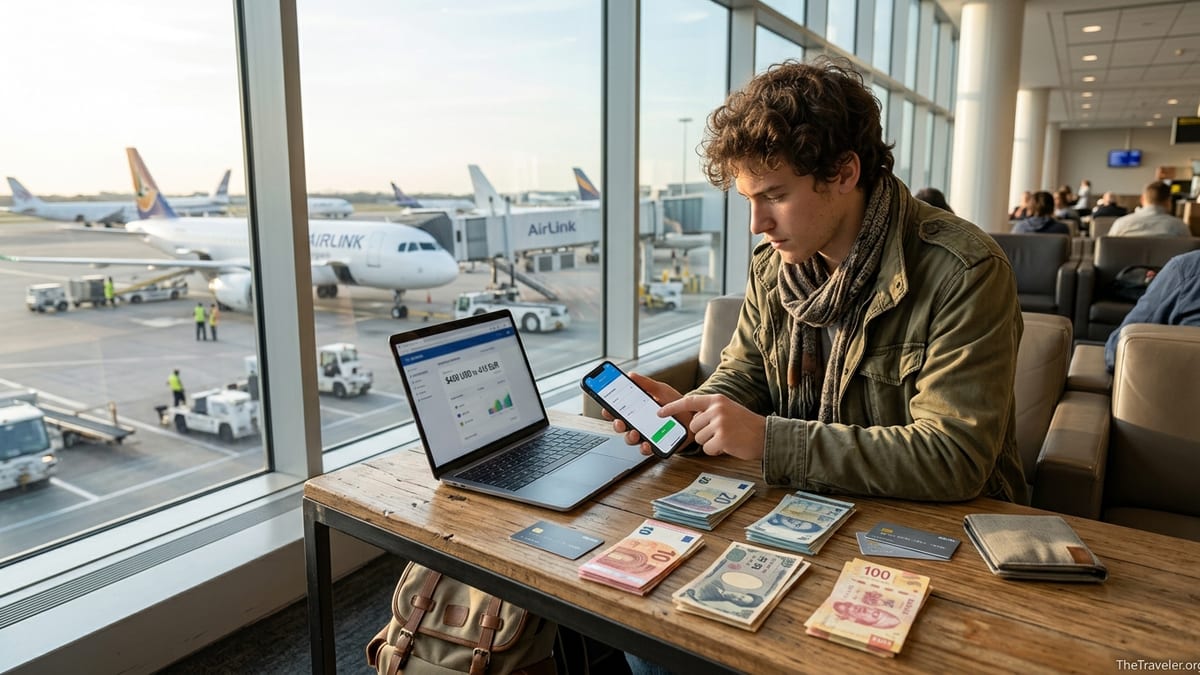
Unlike a bank wire, which often involves a branch visit, paper forms and opaque correspondent bank charges, Xe is designed to be app-first. You create an account, complete a basic identity check, and then can initiate transfers from your phone while sitting in an airport lounge, on a train between cities or from your hotel room. Transfers are not instant in every case, but for many popular routes Xe aims to deliver within minutes to a few hours, and in less common corridors within one to five business days, depending on banking systems and how you fund the transfer.
For travelers, the key benefit is that Xe combines its long-running live exchange rate tools with the ability to act on those rates. You can watch how the dollar trades against the euro before a summer trip, set alerts when a favorable rate appears, and then lock in a transfer to your foreign account or to a trusted contact abroad before you even land.
How a Typical Xe Transfer Works When You Are Traveling
Most travelers will interact with Xe through its mobile app. After signing up and verifying your identity with basic documents, you start on the “Send money” screen. You choose the country you are sending to, then select the currencies. For example, a U.S. traveler preparing for a month in Italy might send 1,000 U.S. dollars to their own euro account in Germany, or directly to an Italian landlord’s bank in euros to pay a deposit on a Rome apartment rental.
Once you enter the amount, Xe displays the exchange rate and an estimated delivery time. The rate you see is not the raw mid-market rate that appears on the Xe currency converter, but a customer rate that includes a small exchange margin. Independent fee trackers report that this margin often sits in roughly the 0.5 to 2 percent range, with larger transfers generally getting better pricing. In many popular routes, Xe either charges no separate transfer fee or only a small flat fee on smaller amounts, so the main cost is baked into that exchange rate rather than a visible service charge.
Next, you choose how to pay. From the United States, funding with a standard bank transfer or ACH is usually the cheapest option, though it can be slower because your bank needs to push the dollars to Xe. Paying by debit or credit card can speed up the process and is sometimes necessary for last-minute transfers, but card issuers may treat this as a cash-like transaction and charge their own cash advance or foreign transaction fees on top of any cost in Xe, so it is worth checking with your bank before relying on card funding.
On the recipient side, you decide between bank deposit, cash pickup or other methods offered for that specific destination. For example, if you are trekking in Guatemala and your guesthouse in Antigua tells you they prefer cash, you could send money in quetzales to a nearby cash pickup location so you are not reliant on a single local ATM. In more developed banking markets like the Eurozone, a straightforward bank transfer to an IBAN is typically the smoothest option and means rent, tours or language school fees can be paid from your own foreign-currency balance rather than withdrawn in cash.
Understanding Xe’s Exchange Rates and Fees in Real Life
Xe’s public currency converter displays the mid-market rate, which is effectively the midpoint between global buy and sell prices on the wholesale market. It is a useful benchmark, but it is not the rate you actually get when sending money. When you initiate a transfer, Xe applies a modest spread on top of that rate. Reviews and independent calculators updated in 2026 indicate that for many popular routes and higher amounts, the total margin can be under 1 percent, while smaller or more exotic currency transfers may sit closer to the upper end of the 0.5 to 2 percent band.
Consider a traveler working remotely from Lisbon for two months. If they need to pay 2,000 euros for a serviced apartment, sending directly from a U.S. bank via an international wire might incur a fixed outbound fee of around 30 dollars, plus poorer exchange rates and possible correspondent bank fees on the way. Using Xe, there may be no fixed fee at that size, and the rate might be just under 1 percent off mid-market. While exact numbers vary by day, the total cost difference can easily amount to tens of dollars on a single rent payment, enough to cover an airport transfer or a couple of dinners out in the city.
For smaller day-to-day transfers, the economics shift slightly. Sending 100 dollars to top up a friend’s account in Canada or to cover a shared hostel bill in Mexico may incur a small flat fee in the region of a few dollars if you are below Xe’s typical threshold for fee-free transfers. At that scale, the combination of a flat fee and an exchange margin might mean it is more efficient to batch several small payments into one larger transfer rather than sending multiple micro payments each week.
Another factor is funding method. A transfer funded by a domestic bank transfer usually attracts Xe’s best available exchange rate and no additional fee. The same transfer funded by credit card might cost slightly more in terms of Xe’s pricing and could also trigger a cash advance fee and immediate interest from the card issuer. Travelers who rely heavily on credit cards for rewards or buyer protection may still prefer card funding in emergencies, but for planned rent payments, course fees or family support, funding Xe transfers by bank is generally more cost-effective.
Delivery Options: Bank Deposit, Cash Pickup and Mobile Wallets
For most cross-border travel finances, bank deposit is the default. You enter the recipient’s name, account number and other standard details such as SWIFT or IBAN, then Xe sends funds to that account. This works well for medium to long stays where you open a local account or where larger expenses such as accommodation, language schools or co-working spaces accept bank transfers. For instance, a digital nomad spending six months between Berlin and Prague might open a euro account in Germany and use Xe to move funds from the United States in larger monthly chunks to minimize fees.
Cash pickup is particularly useful when you or your recipient do not have easy access to a local bank account. Xe partners with large cash agent networks to offer pickup at supermarkets, currency exchange counters and dedicated remittance outlets. A U.S. traveler heading to Marrakech, for example, might send money in Moroccan dirhams for pickup near the main square. On arrival, they show ID and a reference number at the agent location and walk out with local cash. This can be a practical backup if your primary debit card is lost or swallowed by an ATM, or if you are traveling with relatives who are more comfortable receiving funds in cash.
Xe also supports mobile wallet transfers in some countries, where money goes directly into a local wallet app tied to the recipient’s phone number. This is relevant in markets where mobile money is widely used for daily transactions. Imagine traveling in East Africa and paying a safari operator who prefers mobile wallet payments. Instead of withdrawing large sums in cash, you could move funds via Xe from your dollar account to the operator’s mobile wallet balance in local currency, keeping your physical cash exposure low while respecting local payment norms.
Each delivery option has its own cost and speed profile. Bank deposits to major currencies such as euros, British pounds, Canadian dollars or Australian dollars tend to be reasonably fast, typically from same day to a few days depending on cut-off times and local banking systems. Cash pickup is often close to instant once Xe has received your funds, especially when funded by card, but may come with higher overall costs. Mobile wallet transfers can be near real-time where the infrastructure supports it, making them ideal if you are coordinating in the middle of a busy travel day and need funds to arrive quickly.
Using Xe Strategically: Rate Alerts, Timing and Budgeting
One of Xe’s most powerful tools for travelers is its rate alert feature. Within the app, you can set alerts for specific currency pairs at target rates. If you know you will be in Japan in three months and expect to spend around the equivalent of 4,000 dollars, you could set an alert for USD to JPY at a level you consider attractive. When the market touches that rate, Xe notifies you by push notification or email so you can choose to initiate a transfer while conditions are favorable.
For longer trips or remote work stints, this timing can make a practical difference. A traveler planning a six-week stay in Buenos Aires might see the dollar strengthening against the Argentine peso in the weeks before departure. Instead of waiting until landing and withdrawing small amounts at high-fee ATMs, they could lock in a larger Xe transfer into a local account or to a trusted host when the exchange rate moves in their favor, helping stretch their budget further once on the ground.
Rate alerts also make it easier to spread currency risk across time. Rather than sending your entire six-month travel budget in one transfer, you could move funds in stages, setting alerts at several target levels. If the rate improves, you move another chunk; if it weakens, you can pause and reassess. This does not eliminate currency risk, and Xe does not provide investment or trading advice, but it does give budget-conscious travelers more control than simply accepting whatever rate your bank or card offers at the ATM on a given day.
Finally, watching rates and using Xe’s converter during trip planning can help you build realistic daily budgets. Checking what 50 dollars buys in Thai baht or what 100 dollars converts to in Norwegian kroner, then comparing that against typical restaurant prices or transport costs, helps you gauge whether your savings will cover the experiences you want. Once on the road, you can adjust by transferring slightly more or less each month through Xe as your real spending patterns emerge.
Practical Scenarios: How Travelers Actually Use Xe
Consider a family from Chicago planning a three-week summer holiday across Italy and Greece. They book apartments in Florence and an island guesthouse in Naxos, both of which request bank transfers in euros to secure reservations. Rather than paying international wire fees from their U.S. bank for each booking, they open the Xe app, fund a single larger transfer in dollars from their checking account and send euros directly to each landlord. The Xe rate is competitive compared with their bank’s quote and they avoid additional outgoing wire fees and potential intermediary bank deductions.
On a different trip, a solo traveler from Los Angeles spends two months backpacking through Central America. Their U.S. debit card works fine for ATM withdrawals in Costa Rica, but once in Guatemala they find that ATMs around Lake Atitlan are frequently out of cash or impose very low withdrawal limits with high local fees. They switch tactics by using Xe cash pickup. From a hostel with stable Wi-Fi, they send dollars converted into Guatemalan quetzales to a pickup location in Antigua for the equivalent of a few hundred dollars. The next morning, they show a passport and reference code at the counter and collect cash for the next leg of the trip, paying a single transfer margin instead of multiple ATM fees.
Remote workers and digital nomads often rely on Xe in slightly different ways. A Canadian software developer who splits her year between Toronto and Lisbon receives her salary in Canadian dollars but pays rent and daily expenses in euros. Each month she uses Xe to transfer a larger lump sum from Canada to her euro account, timing some of those transfers when rate alerts flag a stronger Canadian dollar. Over the course of a year, the cumulative savings from better rates and lower fees compared with repeated bank wires help finance side trips to Porto and the Azores.
Travelers also use Xe to support friends or family while they are abroad. Parents in New York might top up a child’s budget during a semester abroad in Madrid by sending euros to their European bank account, or by arranging cash pickup if the student is moving around and has not opened an account. This can be particularly reassuring in emergencies: if a wallet is stolen in Barcelona or an ATM retains a card in Lima, family back home can send funds through Xe to a nearby cash location within hours, avoiding multi-day delays and complex banking procedures.
Limitations, Risks and When Xe May Not Be Best
Although Xe is flexible, it is not a one-size-fits-all solution. Availability of features such as cash pickup or mobile wallet payouts depends on the specific corridor. Some countries may only support bank deposits, while others allow multiple payout options. Before building your entire travel money plan around Xe, it is wise to open the app, simulate a small transfer to your intended destination and confirm the available methods, fees and estimated delivery times.
Regulatory checks can also slow things down, especially for larger transfers or routes flagged as higher risk. If you are moving funds to pay for a long-stay visa, a vehicle purchase or a large apartment deposit, Xe may ask for extra documentation such as invoices, contracts or proof of source of funds. This is standard across the industry and helps comply with anti-money-laundering rules, but it means you should not leave large, time-sensitive payments until the very last minute. Initiating a test transfer weeks before you travel can reveal any issues in time to adjust your plan.
In some cases, it may still be cheaper or more convenient to use alternatives. Local banks occasionally offer promotional exchange rates for walk-in customers, or a multi-currency travel card might provide fee-free ATM withdrawals up to a certain limit. For very small, frequent payments such as daily coffee or subway rides, tapping a no-foreign-transaction-fee credit card that you already carry can be simpler than pre-funding multiple transfers. Comparing the total cost, including exchange margin and all fees, remains important, especially on high-volume routes where several fintech providers compete.
Security is another consideration. Xe employs standard protections such as encrypted connections and account verification, but travelers still need to take basic precautions: secure your phone with biometrics or a strong passcode, avoid using public computers to access your account, and double-check recipient details before confirming a transfer. As with any financial app on the road, losing your phone or having someone shoulder-surf your login details could cause trouble, so it is sensible to enable additional verification steps where available and to know how to contact Xe support if you suspect account compromise.
FAQ
Q1. Is Xe Money Transfer safe to use while I am traveling abroad?
Xe is a long-established foreign exchange brand that operates under financial regulations in the regions where it is licensed. It uses standard security measures such as encrypted connections, verification checks and monitoring for unusual activity. No service is completely risk-free, but for most travelers, Xe is considered a reputable and secure way to move money internationally.
Q2. How quickly will my money arrive if I send it through Xe during a trip?
Delivery times depend on the route, currency, funding method and payout method. Many major currency transfers funded by bank transfer arrive within one to two business days, while some card-funded or cash pickup transfers can arrive within minutes once Xe receives your funds. Less common corridors or transfers held for extra checks can take several days, so it is wise to send critical payments early.
Q3. Does Xe charge a fee every time I send money?
Xe earns most of its revenue from the small margin it adds to the exchange rate. On many routes and for larger transfers, there is no separate transfer fee at all. For smaller amounts or certain corridors, Xe may add a flat fee that is shown upfront before you confirm your transfer. The exact structure varies by currency pair, amount and how you pay.
Q4. Is Xe cheaper than using my bank for international transfers?
In many common scenarios, yes. Traditional banks frequently charge fixed wire fees that can run to tens of dollars per transfer and often use less favorable exchange rates. Xe typically offers more competitive rates and lower overall costs, especially for mid-sized and larger transfers. That said, it is smart to compare the total you would pay and the amount your recipient receives through both your bank and Xe for your specific route.
Q5. Can I use Xe to send myself money while I travel?
Yes. Many long-term travelers and remote workers use Xe to move money from a home-country account into an account in their destination country. For example, you can send U.S. dollars from your American bank to your own euro account in Europe, or to a trusted local account if you do not have one yet. This can be more cost-effective than repeated ATM withdrawals and lets you lock in exchange rates on your own schedule.
Q6. What happens if I enter the wrong recipient details in Xe?
If you notice an error before the transfer is processed, you may be able to cancel or modify it within the app, but once funds are sent to the wrong account, recovering them can be difficult and slow. Xe and the receiving bank may attempt to recall the money, yet success is not guaranteed. Always double-check account numbers, names and pickup details before confirming a transfer to avoid avoidable problems.
Q7. Can I rely on Xe instead of carrying cash when visiting cash-heavy destinations?
Xe can reduce the amount of cash you need to carry by allowing you to arrange cash pickup or bank transfers on demand, but it should not completely replace cash in destinations where card acceptance is low. Power outages, internet issues or local network downtime can all affect pickup locations and banks. A balanced approach is best: carry enough local cash for at least a day or two of essentials and use Xe to top up funds as needed.
Q8. Does Xe work for less common currencies and countries?
One of Xe’s strengths is its broad coverage. It supports more than 130 currencies, including many that traditional travel cards and some mainstream apps do not cover. However, availability of specific payout methods varies. Before you travel, open the app, select your destination and test a small transfer quote to confirm that Xe supports the currency and delivery option you need.
Q9. Will my credit card issuer charge extra fees if I fund Xe transfers by card?
They might. Some credit card issuers treat money transfer funding as a cash advance, which can attract a separate fee and immediate interest, often at a higher rate than purchases. Others may apply foreign transaction fees. To avoid surprises, check the terms of your card or call the issuer before relying on card funding for regular transfers. When in doubt, funding Xe via standard bank transfer is usually cheaper.
Q10. How should I decide between using Xe and a travel debit or credit card?
Each tool has strengths. Travel debit and credit cards are convenient for everyday purchases and ATM withdrawals, especially if they waive foreign transaction fees. Xe is often better for larger, planned payments such as rent, school fees, tour deposits or supporting family abroad. Many frequent travelers use both: cards for day-to-day spending and Xe for scheduled transfers where exchange rates and fees matter more.