

I landed in what was supposed to be my great budget escape with the kind of confidence only spreadsheets can give you. Travel blogs promised I could live on 30 dollars a day, forums swore that street food rarely crossed the 2 dollar mark, and social media kept repeating that this was “one of the most affordable countries in the world.” Two weeks later, as I watched my credit card bill creep up night after night, I realised the destination was not the only problem. My expectations, my habits, and a rapidly changing world had all conspired to turn an “affordable” country into a surprisingly expensive trip.
The Myth of the 30 Dollar Day
The version of Vietnam I carried in my head on the flight in was based on other people’s trips from years ago. Friends told me about one dollar banh mi, hotel rooms under twenty dollars, and iced coffees that cost less than a bottle of water back home. Budget guides still talk about backpackers getting by on roughly 25 to 30 dollars per day if they stick to hostels, street food, and buses. That number is not entirely wrong, but it is built on a very particular style of travel and it does not account for how quickly prices have climbed in tourist centres.
On my first morning in Da Nang, I went hunting for the famous dirt cheap breakfast. I found a small local stall where a classic banh mi with pork and herbs still cost around 20,000 to 25,000 Vietnamese dong, roughly one dollar. A plastic stool, traffic noise, and no English menu. That was the price I had seen quoted in online guides from just a year or two ago, and it felt like I was on track. An iced coffee at a basic street cafe was another 20,000 dong or so, well under a dollar if you pay in local currency. At that point it was easy to think the country had stayed frozen in budget time.
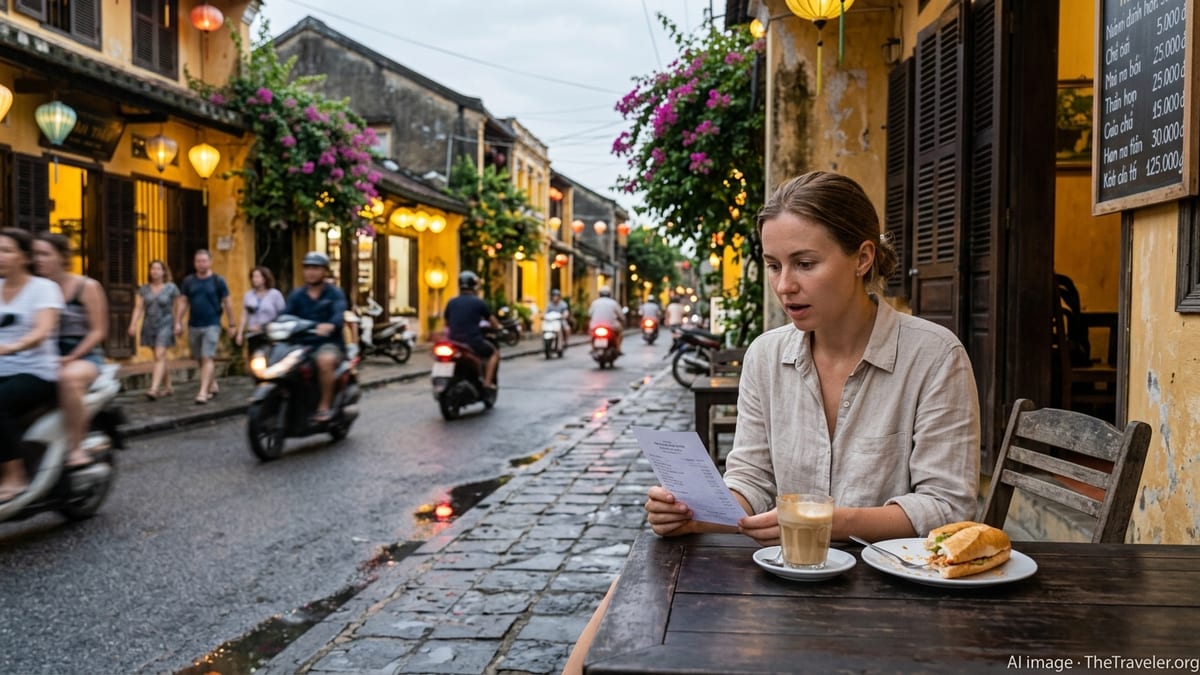
The illusion fell apart later that afternoon in Hoi An. In the lantern lit streets of the ancient town, many of the same dishes cost two or three times more. Trendy banh mi shops charging 70,000 dong for a sandwich sit only a short walk from stalls selling them for a third of that price. In cool, air conditioned cafes catering to visitors, iced coffees can run 40,000 to 70,000 dong and cocktails leap to Western city prices. Suddenly that 30 dollar daily budget looked fragile. To live on it, I would have to ignore most of the cafes and restaurants that actually appealed to me.
What I eventually realised was that there are several Vietnams coexisting. There is the local priced Vietnam of alleyway eateries and metal stools, where a filling plate of rice and meat can still be under 60,000 dong and a basic room in a guesthouse can hover around 20 to 25 dollars. Then there is the tourist priced Vietnam of curated experiences, craft coffee houses, rooftop bars, and riverside restaurants, where those same meals easily climb into the 5 to 12 dollar range and hotel rooms into the 40 to 80 dollar bracket. My budget failed not because the country was unaffordable, but because I thought I could live the more polished version of the trip on the more rugged version of the budget.
When “Still Cheap” Meets “More Expensive Than Before”
Vietnam is far from alone. A few months before that trip, I had a similar surprise in Mexico City, another destination routinely described as affordable. Guides still praise the metro, which costs just a handful of pesos per ride and remains one of the lowest priced urban transit systems anywhere. Current travel budget reports show that a week in the city can be manageable for a few hundred dollars if you share a hostel dorm, rely on street tacos, and use public transport. On paper, that sounded almost too easy.
Walking through the Roma and Condesa neighbourhoods, the gap between the old reputation and present day prices was obvious. Three street tacos on a busy corner might come to 4 to 7 dollars now, still inexpensive by big city standards but no longer the pocket change several older bloggers described. Mid range restaurants, especially those with English menus and minimalist decor, frequently charge the equivalent of 10 to 20 dollars per person for a main and a drink. It is still very good value for the quality, but it is not the shockingly cheap experience travel writing often promises.
Accommodation tells the same story. Budget breakdowns for Mexico City in 2026 show hostel dorms in central areas clustering around 18 to 25 dollars per night and simple private rooms in guesthouses closer to 35 to 60 dollars, while nicer boutique hotels start at 80 dollars and climb quickly. Those figure are perfectly fair for a major capital that offers world class museums and food. The issue is that they sit much higher than the “ten dollar rooms” and “five dollar meals” that dominate search results from ten years ago. For a traveller planning purely off those older numbers, reality feels expensive even when it is objectively reasonable.
“Affordable” is therefore two things at once. Compared to London, New York, or Sydney, cities like Da Nang, Hoi An, and Mexico City still offer extraordinary value, especially when you stick close to local patterns. A bowl of pho for under three dollars or a metro ride for a fraction of that is almost unthinkable in many wealthy countries. Yet compared to their own recent past, these places have grown pricier because of inflation, tourism, and development. The hike is especially painful if you booked flights and time off work based on yesterday’s costs instead of today’s.
The Hidden Costs I Pretended Not to See
The biggest blow to my budget in Vietnam did not come from meals or hotel rates. It came from all the small, unglamorous expenses I had failed to add up properly. Currency conversion fees on my bank card. Ride hailing trips I took instead of learning the bus routes. Entrance fees that seemed trivial in isolation but quickly accumulated into real money. Each one was easy to overlook when I made my pre trip spreadsheet back home.
In Da Nang, I often chose a Grab car over a motorbike taxi because it felt safer on unfamiliar roads. The fares were modest, often just a few dollars for a cross town trip, but using them multiple times per day added 10 to 15 dollars to my daily spend. In Hoi An, I booked a packaged tour to the Cham Islands instead of piecing together ferries and local operators on my own. The tour included hotel pickup, a guide, and lunch. Priced between roughly 300,000 and 500,000 dong depending on inclusions, it was not a rip off at all, but it erased the savings from my cheap breakfast in an instant.
Mexico City threw its own surprises at me. The cheap metro ride is only cheap if you actually use it. On evenings when I was tired or returning from areas less connected by subway, I opened a ride share app. A ten or fifteen minute journey from Roma to Chapultepec or the historic centre often came to 2 to 4 dollars. Integrated over a week, that convenience quietly broke the bounds of the budget I had set. Museum entry fees, usually a few dollars each, created a similar effect. A visit to three or four cultural sites in a day could easily add another 15 to 25 dollars, which none of my mental math had fully acknowledged beforehand.
Then there were the digital leaks. International roaming charges for data when I was too impatient to connect to wifi. Currency conversion spreads when I let the card machine in a cafe charge me in my home currency instead of in dong or pesos. Service fees on ticketing apps that turned a 30 dollar event into a 38 dollar one. None of these broke the bank, but collectively they became the difference between the affordable fantasy and the expensive reality.
How Travel Content Fuels the “Cheap Country” Trap
As I watched my careful calculations fall apart, I realised how much of the problem started long before I packed my bag. The way we talk about “cheap countries” is often lazy, outdated, or hopelessly narrow. Budget articles like neat headlines. They tend to highlight the absolute minimum someone has survived on, then present it as a typical experience rather than what it really is: a gamble that demands constant tradeoffs and the willingness to be uncomfortable in ways many short term travellers underestimate.
In Vietnam, I could probably shave my expenses down to the famous 25 dollar day by sharing a hostel dorm, eating exclusively from basic street stalls, skipping alcohol almost entirely, and limiting my paid activities to a handful of entrance tickets. That would be an authentic and rewarding style of travel for some, but it is not what most people silently imagine when they book a ticket after watching travel influencers sip coconut coffee in stylish cafes and lounge at beachfront hotels. They want the aesthetics of mid range or even upscale tourism supported by the costs of hard core backpacking.
Mexico City exposed the same disconnect. Many blogs still lead with images of sleek bars in Roma Norte, modern art museums, and lush courtyards in restored mansions while quoting food and lodging prices pulled from more utilitarian parts of town. The assumption is that readers can slide seamlessly between those worlds. In practice, you are likely to settle into one or the other. If you sleep in a well located boutique hotel it is harder to resist the equally polished bakery next door, even if a cheaper taqueria exists a few blocks away under neon lights and flickering fluorescent tubes.
Once I recognised that my expectations were built on mixed signals, I grew more forgiving of my battered budget. It was not that the countries or cities had lied. It was that I had listened only to the parts of the story that made me feel clever and resourceful. I wanted the bragging rights of travelling “cheap” without the full set of compromises that the word requires in practice.
Designing a Budget That Matches the Trip You Actually Want
The lesson I eventually took home from Vietnam and Mexico was simple: budget for the version of the trip you are actually going to take, not the one you like telling people about. That starts with being honest about how you travel. If you know you prefer private rooms over dorms, build your budget around realistic nightly rates for guesthouses or small hotels. In 2026, that might mean assuming 25 to 40 dollars per night in mid sized Vietnamese cities like Da Nang and potentially more in prime tourist zones like Hoi An’s ancient town, and planning on at least 40 to 70 dollars for central, comfortable options in Mexico City.
The same goes for food. If you are excited about street food but also know that you enjoy a sit down restaurant every evening, assume only half your meals will be at the ultra low prices quoted in forums. In Vietnam, that might translate into a few one or two dollar dishes during the day and a five to ten dollar dinner in a place with air conditioning, English menus, and a view. In Mexico City, it could be a day that starts with a pastry and coffee from a local bakery for a few dollars, includes tacos from a stand for lunch, and ends with a dinner at a mid range spot where mains hover around ten to fifteen dollars.
Transport and activities are the next line items to reality check. Before my later trips, I started listing out every museum, day trip, guided tour, and internal transfer I realistically wanted to do, then looked up current prices in local currency instead of trusting vague daily totals from strangers. A half day excursion from Hoi An to nearby ruins, or a cable car and theme park visit in Central Vietnam, often landed in the 20 to 40 dollar range per person. In Mexico City, spreading out paid attractions like the National Museum of Anthropology, Frida Kahlo’s Blue House, and a trip to Teotihuacan ruins can add a healthy extra cost that generic “daily budget” numbers rarely incorporate fully.
Finally, I began to pad every budget with what I now call the temptation margin. This is a deliberate buffer of maybe 20 to 30 percent on top of the amount I think I need, designated for the little splurges I will almost certainly encounter. An extra dessert at a cafe that looks too inviting to skip. A last minute cooking class. An upgraded room when the basic one turns out to face a construction site. Pretending these things will not happen does not make me disciplined. It just ensures I end the trip feeling guilty instead of grateful.
The Takeaway
When I look back at my so called affordable trips that ran over budget, what stands out is not a sense of being cheated, but a series of mismatches. I was comparing prices in Da Nang to older, cheaper versions of the city. I was measuring meals in Hoi An against the lowest possible cost of eating in Vietnam, then choosing cafes and restaurants that belonged to a different tier. In Mexico City, I quoted subway fares to myself while repeatedly reaching for ride share apps. The destinations were not dishonest. My planning was.
The next time you see a destination marketed as incredibly cheap, pause before letting the headline lodge itself in your imagination. Ask when the prices you are reading were last updated. Notice whether the photos match the price point being discussed. Pay attention to how much of the budget depends on choices you may not actually make, such as avoiding alcohol, staying in dorms, or eating exclusively at bare bones eateries. Then build a plan that reflects where you fall on that spectrum.
Vietnam and Mexico City are still remarkable values in 2026. You can absolutely travel both on a modest budget if you lean into local rhythms. But affordability is not a magic property that automatically applies to every trip there, no matter how you design it. My budget did not agree with the myth of the cheap country because I had never truly asked it to. I had asked for comfort, flexibility, and a few indulgences, then pretended those could be had at the same price as the hardest working backpacker’s itinerary. The country was affordable. My fantasy of it was not.
FAQ
Q1: Why do so many people say Vietnam is incredibly cheap if I found it pricey?
Many travellers quote the lowest possible costs based on street food, dorm beds, and buses. If you prefer private rooms, cafes, and some tours, your daily spend naturally rises above those headline figures.
Q2: Is Mexico City still an affordable destination in 2026?
Yes, compared with major Western capitals it offers excellent value, especially for food and public transport, but central neighbourhoods and mid range hotels cost more than older guides suggest.
Q3: How much should I realistically budget per day for Vietnam now?
For a comfortable mid range trip in cities like Da Nang or Hoi An, many travellers do well with roughly 40 to 70 dollars per person per day, depending on activities and alcohol.
Q4: Can I still travel Vietnam on 25 to 30 dollars a day?
It is possible if you stay in hostels, eat mainly local street food, limit paid activities, and avoid regular taxis or ride hailing, but it requires discipline and compromise.
Q5: What daily budget makes sense for Mexico City?
Shared hostel dorms and street food can keep costs near 40 to 60 dollars per person per day, while private rooms and regular restaurant dinners push that closer to 70 to 120 dollars.
Q6: Why did my actual spending end up higher than the online “average daily budget”?
Those averages often exclude occasional splurges, card fees, ride shares, alcohol, and multiple paid attractions in one day, all of which quickly inflate real world costs.
Q7: How can I avoid the tourist price trap in supposedly cheap countries?
Spend time in local style eateries, check menus before sitting down, compare a few similar options, and ask locals or hotel staff where they eat for honest baseline prices.
Q8: Is it worth paying more to stay in central, trendy neighbourhoods?
Often yes, because you save time and feel safer walking, but you should accept that food, coffee, and bars nearby will reflect that higher price point instead of the national average.
Q9: What is a smart way to build a realistic travel budget?
Research current prices in local currency for accommodation, meals, transport, and specific activities you want, then add a 20 to 30 percent buffer for unplanned treats and small surprises.
Q10: How can I keep my trip enjoyable if costs are higher than I expected?
Focus on free or low cost experiences, such as markets and parks, alternate cheaper meals with occasional splurges, and adjust your plans early instead of stressing once money is already tight.