


If you have never been to North Macedonia, plan at least two full days in Ohrid, or three if you want both relaxed lake time and a deeper dive into its villages and mountains. For a balance of comfortable sightseeing, good swimming conditions and manageable visitor numbers, late May to late June and the first half of September are usually the sweet spots: the water is warming or still pleasantly warm, temperatures in town are comfortable for walking its steep cobbled streets, and crowds are far smaller than at the height of July and August.
Get the latest updates straight to your inbox!
Why Ohrid Rewards a Two or Three Day Stay
Ohrid is compact on a map, but its character shifts quickly between the UNESCO-listed Old Town on the hill, the busy lakeside promenade and quieter residential quarters. Two full days are enough to see the major historic sites, cruise the lake to the celebrated St Naum Monastery and enjoy a sunset above the water. A third day lets you slow down: swim off quieter beaches, explore villages like Trpejca or Peštani, or cross into Galicica National Park for mountain views over two different lakes.
Climate and water temperature are important when planning. Lake Ohrid is deep and cold at its bottom but the surface warms significantly in summer. Recent multi-year averages show June surface temperatures around the high teens to about 20 degrees Celsius, rising to roughly 23 to 24 degrees in July and August and staying near 20 degrees into early September. These figures mean that confident swimmers will be happy from mid June, while most casual swimmers find late June to early September most comfortable.
High summer brings real heat in the Old Town, where stone streets and whitewashed walls reflect sun and there is little shade around the fortress. July and August daytime highs regularly pass 30 degrees Celsius, which can feel oppressive on the steepest alleys. At the same time, these months are when festivals, music events and the most frequent lake boats run. If you want atmosphere and nightlife, peak season may appeal, but those prioritizing relaxed sightseeing and lower prices usually prefer late spring or early autumn.
Winter travel is quieter and more atmospheric in a different way, with mist on the lake and snow on surrounding mountains, but daylight hours are short and some seasonal lake services do not operate. For an independent first-time visit that includes boat trips and swims, it is usually better to aim for late April through October, with May, June and September offering the best compromise between comfort, crowding and cost.
Getting to Ohrid and Around the Region
Ohrid St Paul the Apostle Airport sits roughly 9 to 10 kilometres northwest of the town. It is a small, simple airport used heavily by seasonal charters and low-cost carriers. There is currently no regular public bus linking the terminal with Ohrid. Instead, arrivals rely on taxis, pre-booked transfers or rental cars. Recent official fare information and on-the-ground reports indicate a fixed taxi price of about 12 euros one way between the airport and central Ohrid, with the drive usually taking 15 to 20 minutes depending on traffic.
Skopje International Airport, around 200 kilometres away, has many more year-round connections. It is linked to Skopje city centre by a shuttle bus that costs roughly 3 euros one way. From Skopje’s central bus station, several companies including Galeb and Makedonija Soobrakaj run intercity coaches to Ohrid. Recent timetables show multiple departures per day, with typical travel times between about 3 hours 15 minutes and 3 hours 30 minutes on the fastest runs and some slower services closer to 5 hours. As of late 2026, one-way fares listed by Macedonian ticketing platforms are around 900 to 1,000 Macedonian denars, roughly 15 to 17 euros, with return tickets often slightly discounted.
It is also practical to arrive or depart via Albania. The lakeside town of Pogradec on the Albanian shore and the regional centre of Korçë are linked by minibus and informal shuttles to the North Macedonian side, often changing at the border crossing near Sveti Naum or via the Struga area at the north end of the lake. Schedules and prices change frequently and are rarely well documented online, but many travelers report paying the equivalent of 10 to 20 euros for shared taxis or minibuses between Ohrid and Albanian destinations such as Pogradec, Korçë or even Tirana, with travel times ranging from about one hour to Pogradec to five or more hours to Tirana. Flexibility and asking locally at bus stations or guesthouses remain important for this route.
Crucially, Ohrid has no passenger railway connection. North Macedonia’s modest rail network does not serve the lake, and there are no direct trains from Skopje, Bitola or elsewhere. For intercity travel you will depend on buses, cars or organized transfers. The rebuilt Ohrid bus station, a short distance from the center, is the main hub, handling routes to Skopje, Bitola, Struga and other towns. Buying bus tickets at the station shortly before departure is still normal practice, although some companies now allow online purchase.
Walking the UNESCO Old Town: A Practical Route
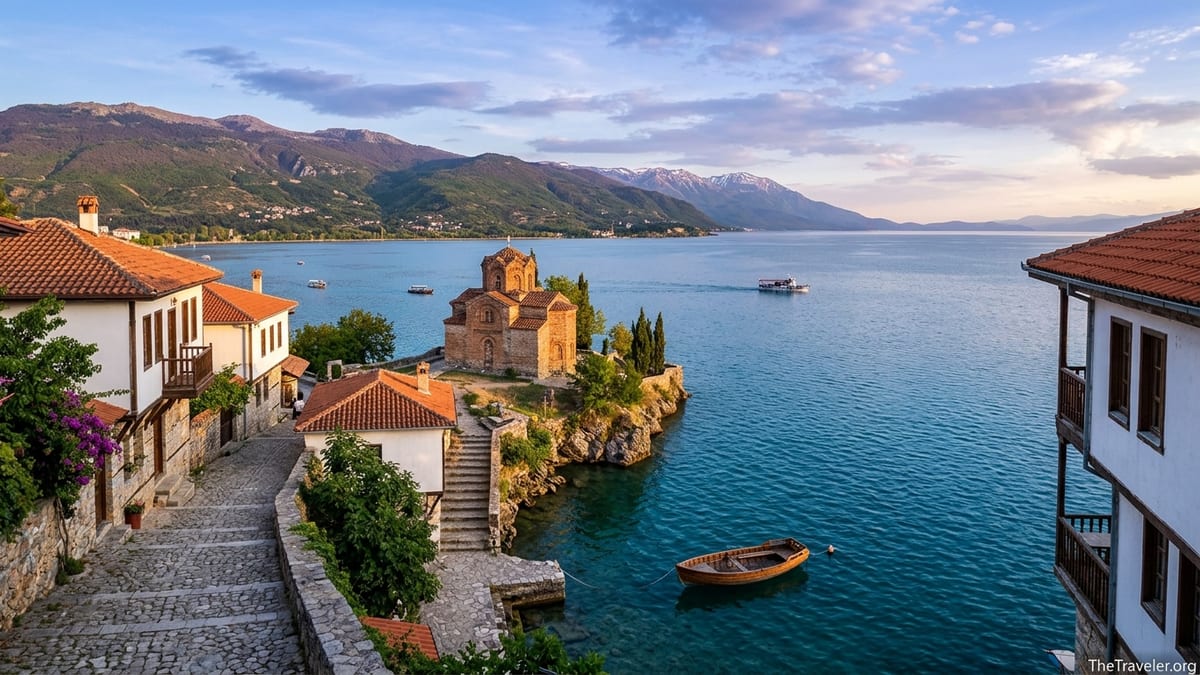
The UNESCO-protected core of Ohrid climbs steeply from the lakeside promenade up to Samuel’s Fortress. A realistic, rewarding walking route starts near the main square by the lakeshore and winds through the hillside to the Church of St Sophia, the Ancient Theatre, Plaošnik, the fortress itself and finally the Church of St John at Kaneo overlooking the lake. The whole circuit covers roughly 4 to 5 kilometres with several hundred metres of combined ascent and descent, mostly on cobbles and steps. Allow at least half a day, and more if you like to linger.
Begin near the lakeside promenade and walk a few minutes into the Old Town to reach the 11th century Church of St Sophia. Admissions and opening hours change periodically, but in recent seasons adult tickets have been in the range of 120 to 200 denars, with the church generally open from late morning into the late afternoon during the main season and more restricted hours in winter. From St Sophia, climb uphill for around 10 minutes on narrow streets to reach the Ancient Theatre, a Hellenistic amphitheatre later used by the Romans. Views from the seats take in tiled rooftops and the lake below, and the site is usually free to enter or carries a modest fee when events are not in progress.
From the theatre it is another 10 to 15 minutes uphill on stepped lanes to Plaošnik, an important early Christian site where the reconstructed Church of St Clement and Panteleimon stands amid archaeological excavations. Here you move through layers of history from early basilicas to medieval frescoes. Tickets for the complex, which sometimes cover adjacent exhibits, have recently been listed around 100 to 150 denars, with longer opening hours in summer. Above Plaošnik rise the walls of Samuel’s Fortress. The final climb takes another 10 minutes or so. Inside, you can walk sections of the ramparts and look out over the lake on one side and mountain ranges on the other. Entry prices have been in a similar range to other monuments, often around 120 denars for adults, with extended hours in high season when sunset visits are especially memorable.
From the fortress, descend on a path through pines towards the Church of St John at Kaneo, one of the most photographed spots in the Balkans. The walk downhill through the forested slope to Kaneo takes about 15 to 20 minutes, with some uneven stone steps near the church. There may be a small admission charge to enter, frequently in the region of 100 denars, while access to the terrace outside remains free. Late afternoon and early evening provide soft light on the cliffs and water, and from Kaneo you can continue down to the lakeside path and stroll back along the shore to the town center in another 20 to 25 minutes.
Choosing Where to Stay on Ohrid’s Slopes
Because the Old Town sits on a hill, accommodation choice has a real impact on how tiring your stay will be. The historic core offers atmospheric stone houses, wooden balconies and intimate guesthouses, but many streets involve steep, uneven steps. Carrying luggage up from the lakeside to a room near the upper walls can be demanding, especially in summer heat or for anyone with mobility issues. Once you have settled in, expect every outing to involve climbs and descents.
The lakeside promenade area, from the central square to the section just south of Kaneo, is flat or gently sloping, with easy access to cafés, boat piers and evening walks. Here you find a mix of small hotels, apartments and rooms above restaurants. In peak season the promenade is lively and can be noisy until late at night, especially near bars with music, so travelers who value silence may prefer streets set one or two blocks back or properties that explicitly advertise soundproofing.
Quieter options lie toward Biljanini Izvori, the springs and parkland on the western edge of town. This area, a 20 to 30 minute walk from the Old Town depending on your exact location, is relatively flat and more residential. Hotels and apartment complexes here often have parking, slightly larger rooms and closer access to town beaches while still being walkable to the Old Town along the lakeside. For many visitors, especially families or anyone with knee or mobility concerns, this area offers the best compromise between charm and practicality.
Prices fluctuate strongly by season. Recent examples from booking platforms in 2026 show central double rooms in the Old Town or along the promenade starting around 40 to 50 euros per night in May or October, rising to 80 euros or more in July and August for comparable standards. Simple apartments near Biljanini Izvori or further from the core can still be found for around 35 to 45 euros in shoulder seasons, increasing to roughly 60 euros in peak months. These figures vary year to year, but they illustrate how timing affects budgets as much as location.
Boats, Buses and Roads to St Naum and the Southern Shore
St Naum Monastery lies about 25 kilometres south of Ohrid near the Albanian border, where karst springs feed the lake. One of the most enjoyable ways to reach it is by boat across the water. The main public ferry from Ohrid town’s pier operates seasonally. Recent schedules for summer 2024 and 2025 indicate daily departures between 1 June and 30 September, typically leaving Ohrid at around 10:00 in the morning and returning from St Naum at about 16:00 in the afternoon. The direct lake crossing takes approximately 90 minutes each way, and round-trip ticket prices reported by visitors during these seasons cluster around 12 to 15 euros per person.
Smaller private boats and tour operators supplement the main ferry, especially in July and August. These can be more flexible on timing, and some combine the St Naum trip with swimming stops or commentary, often at higher prices per person or by negotiating for a group. Because offerings change by season and demand, it is sensible to confirm current prices and departure times at the lakefront kiosks a day or two in advance rather than relying on old information printed elsewhere.
By land, the road to St Naum follows the eastern shore of the lake, passing villages such as Peštani and Trpejca and the Bay of Bones archaeological complex. Public buses and minibuses run this lakeside route from Ohrid’s bus station and central stops, though frequency reduces outside summer. Travelers in recent years have mentioned paying the equivalent of a few euros for a one-way bus ride to places such as Peštani or Trpejca and somewhat more to reach the monastery at the border. The drive to St Naum usually takes about 45 minutes to one hour, depending on stops and traffic.
Comparing the two options, the boat is slower than driving but becomes part of the experience, giving long views of the mountains on either side and the clarity of the lake water. The road route offers flexibility, particularly if you want to stop at Bay of Bones or swim at intermediate beaches, and is cheaper if several people share a taxi or you use local buses. In shoulder seasons or on days of strong wind, some boat services may be cancelled or curtailed for safety, in which case the road becomes the practical alternative.
Bay of Bones, Lakeside Villages and Galicica Views
The Bay of Bones Museum on the eastern shore reconstructs a prehistoric pile-dwelling settlement on wooden platforms over the water. It sits roughly 15 kilometres south of Ohrid. Recent tourism materials from local authorities and hospitality providers have cited entry tickets in the region of 100 to 150 denars, or a couple of euros, making it an affordable stop en route to St Naum. The site combines a small indoor exhibition with open-air walkways among reconstructed huts and views back towards the mountains.
Further along the same road lie Peštani and Trpejca, compact lakeside villages backed by the steep slopes of Galicica National Park. Peštani is closer to Ohrid and has a mix of small hotels and pebbly beaches. Trpejca, once primarily a fishing village, has become known for its clear water, simple waterfront restaurants and cliff-backed swimming spots; it still feels smaller and more secluded than the main town. Both villages are accessible without a rental car via local buses or taxis, although services thin out in the evenings and outside summer, so it is wise to ask locally about the last return options.
Galicica National Park rises sharply behind these settlements and offers some of the best viewpoints in the region. A paved road climbs from the Ohrid side across the mountain crest to the Prespa Lake side, with parking spots where short walks lead to panoramic points where you can see both lakes at once. Without your own car, reaching these high viewpoints is more challenging but not impossible: in high season some guesthouses and tour agencies in Ohrid and Peštani advertise half-day excursions by minivan or jeep. Independent hikers occasionally arrange taxi drop-offs at trailheads and then walk down to villages, but this requires preparation, good footwear and awareness of weather conditions.
For visitors staying only two or three days without a car, the most realistic combination is to visit Bay of Bones and one village such as Trpejca on the same day as the St Naum excursion if traveling by road, or to set aside a separate day to ride the bus to a village for swimming and lunch with mountain views. This way you can enjoy the lakeside atmosphere without spending most of your short stay in transit.
Lake Ohrid’s Depth, Ecology and Swimming Conditions
Lake Ohrid is one of Europe’s oldest and deepest lakes. Scientific studies indicate a maximum depth of around 285 metres and an estimated age of more than one to several million years. Its isolation and stability have allowed many unique species to evolve, including endemic fish, snails and other organisms found nowhere else. Conservation organizations emphasize its global ecological importance and the need to manage tourism, construction and fishing to protect water quality and habitats.
The great depth means that water layers mix slowly. Research published through UNESCO and limnological studies notes that the deepest water remains cold, around 6 degrees Celsius year-round, while surface temperatures in summer can reach 24 to 27 degrees during warm spells. Average monthly figures for the surface show values climbing from around 10 to 15 degrees in April and May to roughly 19 to 20 degrees in June, peaking around 23 to 24 degrees in July and August, then declining toward 20 degrees or slightly below in September and into the low teens in October.
For swimmers, this translates into a clear seasonal pattern. Locals often start dipping in May on sunny days, but comfortable sustained swimming for most visitors generally begins from mid June and runs to mid or late September, with July and August offering the warmest water. The main town beaches near the promenade, as well as those near Biljanini Izvori and in villages like Peštani and Trpejca, are a mix of pebbles, small stones and some sandy patches. Water clarity is a highlight: visibility can extend many metres down in calm conditions, and the shoreline drops off relatively quickly in some places because of the lake’s depth.
Responsible tourism practices make a difference here. Using biodegradable sunscreen or allowing time between application and swimming reduces chemical load in the water. Avoiding disposable plastic on the beach, not feeding birds or fish bread, and respecting designated swimming zones around boat lanes all help maintain the lake’s fragile balance. Local initiatives occasionally organize shoreline cleanups and encourage visitors to pack out their rubbish, which independent travelers can support simply by being attentive to their own impact.
Suggested Two and Three Day Itineraries
On a first full day, focus on the Old Town. Start mid morning at St Sophia, then climb to the Ancient Theatre, Plaošnik and Samuel’s Fortress, allowing time to step into side alleys and small churches. Plan a pause in a shaded café around midday when the sun is strongest. In the late afternoon descend through the pines to St John at Kaneo and finish with a slow walk along the lakeside promenade as the light softens. This day involves several hours of walking and significant elevation change, so pacing yourself and carrying water are important, especially in summer.
Day two is ideal for St Naum and the southern shore. If the main ferry is running and the lake is calm, take the morning boat across, enjoy the monastery complex, its frescoed church and the nearby springs of the Crni Drim River, and return by boat in the afternoon. Alternatively, travel by road, stopping at Bay of Bones for an hour to tour the reconstructed pile dwellings, then continue past Peštani and Trpejca either to swim or directly to St Naum. Returning in the evening, you can still catch the sunset in Ohrid or dine in a lakeside restaurant.
If you have a third day, choose according to your interests. History enthusiasts might revisit particular churches or explore additional sites in town that received less attention on day one. Nature lovers might book a half-day excursion into Galicica National Park for mountain panoramas, while those craving a slower pace could simply claim a spot on a quieter beach near Biljanini Izvori, Peštani or Trpejca, alternating swims with reading and long lunches. Families with children often appreciate this unstructured third day after two more active ones.
Within these outlines, flexibility is essential. Strong wind on the lake can lead to boat cancellations or rougher crossings, making the road route more comfortable. Heat waves in July or August may argue for an earlier start to Old Town explorations, with a long siesta by the water in the afternoon. Shoulder-season visitors might flip the order of days depending on which attractions have shorter hours on certain dates, always checking locally for the most up to date timetables.
Costs, Budgets and Accessibility Considerations
Prices in North Macedonia remain moderate by European standards, though they have risen in recent years. Using late 2026 figures, a realistic daily budget for a mid-range independent traveler in Ohrid might be around 4,000 to 6,000 Macedonian denars per person, roughly 65 to 100 euros, covering accommodation, meals, local transport and basic sightseeing. A double room in a comfortable guesthouse or small hotel typically runs from about 2,400 to 4,800 denars per night in shoulder season and more in peak months. Simple private apartments can come in lower, while boutique lakeside properties and four-star hotels charge more.
For food, a coffee on the promenade often costs around 80 to 120 denars, while a light lunch such as a salad and soft drink might fall in the 300 to 500 denar range. Dinner in a lakeside restaurant with a main course featuring local fish or grilled meat, plus a drink, usually comes to 700 to 1,200 denars per person, depending on the venue. Local buses along the lake shore have fares measured in tens of denars for short hops and somewhat more for longer journeys, while a town taxi ride might cost a few hundred denars within Ohrid, rising for longer distances or night trips. Entry to most individual monuments in the Old Town ranges from roughly 100 to 200 denars per adult, with discounts for children and sometimes combined tickets.
Accessibility is uneven. The lakeside promenade and the newer parts of town near Biljanini Izvori are relatively flat and more manageable for wheelchairs and strollers, although curb cuts and smooth surfaces are not universal. In contrast, much of the historic Old Town is inherently difficult: steep gradients, irregular cobbles, frequent steps and narrow passages. Some major attractions, such as Samuel’s Fortress and St John at Kaneo, require climbing on paths or stairs that may not be suitable for those with limited mobility or for very young children in simple strollers. Families may prefer to carry infants in slings or robust baby carriers rather than rely solely on wheels.
Summer heat adds another layer of challenge. From late June through August, it is wise to plan outdoor walking for early morning and late afternoon, reserving the hottest midday hours for lakeside breaks, shaded cafés or indoor visits. Bringing refillable water bottles, hats and light clothing makes a tangible difference. When taking boats, be aware that decks can be fully exposed; sunscreen, cover-ups and keeping children hydrated are important, and life jackets for younger passengers should be requested and checked.
Different traveler types find different strengths in Ohrid. Couples often enjoy the combination of romantic lakeside views, intimate Old Town streets and sunset boat rides. History enthusiasts appreciate the density of churches, medieval and Byzantine heritage and the ability to connect town monuments with regional sites like Bay of Bones and St Naum. Families value the swimmable lake, short distances and relaxed pace, while travelers seeking a quieter lakeside destination compared to busier Adriatic resorts will find that, outside the absolute peak weeks of late July and much of August, even popular spots around Ohrid retain a more small-town, accessible feeling, especially in the evenings once day trippers and excursion buses depart.