

More news on this day
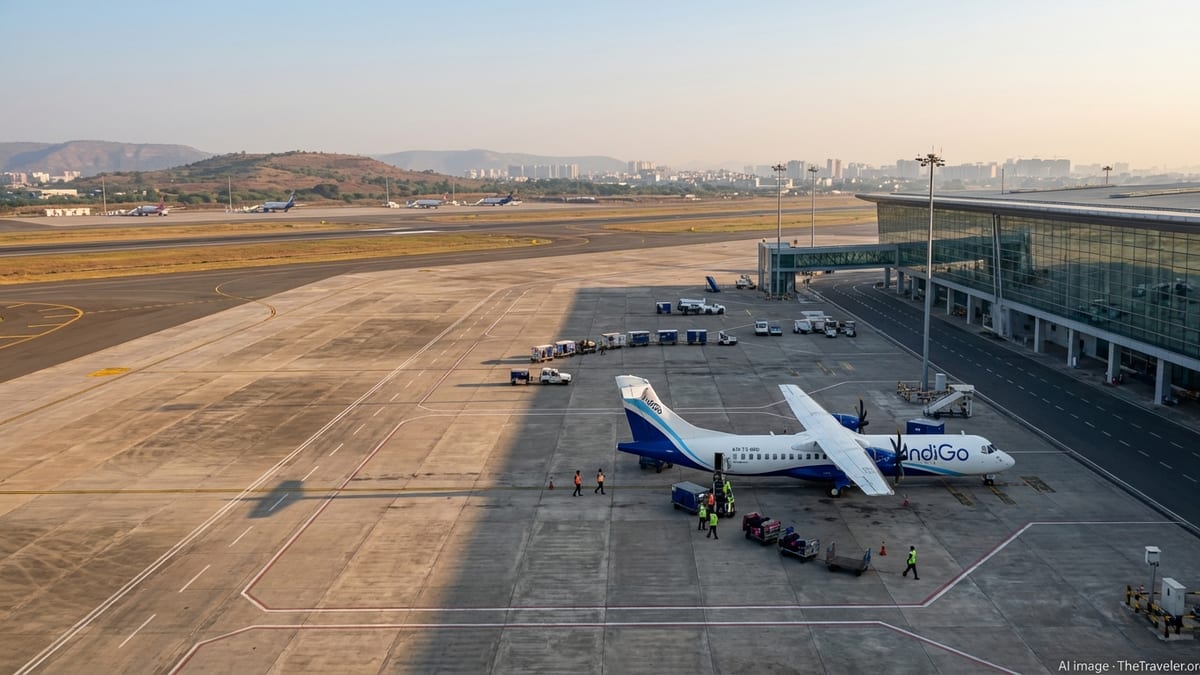
IndiGo is set to reshape domestic air travel around India’s financial capital, announcing a fresh wave of direct flights from the upcoming Navi Mumbai International Airport to six cities from March 29, 2026, in a move aimed squarely at tightening regional links and easing pressure on Mumbai’s main hub.
Six New Direct Routes Put Navi Mumbai on the Map
The low-cost carrier will connect Navi Mumbai International Airport to Ahmedabad, Diu, Goa, Rajkot, Belgaum and Kolhapur with new non-stop services operated by its ATR turboprop fleet. The additions position Navi Mumbai as a serious alternative gateway for domestic travelers who currently rely almost entirely on Mumbai’s congested Chhatrapati Shivaji Maharaj International Airport.
The flights are scheduled to begin on March 29, 2026, coinciding with the ramp-up of commercial operations at the greenfield airport. IndiGo has already opened bookings across channels, targeting both early summer holidaymakers and frequent business travelers keen to cut surface travel time across western India.
Aviation analysts say the choice of cities underscores IndiGo’s focus on regional demand rather than only trunk metro routes. By pairing Navi Mumbai with a mix of business hubs, industrial towns and leisure destinations, the airline is betting on a broad base of short-haul traffic that can feed its wider domestic network.
ATR Operations Tailored to Regional Demand
IndiGo will deploy ATR 72 turboprop aircraft on the new Navi Mumbai routes, a strategic choice designed to match capacity with thinner but growing regional markets. ATRs typically seat around 70 passengers and are optimized for short sectors, with lower operating costs and the ability to handle shorter runways at smaller airports.
By shifting these connections to turboprops, the airline can offer higher frequency and competitive fares while avoiding the risk of underutilized larger jets. For travelers, that translates into more direct options, reduced reliance on road and rail, and faster journeys between tier 2 and tier 3 cities and the Mumbai metropolitan region.
The move also gives Navi Mumbai International Airport a distinct regional profile in its early months. While larger narrow-body jets will continue to serve major trunk sectors, IndiGo’s ATR schedule effectively turns Navi Mumbai into a hub for short-haul feeders criss-crossing Gujarat, Maharashtra and coastal destinations along the Arabian Sea.
Relief for Mumbai and a Boost for Western India
For the wider Mumbai region, IndiGo’s expansion at Navi Mumbai is expected to relieve some pressure from the city’s primary airport, which has long struggled with slot constraints and peak-time congestion. Even a modest shift of regional services to the new facility can free up valuable capacity for long-haul and metro-to-metro flights from the existing airport.
At the same time, cities like Rajkot, Belgaum and Kolhapur stand to gain from faster access to Mumbai’s economic ecosystem without the last-mile bottlenecks that can significantly extend door-to-door journey times. Direct flights into Navi Mumbai, located closer to many of the region’s industrial corridors and emerging residential zones, could trim hours off business trips and cargo movements.
Leisure travelers are also set to benefit, particularly on the Navi Mumbai to Goa, Diu and Kolhapur routes. With multiple daily frequencies planned on some sectors, the new schedule allows for flexible weekend and short-break itineraries, avoiding long overland journeys and giving coastal tourism hubs a fresh inflow of visitors from the Mumbai metropolitan area and beyond.
Strategic Play in a Competitive Aviation Market
IndiGo’s decision to deepen its presence at Navi Mumbai comes as Indian carriers jostle for position in a rapidly expanding aviation market. By locking in early capacity and building a distinct regional network from the new airport, the airline is positioning itself as the default choice for travelers in Navi Mumbai, Panvel and the surrounding districts.
Industry observers note that early mover advantage at a new hub can pay long-term dividends, especially once connecting traffic patterns are established and passengers grow accustomed to particular routings. With six domestic points linked from day one of its ATR operations, IndiGo is effectively seeding a mini-hub that can be scaled up as demand grows.
The expansion dovetails with broader infrastructure investment around Navi Mumbai, including new road links, metro extensions and planned logistics parks. As these projects mature, the airport’s catchment is expected to widen, strengthening the case for additional routes and higher frequencies over the next few seasons.
What It Means for Domestic Travelers
For passengers, the most immediate impact will be choice and convenience. Residents of Navi Mumbai and neighboring districts will no longer need to budget extra travel time across the harbor to reach a long-haul or regional flight. Instead, they can access a growing menu of domestic routes from an airport located significantly closer to home and connected to new transport infrastructure.
Travelers flying in from Ahmedabad, Diu, Goa, Rajkot, Belgaum and Kolhapur, meanwhile, gain a direct gateway to the rapidly growing business and residential zones on Mumbai’s eastern flank. For many, that could reduce both travel time and cost, particularly where road transfers and overnight stays in central Mumbai were previously unavoidable.
As airlines and airports continue to rebuild and expand in the wake of shifting demand patterns, IndiGo’s Navi Mumbai push illustrates how targeted regional routes and right-sized aircraft can transform domestic connectivity. If the new services gain traction, the six-city network announced for March 2026 is likely to be only the opening chapter of Navi Mumbai’s role in India’s aviation story.