


More news on this day
An injured ticket inspector is being praised for helping passengers to safety in the chaotic minutes after a fatal train crash near Bedford, where a driver died and around 100 people were injured in a rear-end collision on the busy Midland Main Line.
Get the latest news straight to your inbox!
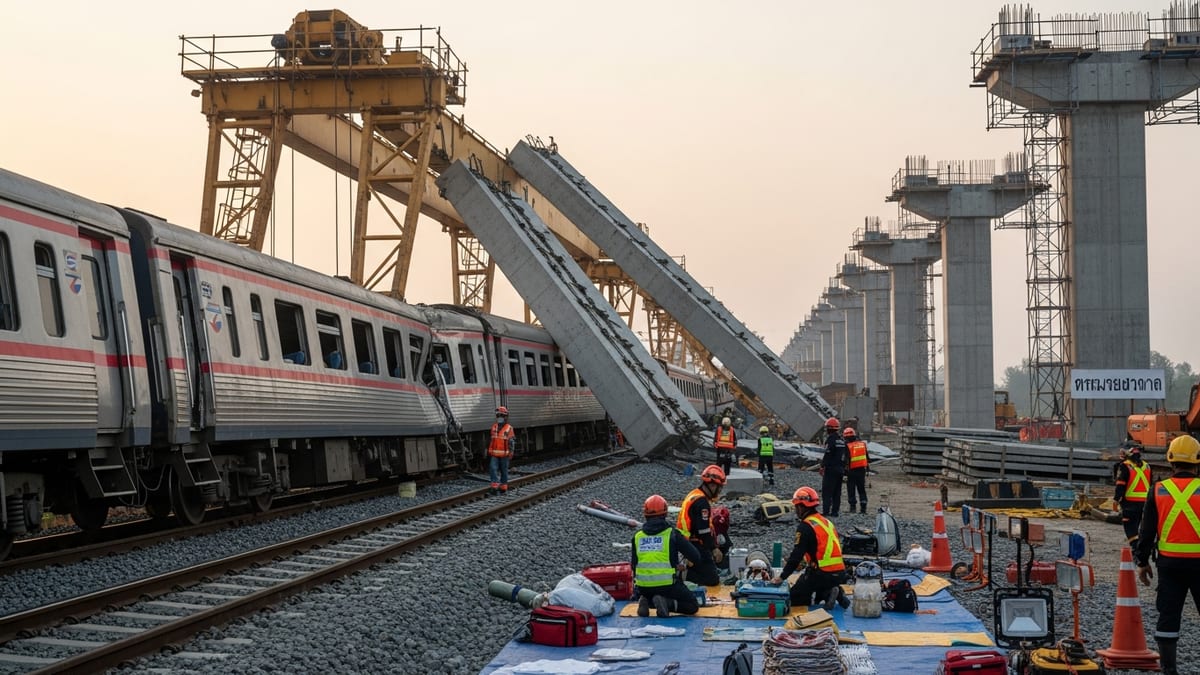
Deadly collision on key Bedford commuter artery
The crash occurred on the evening of 19 June on the stretch of the Midland Main Line between Bedford and Luton, a crucial corridor for services linking London St Pancras with the East Midlands and Luton Airport. Two East Midlands Railway services heading towards the capital were involved, with one train running into the rear of another in the Elstow area, just south of Bedford.
Publicly available information indicates that one of the trains was operating as a Luton Airport Express, used by hundreds of air travelers and commuters each day. The force of the impact crumpled carriages, shattered interiors and threw passengers from seats, turning a routine Friday evening journey into one of the most serious rail incidents in Britain in recent years.
Ambulance and fire crews mounted a major incident response, with reports indicating that approximately 100 people suffered injuries of varying severity. Figures released through regional media describe at least 11 people with very serious injuries, more than 30 with serious trauma and dozens more with minor wounds, highlighting the scale of the emergency.
The train driver at the front of the moving service died at the scene, according to multiple news outlets, becoming the sole confirmed fatality in the crash. Railway industry reports note that it is rare for a passenger rail collision in the United Kingdom to result in a death, underlining the exceptional seriousness of the Bedford incident.
Ticket inspector’s actions draw widespread praise
Amid the wreckage and confusion, attention has turned to the actions of an onboard ticket inspector who was injured in the collision yet is reported to have remained focused on getting passengers out of damaged carriages. Accounts in British and European news coverage describe the staff member moving through the train despite their own injuries, helping travelers to navigate debris-strewn aisles and reach exits.
Several reports circulating in national and regional outlets refer to the inspector as a “hero,” reflecting the reaction of passengers and railway observers who have shared details of the response on social media and in interviews with broadcasters. While the full extent of the staff member’s injuries has not been formally detailed, coverage suggests that they declined immediate treatment at first in order to concentrate on ushering passengers towards safer areas and assisting those who were disoriented or trapped.
Commentary across transport-focused publications points out that ticket inspectors and other on-board staff receive safety and evacuation training, but rarely face an event of this magnitude in their careers. The Bedford crash has therefore placed a spotlight on the preparedness and professionalism of front-line rail employees who are often more visible to passengers as ticket checkers than as emergency responders.
Travel commentators note that such accounts of individual bravery can play a significant role in how the public remembers a major transport disaster. In this case, the image of an injured member of staff guiding people to safety has quickly become one of the most shared human stories emerging from an otherwise technical and forensic investigation into signals, braking systems and operating procedures.
Casualty figures underline severity of incident
Updated tallies from ambulance services and hospital trusts, reported widely in the British press, show that around 100 passengers and staff required medical attention following the crash. At least nine people remained in critical condition in the days after the collision, with intensive care specialists treating head injuries, fractures and internal trauma consistent with a high-energy impact inside a confined space.
Emergency planners have highlighted the complexity of working inside tilted or partially derailed carriages, often in narrow embankments with limited road access. Reports indicate that crews worked into the night to stabilize injured passengers, erect lighting and create safe pathways to move stretchers from the trackside to ambulances waiting on nearby roads.
For hospitals across the region, the incident triggered major incident protocols, with elective procedures postponed and additional staff called in to handle the influx of casualties. Publicly available data from regional health services shows that dozens of patients were admitted for observation, many suffering from whiplash-type injuries, lacerations and psychological shock even where physical trauma was relatively minor.
Observers in the rail industry have also pointed out that the relatively low number of fatalities, despite the severity of the collision and the crowded trains, suggests that modern rolling stock design and crashworthiness standards may have helped to prevent an even more tragic outcome. Nevertheless, the death of the driver and the high number of serious injuries have prompted renewed scrutiny of whether additional protective measures are needed.
Investigators focus on signals, braking and track layout
In the aftermath of the collision, specialist rail accident investigators and safety regulators began a detailed examination of the scene, drawing on data recorders from both trains, signal box logs and CCTV from trackside and on-board cameras. According to widely cited coverage from national broadcasters and transport news outlets, early lines of inquiry include the performance of lineside signals, the status of track circuits and the functioning of any automatic train protection systems in the area.
Experts quoted in technical and industry media have noted that the Midland Main Line south of Bedford features multiple tracks, allowing fast and stopping services to be routed around each other. This complex layout, combined with heavy peak-hour traffic and planned engineering work in the region, is being scrutinized to determine how two trains came to occupy the same section of line heading in the same direction.
Rail specialists are also examining braking performance and communication between train crew and control centers in the moments before impact. Publicly available information suggests that both trains were operating under standard timetables and that no extreme weather conditions were present at the time, focusing attention instead on operational, technical or human factors.
While early commentary has inevitably raised questions about signal failures or procedural lapses, investigators are expected to take weeks or months to publish a comprehensive report. Rail safety analysts caution that past major accident inquiries in the United Kingdom have often revealed complex combinations of factors, rather than a single point of failure, underpinning catastrophic events.
Travel disruption and wider safety debate
The crash caused immediate and extensive disruption along the Midland Main Line, with services between London, Bedford, Luton and key East Midlands cities suspended or heavily curtailed. Travel bulletins over the weekend reported cancellations, diversions and reduced timetables, while coaches and alternative routes were drafted in to help stranded passengers complete their journeys.
Air passengers using Luton Airport were particularly affected, as the dedicated express service forms an important part of the airport’s surface access network. Transport observers noted that the incident highlighted the reliance of major UK airports on single mainline corridors, raising questions about resilience when rail links are severed by accidents or infrastructure failures.
The Bedford crash has also reignited public discussion about broader rail safety, staffing levels and investment in digital signaling systems. Comment pieces in national newspapers and trade publications have questioned whether modernization programs, including the roll-out of advanced train control technology, are progressing quickly enough on intensively used routes serving major cities and airports.
Within that wider debate, the story of the injured ticket inspector has resonated strongly with regular rail users and industry staff alike. For many commentators, the individual effort to protect passengers amid chaos sits alongside structural questions about technology, funding and regulation, reminding travelers that human judgment and courage remain central to safety on even the most modern railway.