


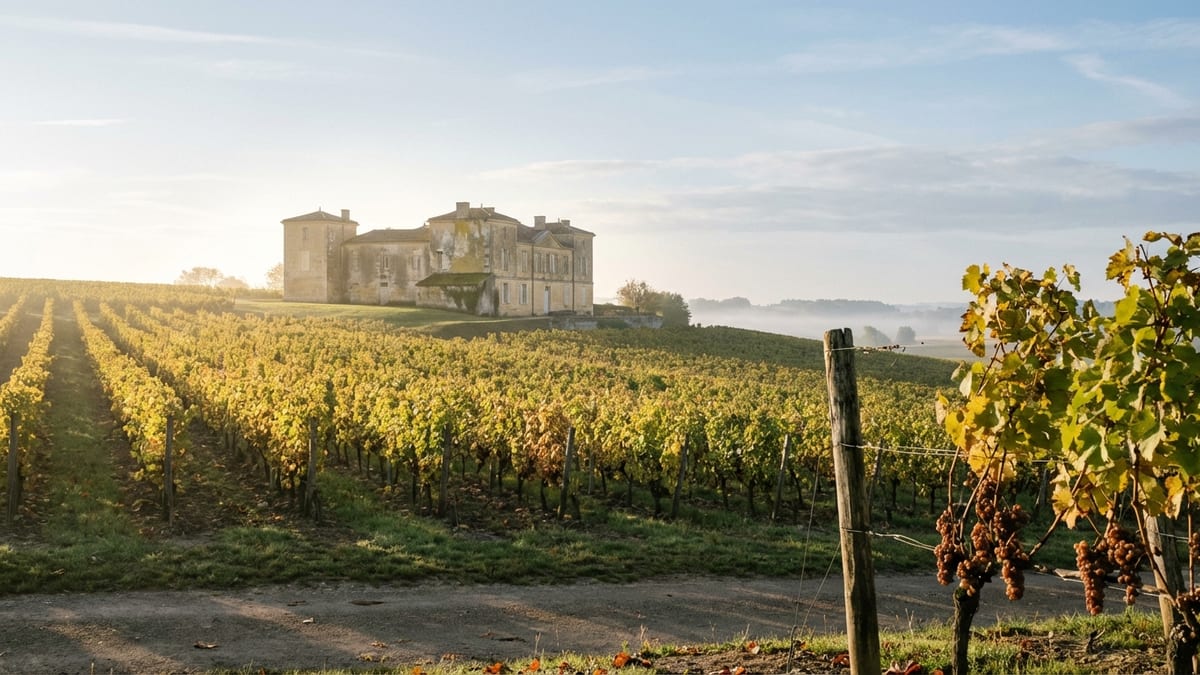
There are few words in wine that carry as much quiet power as “1855.” For Bordeaux lovers, the Bordeaux Wine Official Classification of 1855 is a touchstone that still shapes reputations, prices, and dreams nearly two centuries later. Among its many tiers and hierarchies, one anomaly stands apart: Château d’Yquem, the only estate ever granted the title Premier Cru Supérieur.
To understand why this Sauternes property was elevated above all others, you have to travel back to the mid 19th century, trace the way merchants ranked wines by price and prestige, and look closely at the singular conditions that allow Yquem to produce some of the world’s most ethereal sweet wines.
The World of Bordeaux in 1855
When Emperor Napoleon III decided to host the Exposition Universelle in Paris in 1855, he wanted France to showcase the very best of its agriculture and industry. Bordeaux was already famous for its wines, and the emperor requested a clear, authoritative ranking that visitors could easily understand. The Bordeaux Chamber of Commerce turned to the region’s wine brokers, who had decades of market data and practical knowledge of which châteaux consistently fetched the highest prices.
The result was the Bordeaux Wine Official Classification of 1855, a snapshot of the commercial hierarchy of top estates at that particular moment in time. For the red wines, only properties from the Médoc and a single estate from Graves, Château Haut Brion, were classified. They were grouped into five levels, from First Growths to Fifth Growths, according to reputation and average trading prices over previous decades. It was a commercial rating, not a quality decree from on high, but price reflected how the market perceived quality and rarity.
For the region’s great sweet wines, a separate ranking was drawn up for the wines of Sauternes and Barsac. These white wines were already viewed as something special: painstaking to produce, rare in quantity, and revered at the tables of Europe’s aristocracy. Unlike the Médoc reds, which were spread across multiple appellations, the sweet wines came almost entirely from a tight cluster of vineyards south of Bordeaux, where misty mornings fostered the “noble rot” essential for their style.
In Sauternes and Barsac, the classification was deliberately tighter and more selective. Rather than five levels, the brokers settled on only three: Second Growths, First Growths, and above them all, a single Premier Cru Supérieur. It was an extraordinary step that formalized what merchants and collectors had long believed: that one estate towered over the rest.
How the 1855 Sauternes & Barsac Classification Was Built
The classification of Sauternes and Barsac worked from the same basic principles as the Médoc: reputation, consistency, and above all, the actual prices that wines commanded on the market. Wine brokers consulted their archives, examined sales ledgers, and cross checked their own tasting notes. The goal was not to predict the future but to capture, as accurately as possible, the established order of things in the mid 19th century.
For the sweet wines, the brokers had a relatively compact set of estates to consider. The region’s finest properties were already well known to merchants in Bordeaux and London, and many had been praised by writers and travelers for decades. The brokers identified 27 crus whose wines had consistently achieved the highest standing. They placed 15 in the category of Second Growths and 11 in the category of First Growths, names that remain familiar to Sauternes enthusiasts today: Château La Tour Blanche, Lafaurie Peyraguey, Clos Haut Peyraguey, Rayne Vigneau, Suduiraut, Coutet, Climens, Guiraud, Rieussec, Rabaud Promis, and Sigalas Rabaud.
But one estate’s records stood out. In sale after sale, year after year, its wines had fetched significantly more than any of the others. Merchants recognized that it played in a category of its own, and clients in London, Saint Petersburg, and beyond were willing to pay a premium simply to secure a few bottles. Rather than merely place it at the top of the First Growths, the brokers decided to carve out an entirely separate echelon: Premier Cru Supérieur. Only Château d’Yquem would occupy this pedestal.
This unusual step tells you how highly Yquem was regarded in 1855. Other wines might approach it in certain vintages, but none matched its combined track record of quality, longevity, and price over decades. The classification did not bestow greatness on Yquem; it acknowledged a pre existing reality that the market had already established.
Château d’Yquem’s Long Road to Premier Cru Supérieur
The story of Château d’Yquem begins centuries before the 1855 classification. The estate occupies a hilltop in the commune of Sauternes, with a history of viticulture that stretches back at least to the Middle Ages. By the 16th and 17th centuries, the property had passed through the hands of prominent local families, gradually consolidating vineyards and refining its winemaking traditions.
By the 18th century, Yquem was already singled out in merchant records and travelers’ accounts as a wine of rare distinction. It was shipped to royal courts and aristocratic households across Europe, often at prices that exceeded those of the Médoc’s most admired reds. The estate’s owners recognized early on that botrytized, late harvested grapes could yield wines of extraordinary intensity and longevity. They embraced this style with a rigor that set them apart, insisting on meticulous grape selection even when it meant sacrificing quantity.
One of the defining features of Yquem’s history is its unwavering focus on quality, even at economic cost. The estate’s records show that in challenging years, when noble rot failed to develop in a satisfactory way, the owners sometimes refused to bottle a grand vin at all rather than compromise the estate’s reputation. Those decisions, which carried real financial consequences, reinforced Yquem’s aura of absolutism in matters of quality.
By the time Napoleon III’s Exposition Universelle loomed in 1855, Yquem’s long record of excellence and its unmistakably higher prices had created a kind of gravitational field around the estate. When brokers compiled their hierarchies, they did not have to debate whether Yquem belonged among the First Growths. The only question was whether its status warranted a completely separate category. The creation of the Premier Cru Supérieur rank was simply a formal recognition of a hierarchy that collectors and merchants already observed.
The Terroir and Botrytis Magic Behind Yquem
Understanding why Château d’Yquem earned its singular status means looking closely at what happens in its vineyards each autumn. Sauternes sits along the Garonne and the small Ciron River. Cool, humid air rises from the waters of the Ciron and meets warmer air from the Garonne, creating lingering morning mists that wrap the vines. As the sun burns off the fog, the grapes dry slowly, and under those alternating conditions of humidity and warmth, the fungus Botrytis cinerea thrives.
In most vineyards around the world, Botrytis cinerea is a destructive gray rot that ruins grapes. In Sauternes, under the right conditions and on carefully chosen grape varieties like Sémillon and Sauvignon Blanc, it transforms into what winemakers call noble rot. The fungus punctures the grape skins, evaporating water and concentrating sugar, acidity, and flavor. Grapes shrivel into tiny, aromatic berries, intensely sweet yet often still balanced by lively acids.
Yquem’s particular location and soils amplify this process. The estate stretches over more than a hundred hectares of vineyards, planted on a complex mosaic of gravel, clay, and limestone. The elevation of its hilltop parcels provides superior air flow, which helps control disease, while the underlying geology allows roots to dig deep for water and minerals. The combination of soils, slope, and proximity to the Ciron corridor means Yquem often obtains more regular, finely tuned noble rot than many of its neighbors.
Equally crucial is how the estate responds to this natural advantage. Harvest at Yquem is carried out through an almost obsessive series of selections. Pickers pass through the same rows many times, often a dozen or more, taking only the berries that have reached exactly the degree of noble rot the cellar master seeks. The yields are typically extremely low, sometimes a fraction of what a dry white vineyard might produce. The cost in labor and lost volume is immense, but it is this ruthless selection that gives the finished wine its concentration and layered complexity.
In the Cellar: Crafting a Wine Worthy of Its Rank
Yquem’s status as Premier Cru Supérieur is not just about vineyard excellence; it is also a testament to its exacting work in the cellar. Once the tiny, shriveled berries reach the winery, they are gently pressed. Because the grapes are so dehydrated, the juice they yield is exceptionally rich and viscous, with very high sugar levels. Fermentation is slow and carefully monitored, typically in oak barrels, some of which are new each year.
The balance between sugar and alcohol is crucial. For a great Sauternes, fermentation should stop while enough residual sugar remains to create sweetness, but not so much that the wine feels heavy or cloying. At Yquem, this equilibrium is carefully pursued barrel by barrel. The estate’s wines often show an almost paradoxical character: opulently sweet, yet lifted by vibrant acidity and precise structure. That tension between richness and freshness contributes significantly to their longevity.
Yquem’s élevage, or maturation phase, is equally meticulous. The wine typically spends a lengthy period in barrel, during which lots are regularly tasted, re classified, and blended. Not every barrel makes it into the final grand vin. Those that do represent a rigorous distillation of the estate’s best work in that vintage. The resulting wine, when finally bottled, is often capable of graceful aging for many decades, sometimes more than a century, without losing its energy or complexity.
This unwavering commitment to detail explains why Yquem has not hesitated to skip a vintage entirely when conditions were inadequate for making a wine worthy of the château’s name. In such years, the economic cost is enormous, but the long term value of protecting its reputation is deemed more important. That combination of terroir advantage, painstaking selection, and strict self censorship goes a long way toward explaining why the estate has held its singular position in the classification without challenge.
How Yquem Compares to Other Great Sauternes
The 11 First Growths of Sauternes and Barsac were, and remain, formidable neighbors. Estates like Château Climens, Coutet, Rieussec, Guiraud, Suduiraut, Lafaurie Peyraguey, and others have produced many legendary bottles. In certain vintages, some connoisseurs and critics have even preferred one of these wines to Yquem, depending on stylistic preference and the peculiarities of the year.
So what, in practical terms, makes Yquem’s position as Premier Cru Supérieur different? Historically, the most tangible distinction has been price. Under the market based logic of the 1855 classification, Yquem’s average trading prices were roughly double those of the other top Sauternes estates. That premium persisted across multiple vintages, suggesting that merchants and collectors perceived a consistent gap in desirability and perceived quality, not just a handful of outstanding years.
There is also the question of terroir scale and diversity. Yquem’s extensive holdings encompass a larger and more varied range of parcels than almost any other Sauternes estate, giving the winemaking team a deep palette of components from which to build complexity. That size has not translated into higher yields because of the estate’s strict selection policies, but it has provided a broader foundation of raw material from which to assemble the grand vin.
Over time, reputation and mystique have reinforced the original pricing logic. Yquem became, to many wine lovers, the archetype of a great sweet wine: the bottle served at coronations and state banquets, the one collectors opened at life’s most significant occasions. That symbolic role in turn strengthened its market value, completing a virtuous circle that kept it securely on its pedestal, even as the broader Bordeaux vineyards landscape evolved.
The Legacy and Limits of the 1855 Classification
The Bordeaux Classification of 1855 has proved remarkably durable. While a few adjustments have occurred over the decades on the red wine side, often due to changes in estate ownership or mergers, the structure has remained largely intact. For Sauternes and Barsac, the picture has been even more stable. The list of 27 classified crus remains essentially as it was, with only minor revisions in spelling and estate configuration.
That stability has benefits and drawbacks. On the one hand, it gives consumers a clear and historically grounded guide to the region’s traditional elite. On the other, it can obscure the reality that viticulture has changed considerably since 1855. Some unclassified estates now produce wines that rival or exceed their classified peers, while a few classified properties have gone through periods of decline. The classification is a historical benchmark, not a frozen, infallible measure of current quality.
Yet Château d’Yquem has largely transcended that debate. The estate has maintained a standard that makes its Premier Cru Supérieur rank feel more like a living reality than a dusty honorific. Vintage after vintage, it continues to be judged against the world’s greatest sweet wines, from Tokaji to German Trockenbeerenauslese, and it consistently holds its own. Its performance over the modern era has effectively re validated what the brokers’ ledgers suggested in 1855.
At the same time, the classification’s endurance has turned Yquem into a reference point for understanding the entire category of botrytized sweet wines. To write or talk about Sauternes without mentioning Yquem is difficult. For many travelers to Bordeaux, a visit to Yquem, even if only to gaze at the château from the road and walk among the surrounding vineyards, has become a kind of pilgrimage, a way of connecting the abstract notion of Premier Cru Supérieur to a real landscape of vines and mist.
Experiencing Yquem Today
For contemporary wine lovers planning a journey through Bordeaux, Sauternes offers a very different atmosphere from the Médoc’s grand avenues and formal châteaux. The countryside is quieter, the villages smaller, and the landscape more intimate. Many estates now welcome visitors by appointment, showing off cellars where golden, honeyed wines rest in barrel, awaiting their long lives in bottle.
Château d’Yquem remains the spiritual and physical high point of this landscape. Perched on its hill, the estate looks out over a patchwork of vines and woodland that make the geography of noble rot visible. Travelers who have the opportunity to visit are often struck less by grand architecture than by the feeling of precision and calm that permeates the place: neatly tended rows, carefully pruned vines, and a sense that everything is done with long term continuity in mind rather than short term show.
Tasting Yquem, whether at the estate or from a carefully sourced bottle elsewhere, can be a revelatory experience. The best vintages offer an intricate interplay of sweetness, acidity, and aromatic detail, with flavors that evolve in the glass over hours. Notes of apricot, saffron, honey, toasted almond, exotic spice, and candied citrus peel may all appear, framed by a texture that is both rich and weightless. Even in youth, there is a structure suggesting decades of positive evolution ahead.
For travelers, Yquem can also serve as a lens for appreciating the broader region. By comparing it with wines from neighboring First and Second Growths, you begin to understand both the common threads that unite Sauternes and the subtle distinctions that separate its estates. The classification becomes not just a historical curiosity but a starting point for sensory exploration, with Yquem’s Premier Cru Supérieur status as a guiding star rather than a distant abstraction.
The Takeaway
The 1855 classification captured a moment in Bordeaux history when market forces, reputation, and emerging notions of terroir converged. Among all the estates it ranked, Château d’Yquem occupies a unique place as the only Premier Cru Supérieur, a title born from clear eyed assessment of price and performance rather than romantic legend alone. That special status recognizes the estate’s long track record of producing sweet wines of unmatched intensity, balance, and longevity, supported by a rare combination of terroir, meticulous vineyard work, and uncompromising decisions in the cellar.
Today, nearly two centuries later, Yquem’s continued excellence has largely justified the singular pedestal on which it was placed. The estate’s wines remain a benchmark not only for Sauternes and Barsac, but for sweet wines worldwide. For travelers, wine lovers, and curious readers, understanding why Yquem stands alone in the classification is a way of understanding what makes Sauternes itself so distinctive. It is a reminder that in wine, as in travel, the most memorable experiences often occur where natural advantage meets human persistence and the patience to wait for perfection, even if it comes at great cost.
FAQ
Q1: What exactly is the 1855 Bordeaux Classification?
The 1855 Bordeaux Classification is a historical ranking of top Bordeaux châteaux requested by Napoleon III for the Paris Exposition Universelle. Wine brokers organized leading estates according to their market prices and reputations at the time, creating formal tiers such as First through Fifth Growths for Médoc reds and separate levels for Sauternes and Barsac sweet whites.
Q2: Why was Château d’Yquem given its own category, Premier Cru Supérieur?
Château d’Yquem consistently commanded much higher prices than other Sauternes estates and had an exceptional reputation for quality and longevity. When the classification was drawn up, brokers recognized that it stood significantly above even the other First Growths, so they created a unique category, Premier Cru Supérieur, to reflect its singular status.
Q3: How many Sauternes and Barsac estates were classified in 1855?
The Sauternes and Barsac classification included 27 crus in total. One estate, Château d’Yquem, was ranked as Premier Cru Supérieur. Below it, 11 estates were recognized as First Growths and 15 as Second Growths, all of them producing sweet wines from grapes affected by noble rot.
Q4: What is “noble rot” and why is it important for Yquem?
Noble rot is a beneficial form of the fungus Botrytis cinerea that develops on ripe grapes under specific conditions of humidity and warmth. It causes water in the berries to evaporate, concentrating sugar, acidity, and flavor. At Château d’Yquem, noble rot is central to the style of its grand vin, giving the wine its remarkable intensity, sweetness, and aromatic complexity.
Q5: Are there other wines in Sauternes considered almost as good as Yquem?
Several First Growth estates in Sauternes and Barsac, such as Château Climens, Coutet, Rieussec, Guiraud, Suduiraut, and others, produce outstanding wines that in some vintages can rival or even surpass Yquem in certain tasters’ opinions. However, Yquem’s long term record of quality, higher historical prices, and consistent performance across many vintages underpin its unique official status.
Q6: Has the Sauternes classification changed much since 1855?
The Sauternes and Barsac classification has remained notably stable since 1855. While the wine world around it has evolved and some estates have merged or changed names, the basic structure of one Premier Cru Supérieur, 11 First Growths, and 15 Second Growths has stayed largely intact, making it one of the most enduring wine rankings in the world.
Q7: Does Premier Cru Supérieur mean Yquem is always the best wine?
The Premier Cru Supérieur title reflects Yquem’s historical standing, consistent high quality, and market value, not a guarantee that it will be every taster’s favorite in every vintage. In some years, other Sauternes estates may produce wines that certain drinkers prefer. The ranking signals long term excellence rather than an absolute verdict on all individual bottles.
Q8: How long can a bottle of Château d’Yquem age?
Château d’Yquem is famous for its remarkable aging potential. In top vintages, bottles can evolve positively for many decades and sometimes for more than a century, developing layers of complexity while retaining freshness. Even in modest vintages, well stored bottles often offer a very long drinking window compared to most white wines.
Q9: Is visiting Château d’Yquem possible for travelers?
Château d’Yquem is a working wine estate, and visits are typically arranged by advance appointment. Policies can change, so travelers should check current visiting options and requirements before planning a trip. Even if a formal tour is not possible, exploring the surrounding Sauternes vineyards provides valuable context for understanding the region’s unique climate and landscape.
Q10: How should Château d’Yquem be served and paired at the table?
Château d’Yquem is generally served well chilled but not ice cold, so its aromas can fully express themselves. Classic pairings include foie gras, blue cheeses, and rich poultry dishes, but it can also work beautifully with dishes that feature spice, umami, or subtle sweetness. Many enthusiasts also enjoy it on its own, at the end of a meal, as a contemplative wine to savor slowly.