


More news on this day
Travelers across Asia are facing widespread disruption after more than 75 flights were canceled or severely delayed on key routes linking Indonesia, Malaysia, Hong Kong, Taiwan, and other regional hubs, leaving passengers stranded at airports and scrambling to rebook onward journeys.
Get the latest news straight to your inbox!
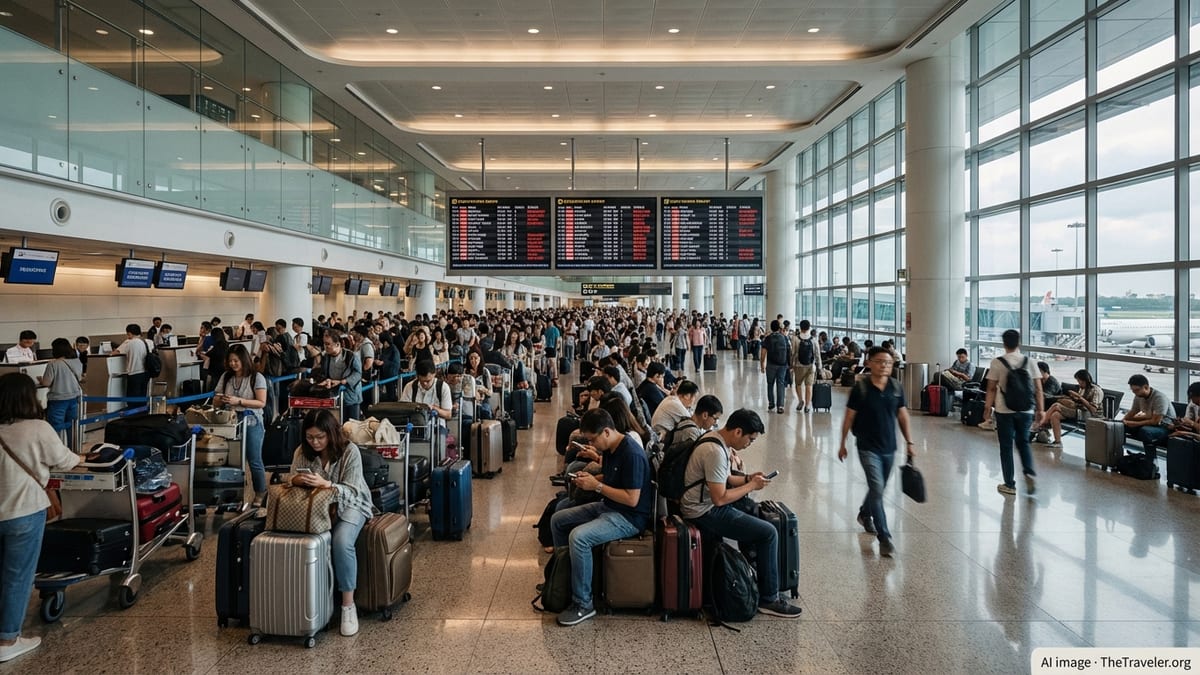
Wave of Cancellations Hits Major Asian Gateways
Publicly available flight tracking boards and airline updates indicate that carriers including Garuda Indonesia, Batik Air, AirAsia, Malindo, United Airlines, Saudia, and several regional operators have canceled or consolidated dozens of services over recent days. The disruptions are affecting traffic into and out of Jakarta, Kuala Lumpur, Bali, Penang, Hong Kong, and onward routes across Northeast and Southeast Asia.
At Jakarta’s Soekarno Hatta International Airport, live arrival and departure boards show a growing list of canceled domestic and regional flights, notably on Garuda Indonesia, Batik Air, and Lion Air, with some routes to Denpasar, Balikpapan, and other Indonesian cities marked as canceled while others continue to operate. Similar patterns are visible at Kuala Lumpur International Airport, where multiple low cost and full service carriers have trimmed frequencies or scrubbed flights on short notice.
Reports from Hong Kong, Taiwan, and Malaysian gateways such as Penang suggest a patchwork of disruption, rather than a single blanket shutdown. In Hong Kong, airport data and local coverage describe overall cancellation rates in the low single digits, yet specific services on international and regional carriers have been withdrawn or retimed, creating bottlenecks for passengers attempting to connect onward to Jakarta, Bali, and other Indonesian leisure destinations.
Industry observers note that even when total cancellation percentages remain modest, the concentration of schedule changes on certain city pairs can have an outsized impact on travelers, particularly those relying on tight connections or limited daily frequencies between secondary cities and major hubs.
Operational Pressures, Volcanic Activity and Route Cuts Converge
The current wave of disruption appears to stem from a mix of factors, rather than a single incident. In Indonesia, heightened volcanic activity has drawn renewed attention to the long standing vulnerability of aviation networks in the archipelago. In recent days, Mount Semeru in East Java has produced an ash column that authorities reported drifting across parts of the region, prompting aviation warnings and renewed scrutiny of flight paths serving Java and Bali.
Research published this month in a specialist volcanology journal highlights how even relatively short lived ash events can force airports and airlines to cancel or divert flights as a precaution, to avoid engine damage and maintain safety margins. Historic data compiled in that study show hundreds of cases worldwide where ash related flight suspensions triggered knock on disruption far from the volcano itself, particularly when, as in Indonesia, many domestic routes funnel through a small number of hubs.
At the same time, several airlines operating in and around Southeast Asia have been implementing schedule reductions and selective route suspensions for commercial and operational reasons. AirAsia has updated customer facing information to confirm a temporary suspension of selected services from early May as part of network adjustments, while travelers on Philippine and Thai AirAsia routes have reported cancellations and reroutings on corridors linking Manila, Hong Kong, Tokyo, and Bali.
Fuel price volatility and the broader impact of geopolitical tensions on long haul routings are adding further pressure. Regional coverage from Hong Kong and other markets notes that carriers are seeking to manage higher operating costs by consolidating lightly booked flights, trimming frequencies on secondary routes, or adjusting departure times, moves that can leave passengers with fewer alternatives when disruption strikes.
Passengers Stranded in Jakarta, Kuala Lumpur, Bali and Penang
The effects on travelers have been immediate and highly visible at several airports. In Jakarta, domestic and regional passengers have reported last minute cancellations on routes to Denpasar, Palembang, and other cities, with some flights removed from departure boards only hours before scheduled takeoff. Travelers have described having to queue at airline counters to secure rebookings for the following day or to be rerouted through different Indonesian hubs.
In Kuala Lumpur, consumer advocates in Malaysia have recently highlighted recurring operational issues at Kuala Lumpur International Airport, including past disruptions linked to airport systems. Against that backdrop, the latest cluster of cancellations on Malaysian and foreign carriers has renewed concerns over resilience at one of the region’s busiest transit points, particularly for travelers using Kuala Lumpur as a one stop gateway to Bali, Penang, and other leisure markets.
On the island of Bali, flight tracking platforms show a pattern of selective cancellations and schedule changes on services to and from Kuala Lumpur, Jakarta, and multiple Australian and Asian cities. While many flights continue to operate, cuts by low cost airlines have left some travelers facing long layovers or unexpected overnight stays when connections no longer align. Reports from Penang indicate that the city’s outbound links to Kuala Lumpur and other regional hubs have also seen sporadic cancellations and equipment changes, complicating plans for holidaymakers and business travelers alike.
For passengers already in transit, disruption at upstream hubs such as Hong Kong and Taipei has translated into missed onward flights into Indonesia and Malaysia, especially where carriers have reduced frequencies to a single daily service. With alternative options limited, some travelers have had to route through entirely different hubs, adding many hours to already long journeys.
Knock On Impact on Long Haul Networks
The cancellations are not limited to regional airlines. Publicly accessible schedule and status data show that long haul operators such as United Airlines and Saudia have also been adjusting services touching Asian hubs, as they respond to changing demand patterns and airspace constraints linked to conflicts in other regions. While most of these flights continue to operate, even isolated cancellations or aircraft swaps can ripple through connecting banks that rely on precise timing.
For example, when a transpacific or Middle East service into Hong Kong or Kuala Lumpur is delayed or canceled, passengers expecting to connect onward to Jakarta or Bali on partner airlines may find that the last flight of the day has already departed, forcing unplanned overnight stays. Travel forums and social media posts in recent days feature multiple accounts of travelers needing to rebook at short notice, sometimes at higher fares, after learning that their original itineraries involving United, Saudia, or regional partners had changed.
Airline analysts point out that many carriers are still rebuilding networks after the pandemic and are operating with tighter fleet margins and leaner staffing levels. Under these conditions, an aircraft taken out of rotation for unscheduled maintenance, or a single weather or ash related disruption at a hub like Jakarta, can cascade into cancellations across several routes, particularly at smaller subsidiaries such as Batik Air and Malindo that serve secondary cities.
The concentration of disruptions on corridors feeding popular leisure destinations such as Bali and Penang has also raised questions about capacity planning at the start of the mid year travel season, when demand tends to spike but airlines have less flexibility to redeploy aircraft from other markets.
What Travelers Can Do Now
Travel advisories from airlines and airport operators across the region emphasize the importance of checking flight status frequently in the days before departure, and again on the day of travel. Many carriers now publish real time updates through their own websites and apps, but discrepancies can still arise between global booking platforms, airline systems, and airport displays, especially during rolling disruption.
Passenger experiences shared on travel forums suggest that those who booked directly with airlines have, in many cases, been reprotected onto alternative flights more quickly than those using third party agencies, particularly when only a handful of seats remain on the next available service. However, travelers also report that low cost carriers often provide fewer rebooking options when cancellations stem from operational or commercial decisions rather than air traffic control restrictions.
Consumer groups in the region continue to call for clearer communication around the reasons for cancellations and for more consistent handling of stranded travelers, including hotel and meal support in cases where passengers are forced to stay overnight. For now, publicly available guidance generally recommends allowing extra connection time through Jakarta, Kuala Lumpur, and Hong Kong, and considering travel insurance products that specifically cover missed connections and schedule changes.
With volcanic activity, fuel market volatility, and geopolitical tensions all feeding into airline decision making, analysts expect that Asia’s flight schedules may remain fragile in the coming weeks. Travelers planning trips that involve Jakarta, Kuala Lumpur, Bali, Penang, Hong Kong, Taiwan, or secondary cities connected by Batik Air, AirAsia, Malindo, and similar carriers may wish to build in additional flexibility and prepare contingency plans in case of further cancellations.