

More news on this day
From opulent palaces in Tehran to centuries-old mosques in Isfahan, Iran’s cultural jewels are suffering fresh damage as a widening Middle East conflict tears through historic cities and threatens some of the world’s most important heritage sites.
Get the latest news straight to your inbox!
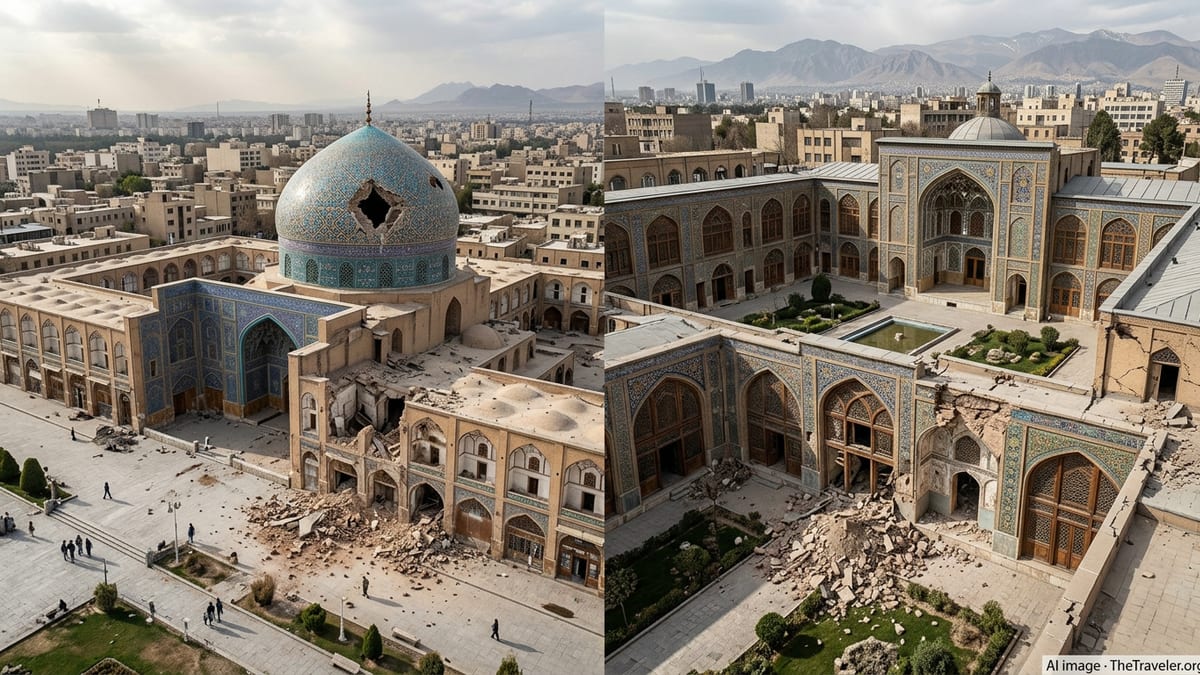
Historic Palaces and Mosques Damaged in Iran’s Urban Hearts
Recent strikes in Iran have inflicted visible damage on several landmark sites that define the country’s cultural identity. Publicly available information indicates that the Qajar-era Golestan Palace in central Tehran, the only UNESCO World Heritage site in the capital, has suffered broken masonry, shattered decorative elements and structural cracks after nearby impacts. Imagery of its courtyards and richly tiled facades shows debris scattered across areas that previously drew steady streams of domestic and foreign visitors.
In Isfahan, long celebrated as one of the world’s great Islamic cities, the impact has been even more alarming for heritage experts. Reports indicate that the 17th century Chehel Sotoun pavilion, part of the Persian Garden inscription, and the city’s historic Friday mosque, the Masjed-e Jameh of Isfahan, have both been affected by recent airstrikes in and around the Safavid-era government quarter. Assessments describe damage to surrounding historic fabric, including administrative buildings closely integrated with the old bazaar and the wider ensemble of Naqsh-e Jahan Square.
UNESCO has publicly stated that four of Iran’s 29 World Heritage sites have recorded damage since the escalation of hostilities involving Iran, Israel and the United States. The agency has emphasized that it previously shared precise coordinates of major heritage assets with all parties to help reduce the risk of accidental strikes, but satellite-based monitoring now shows visible impact scars in protected zones. Iranian cultural officials have warned that sites which survived revolutions, earlier wars and natural decay may now be entering their most precarious phase.
For Iran’s tourism sector, which had been slowly rebuilding before the latest crisis, the blows are severe. Iconic destinations such as Tehran’s historic core and Isfahan’s monumental squares are central to the country’s international image. Travel specialists note that even limited physical damage can trigger a sharp fall in visitor confidence, while prolonged insecurity around major cities can shut down tour circuits entirely.
Wider Middle East Conflict Leaves a Trail of Ruins
The blows to Iran’s heritage are part of a broader pattern of destruction unfolding across the Middle East. In Gaza, months of intense bombardment since late 2023 have levelled or heavily damaged a dense concentration of mosques, historic houses and civic institutions that together chronicled centuries of coastal life. Publicly available assessments drawing on satellite analysis point to verified damage at well over one hundred sites, including religious monuments, historic public buildings and archaeological zones.
In Syria, where war has raged for more than a decade, the list of affected sites reads like a catalogue of world civilization. International monitoring and academic studies describe severe damage and looting across all six of the country’s UNESCO World Heritage properties, from the ancient souks and citadel of Aleppo to the classical colonnades of Palmyra and the medieval fortress of Crac des Chevaliers. Many historic districts that once sustained vibrant tourism circuits now consist of fractured facades, unstable walls and makeshift repairs carried out by residents with limited resources.
Iraq, still recovering from the devastations wrought by the so‑called Islamic State, continues to count the cost to its own layered heritage. Research on the period since 2014 documents the destruction of shrines, churches, libraries and archaeological stores in Mosul, Nimrud and other historic centers. While reconstruction projects have begun in some areas, the combined impact of looting, intentional demolition and collateral damage has erased countless artifacts and inscriptions that once underpinned museum collections and cultural itineraries.
Further south, Yemen’s walled cities and hilltop citadels bear scars from years of airstrikes and ground fighting. Studies and local reporting describe impacts to the Old City of Sana’a, Shibam’s famed mud-brick towers and museum collections across several governorates. Conservators now warn that climate stress and neglect, filtering through bomb-damaged roofs and broken windows, are accelerating deterioration of manuscripts, textiles and wooden architectural details that war did not immediately destroy.
A Region of World Heritage Under Sustained Strain
UNESCO and heritage organizations describe the current moment as one of the most dangerous in decades for cultural property across the Middle East. From Iran and Lebanon to Israel, Palestine, Syria, Iraq and Yemen, historic districts are often located close to modern government compounds, energy infrastructure or dense residential areas that have become military targets. As a result, even precision strikes can ripple through fragile old quarters built in stone, brick and timber that were never engineered to withstand contemporary weapons.
Recent analyses of cultural damage in the region stress that the toll reaches well beyond the most famous landmarks. In addition to marquee sites such as Golestan Palace in Tehran or the Great Omari Mosque in Gaza, reports catalogue smaller neighborhood shrines, 19th century townhouses, local museums and archives that provided everyday residents with a sense of continuity. Once destroyed, these layers of ordinary heritage are rarely rebuilt in authentic form, leaving gaps in the lived fabric of cities.
The legal framework for protection exists but is frequently tested. Many of the countries and parties involved are signatories to the 1954 Hague Convention for the Protection of Cultural Property in the Event of Armed Conflict, which prohibits targeting cultural sites and calls for their avoidance in military planning. Nonetheless, human rights and heritage groups argue that the widespread use of explosive weapons in dense urban areas has made substantive compliance extremely difficult, particularly where armed groups embed themselves in civilian districts.
International concern has prompted new appeals for “enhanced protection” status for particularly important properties, a mechanism that can raise the political cost of damage but does not provide physical shielding. Observers note that in the current conflict cycle, symbolic sites, including religious monuments and palaces associated with national identity, risk becoming entangled in messaging wars, heightening anxiety about potential future strikes.
Tourism Futures at Risk as Cultural Landscapes Fragment
The long-term impact on tourism across the Middle East may be profound. Before the latest round of conflict, Iran, Jordan, Egypt, Lebanon and parts of the Gulf were investing heavily in heritage-led travel, positioning ancient cities, archaeological landscapes and Islamic architecture as cornerstones of diversified economies. Images of damaged palaces in Tehran, cratered squares in Isfahan or shattered historic districts in Gaza undermine that narrative and reinforce perceptions of a region locked in perpetual crisis.
Tour operators who once combined itineraries across several countries now face an increasingly fragmented map. Even in destinations that remain relatively safe, travelers may hesitate to book multi-country cultural routes if prominent heritage cities nearby are in the news for strikes or urban warfare. Industry analysts warn that this can redirect visitor flows for years, as global travelers choose alternative historic centers in Europe, Asia or Latin America that are perceived as more stable.
Within affected countries, the loss of cultural landmarks also erodes local tourism ecosystems. Small hotels, guesthouses, guides, craftspeople and food businesses clustered around heritage attractions are often the first to feel the shock when visitor numbers collapse. In places like Isfahan’s bazaar, Gaza’s historic core or old quarters of Syrian cities, these micro-economies have already endured cycles of sanctions, pandemic closures and earlier rounds of conflict; fresh damage to signature sites adds another layer of uncertainty.
Experts in sustainable recovery emphasize that heritage can also serve as a powerful driver of postwar revitalization, if protected and restored in time. Evidence from previous conflicts suggests that carefully planned conservation projects, community-led rebuilding of historic quarters and renewed cultural programming can help revive urban tourism and reinforce social cohesion. Yet such outcomes depend on an end to fighting, dedicated funding and international cooperation that currently appear precarious.
Race to Document and Safeguard What Remains
As cultural losses mount, documentation and emergency stabilization work have become urgent priorities. University research groups, local NGOs and international bodies are using satellite imagery, digital mapping and ground reports to log damage in near real time. In Iran, this includes detailed recording of cracks, broken tilework and structural shifts at sites in Tehran and Isfahan, information that will be essential for any future restoration campaigns.
Across Syria, Iraq and Yemen, similar efforts aim to capture the current condition of monuments, historic streetscapes and archaeological mounds before further deterioration sets in. Field reports describe improvised measures by residents and municipal workers, such as propping up leaning walls with timber, covering exposed frescoes with plastic sheeting and moving surviving artifacts into temporary storage. These acts, modest in scale, may make the difference between a building that can be repaired and one that must be entirely rebuilt.
Digital technologies are playing a growing role. High-resolution photogrammetry, 3D laser scanning and crowd-sourced photography archives allow specialists to reconstruct lost details even when physical elements are gone. Documentation from tourists who visited Iranian, Syrian or Yemeni sites before the wars is now being repurposed as reference material for future artisans. However, conservation professionals caution that virtual records are not a substitute for preserving original fabric on the ground.
For now, Iran’s damaged palaces and mosques stand as stark symbols of how quickly conflict can unravel centuries of cultural achievement. Together with shattered landmarks from Gaza to Sana’a, they illustrate the fragile line between living heritage and irreversible ruin. As the regional crisis continues, heritage advocates argue that limiting further harm to these irreplaceable places is not only a cultural imperative but a prerequisite for any eventual revival of travel and tourism across the Middle East.