


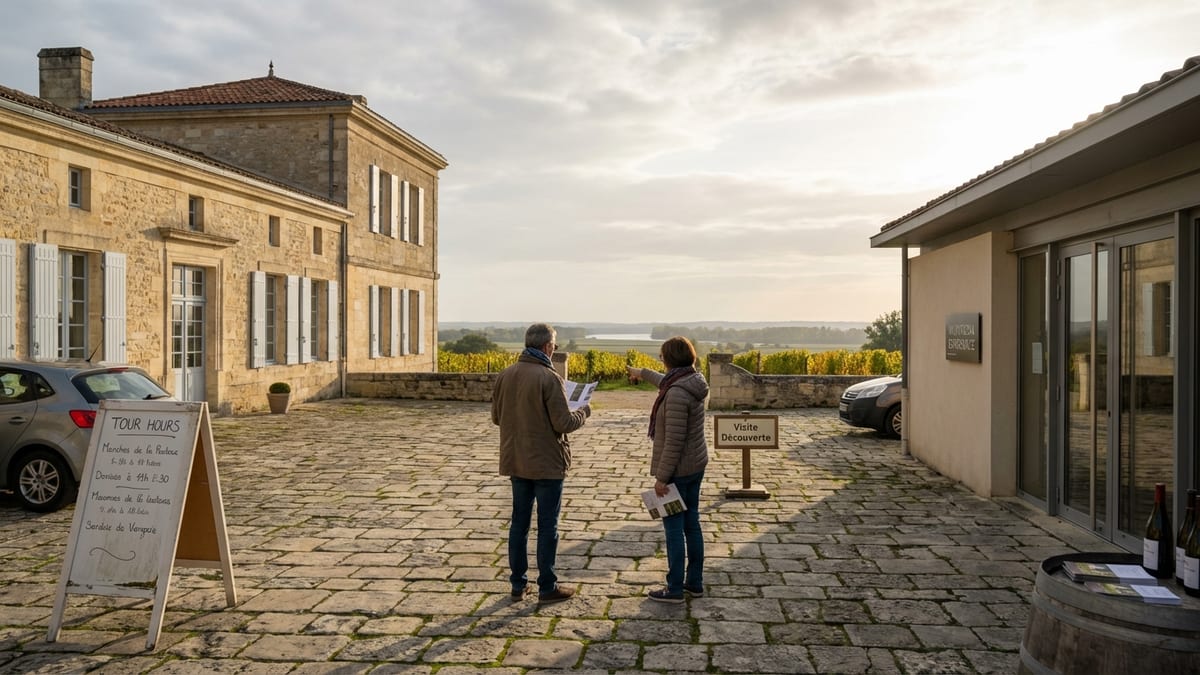
I spent a long weekend in the Graves wine region south of Bordeaux and decided to devote one afternoon to Château de Portets, a property that has been popping up more and more in local tourism brochures and wine tourism platforms.
The images of the château facing the Garonne, combined with the promise of a modern, multimedia visitor experience, made it sound like a polished but still intimate alternative to the big-name Bordeaux estates. What I actually found was a mix of genuinely thoughtful wine tourism, some clever storytelling, and a few frustrating inconsistencies and expectations-versus-reality moments that are worth being aware of before you book.
Getting There and First Impressions
I based myself in central Bordeaux and visited Château de Portets as a half-day trip. Reaching the estate by public transport is possible but not especially convenient. I opted for a rental car, which made the roughly 30-minute drive along the Garonne straightforward. The access is signposted from the village of Portets, though the last few turns on small local roads required more attention than the glossy brochures suggest. The estate is on Rue de Mongenan, close to the river, and I had no trouble finding the entrance once I was in the village.
Before going, I checked the official information about opening hours and visits. At the time of my visit, individual tours were presented as available most of the week, with structured wine tourism offers like the “Visite Découverte” and several themed experiences. According to the château and local tourism offices, visits from April to October generally run Tuesday to Saturday, 10:00 to 18:00, with more weekday-focused hours in the cooler months. I quickly realized that, in practice, you should treat those hours as the framework, not an open-door guarantee. Almost every activity is “on reservation,” and that is not just a formality. If you show up unannounced hoping to be folded into an existing group, you may be turned away or left to do only the shop and a very basic tasting.
On arrival, the estate presents well. The main building and inner courtyard are attractive and airy rather than ostentatious. It feels like a working property adapted for visitors, not a stage set. Parking is free and straightforward along the access, and the site is described as accessible for people with reduced mobility. The courtyard is paved, and the main public spaces are on relatively level ground. It is not a jaw-dropping fairy-tale château, but the atmosphere is charming in a low-key, rural way, with the added plus of being a short drive from Bordeaux city.
Choosing and Booking the Visit: Options vs Reality
Château de Portets heavily leans into oenotourism and offers a surprising number of formats for a single estate. When I was researching, the core product was the “Visite Découverte,” essentially the flagship guided tour, priced around 16 euros per person for adults. This includes a film presentation, a guided walk through the winery and cellars, and a tasting of three wines, usually paired with small bites like pâté and a confit made from the estate’s wines. On paper, it is an attractive, fairly priced way to understand Graves wine in one stop.
There are also more elaborate options: “Visite Fins Gourmets,” which doubles down on the food pairings with a cheese and charcuterie plate; “Retour du Marché,” a full visit followed by a chef-prepared lunch; an “Escapade bucolique” that adds a picnic in the park during the warmer months; and a “Balade web-guidée” called “Un port sur la vigne,” a low-carbon, app-guided walking tour around the property and former port. On top of that, there is a self-guided “De la vigne au verre” experience with a shorter, 45-minute format and tasting for a slightly lower price. The estate also offers family-oriented experiences and escape games, as well as a simple kids’ trail with grape juice tasting and a diploma.
In practice, not all of these options may be running or easily bookable on the day and time you want. The reality I encountered was that the “Visite Découverte” is the backbone of their offering, and everything else is more conditional. The picnic “Escapade bucolique” runs only in the better weather months and requires booking and confirmation. The more elaborate lunch experiences depend on minimum participant numbers. Prices can drift slightly from what you see on secondary sites, with the official tourism board listing the basic guided visit at around 16 euros, the free-flow visit at about 12 euros, and the walking tour “Un port sur la vigne” at roughly 20 euros per adult. None of these price differences are dramatic, but they add to a general feeling that the château’s communication is enthusiastic first, precise second.
I decided to book the “Visite Découverte” as a safe baseline and, time permitting, to add the self-guided walk. Communication by email was courteous and reasonably fast, but I did find I had to ask very specific questions to get clear answers about language availability, group size, and whether my visit would be shared with another booking. If you like certainty, I recommend insisting on written confirmation of the time, language, and format of your tour. Treat the online schedule as a general guide, not a hard promise.
The Tour Experience: Film, Cellars, and Storytelling
The visit begins in a dedicated visitor space where you watch a short film about the château, the Graves appellation, and the connection between the estate, the river, and the surrounding landscape. This sets the tone for the experience: Château de Portets is not trying to be the most technical winery visit in the region. Instead, it leans into narrative, accessibility, and multi-sensory elements. The film was slick without being overproduced, with enough historical snippets to give context but not so much that non-history buffs would tune out.
From there, my small group moved into the production areas and barrel cellars. The guide spoke clear English, though French is naturally the default language. The promised language coverage is French, English, and Italian, which seems accurate, but again this depends on staffing on the day. I was told Italian visits are subject to guide availability, and that felt true rather than just a marketing line. The tour path is thoughtfully laid out, and for anyone who has never seen a working Bordeaux winery, it hits all the main points: steel tanks, barrel rooms, and basic explanations of viticulture and vinification.
Where Château de Portets tries to distinguish itself is in the scenographic area known as “Les Quatre saisons” with a tactile table and panels explaining winemaking and the cyclical nature of the vineyard. I appreciated the effort to make the information accessible and visually engaging, especially for visitors who might not be deeply into wine. However, as someone who has done multiple Bordeaux vineyards visits, I found it a bit underutilized. Our guide did not spend much time here, and we were encouraged to explore the interactive table on our own. The content was solid but not particularly deep, and it felt like a missed opportunity to tailor explanations more actively to the group’s level of knowledge.
One thing I did appreciate was that the tour did not feel rushed. The advertised duration of about one hour was roughly accurate, and there was time for questions. At the same time, the tour did not delve much into the hard details of terroir, blending decisions, or vintage variation. If you are an advanced wine geek hoping for a technical deep dive into Graves winemaking, you might find the content too light. If you are new to Bordeaux or traveling with someone who is, the overview is clear and non-intimidating, which is likely exactly what the estate is aiming for.
Tasting: Wines, Pairings, and Value for Money
The tasting that followed was in a bright, modern space that felt more like a dedicated hospitality room than a traditional château salon. Depending on which visit you choose, you generally taste three wines from the property. In my case, it included a dry white and one or two reds. The wines themselves were competent, classic Graves in style, with a pleasant, food-friendly profile. They are not the most complex or memorable wines I tasted in the region, but they are representative and well-made.
The promised food pairings consisted of a small portion of pâté and a wine confit made from the estate’s own cuvées. This was more of a nibble than a mini meal, so do not expect to substitute it for lunch. That said, I liked the idea of integrating products from the estate’s own production beyond just the wine. The portions and presentation were modest, but given the overall price of the visit, the inclusion felt fair. In the more expensive options like “Visite Fins Gourmets” or the lunch-based experiences, there is clearly more of a gastronomic angle, though I did not personally test those formats.
One thing that impressed me was that there was no aggressive sales push at the end. Of course, there is a shop and an opportunity to buy bottles and local products, but the tone was suggestive rather than insistent. Prices in the shop were in line with what you would expect for direct estate purchases in Graves. If anything, I would have liked more guidance or suggestions, such as “If you liked the second wine, you might enjoy this cuvée with similar style.” As it was, the shop interaction felt a bit detached from the narrative and tasting we had just experienced.
Overall, on a pure value-for-money basis, the standard visit plus tasting felt reasonable. Around 16 euros for a one-hour guided experience, three wines, and a small local pairing is competitive compared with both big-name and smaller Bordeaux châteaux. You are paying for the experience as much as for the tasting, and on that front, Château de Portets delivers a professional, if slightly generic, package.
Extra Experiences: Walks, Escape Games, and Family Options
Château de Portets clearly wants to be more than “just another wine tour,” and this shows in the additional experiences they offer. I tried to fit in the “Un port sur la vigne” walking tour, which is presented as an environmentally minded, app-guided exploration of the estate, its former port, and the nearby village. Priced around 20 euros per adult, it includes the walk plus another tasting of three wines. I liked the concept a lot, especially as a way to connect the site to the broader Garonne landscape rather than keeping visitors confined to the cellar and shop.
In reality, the experience depends heavily on weather, your comfort with using a smartphone outdoors, and how well you understand the app interface. The day of my visit was dry but windy, and the audio explanations were sometimes hard to hear clearly. The route itself is not physically demanding, but there is limited shade in some stretches. The historical content was interesting, and I appreciated learning about the former river trade and how the château interacted with the port in earlier centuries. Still, I came away feeling that this particular add-on is best suited to visitors who are genuinely curious about local history and happy to take things at a relaxed pace. If you simply want more wine or more dramatic “wow” moments, you might not feel the extra cost is justified.
For families, the estate has put effort into making children feel included. There is a short treasure-hunt-style trail around the courtyard, ending with grape juice tasting and a diploma for the kids. There are also escape-game concepts, one outdoors and one indoors, with storylines about the “Barons de Portets” and a quest to save the vineyard. These are billed as lasting between 1.5 and 2 hours and cost in the range of 20 to 36 euros per adult, with lower prices for children. I did not participate in the escape game myself, but based on timing and conversations on site, it is clearly designed for groups of friends, families, or corporate outings who enjoy gamified experiences. My impression is that it works best if you treat it as the main event of your visit, rather than trying to tack it awkwardly onto the end of a standard tour.
The flip side of all these options is that the estate’s offer can feel a little scattered. There is a risk of information overload when you are trying to decide what to book. Different brochures, tourism sites, and the estate’s own channels do not always present exactly the same lineup or pricing structure, which adds to the sense of confusion. I found it helpful to think in simple terms: basic guided tour, more food-focused tour, self-guided exploration, or game/family experience. Then I picked only what I could enjoy without time pressure.
Practicalities: Opening Hours, Languages, Accessibility, and Booking
On the practical side, Château de Portets does many things right, but you need to approach the visit like a planned activity, not a spontaneous drop-in. Opening hours shift with the seasons. Typically, from April to October the estate receives visitors Tuesday to Saturday, roughly 9:00 or 10:00 to 13:00 and again 14:00 to 18:00. In the cooler months and over the winter, visits are concentrated on weekdays, with Saturdays more limited or dependent on reservations. There are also occasional closures for private events, as the château rents out spaces for seminars and functions. If you are coming from Bordeaux specifically for this visit, I would not risk showing up without a confirmed booking.
Languages offered officially are French, English, and Italian. In practice, English is widely available, but whether you get a fully English-language tour or a bilingual one depends on the composition of your group. My guide handled both languages smoothly, though this naturally slows the pace a little. If you are strict about having the entire visit in one language, it is worth asking at the time of booking. For the digital walking tour, the app experience is similarly language-dependent, and you may find that some snippets or written panels are stronger in French than in the translations.
Accessibility is one of the stronger points of the estate. The site makes a point of being accessible to visitors with reduced mobility. The main buildings and tasting spaces are on even ground, and I did not notice any major physical barriers within the standard tour route. The outdoor walking experiences have uneven surfaces and some slopes, which may be more challenging, but the core cellar and scenographic areas are generally manageable. Parking is close to the entrance, and there are restrooms available in the visitor area.
Booking is possible by phone or email, and the estate also collaborates with booking platforms for some of its tours. I preferred dealing directly, both to ask practical questions and to avoid any confusion about which version of the visit I was booking. One small frustration: the online information is scattered and sometimes slightly out of sync between different sites. The safest route is to treat third-party information as indicative and verify final details directly with the château in the days before you go. This includes verifying the price, time, and language of your visit, especially in shoulder seasons when hours and availability can change.
Comparing Château de Portets With Other Graves Visits
To evaluate whether Château de Portets is worth it, it helps to compare it with other estates in the Graves area. Within a short drive, there are properties that offer free tastings with a more basic tour, and others that charge similar or higher prices for more prestigious appellations or more in-depth technical visits. Some neighboring châteaux operate almost purely as working farms that welcome you at the cellar door, while others are sleek, corporate-feeling operations with polished but impersonal scripts.
Château de Portets sits somewhere in the middle. It is more structured, multimedia, and experience-driven than many small family estates, but less grandiose than some of the top-tier names north of Bordeaux. If your priority is pure wine quality at the best price, you might actually be happier at a smaller, lower-key property that spends less effort on visitor infrastructure. If, however, you are traveling with people who are new to wine or less passionate about viticulture, Portets provides a more rounded cultural and historical package, with a clear story connecting the estate, the river, and the region.
One downside I did notice compared with a couple of nearby visits was the emotional distance. At certain smaller châteaux, the owner or winemaker is the person who shows you around, and you get a strong sense of their personal history and connection to the vines. At Château de Portets, the experience is mediated by staff and designed spaces. My guide was knowledgeable and pleasant, but it felt like a professional service more than a conversation with the people behind the wine. That may be exactly what some visitors want, but if your dream is to sit in a rustic kitchen chatting with a vigneron, this is not that type of visit.
On the plus side, the breadth of experiences at Portets means it handles mixed groups well. If you are a couple with one partner deeply into wine and the other more interested in scenery and light activity, the combination of film, cellar, scenography, and optional walks can satisfy both. Families and groups of friends who enjoy games and interactive elements will find more to do here than at a typical “tour plus tasting” cellar. The key is to be honest about your priorities. If you want intimacy and depth, pick a small, appointment-only estate. If you want structured, accessible, and visually polished experiences, Château de Portets becomes more attractive.
What I Would Do Differently Next Time
My overall experience at Château de Portets was positive but not without its frustrations. If I were to plan the day again, I would make a few concrete adjustments. First, I would book an earlier slot for the “Visite Découverte” and leave more buffer time afterward. On my schedule, I had packed the afternoon with another appointment that left me rushing through the shop and reconsidering whether to do the walking tour. The visit is more enjoyable if you allow yourself to linger in the scenographic space and possibly wander the grounds on your own afterward.
Second, I would clarify more aggressively in advance which exact experiences are realistically available on my chosen date. The abundance of options sounds exciting online, but not everything can be run at every time. I would ask directly: “On this date and time, which visits are available in English, and which include food?” Then I would pick only one main format. Trying to stack several experiences in one afternoon made the visit feel a bit like a checklist rather than a relaxed discovery.
Third, I would mentally position Château de Portets as a gentle introduction or mid-level deepening of knowledge, not the most intense, wine-geek-oriented stop of the trip. When I reframed it as a visually engaging, broadly educational visit with good wines rather than great wines, I appreciated the experience more. I would combine it with at least one smaller, more traditional estate either earlier or later in the day, so that the contrast enriches both visits.
Finally, I would be less dependent on online information and more insistent on up-to-date confirmation from the estate itself. Opening hours, seasonal closures, and visit formats can change, especially outside high season. A simple email a few days before, asking for a confirmation of time, language, and price, is worth the minor effort to avoid awkward surprises.
The Takeaway
So, is Château de Portets worth visiting? For me, the answer is yes, with conditions. It is not the most spectacular château in the Bordeaux region, nor does it produce the most sought-after wines. What it does offer is a carefully structured visitor experience that blends history, light interactivity, and approachable wine education in a setting that is easy to reach from Bordeaux. If you value a clear narrative, multimedia elements, and a choice of formats from simple tours to picnics and escape games, Portets makes a strong case for a half-day in Graves.
The main drawbacks are a certain lack of intimacy compared with smaller, family-run estates, occasional confusion around the exact lineup and pricing of visits, and a tendency for the experience to feel more pre-packaged than personal if you arrive with very high expectations. The wines themselves are solid rather than unforgettable, and the food pairings in the standard visits are more symbolic than substantial. You are paying for the overall experience and infrastructure rather than just the tasting.
I would recommend Château de Portets particularly to first-time visitors to Bordeaux, mixed-ability groups, and families who want something more engaging than a straightforward cellar tour. It is also a good fit if you enjoy light walks and the idea of connecting the wine in your glass to the river and landscape that shaped it. If you are a serious wine enthusiast in search of depth, collector-level wines, or long conversations with the winemaker, you might prefer to focus your limited time on smaller, appointment-only properties and treat Portets as a secondary stop, if at all.
Go with realistic expectations, book ahead, and choose one experience that matches your style rather than trying to do everything at once. Under those conditions, Château de Portets delivers a pleasant, well-organized window into Graves wine and local history, and it can earn a worthwhile place in a broader Bordeaux itinerary.
FAQ
Q1. Do I need to book my visit to Château de Portets in advance?
Yes. While the château publishes general opening hours, most tours and tastings effectively operate on a reservation basis. You should contact the estate directly to secure a specific time, language, and visit format, especially outside peak season or if you want a particular experience such as the picnic or escape game.
Q2. How long does the standard tour and tasting last?
The “Visite Découverte,” which is the main guided tour, typically lasts about one hour, including the introductory film, walk through the cellars, and tasting of three wines. Allow extra time before or after for the shop, the scenographic area, or a walk around the grounds.
Q3. What are the typical opening hours during the year?
In general, from spring to autumn the estate opens from late morning to early evening on weekdays and Saturdays, with a midday break. In the cooler months, it tends to focus on weekdays and may limit weekend visits to reservations only. Hours can vary with private events and seasons, so you should always verify current times with the château shortly before your visit.
Q4. Is the visit suitable for people who know very little about wine?
Yes. The tour is designed to be accessible, with a clear, non-technical explanation of the vineyard, the winemaking process, and the appellation. The film and interactive displays help beginners understand the basics without feeling overwhelmed. More experienced wine enthusiasts may find the explanations somewhat introductory.
Q5. Are children welcome at Château de Portets?
Children are welcome, and the château offers specific family experiences such as a short treasure-hunt-style trail and escape games. Kids generally receive grape juice instead of wine at tastings and can participate in playful educational activities. The standard tour is manageable for most school-age children, though very young ones may become restless during the cellar explanations.
Q6. In which languages can I do the tour?
Visits are officially available in French, English, and Italian. English tours are usually easy to arrange, while Italian depends more on staff availability. If you require a specific language, make sure to mention it clearly at the time of booking and ask for confirmation.
Q7. How much does a visit and tasting cost?
As a guideline, the main guided visit with tasting is priced in the mid-teens per adult, while more elaborate formats with food pairings or walks cost more, typically between 20 and 45 euros depending on what is included. Escape games and special experiences are at the higher end of that range. Children’s activities are less expensive. Prices can change, so check the current rates directly with the estate.
Q8. Is Château de Portets accessible for visitors with reduced mobility?
The core visitor spaces, including the courtyard, main buildings, film room, and tasting area, are on relatively flat ground and are presented as accessible. The standard tour route is generally manageable for visitors with reduced mobility. Some outdoor experiences, such as the walking tour, involve uneven paths and may be more challenging.
Q9. Can I visit without taking a full tour, just for a tasting or to buy wine?
It is often possible to stop by the estate shop to purchase wine or local products, and in some cases to arrange a simpler tasting without the full tour. However, this depends on staff availability and the day’s schedule. If you are traveling specifically for a tasting, it is safer to book a visit rather than relying on a completely spontaneous drop-in.
Q10. Is Château de Portets a good choice for serious wine collectors?
Château de Portets is better suited to curious travelers, beginners, and mixed-interest groups than to highly specialized collectors. The wines are solid and representative of Graves, but the visit focuses more on storytelling and accessibility than on deep technical detail. Serious collectors may still enjoy the experience as part of a broader itinerary but will likely want to combine it with visits to smaller, more specialized estates for in-depth discussions and higher-end cuvées.